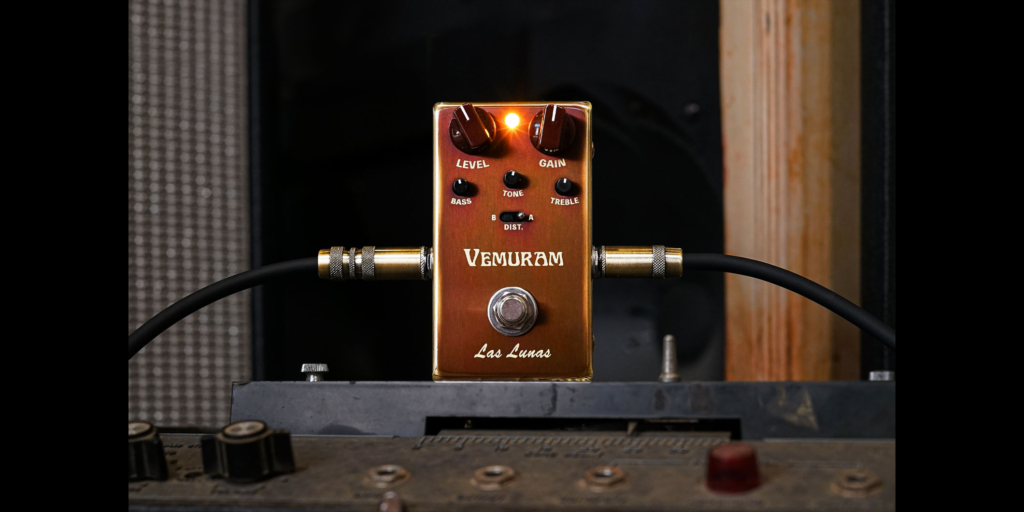
The Vemuram Las Lunas, the brand’s first full distortion, pairs two switchable drive voices, a passive 3-band EQ and a separate saturation trimmer for each mode, at 54,780 yen in Japan.
In stores now · Released July 10, 2026
Vemuram announced the Las Lunas in June and put it in Japanese stores on July 10, 2026, at 54,780 yen including tax. The Tokyo builder says the pedal chases the drive sound of the late 1970s and early 1980s and took years of development to finish, according to the Japanese press release. That makes the Vemuram Las Lunas an unusual move for a company known almost entirely for polite, low-gain overdrive. To me the pitch is refreshingly narrow: this is for players who love the music of that specific era, or who want to rebuild that sound, and it should be judged on whether it gets them there.
Vemuram Las Lunas: two drive modes, two saturation trimmers
DIST A is the flatter voice: fine-grained, warm, and even across the frequency range by the maker’s account. On paper that is the setting for players who want the era’s saturation without the era’s harshness, and it is the one I would expect to sit better under single coils.
DIST B is the harder of the two toggle positions. Vemuram describes it as an edge-defined distortion with a stronger sense of pressure, which should mean more bite and more apparent volume the moment you flip to it. What stands out is that these are not two points on one gain range dressed up as voicings. They are presented as two different distortion characters, and each gets its own adjustment.

SAT A and SAT B are the reason the Vemuram Las Lunas is worth a post rather than a listing. Two trimmers on the top edge of the enclosure set the harmonic saturation of each mode independently, so the A and B voices can be balanced against each other instead of accepted as shipped. Very few pedals at any price hand you that after purchase. That is genuine circuit access rather than a cosmetic extra, and combined with the toggle it is the whole design argument.

What the Vemuram Las Lunas runs on
Under both modes sits a passive three-band EQ. According to the Japanese press release, BASS covers a wide low-frequency range, TONE sets midrange brightness and the overall character of the pedal, and TREBLE trims the top end without disturbing the lows and mids. Power is a 9V regulated centre-negative adapter or a 006P battery, current draw is about 6 mA, and the pedal measures 70 x 113 x 50 mm at 415 g. That weight is the giveaway: Vemuram builds in brass, and brass is heavy.
Vemuram has built in Tokyo since 2008 under Tri-Sound Inc., hand-assembling every pedal into a machined brass housing, which is why supply has always run thin rather than deep, as covered in our Vemuram brand overview. If the late 1970s and early 1980s is your era, or you are trying to rebuild that sound, the Vemuram Las Lunas belongs on the list of pedals to try. If it is not your era, this is an expensive way to find out.