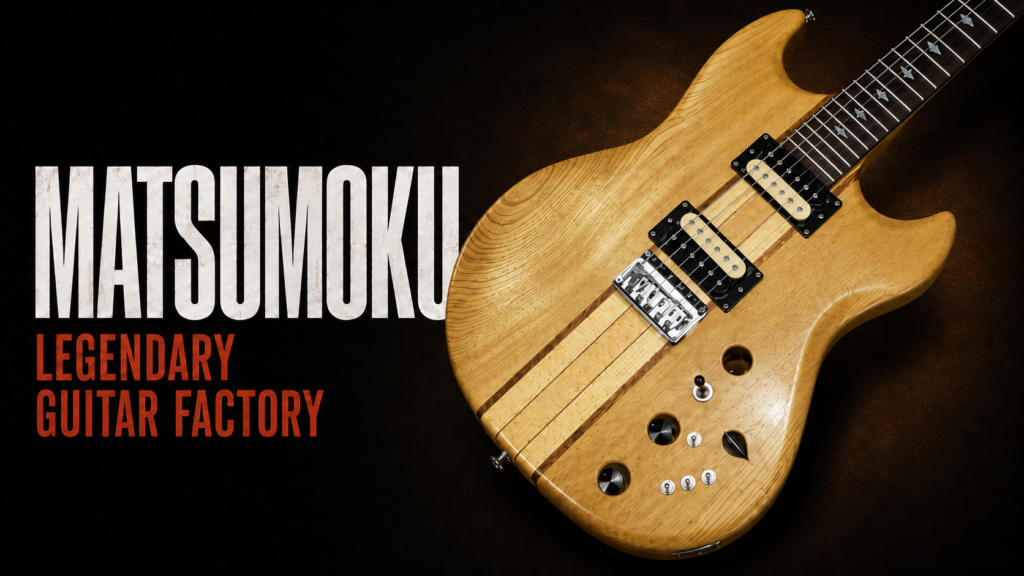
Aria Pro II, Westone, the old Epiphones. What do these guitars have in common? They are all Japanese-made, but that answer is incomplete. The real link is that they were all built in the same factory: Matsumoku. It is a name MIJ fans see constantly in auction listings and forum threads, and yet very few people outside Japan know what the company actually was. This article covers Matsumoku’s 36-year history, the thirty-plus brands it quietly built for, and which of its guitars are worth hunting down today.
Matsumoku Quick Facts
- Founded: 1951 as Matsumoto Mokko (Matsumoto Woodworking), in Matsumoto, Nagano; renamed Matsumoku Industrial Co., Ltd. in 1971
- Original business: Furniture, then sewing machine cabinets for the American company Singer
- Guitar production: Roughly 1963 to 1987, about 24 of the company’s 36 years
- Known for: OEM production for Aria Pro II, Epiphone, Greco, Electra, Vantage, Univox, Alvarez Yairi and Fernandes
- Own brand: Westone, which held the number one market share in the UK at its peak
- Peak scale: Around 40,000 square metres of land, 400 woodworking machines, 1,300 employees, 30,000+ guitars a year
- Closed: February 1987, carrying roughly 1 billion yen in debt
- Used market value: Many good examples still trade around 800 USD (roughly 120,000 yen)
- What Is Matsumoku?
- Matsumoku History in Brief
- Brands Matsumoku Built For
- The Guitars Worth Hunting
- Aria Pro II PE Series: The MIJ Les Paul Alternative
- Aria Pro II SB Series: The Bass Jack Bruce and Marcus Miller Played
- Aria Pro II RS, TS, CS, NK and ST: Where the Value Is
- Westone: The One Brand That Was Matsumoku's Own
- Epiphone: The Japanese-Built Years
- Greco: The Ones People Do Not Expect
- Export-Only Brands: Electra, Vantage and Univox
- Buying a Matsumoku: Three Honest Caveats
- Final Thoughts
- FAQ
What Is Matsumoku?
Matsumoku was a guitar factory in Matsumoto, Nagano Prefecture, about 25 kilometres from Fujigen. It was never a brand. It designed and built instruments, but the planning and the selling were handled by trading companies and wholesalers, and its own name never appeared in a catalog. Orders came in, the client’s logo went on the headstock, and the guitars shipped out.
That is exactly why so many players have owned a Matsumoku without knowing it. If you have played an Aria Pro II from 1975 onward, a 1970s Epiphone Casino, a Westone Thunder, an Electra, a Vantage or a Univox, there is a very good chance a Matsumoku craftsman built it. More than thirty brands have been confirmed in total.
The one exception was Westone, the brand Matsumoku owned outright. It was the only headstock in the company’s history that was genuinely its own.
Matsumoku History in Brief
Matsumoku spent its first decade building furniture and sewing machine cabinets for Singer, which is the whole story in one line. The plant it built to that standard in 1960 came with 400 woodworking machines, an air-drying yard and three kilns. When guitars arrived, the tolerances and the timber drying were already there.
And they arrived by accident. In 1963 a salesman from Fujigen, in the same city, met Matsumoku’s managing director in a bar and asked whether they could dry some timber. Matsumoku came back and asked whether they could machine the bodies and necks too. Aria exports followed, Gibson handed over Epiphone production in 1970, and within six years guitars were 88% of sales.
| Year | Milestone |
|---|---|
| 1951 | Founded; furniture, then Singer sewing machine cabinets |
| 1963 | First guitar work, via a Fujigen salesman |
| 1970 | Gibson hands Epiphone production to Matsumoku |
| 1975 | Aria Pro II launched |
| 1977 | The Aria Pro II PE-1500 arrives |
| 1987 | Matsumoku Industrial closes in February |
The end came from currency. A failed move into Buddhist altars drained cash in 1983, and when the dollar hit 170 yen in 1986 an export-dependent company went into the red. Matsumoku closed in February 1987. The site is now a public park with a stone monument shaped like a guitar where the factory gate stood. I have not been yet, but it is high on my list.
Brands Matsumoku Built For
Look at that list and the appeal becomes obvious. An entire American institution, Epiphone, was being maintained in Nagano. What is interesting is that inside the factory, people apparently did not grasp what they were handling. There is an account describing the attitude as: we do not really know what this Epiphone brand is, but we are building a lot of them.
In the Japanese instrument business of the seventies, the assumption was that Gibsons and Fenders were real instruments and Japanese guitars were something else, and there are accounts of people on Gibson’s side treating Matsumoku as nothing more than a subcontractor. Fifty years later, guitars from that factory are being hunted down all over the world. There is something satisfying about that.
The Guitars Worth Hunting
Aria Pro II PE Series: The MIJ Les Paul Alternative
This is the name most associated with Matsumoku, and the PE-1500 of 1977 is the model that defines the factory. It was drawn by Nobuaki Hayashi, who had joined the company as a sewing machine cabinet designer, with one single goal: an original design that could compete anywhere in the world. He left Matsumoku the same year it succeeded, and went on to found his own brand, Atlansia.
The PE was not designed to resemble anything. It was designed as an answer to the weaknesses of instruments everyone already considered classics. The neck joint combines the thinking behind set necks and bolt-on necks, and there is no neck heel at all, which attacks the awkward upper-fret access that both Gibsons and Fenders suffer from. The body is carved on both the top and the back, giving it an almost violin-like shape that sits against your ribs rather than on them.
The price was 150,000 yen with hard case at a time when copy models sold for around 50,000. That was roughly 560 USD in 1977, close to 3,000 USD today, and well above what a Japanese university graduate earned in a month starting out. This was a top-tier instrument, without question.
The series ran PE-1500, PE-1000, PE-800 and PE-600, and was later revised into the PE-R series. There is also the PE-1000U, a Japan-market version finished in urushi, traditional Japanese lacquer, by a workshop in Kiso.
Which one to buy: the PE-1000 is the sweet spot, giving you most of the 1500’s construction without the collector premium. If it were my money, I would go for a PE or a PE-R over anything else on this page. It would also be interesting to compare one against the current Japanese-built PE. The Aria Pro II brand overview covers the modern lineup in full.
Aria Pro II SB Series: The Bass Jack Bruce and Marcus Miller Played
From 1978, starting with the SB-1000. Neck-through construction, and far better regarded outside Japan than within it.
Neck-through means no heel and no dead spot at the joint, which bass players notice immediately as longer and more even sustain. Jack Bruce of Cream and Marcus Miller both used them, which for a Japanese bass in that era was extraordinary.
Which one to buy: the SB-700 and SB-900 give you the same construction for less money. The SB-1000 is the one on the records. This is probably the single most internationally respected thing Matsumoku ever built.
Aria Pro II RS, TS, CS, NK and ST: Where the Value Is
Arriving between 1979 and 1981. The TS is the neck-through workhorse of the group, and the CS-350 was a genuinely successful low-cost original design rather than a copy.
From 1980 came the DiMarzio Powered series, which used Arai Trading’s position as DiMarzio’s Japanese distributor to put real American pickups into affordable instruments. It sold well, and it is still the cheapest honest way into a good Matsumoku.
The endorsement list from this era was serious: Neal Schon, Yngwie Malmsteen, Michael Schenker and Will Lee, plus Japanese heavyweights Kazumi Watanabe, the fusion guitarist who took Japanese jazz-rock international, Masaki Matsubara, and Earthshaker, one of the defining bands of Japan’s 1980s metal scene.
Westone: The One Brand That Was Matsumoku’s Own
Westone started with folk guitars around 1974 to 1975 and went electric in force from 1981, taking the number one market share position in the United Kingdom. Players included Trevor Rabin of Yes, Glenn Tipton of Judas Priest, and Blue Oyster Cult.
You do not see many in Japan, but because so many went to Britain they are still relatively easy to find on the international used market. This is the purest expression of the factory’s own thinking, with no client compromising the brief. If you want to know what Matsumoku built when nobody was telling it what to build, this is where to look.
Epiphone: The Japanese-Built Years
Most Epiphones from the 1970s were built by Matsumoku. Casino, Sheraton, Riviera and Wilshire all left Matsumoto, and the 1980s Epiphone Genesis was theirs too.
Contrary to the “we did not know what this brand was” story inside the factory, people from Gibson were coming to Matsumoto in person and working through the specifications model by model.
How to identify them: the Matsumoku-built instruments are generally identified as the blue-label guitars of the seventies and the beige-label guitars of the eighties. Casinos were made in Japan until fairly recently, so the label is what narrows it down to this earlier period.
Greco: The Ones People Do Not Expect
This surprises people, but some Grecos are Matsumoku builds. The early EG-series Les Paul copies, with set necks and carved tops, have accounts pointing to Matsumoku work.
Then there are the Fender-style copies of the late 1970s. On some bolt-on models, the neck plate is stamped MATSUMOKU. If you own one, it is worth taking the plate off and having a look. It takes two minutes.
Export-Only Brands: Electra, Vantage and Univox
There is a whole group of brands that barely circulated in Japan at all. The three main ones are Electra, built for St. Louis Music in the United States, Vantage, for JAM Industries in Canada, and Univox, also American. Beyond those, more than ten other export-only names came out of this factory.
If you want a guitar nobody at your rehearsal studio will recognise, this is the category. And it is not rare for the sake of being rare. These came out of one of the best factories in Japan, and you can explain exactly why in ten seconds.
Buying a Matsumoku: Three Honest Caveats
There is variation. This factory built 30,000 guitars a year. Plenty of them came off a production line. Made by Matsumoku does not automatically mean exceptional, and treating the name as a quality guarantee is how people overpay.
Condition is everything. These are forty to fifty year old instruments. Check the neck, check the fret wear, and pay particular attention to the electronics, which are the usual failure point. Look at the instrument before you look at the name on it.
Parts availability is the real risk. The more original the design, the more likely it uses a proprietary bridge or proprietary hardware, and replacements can be almost impossible to find.
That last one is not theoretical for me. My father’s Aria Pro cracked a single saddle. Finding a replacement for one saddle turned out to be nearly impossible, so the entire bridge had to be replaced, and even then there was no guarantee a replacement bridge would fit the stud spacing. In the end we got rid of the guitar. Looking back, it feels like such a waste. Before you buy an original-design Matsumoku, make sure the bridge is intact and clearly photographed.
Clear those three, and there are not many guitars on the market right now that give you this much back for what you pay.
Final Thoughts
Matsumoku Industrial disappeared in 1987. The factory has been gone for nearly forty years, and its guitars are still praised for their build quality and playability.
What stays with me is how the whole thing started. A salesman asked a favour at a bar, and a sewing machine cabinet company said yes. There was no plan. The drying yard, the 400 machines, the tolerances, all of it existed for Singer, and it happened to be exactly what a guitar factory needs.
There are models and specifications that exist only because Matsumoku existed. I hope you will take a moment to feel that part of Japanese instrument making. If you own a Japanese-made guitar from this era, please share it in the comments, and if you spot anything here that needs correcting, tell me. I would rather fix it.
FAQ
What is Matsumoku?
Matsumoku was a guitar factory in Matsumoto, Nagano Prefecture, Japan. Founded in 1951 as a furniture and sewing machine cabinet maker, it built guitars from around 1963 until it closed in February 1987. It was a contract manufacturer rather than a brand, producing instruments for Aria Pro II, Epiphone, Greco, Electra, Vantage, Univox and more than thirty other names.
Is Matsumoku a guitar brand?
No. Matsumoku designed and built instruments, but the planning and sales were handled by trading companies and wholesalers, and its own name never appeared in a catalog. The one exception was Westone, a brand Matsumoku owned and sold under its own control.
How do I know if my guitar was made by Matsumoku?
Start with the badge. Aria Pro II from 1975 to 1987, Westone, most 1970s and 1980s Japanese Epiphones, Electra, Vantage, Univox and Alvarez Yairi are all safe bets. On some late-1970s bolt-on Grecos the neck plate is stamped MATSUMOKU, so it is worth removing the plate and checking. For Epiphone, the blue labels of the seventies and beige labels of the eighties indicate the Matsumoku period.
Are Matsumoku guitars good?
The best ones are excellent. The company came out of furniture and sewing machine cabinets, so it had industrial-scale timber drying and very tight woodworking tolerances before it ever built a guitar, which is why so many of these necks are still stable fifty years on. But the factory produced 30,000 units a year across every price point, so the name alone guarantees nothing. Judge the individual instrument.
Why did Matsumoku close?
A combination of things. The yen strengthened from 1978 against a business that earned over 90% of its revenue from guitars and more than 60% of its exports from North America. A diversification into Buddhist altars failed in 1983 at a cost of roughly 200 million yen. When the dollar hit 170 yen in 1986 the company went into the red, and it closed in February 1987 carrying around 1 billion yen in debt.
Did Matsumoku build Fender Japan guitars?
No. Kanda Shokai approached Matsumoku about it, but the company declined because of its existing relationships with Arai Trading and Gibson. The work went to Fujigen instead, arguably one of the biggest forks in the road in Japanese guitar history.
Which Matsumoku guitar should I buy first?
An Aria Pro II PE or PE-R. They are the models that define both Aria and Matsumoku, they are still affordable on the used market, and they are the clearest demonstration of what the factory could do when it was designing rather than copying. The PE-1000 in particular gives you most of the flagship PE-1500 construction without the collector premium.