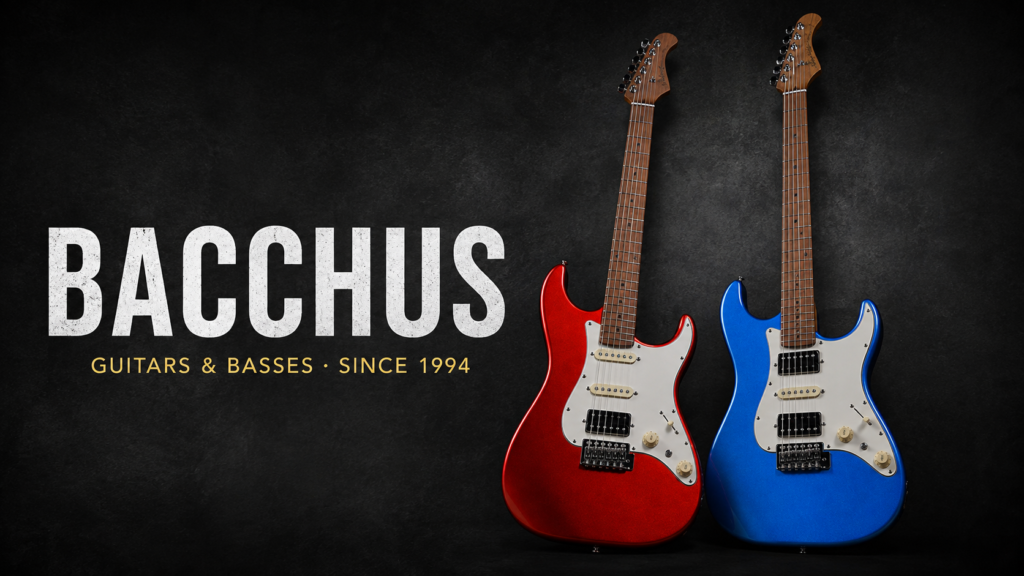
Bacchus guitars are the electric-guitar and bass brand of Deviser, the maker in Matsumoto, Nagano that also builds Headway and Momose. Launched in 1994, Bacchus is the brand that punches hardest above its price: street prices start around ¥40,000 (~$270), and you still get real hands-on build quality.
If you want the single simplest recommendation, it is this: Bacchus guitars make a fantastic first guitar. But that undersells the range, because the lineup climbs all the way to Japanese-made flagships, and there is a lot of quiet, clever engineering hiding under those familiar Strat and Tele shapes.
Bacchus Guitars at a Glance
- Launched: 1994, by Deviser in Matsumoto, Nagano, Japan
- Known for: hands-on build quality and performance that punch above the price
- Starts at: around ¥40,000 (~$270)
- Signature shapes: Strat- and Tele-style guitars; WOODLINE (Jazz Bass-style) basses
- Ahead of its time: roasted-maple necks and headless basses at entry prices
- Series: Universe, Global, Japan Tune-up, Unique (Handmade now discontinued)
- Brand family: Bacchus, Momose, Headway, Seventy Seven, STR, Rosetta, JRP, Sakura Ukulele
History in Brief: Electric Guitars Built on Acoustic Know-How
Deviser started life as Headway, an acoustic maker founded in 1977. After a 1983 factory fire, the company rebuilt as an electric-guitar factory during Japan’s metal boom, and in 1991 the sales side split off to become Deviser. Bacchus launched in 1994, and those precision electric guitars and basses, built on all of that accumulated acoustic and electric know-how, are the foundation the brand still stands on.
Everything above the entry grades traces back to Deviser’s own Aska factory, led by master builder Satoru Yatsuzuka, the same workshop that builds the Japan-made lines for overseas names like James Tyler and Sadowsky. That is the pedigree sitting behind even a ¥40,000 Bacchus.
What Makes Bacchus Guitars Special
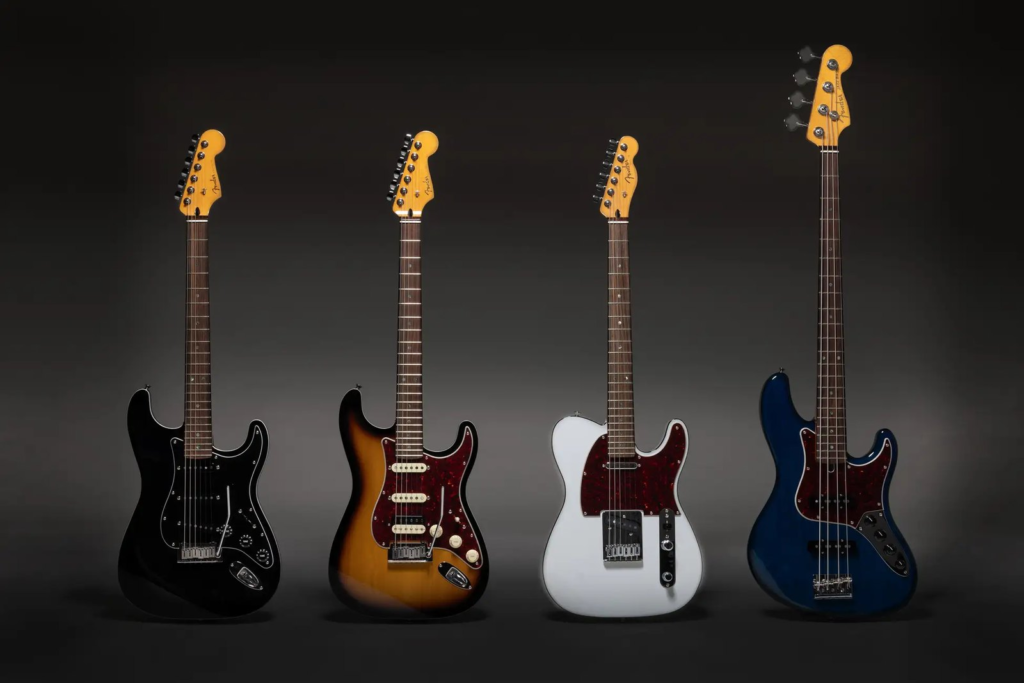
On paper Bacchus builds orthodox Fender-style shapes that work for any genre. Look closer and there is a lot going on that you do not usually get at the price.
Not Just Copies: The Quiet Reworking
Bacchus puts its energy into building traditional shapes properly, then improves them where it counts. You will find a slanted heel cut for easier upper-fret access, some models that drop the neck-joint plate entirely for a smoother heel, and coil taps for more pickup voices. Spec to effect: little changes like the heel cut mean your fretting hand gets to the top of the neck without fighting a boxy joint, which matters more on a working guitar than any spec sheet suggests.
Roasted Maple and Exotic Tops, Years Early
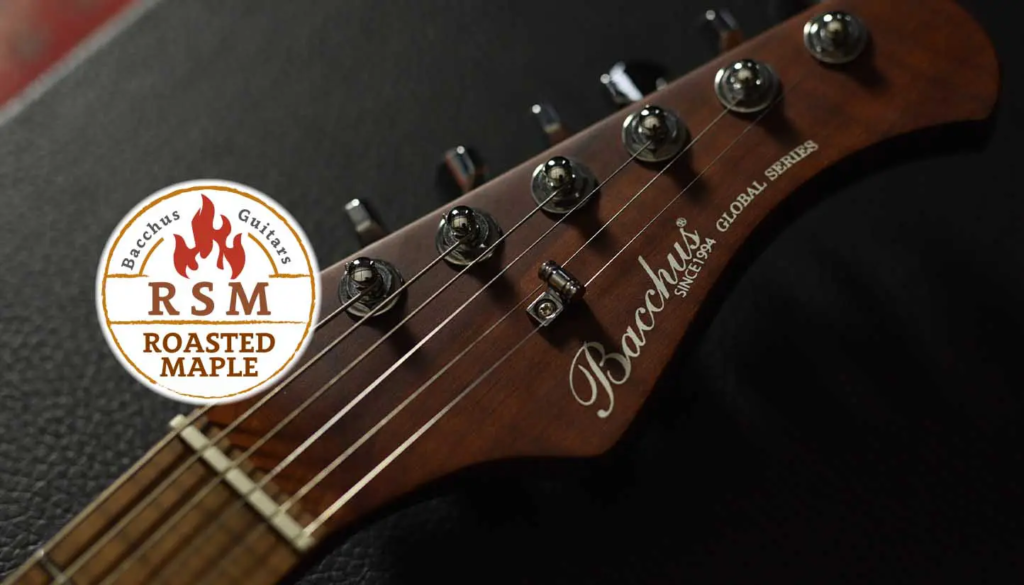
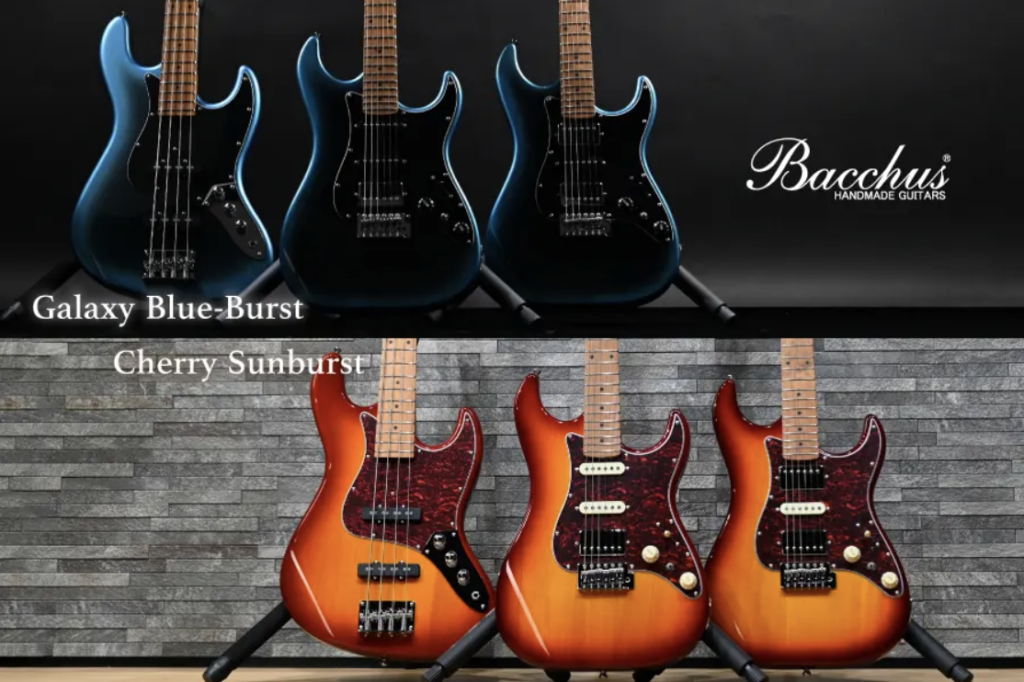
Here is the one to sit with: Bacchus was putting roasted maple necks on entry-level guitars when roasted maple was still a high-end-only feature, arguably one of the earliest brands anywhere in the world to do it. Roasted (torrefied) maple is baked to drive out moisture, so the neck is more stable and resists seasonal movement. On top of that the brand builds headless basses and shows off figured tops, burl poplar, spalted maple, quilted maple and walnut, sometimes with a torched finish to push the grain forward. The wood, and the way Bacchus shows it off, is a big part of the fun.
Colors You Can’t Get Anywhere Else
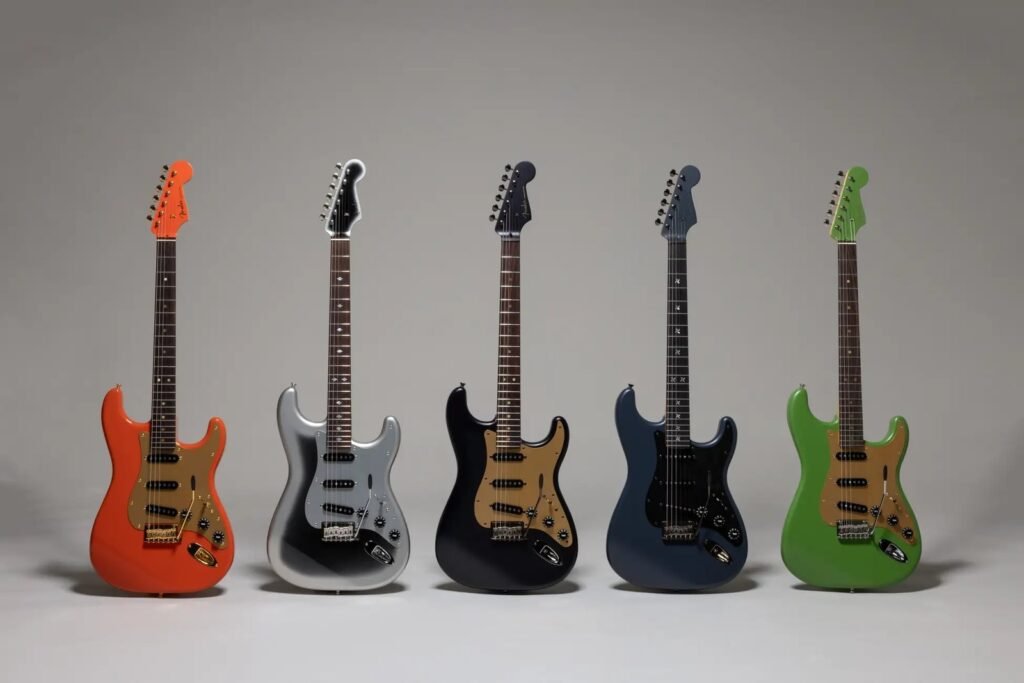
Finishes are a signature too. Bacchus does everything from straight traditional colors to shades you honestly cannot find on another brand, which is a big reason the guitars have so much personality for the money.
The Bacchus Lineup, Series by Series
Bacchus covers a huge price range, from a first guitar to a professional flagship. Here is the map. Prices are Japanese street prices; USD is rough, at about ¥150 to the dollar.
| Series | Price (approx.) | Built / who it’s for |
|---|---|---|
| Universe | ¥40,000-50,000 (~$270-330) | China; the entry point, with genuinely interesting pickup layouts |
| Global | ¥100,000-150,000 (~$670-1,000) | Indonesia, hand-built; the value core of the brand |
| Japan Tune-up | ~¥150,000 (~$1,000) | Overseas body, hand-finished in Japan; gig-ready out of the box |
| Handmade (discontinued) | ¥200,000-300,000 (~$1,300-2,000) | Formerly the top grade, built at the Aska factory |
| Unique | ~¥270,000 (~$1,800) | The current Japan-made flagship (new-generation DUKE) |
Universe: The Entry Point With a Custom-Shop Spec Sheet
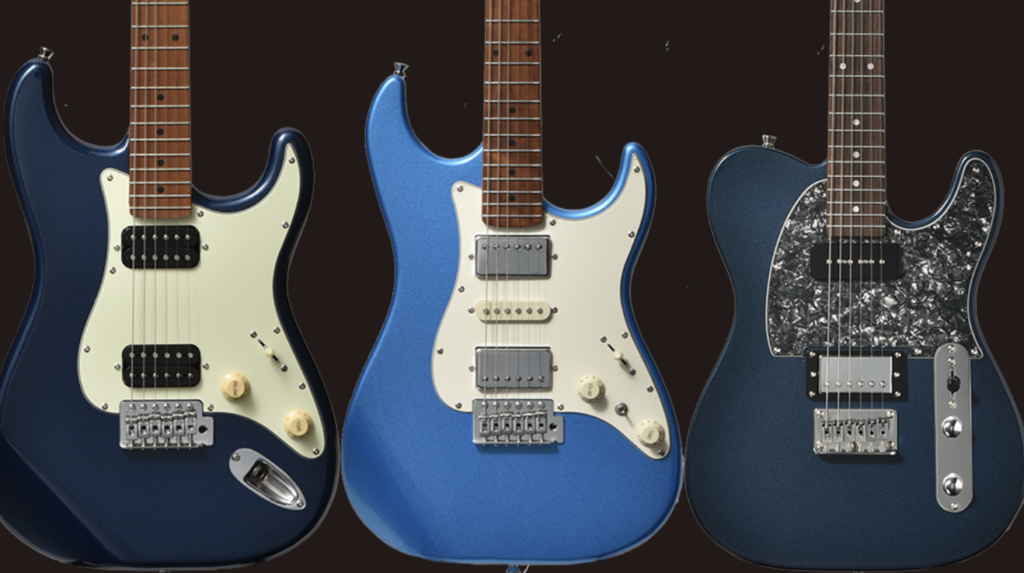
The entry Universe series is made in China, and while the builds are simple and orthodox, the pickup configurations are the fun part. Instead of another plain SSS Strat you get an HSH Strat, an HH Strat, and a Telecaster with a P-90 in the neck and a humbucker in the bridge, essentially custom-shop spec choices right out of the gate. Prices run about ¥40,000 to ¥50,000 (~$270 to $330), and anything with RSM in the part number is a roasted-maple model, at ¥40,000. That, in a nutshell, is Bacchus.
Global: The Value Core, Hand-Built Overseas
Global is the heart of Bacchus today, hand-built in Indonesia. The whole idea is to chase the same quality standard as the Japanese factory from an overseas plant: Deviser deliberately built its master-builder know-how into the Indonesian line, selects wood the way Bacchus always has, and fits the same hardware you get on the models above. The series is also where the Gibson-inspired shapes live, DUKE (Les Paul style), MARQUIS (SG style), BEX (Explorer style) and BFV, a sharp f-hole Flying V. At roughly ¥100,000 to ¥150,000 (~$670 to $1,000), this is where the value is; if you want the most Bacchus for your money, go Global.
Japan Tune-up: Overseas Body, Japanese Setup
Here the bodies are built overseas, then shipped to Japan, where a dedicated Deviser department sets up every single one by hand so it is gig-ready the moment you pick it up. The current lineup centers on TACTICS24 (a Tele shape, in about four versions depending on the top wood) and, on the bass side, WOODLINE, a Jazz Bass platform offered with different top woods. There is one real oddball worth flagging: the WL4-JAZZ uses spruce, the classic acoustic-guitar top wood, over a semi-hollow chambered body, and it has genuine character. Around ¥150,000 (~$1,000).
Handmade (Discontinued): The Aska-Built Top Grade
The Handmade series was the top grade, built by the craftsmen at Deviser’s Aska factory, and sadly it is gone now, retired because raw-material costs climbed so far that the necessary price increase no longer worked. It used to run about ¥200,000 to ¥300,000 (~$1,300 to $2,000). It is worth knowing the name if you shop the used market, because these are the Aska-built Bacchus guitars.
Unique: The Current Japan-Made Flagship
The current flagship is the Unique series, and its first release brings DUKE back as a Japan-made guitar. Bacchus kept the neck-joint design and the arched-top construction it has refined over years, then completely reworked the finishing detail, so it reads as a new-generation DUKE. It lists around ¥270,000 (~$1,800).
How to Choose Your Bacchus
The simplest advice still stands: buy a Bacchus as your first guitar and you will not regret it. If you already own a pile of guitars and want something with unusual wood or specs around the ¥100,000 mark, this is a great place to look, and Global is where the value is. Once you are shopping past ¥200,000, though, the next brand starts coming into view, and that brand is Momose.
Bacchus’s Family: The Deviser Brands
Bacchus is one of a family of brands, all built by the same company in Matsumoto. Here is where it sits.
| Brand | What it is |
|---|---|
| Bacchus | Value-focused electric guitars and basses (this page) |
| Momose | The handmade electric brand, built from Japanese woods |
| Headway | The acoustic brand the whole company grew out of |
| Deviser | The parent company, plus Seventy Seven, STR, Rosetta, JRP and Sakura Ukulele |
Buying a Bacchus
New, the range runs from Universe at ¥40,000 to ¥50,000 (~$270 to $330), through Global at ¥100,000 to ¥150,000 (~$670 to $1,000) and Japan Tune-up around ¥150,000 (~$1,000), up to the Unique flagship near ¥270,000 (~$1,800). If you are overseas, the reliable routes are Japanese retailers that ship internationally, Ishibashi Music and Ikebe among them, plus Reverb and eBay. On the used market, keep an eye out for the discontinued Handmade series, the Aska-built pieces that once topped the range.
Final Thoughts
Bacchus guitars are the easiest recommendation I make in Japanese electrics: a real, hands-on instrument for the price of a toy, with roasted maple and exotic tops that used to be reserved for guitars costing several times as much. Start here if it is your first guitar, reach for Global if you want the most value, and remember that the same factory floor that turns out a ¥40,000 Universe also builds Japan-made flagships and OEM work for boutique American names. Few brands stretch that far, and fewer do it this well.
Bacchus Guitars FAQ
Are Bacchus guitars good for beginners?
Yes, that is arguably the best single use for the brand. Even the entry Universe series (from around ¥40,000) gives you real hands-on build quality, interesting pickup layouts, and often a roasted-maple neck, so a first-time buyer gets far more guitar than the price suggests.
Where are Bacchus guitars made?
It depends on the series. Universe is made in China, Global is hand-built in Indonesia, and Japan Tune-up bodies are built overseas then set up by hand in Japan. The Unique flagship (and the discontinued Handmade series) are Japanese-made at Deviser’s Aska factory.
Which Bacchus series is the best value?
The Global series. It brings Deviser’s master-builder know-how, careful wood selection and the same hardware as pricier models into an Indonesian hand-built guitar at roughly ¥100,000 to ¥150,000, which is where the brand delivers the most guitar per yen.
What is a Bacchus roasted-maple (RSM) neck?
Roasted, or torrefied, maple is baked to drive out moisture, which makes the neck more stable and resistant to seasonal movement. Bacchus was one of the earliest brands in the world to put it on entry-level guitars; any model with RSM in the part number has one.
What is the difference between Bacchus and Momose?
Both come from Deviser’s Aska factory, but Bacchus is the value-focused electric and bass brand starting around ¥40,000, while Momose is the handmade brand that begins where Bacchus tops out, past ¥200,000, and is built from Japanese woods.