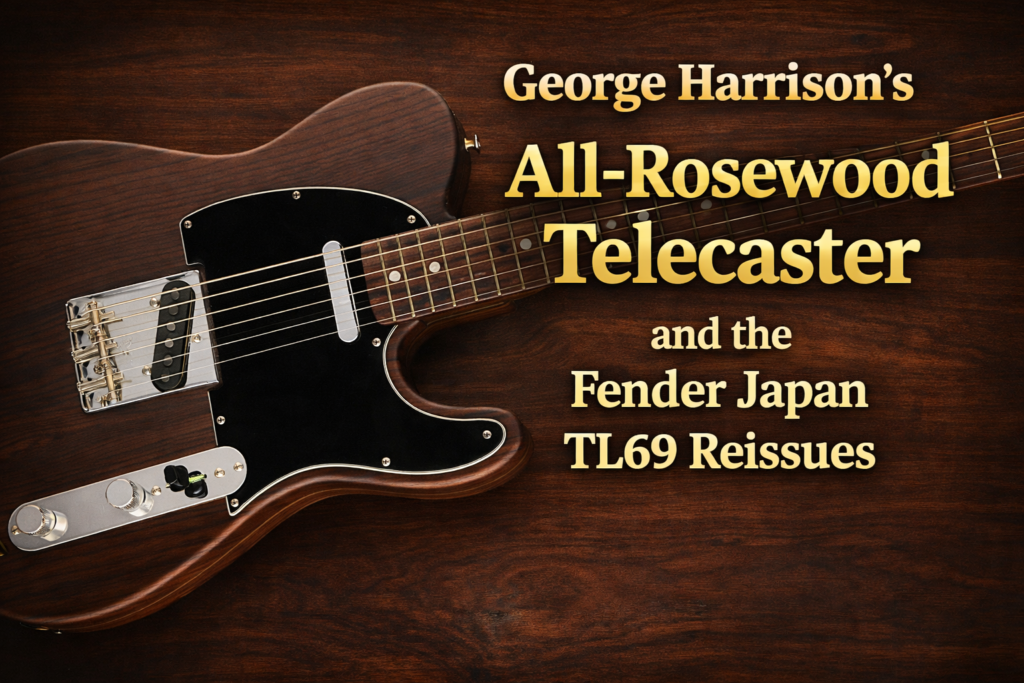
The George Harrison all rosewood Telecaster is one of the most visually distinctive guitars ever associated with The Beatles.
Most fans recognize the George Harrison all rosewood Telecaster from the Let It Be sessions and the 1969 rooftop performance. That moment made the instrument iconic — but the manufacturing history of the all-rosewood Telecaster extends far beyond that single performance.
The Original George Harrison All-Rosewood Telecaster (1968)
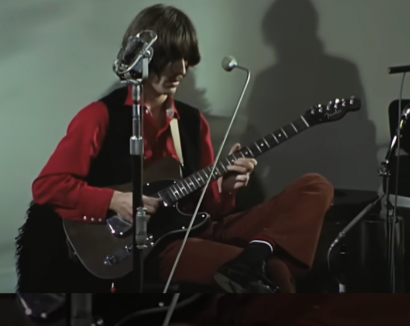
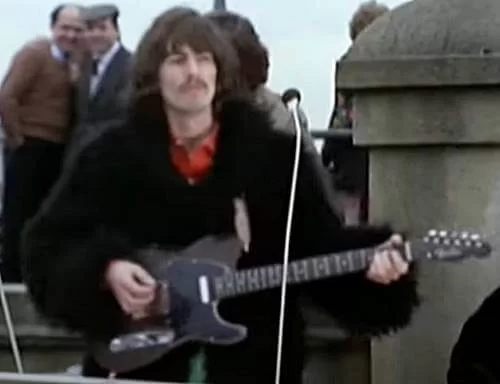
The original George Harrison all rosewood Telecaster was built by Fender in late 1968 as a custom prototype.
It featured:
- Two rosewood slabs
- A thin maple core
- Rosewood neck
- Rosewood fingerboard
- Brass 3-saddle bridge
Weighing approximately 9–10 lbs, the dense hardwood construction gave the all-rosewood Telecaster a unique tonal character and striking visual identity.
Although later tied to the Let It Be era, the guitar began as a bold Fender design experiment.
Fender USA and Early Rosewood Telecaster Production
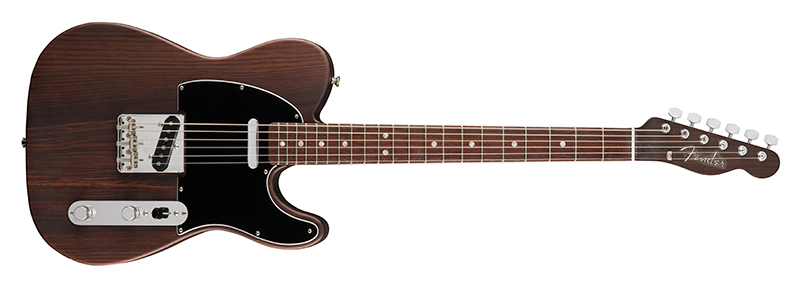
Following Harrison’s use of the instrument, Fender briefly produced all-rosewood Telecasters in the United States between 1969 and 1972.
However, the rosewood Telecaster remained a niche model. It never became a standard catalog staple, and production ended after a short run.
The long-term survival of the George Harrison all rosewood Telecaster concept would later be carried forward in Japan.
Fender Japan TL69: The MIJ Rosewood Telecaster Era
In the mid-1980s, Fender Japan revived the all-rosewood Telecaster under the TL69 series.
These Fender Japan TL69 instruments maintained the layered rosewood body construction and often included chambering to reduce weight. This period marked the true beginning of the MIJ rosewood Telecaster legacy.
TL69-115 (1984–1989)
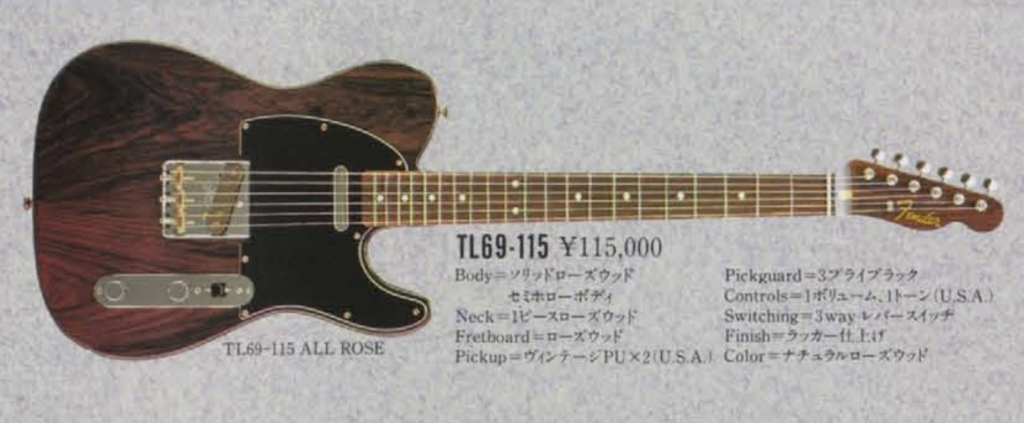
The TL69-115 is widely considered the flagship Fender Japan TL69 model.
Specifications included:
- Chambered rosewood body with maple insert
- One-piece rosewood neck
- USA electronics
- Brass 3-saddle bridge
- No bridge cover
Among TL69 variants, the TL69-115 remained closest to late-1960s specifications and is especially desirable among collectors seeking a George Harrison all rosewood Telecaster-style instrument.
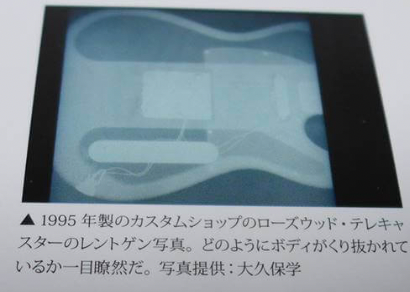
(Image: 『Fender Telecaster Player’s Book』)
TL69-98 (Introduced 1986)
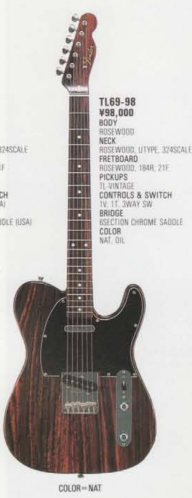
The TL69-98 offered a more accessible MIJ rosewood Telecaster option.
It featured:
- Japanese pickups
- 6-saddle bridge
- Same layered rosewood construction
The modern 6-saddle bridge allowed improved intonation, making it more player-friendly while preserving the rosewood aesthetic.
Rare oil-finish examples from the late 1980s are now considered hidden collector gems.
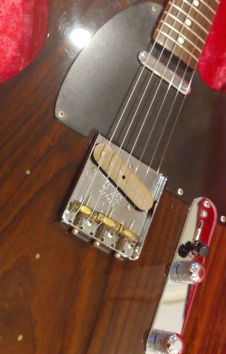
(Image: Yahoo! Auction)
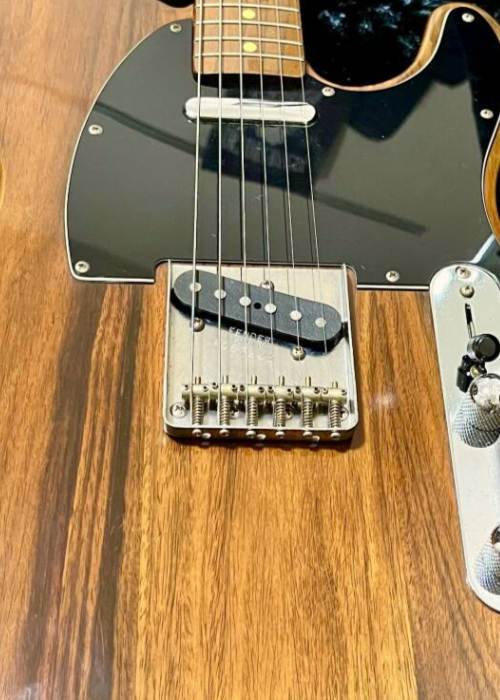
(Image: Yahoo! Auction)
TL69-900 (1990 — One-Year Production)
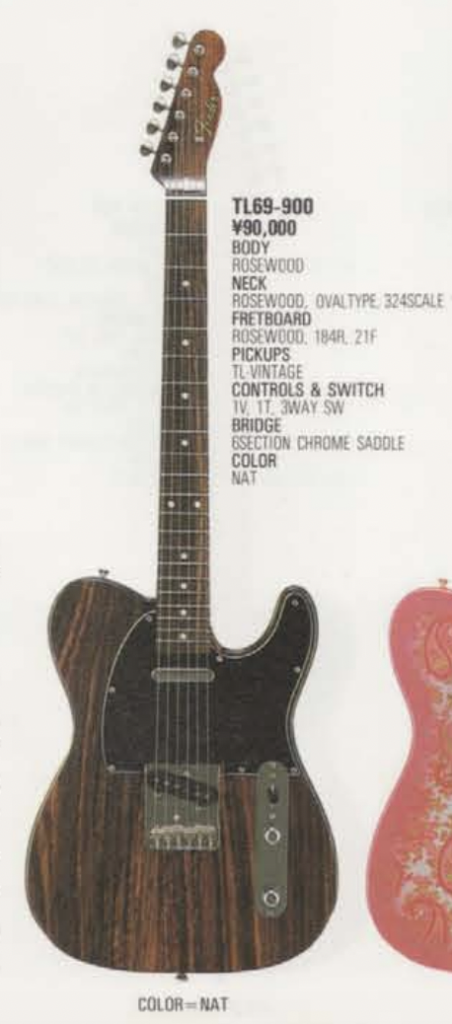
The TL69-900 was produced for only one year in 1990.
With Japanese pickups and a 6-saddle bridge, it followed the 98-style specification. Its extremely short production run makes it one of the rarest MIJ rosewood Telecaster models.
TL69-150 (1995 Premium Revival)
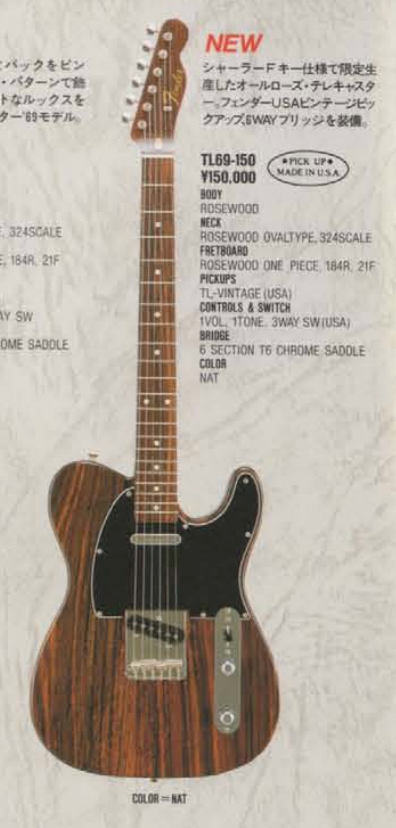
The TL69-150 reintroduced the all-rosewood Telecaster at a premium level.
Specifications included:
- USA pickups
- Schaller F-key tuners
- 6-saddle bridge
- Chambered rosewood body
At 150,000 yen, the TL69-150 positioned the Fender Japan TL69 series as a high-end offering within the MIJ rosewood Telecaster lineup.
Not a Continuous Run — But Multiple Waves
It’s important to clarify:
The Fender Japan TL69 all-rosewood Telecaster models were not produced continuously for 30 years.
Instead, the MIJ rosewood Telecaster appeared in multiple waves:
- Mid-1980s to late-1980s (TL69-115 / TL69-98)
- 1990 (TL69-900)
- Mid-1990s revival (TL69-150)
These intermittent Fender Japan TL69 releases kept the George Harrison all rosewood Telecaster concept alive across generations.
At the same time, Fender USA and the Fender Custom Shop have periodically released limited, spot-production all-rosewood Telecasters — often marketed as George Harrison-inspired or tribute models. These were special editions rather than continuous catalog production.
The all-rosewood Telecaster survived through selective revivals, not uninterrupted manufacturing.
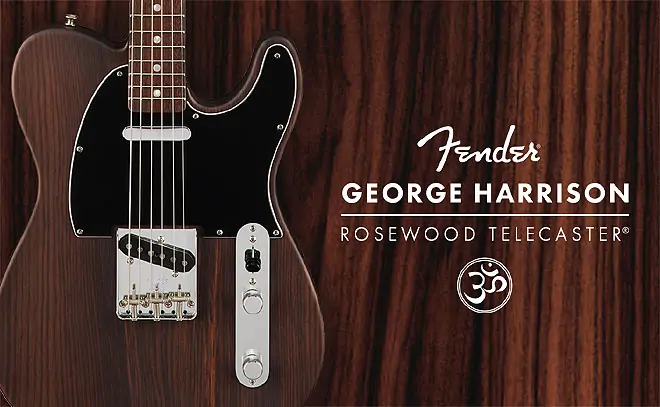
(Image: Fender Official Website)
TL69 All-Rosewood Telecaster Model Comparison
| Model | Years | Pickups | Bridge | Body Construction | Market Position |
|---|---|---|---|---|---|
| TL69-115 | 1984–1989 | USA | 3-saddle brass | Chambered rosewood + maple core | Vintage-correct flagship |
| TL69-98 | 1986–late ’80s | Japan | 6-saddle | Chambered rosewood + maple core | Accessible player model |
| TL69-900 | 1990 | Japan | 6-saddle | Chambered rosewood + maple core | One-year rare release |
| TL69-150 | 1995 | USA | 6-saddle | Chambered rosewood + maple core | Premium revival |
Final Thoughts
The George Harrison all rosewood Telecaster may be forever linked to the Let It Be era, but its legacy spans multiple production waves across decades.
From the original 1968 prototype to the Fender Japan TL69 reissues and occasional USA tribute models, the all-rosewood Telecaster remains one of the most unusual and enduring Telecaster designs ever produced.
Not a continuous production model.
But a recurring icon within both Beatles history and MIJ guitar craftsmanship.
FAQ
What is George Harrison’s all-rosewood Telecaster?
George Harrison’s all-rosewood Telecaster is a custom Fender prototype built in 1968 using rosewood slabs with a thin maple core. It became famous during the Beatles’ Let It Be sessions and the 1969 rooftop performance.
Did Fender produce all-rosewood Telecasters after Harrison’s original guitar?
Yes. Fender produced limited all-rosewood Telecasters in the United States between 1969 and 1972. Later, Fender Japan revived the concept with the TL69 series in the 1980s and 1990s.
What is the Fender Japan TL69 rosewood Telecaster?
The Fender Japan TL69 series was a Made-in-Japan reissue of the all-rosewood Telecaster concept. These guitars featured layered rosewood bodies, often chambered to reduce weight, and were produced in several waves during the 1980s and 1990s.
What are the differences between TL69-115 and TL69-98?
The TL69-115 used USA electronics and a vintage-style brass 3-saddle bridge, making it closer to the late-1960s specifications. The TL69-98 used Japanese pickups and a modern 6-saddle bridge for improved intonation and a lower price point.
Was the TL69 rosewood Telecaster produced continuously?
No. Fender Japan did not produce the TL69 rosewood Telecaster continuously. Instead, models such as TL69-115, TL69-98, TL69-900, and TL69-150 appeared in separate production waves between the mid-1980s and mid-1990s.