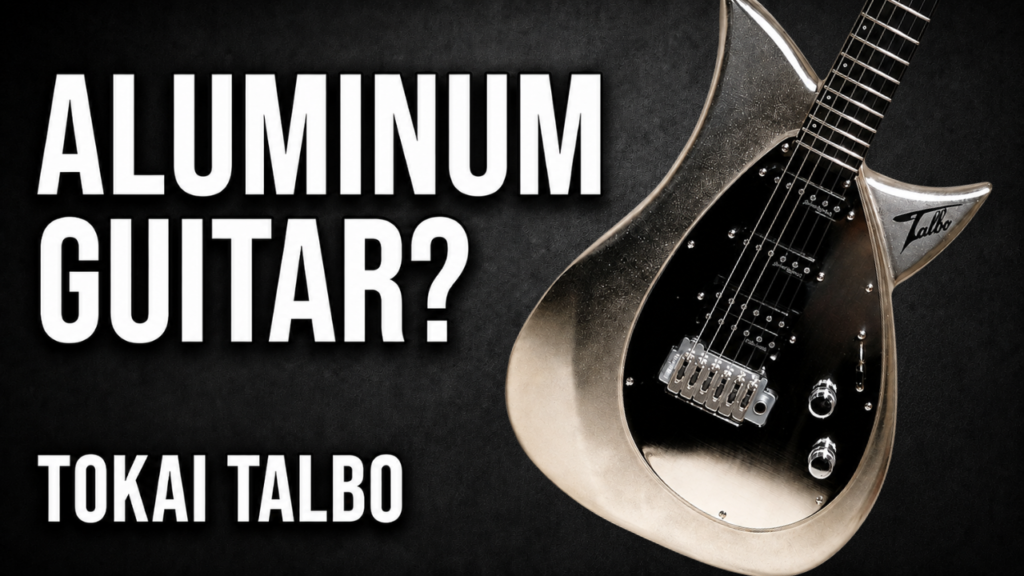
In an era when every electric guitar was made of wood as a matter of course, one Japanese model took its shot with a cast aluminum body: the Tokai Talbo. It sold badly enough that production stopped, then came back in the 1990s, and more than forty years later it is still in the catalog as Tokai’s flagship instrument. This article traces the full arc, from the 1983 launch through the reissue, the variants, and the current lineup as of 2026.
Tokai Talbo Quick Facts
- Introduced: 1983, by Tokai Gakki (Hamamatsu, Shizuoka, Japan)
- Name: commonly explained as “Tokai Aluminium Body”
- Body: sand-cast aluminum, hollow, filled with urethane foam
- 1980s production: roughly 1,300 units, about 2,000 including shop customs
- Discontinued / revived: stopped in the 1980s, reissued 1994, Tokai restarted production 1996
- Signature players: Rory Gallagher, Tim Farriss (INXS), Hisashi Imai (BUCK-TICK), HISASHI (GLAY), Susumu Hirasawa
- Current status: still in production, now Tokai’s flagship model
Prefer to watch? This article is based on my own video below.
- 1983: Why Tokai Built a Guitar Out of Aluminum
- How the Talbo Is Made: Sand Casting and Foam Filling
- Tokai's Case for Aluminum: What the 1980s Catalogs Claimed
- Why the Talbo Failed the First Time
- The 1990s Revival: How the Talbo Came Back
- 1990s Reissue vs 1980s Original: What Changed
- The Talbo Family: Bass, Woody, Jr., Acrylic and Zemaitis
- TALBO SECRET FACTORY: The Custom Shop the Fans Built
- 2024 to 2025: Shinkansen Aluminum, Seven Strings and the Talbo3
- Final Thoughts
- Frequently Asked Questions
- More Tokai guitar articles
1983: Why Tokai Built a Guitar Out of Aluminum
The Talbo arrived in 1983. The name is generally said to stand for “Tokai Aluminium Body,” and for once the marketing was literal: the body really is metal.
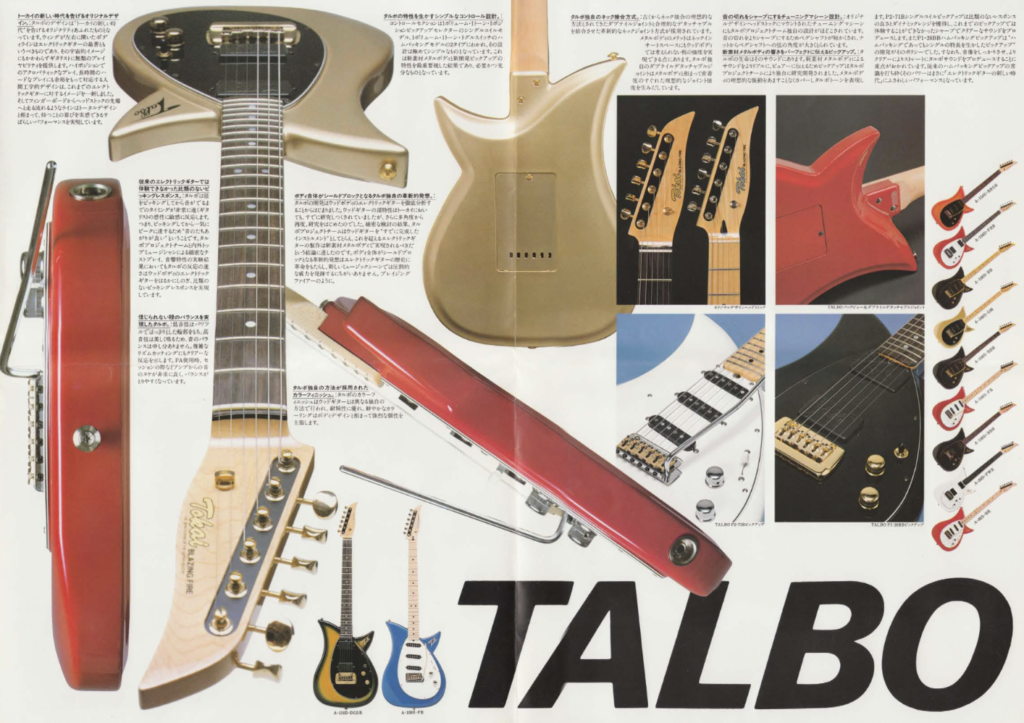
The timing matters. 1983 was the year after Fender Japan was founded, and the Japanese industry was in the middle of a shift. Makers were moving away from the faithful replicas of what later got called the Lawsuit Era, the peak of which you can see in the Greco Super Real series, and starting to push original models, or at least Strat and Les Paul outlines with the shapes subtly redrawn.
Even against that background, Tokai went further than anyone. In the pursuit of something genuinely original, they abandoned wood entirely.
| Year | Milestone |
|---|---|
| 1983 | Talbo launched with a two-piece welded cast aluminum body |
| c. 1985 | Tokai MAT launched, a parallel experiment in carbon-based materials |
| Late 1980s | Talbo discontinued after roughly 1,300 units |
| 1994 | Mitaka Gakki revives the model using leftover 1980s bodies |
| 1996 | Tokai restarts production; TALBO SECRET FACTORY begins |
| 2000s onward | Bass, Woody, Jr., acrylic and Zemaitis variants expand the family |
| 2024 | Re:A-700 Talbo built from recycled Shinkansen aluminum, 60 units |
| 2025 | 7-string A-101 CM7 FI and the billet-machined Talbo3 (ACV-501) |
How the Talbo Is Made: Sand Casting and Foam Filling
The way the Talbo is built is as unusual as the material. The body is cast. Aluminum is melted at over 800 degrees Celsius (about 1,500 degrees Fahrenheit) and poured into a sand mold, the same basic casting technique used to produce automotive engine blocks.
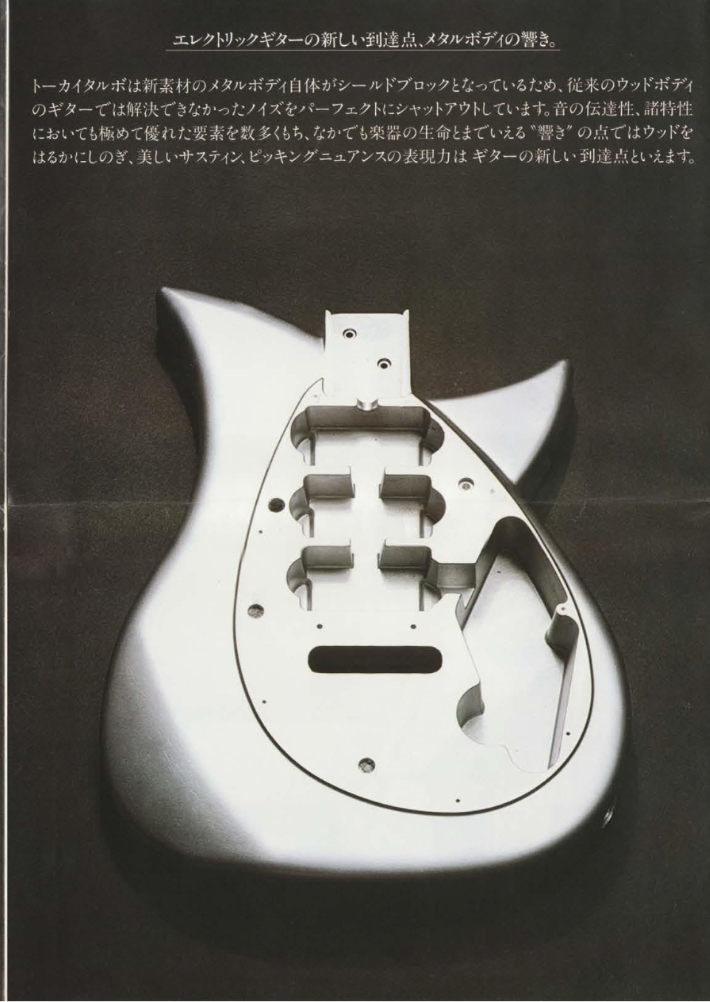
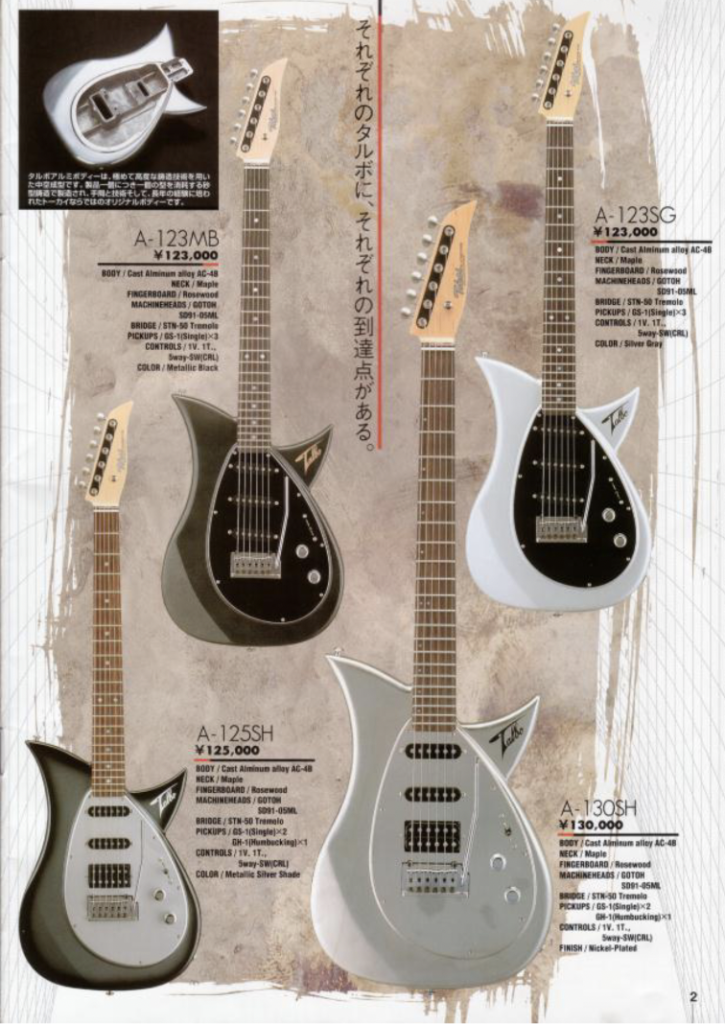
The original 1980s body was a two-ply construction. Upper and lower halves were cast separately, placed together, and the seam was welded. The burrs were then ground down to finish the hollow shell, and lightweight urethane foam was injected into the cavity through a hole in the body to control unwanted resonance.
That is a lot of hand labor for one guitar body, and it is a large part of why the Talbo was expensive to make.
Tokai’s Case for Aluminum: What the 1980s Catalogs Claimed
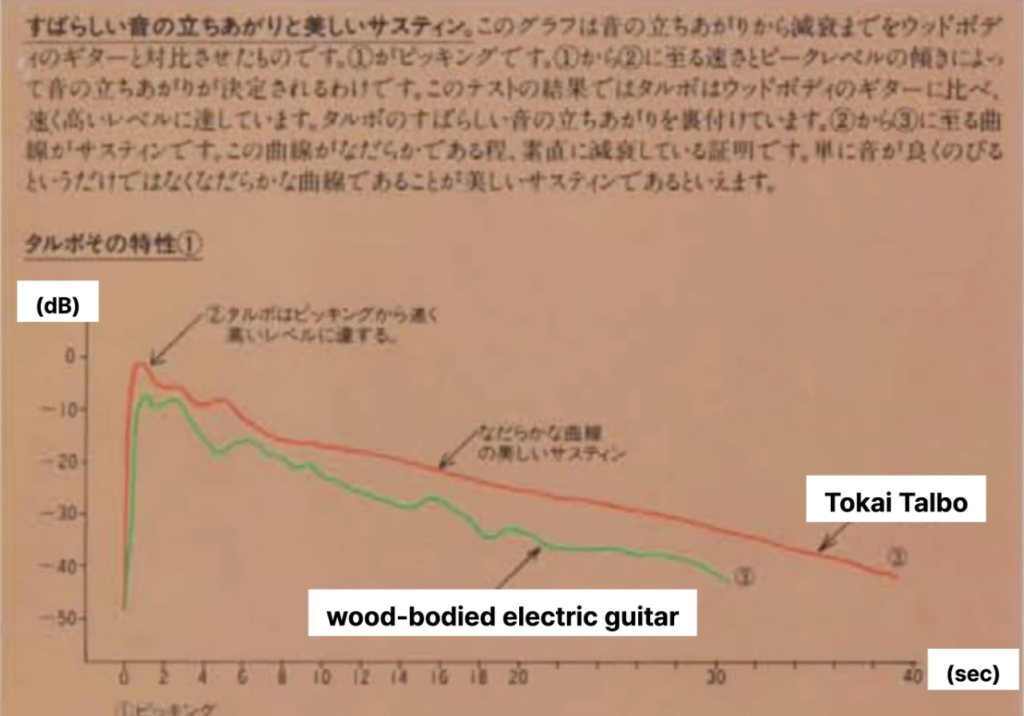
So why use a material like this at all? Tokai’s argument came down to three things: noise shielding from the metal itself, a bright and sharp tone, and long sustain. The catalogs of the period made the case in detail, with two graphs.
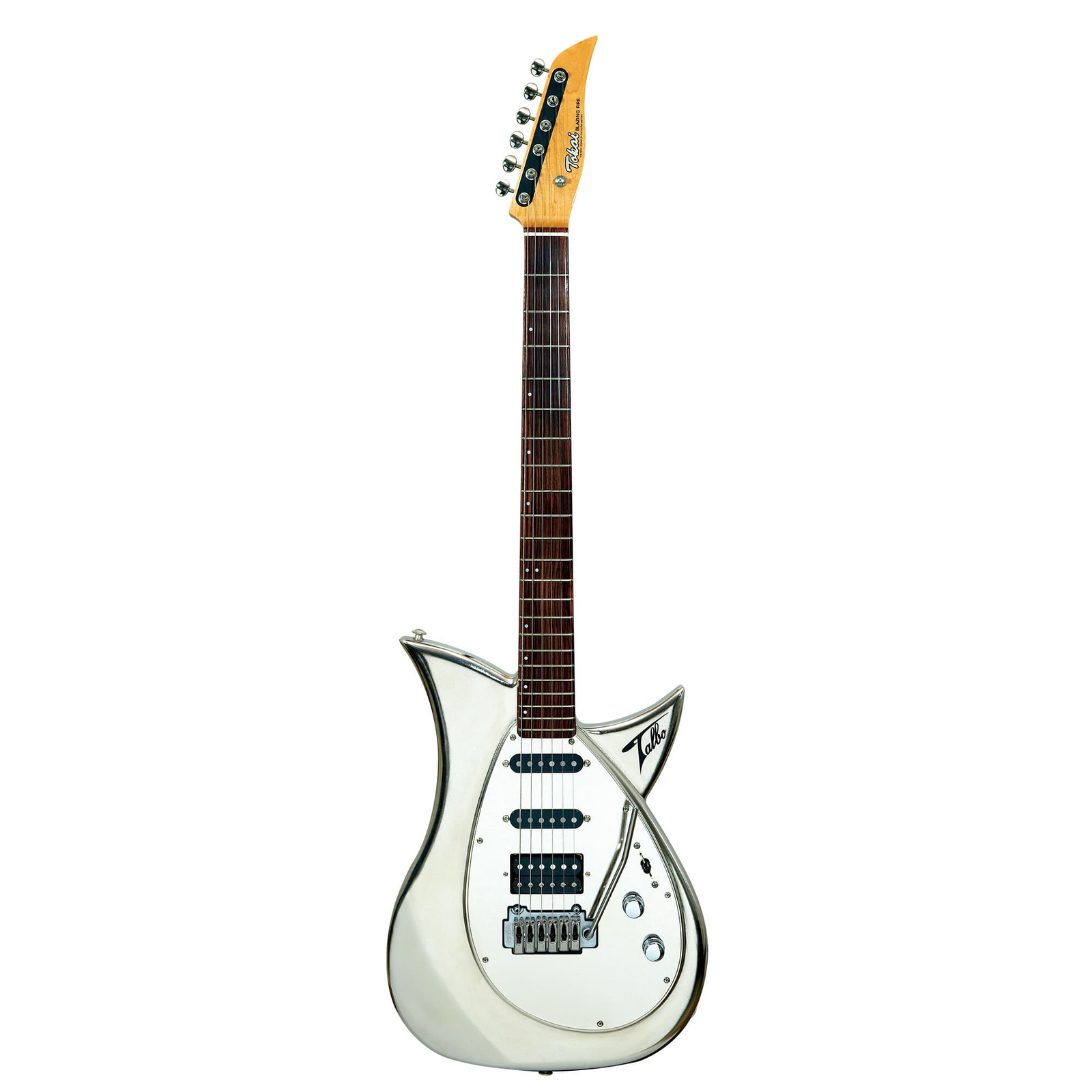
The first showed how a note rises and decays from the moment the string is plucked. Tokai’s claim was clear enough: the Talbo reaches its peak faster, meaning a sharper attack and faster response, and its decay curve was drawn smoother and more gradual, supporting the promise of long, controlled sustain.
The second graph dealt with how much vibrational energy is lost inside the body. Wooden guitars were shown losing a lot of energy, especially in the high end, while the Talbo showed low internal loss across the whole range. More of the string’s vibration is preserved, and that translates directly into clarity and sustain.
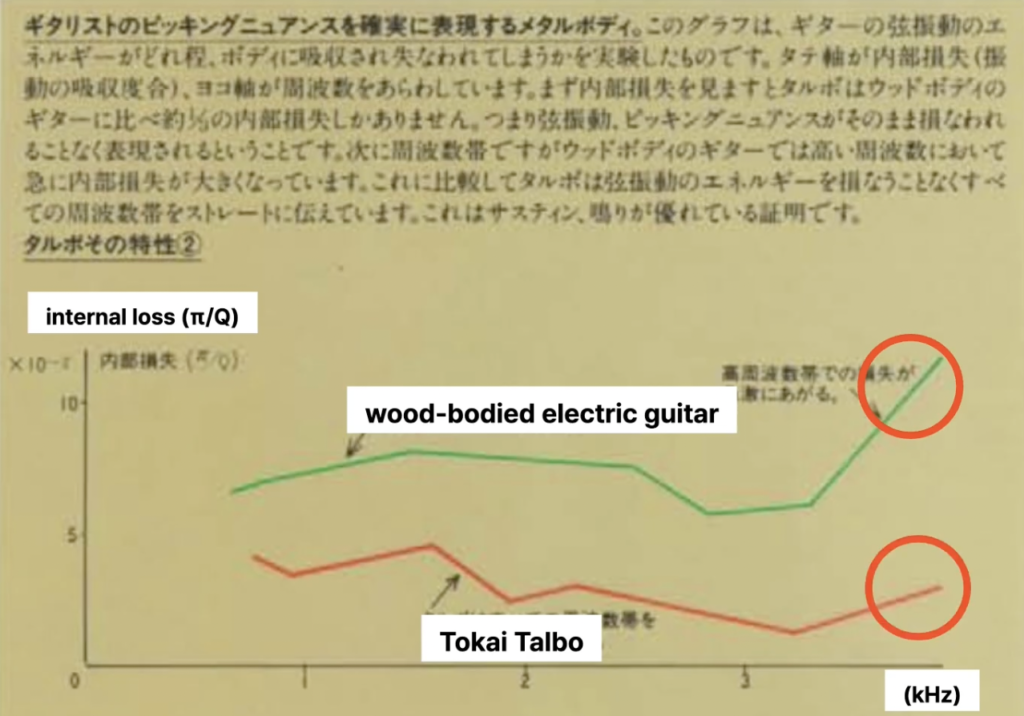
Put together: because the body itself is aluminum, the instrument is low-noise without any special shielding added to the circuit. Combine that with the sonic character of the metal and you get an instrument with a clean, honest sound. Whether you love that or find it clinical is a matter of taste, but the reasoning was sound.
Why the Talbo Failed the First Time
Sales were not strong, and production costs were high. Production stopped.
This was despite genuine artist visibility: Rory Gallagher and Tim Farriss of INXS both owned Talbos and used them live and in the studio. Even so, only about 1,300 were made in the 1980s. Including shop custom models, the total comes to roughly 2,000 instruments.
Tokai was running a second radical experiment at the same time, the carbon-material Tokai MAT, which met the same fate within a few years.
The 1990s Revival: How the Talbo Came Back
Both of Tokai’s big material experiments were promoted relentlessly as better than wood in tone and durability, and both were discontinued within a few years. Yet only one of them is still in the lineup today, and it has become Tokai’s signature product. Why?
The turning point came in the 1990s. Japanese musicians started playing them, beginning with Hisashi Imai of BUCK-TICK, and the Talbo drew attention again. In 1994, Mitaka Gakki revived the model using 1980s bodies still sitting in Tokai’s stock. In 1996, Tokai restarted production themselves. Among the players who defined the model from that era, HISASHI of GLAY and Susumu Hirasawa both made it a trademark instrument.
That is the whole answer, and it is worth saying plainly: the Talbo was saved by players, not by engineering.
1990s Reissue vs 1980s Original: What Changed
The reissue was not a straight copy of the 1980s guitar. Several construction details changed.
The big one is the body, which went from two-ply to a one-piece construction. Originally the halves were joined and then filled with urethane. In the reissue the urethane foam is cut precisely and fitted in, which made a single-piece body possible. The neck pocket and joint were also revised: because the one-piece construction and the fitted urethane make the body slightly heavier, the neck is held with a four-bolt joint.
| Feature | 1980s original | 1990s reissue onward |
|---|---|---|
| Body construction | Two-ply, halves welded together | One-piece cast body |
| Urethane filling | Foam injected through a hole after welding | Foam pre-cut and fitted into the cavity |
| Neck joint | Lighter body, fewer bolts | Four-bolt joint for the heavier body |
| Frets | Period-typical sizing | Larger frets on later updates |
| Logos | Original headstock and body logos | Redesigned headstock logo, new body printing method |
Since the restart the model has been updated every few years or so, so a Talbo bought in 1997 and one bought in 2026 are not quite the same instrument, even where the outline is identical.
The Talbo Family: Bass, Woody, Jr., Acrylic and Zemaitis
The reissue opened the door to a wave of new models, and the Talbo stopped being a single guitar and became a platform.
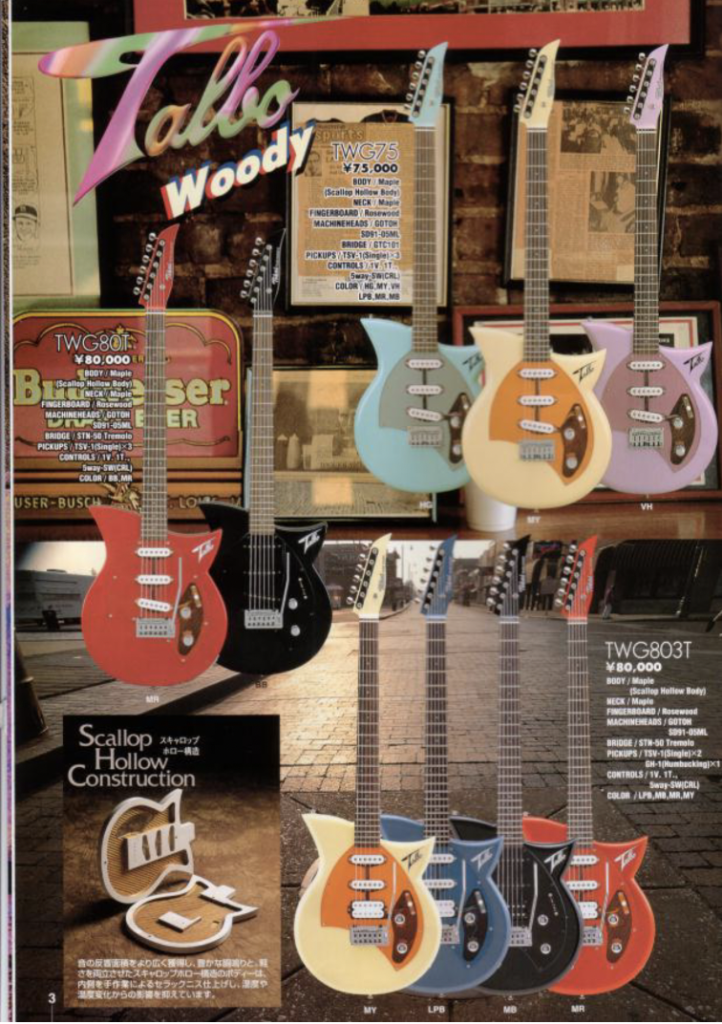
There is a bass version, and it was with the Talbo Bass that Tokai first achieved a seamless one-piece cast body with no welding at all. Then came a model that dropped aluminum, supposedly the entire identity of the guitar, in favor of wood: the Talbo Woody, whose defining feature is a semi-hollow design Tokai calls “scalloped hollow” construction. The TARBOSAURUS is also wooden, but built in the same shape as the aluminum Talbo. The Talbo Jr. has a battery-powered amp and speaker built into the body. There is even a Talbo with a clear acrylic body.
On top of that there is a collaboration with Zemaitis, the brand owned by Kanda Shokai: a Talbo body paired with a Zemaitis headstock. The first was the Z-Talbo Jr., with a 5-watt amp running on a 9-volt battery, a 10 cm (4 inch) full-range speaker, a headphone mini jack and an external output jack. The second was the ZT-2500, a neck with the Zemaitis headstock logo set straight into a Talbo body. There is no Tokai logo and no Talbo logo anywhere on it, so it genuinely reads as a Zemaitis with a Talbo body attached. Both were made in small numbers, which makes them extremely rare today.
| Model | Body | Defining feature |
|---|---|---|
| Talbo (standard) | Cast aluminum | The original shape and concept |
| Talbo Bass | Cast aluminum | First fully seamless one-piece cast body |
| Talbo Woody | Wood | “Scalloped hollow” semi-hollow construction |
| TARBOSAURUS | Wood | Wooden build in the aluminum Talbo outline |
| Talbo Jr. | Cast aluminum | Built-in battery amp and speaker |
| Acrylic Talbo | Clear acrylic | Transparent body |
| Z-Talbo Jr. | Cast aluminum | Zemaitis headstock, 5W amp, 10 cm speaker, headphone jack |
| ZT-2500 | Cast aluminum | Zemaitis logo only, no Tokai or Talbo branding |
TALBO SECRET FACTORY: The Custom Shop the Fans Built
The Talbo also has a solid core of dedicated fans, and out of that came a project, or really a brand, called TALBO SECRET FACTORY, which plans and builds special-spec and custom models based on the Tokai Talbo.
It started in 1996 at Mitaka Gakki as a collaboration with HISASHI of GLAY. When Mitaka Gakki closed in 2003, the project moved to Ikebe Gakki along with the staff running it. One of their best-known builds is a HISASHI anniversary model where the clear coat is stripped off the body and the bare aluminum is engraved.
2024 to 2025: Shinkansen Aluminum, Seven Strings and the Talbo3
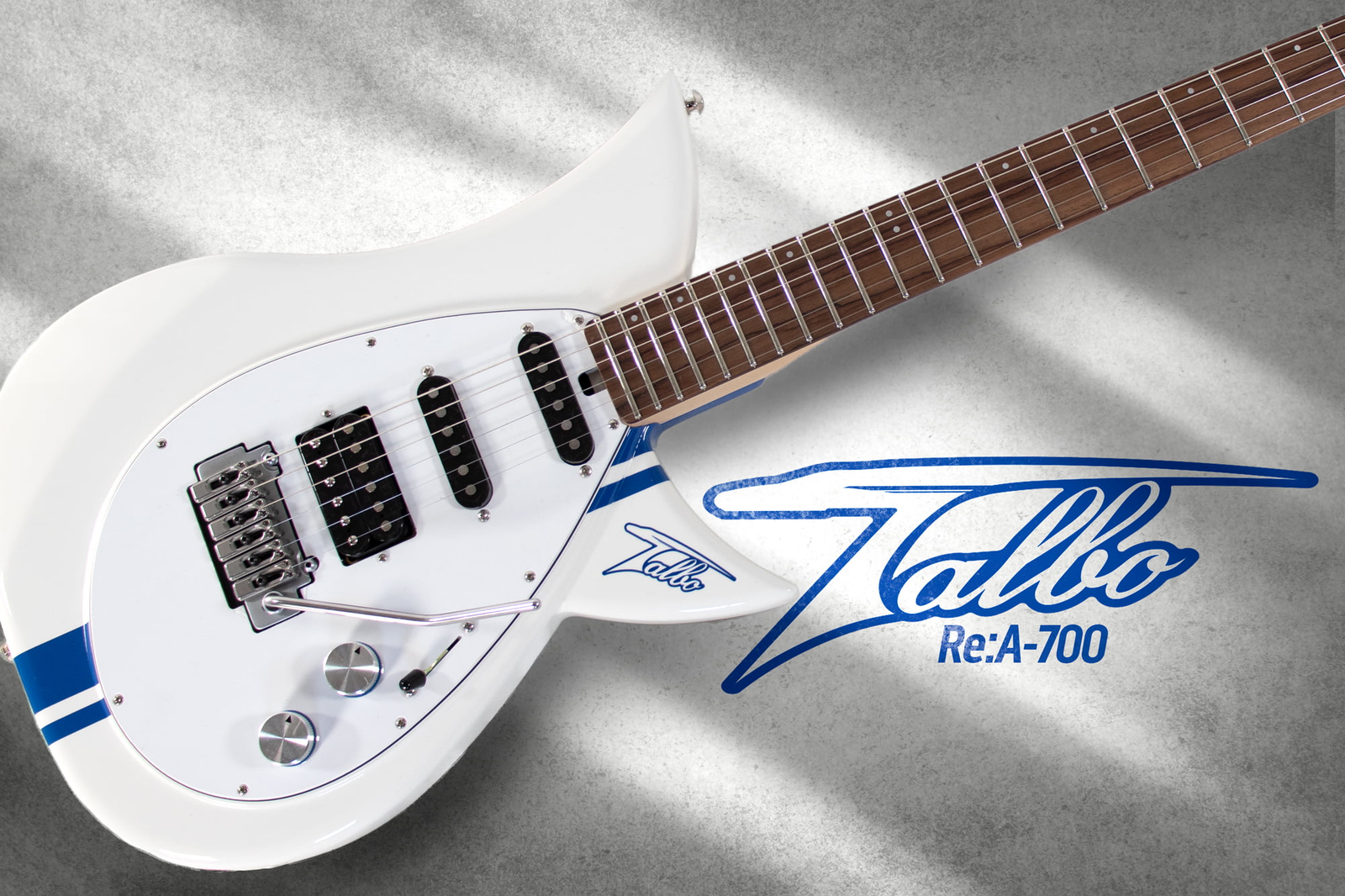
Re:A-700 Talbo (2024)
The most remarkable recent example is the Re:A-700 Talbo, released at the end of 2024. Tokai collaborated with Japanese railway operator JR, building the guitar from recycled aluminum reclaimed from retired N700 series Shinkansen cars. The design is styled after the N700 itself with a special finish, and it was limited to just 60 units. The recycling technology behind that high-strength bullet-train aluminum, and the sustainability angle, got a lot of attention.
A-101 CM7 FI / 7-Talbo (2025)
2025 brought a seven-string model, the A-101 CM7 FI / 7-Talbo. It is a joint build with Frontisland CustomGuitarWorks, a guitar shop based in Hamamatsu, Shizuoka, the same city as Tokai. It is loaded with Fishman pickups and even has LED position markers, so you would assume it is a purely modern instrument. The spec sheet is more considered than that, though: Brazilian rosewood, for one.
Talbo3 / ACV-501 (2025)
The same year brought the Talbo3, model ACV-501. Overall dimensions, neck, pickguard and tremolo all follow the standard Talbo format. What sets it apart is the body: machined from solid aluminum billet and anodized, rather than cast. It is the Talbo updated into something modern and refined, and it is the clearest sign yet that Tokai still treats this design as worth engineering budget.
Final Thoughts
The Talbo has been going for over forty years, and the lesson I take from it is not the one Tokai’s catalogs were arguing for.
Superior specs and sound engineering reasoning are not enough to keep an instrument alive. Tokai had the graphs, the materials science and the durability argument in 1983, and it still failed. What set the Talbo apart from every other clever idea of that period is that players picked it up in the 1990s, and that customs and new models have kept coming ever since, without a break.
There is a business detail behind that which I keep coming back to. Developing a new model means pattern and jig fabrication, body and neck design, and getting the thing onto a factory line. That is tens of thousands of dollars in development cost before a single guitar sells. Most of the Japanese makers who spent that money in the 1980s got nothing back for it, which is part of what makes the era’s originals such interesting buys today, and part of what makes Japanese guitars of that period worth taking seriously.
Maybe a guitar is decided not just by what it can do, but by whether it can become part of someone’s identity. The Talbo is one of the rare cases where that happened. If you own one, or if this got you interested, I would like to hear about it.
Frequently Asked Questions
What does Talbo stand for?
Talbo is commonly explained as an abbreviation of ‘Tokai Aluminium Body,’ which describes the guitar literally: a Tokai electric with a cast aluminum body instead of a wooden one.
Is the Tokai Talbo body solid aluminum?
No. The body is a hollow aluminum casting filled with lightweight urethane foam to control unwanted resonance. The 2025 Talbo3 (ACV-501) is the exception in method, being machined from solid aluminum billet and anodized rather than cast.
How many 1980s Tokai Talbos were made?
Roughly 1,300 units were produced in the 1980s, or about 2,000 including shop custom models. That low number is why original first-run Talbos are hard to find today.
What is the difference between an original 1980s Talbo and a reissue?
The 1980s body was two-ply, with the halves welded together and urethane injected afterward. The reissue uses a one-piece cast body with pre-cut urethane fitted inside, and a four-bolt neck joint to handle the slightly heavier body. Later updates changed the headstock logo, the body logo printing method, and fret size.
Which famous players use the Tokai Talbo?
Rory Gallagher and Tim Farriss of INXS used Talbos in the 1980s. The 1990s revival was driven by Japanese players, above all Hisashi Imai of BUCK-TICK, HISASHI of GLAY, and Susumu Hirasawa.
Does an aluminum guitar body actually sound different?
Tokai’s own catalogs argued yes: faster attack, smoother decay, lower internal energy loss across the frequency range, and inherent noise shielding from the metal body without extra circuit shielding. In practice the Talbo is known for a bright, clear, sustaining tone. Whether that suits you is a matter of taste.
More Tokai guitar articles
Tokai Guitars History: From Harmonicas to the Copies That Beat the Originals
Tokai is the Japanese brand that made the phrase “better than the original” stick. It…
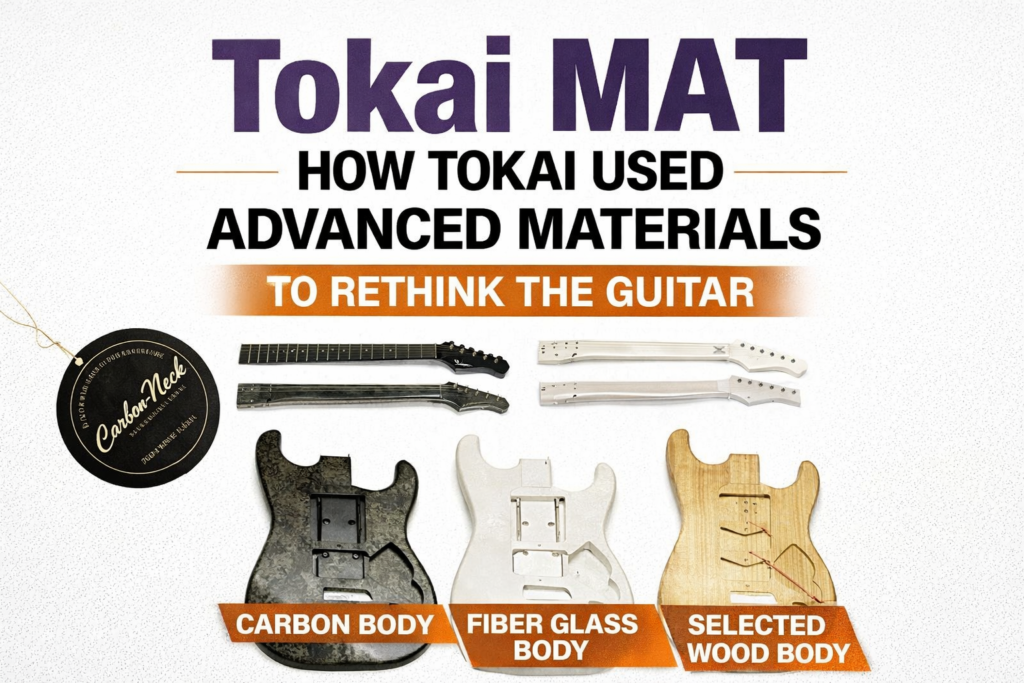
Tokai MAT: How Tokai Used Advanced Materials to Rethink the Guitar
The Tokai MAT is one of the most unusual guitar projects to come out of…
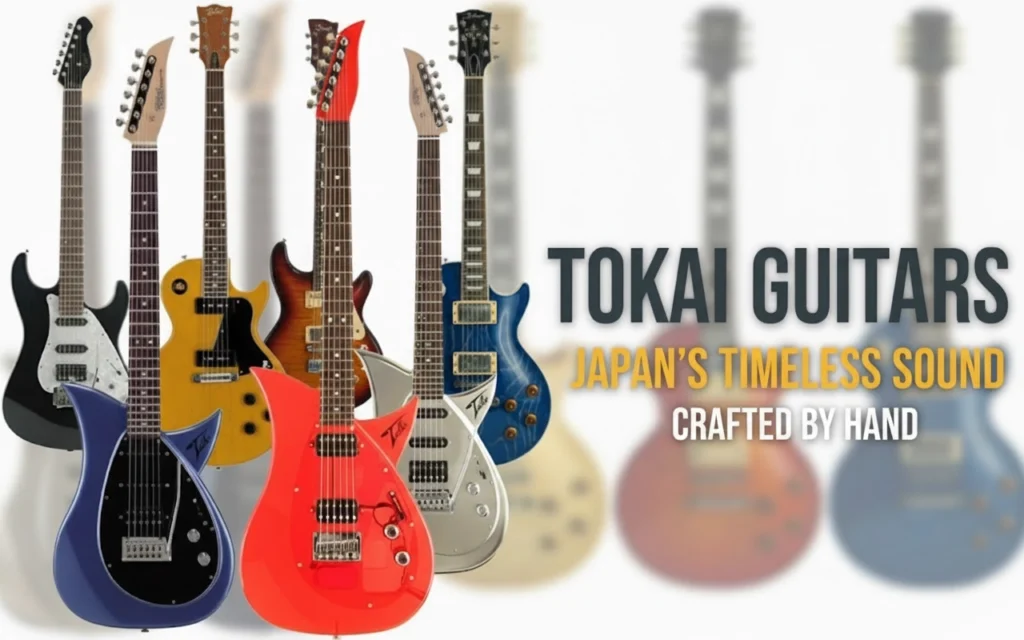
Tokai Guitars — The Art of Japanese Timeless Sound and Craftsmanship
Tokai Gakki Manufacturing Co., Ltd. (東海楽器製造株式会社) is a Hamamatsu-based manufacturer in the truest sense: a…