The Ibanez RG series is one of the most influential modern electric guitar designs, evolving from the Roadster and Roadstar guitars of the late 1970s and early 1980s before emerging as a dedicated model line with the RG550 in 1987.
Ibanez RG Quick Facts
- First RG model: RG550 (1987)
- Where it came from: Based on the performance design of Steve Vai’s Ibanez JEM (1987)
- RG meaning: Originally “Roadstar Guitar”
- RG trademarks: 24 frets, Wizard-style thin neck, superstrat body, floating tremolo
- Extended-range milestones: 7-string RG7620 (1998), 8-string RG2228 (2007)
Prefer to watch? This article is based on my own video below.
- Introduction: The Birth of a Modern Guitar Icon
- Key Milestones in Ibanez RG History
- Ibanez Before the RG
- Roadster Series: The Pre-RG Era (1979–1986)
- The Rise of the Superstrat
- Steve Vai and the JEM: The Direct Path to the RG
- The Launch of the Ibanez RG550 and the Birth of the RG Series (1987)
- Early Ibanez RG Models
- The Ibanez RG Design Philosophy
- The Wizard Neck
- Expansion of the IbanezRG Series
- Major RG Series Variants
- Prestige and J Custom
- Extended Range RG Guitars
- Materials and Construction
- Hardware and Electronics
- The Ibanez RG as a Modern Guitar Platform
- Why the Ibanez RG Became One of the Most Influential Superstrats
- Conclusion
- FAQ
- More Ibanez Articles
Introduction: The Birth of a Modern Guitar Icon
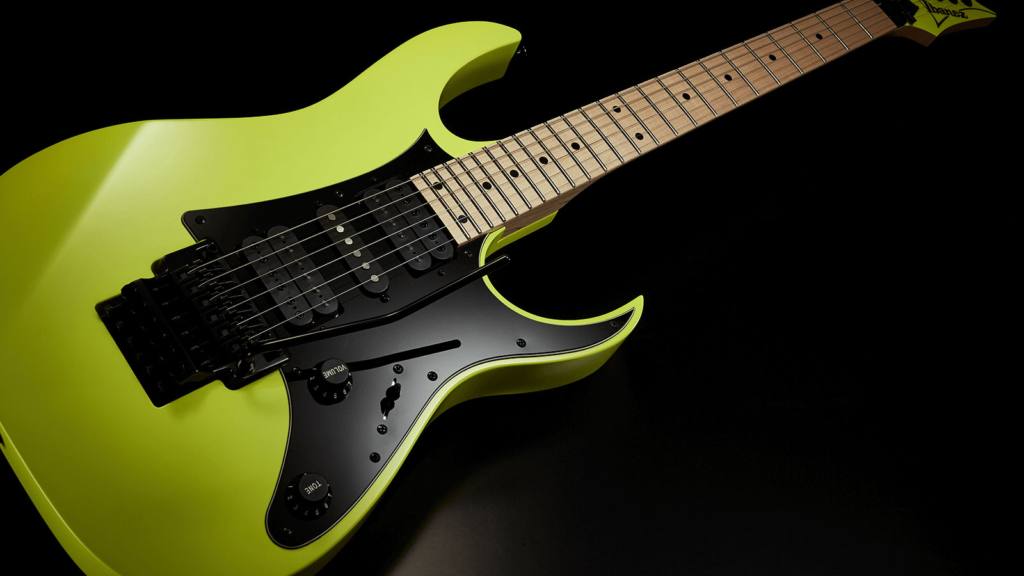
The Ibanez RG series is widely regarded as one of the most influential electric guitar designs of the modern era. Since its introduction in 1987, the RG has become closely associated with fast necks, modern hardware, and high-performance playability. For many guitarists, the RG represents the archetypal superstrat.
Over the decades, the RG family has grown into one of the largest guitar lineups ever produced. Dozens of variations exist today, ranging from entry-level models to high-end Japanese instruments built for professional players. The design has also expanded into extended-range guitars, including seven-, eight-, and even nine-string instruments.
However, the RG did not appear suddenly as a completely new concept. Its design emerged from several overlapping developments in the guitar industry during the late twentieth century. These included Ibanez’s transition away from copy-era guitars, the growing popularity of high-performance superstrat instruments, and the influence of guitarist Steve Vai, whose ideas helped shape the guitar that would eventually become the RG.
This article explores the origins and development of the Ibanez RG series, tracing its roots from the Roadster guitars of the late 1970s to the launch of the RG550 in 1987.
The timeline below highlights key milestones in the development of the Ibanez RG series.
Key Milestones in Ibanez RG History
The development of the Ibanez RG series can be understood through several key milestones in the company’s history.
| Year | Event | Significance |
|---|---|---|
| 1979 | Ibanez Roadster introduced | Early Strat-style platform that later influenced the RG design. |
| 1983 | Roadstar II series released | Refined Strat-style guitars that formed the foundation for later RG models. |
| 1987 | Ibanez JEM introduced | Steve Vai signature model whose performance design directly influenced the RG series. |
| 1987 | Ibanez RG550 introduced | The first RG guitar derived from the JEM platform. |
| 1996 | Prestige and J Custom launched | High-end Japanese RG models introduced. |
| 1998 | RG7620 released | One of the first widely adopted seven-string RG guitars. |
| 2007 | RG2228 released | One of the earliest production eight-string electric guitars. |
| 2014 | Nine-string RG models released | Expansion of the RG platform into extended-range instruments. |
Although the RG series is now one of Ibanez’s most recognizable guitar families, its origins are deeply connected to earlier Ibanez instruments such as the Roadster and Roadstar models of the late 1970s and early 1980s.
Understanding the history of the RG therefore requires looking at how Ibanez transitioned from copy-era guitars to original high-performance designs during the 1980s.
Ibanez Before the RG
The company behind the Ibanez brand is Hoshino Gakki, a musical instrument distributor based in Nagoya, Japan. The company’s origins go back to the early twentieth century, when it initially operated as a bookstore selling sheet music. Over time, the business expanded into selling musical instruments as well.
In the late 1920s, Hoshino began importing classical guitars made by Spanish luthier Salvador Ibáñez. These instruments became popular in Japan, and the company eventually adopted the Ibanez name for its own guitars.
By the 1950s and 1960s, Ibanez had entered the electric guitar market. Production was frequently handled by external manufacturers rather than by Hoshino itself. One of the most important partners in this process was FujiGen Gakki, a factory located in Matsumoto that would later become famous for producing many Ibanez guitars.
During the 1960s and 1970s, Ibanez became widely known for producing instruments that resembled popular American guitars. These guitars often replicated designs associated with Fender and Gibson while offering players a more affordable alternative.
This period is often referred to as the copy era or lawsuit era.
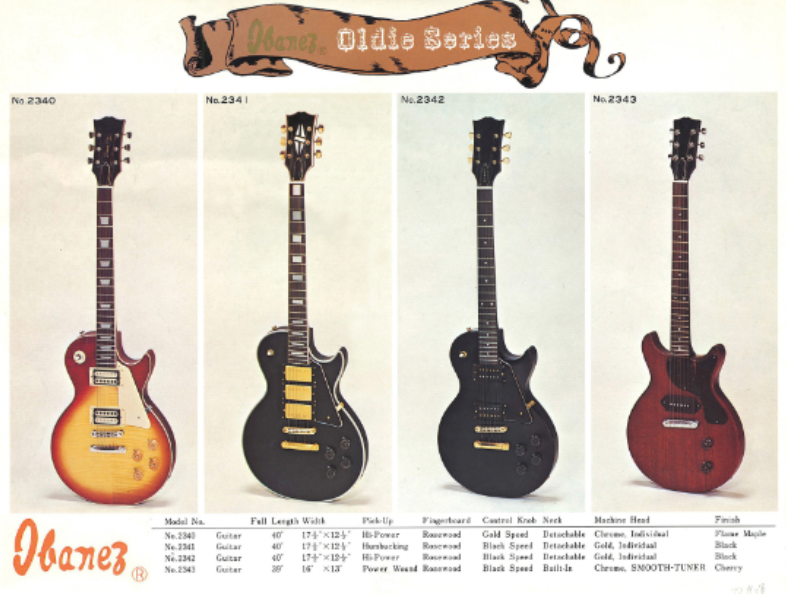
Although these instruments were commercially successful, the strategy created legal and reputational challenges. In the mid-1970s, trademark disputes related to headstock shapes encouraged Ibanez to rethink its approach to guitar design.
Rather than continue producing copies, the company began shifting toward original instruments. This transition led to the development of models such as the Artist series and the Iceman, which helped establish Ibanez as a company capable of designing its own guitars.
Roadster Series: The Pre-RG Era (1979–1986)
Roadster (1979)
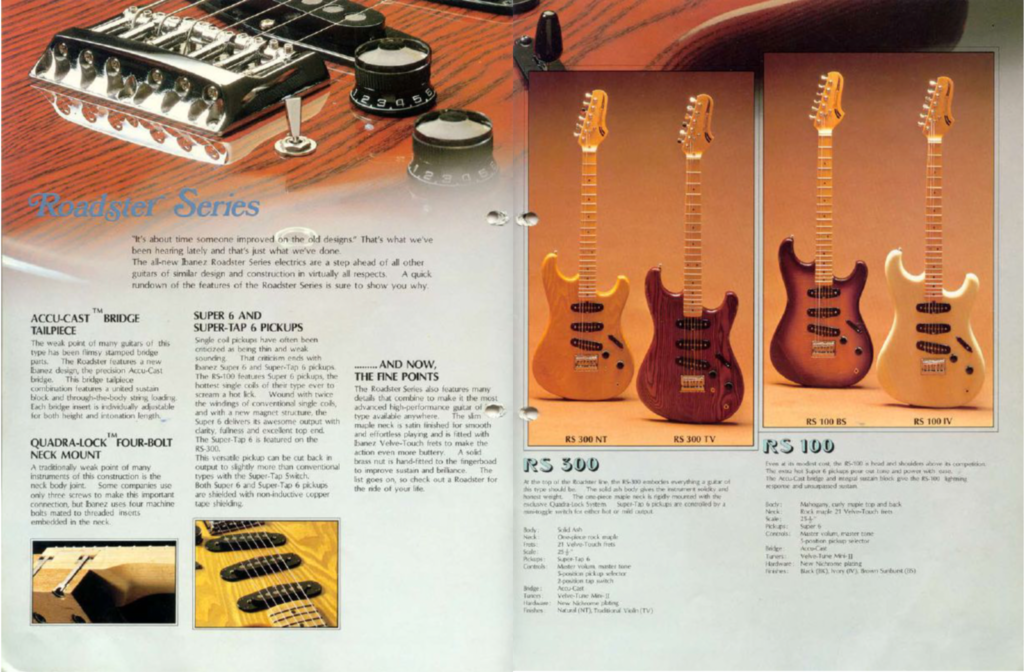
Before the RG series appeared, Ibanez had already begun experimenting with Strat-style guitars under a different name.
In 1979, the company introduced the Ibanez Roadster. This guitar represented one of the first Ibanez instruments designed to resemble the familiar double-cutaway Stratocaster layout while still carrying the Ibanez brand identity.
Typical Roadster specifications included:
- bolt-on neck construction
- three single-coil pickups
- double-cutaway body shape
- six-in-line headstock
The Roadster was significant because it represented Ibanez’s return to a Strat-inspired platform after the earlier copy-era guitars of the 1970s.
Roadstar II (1983–1986)
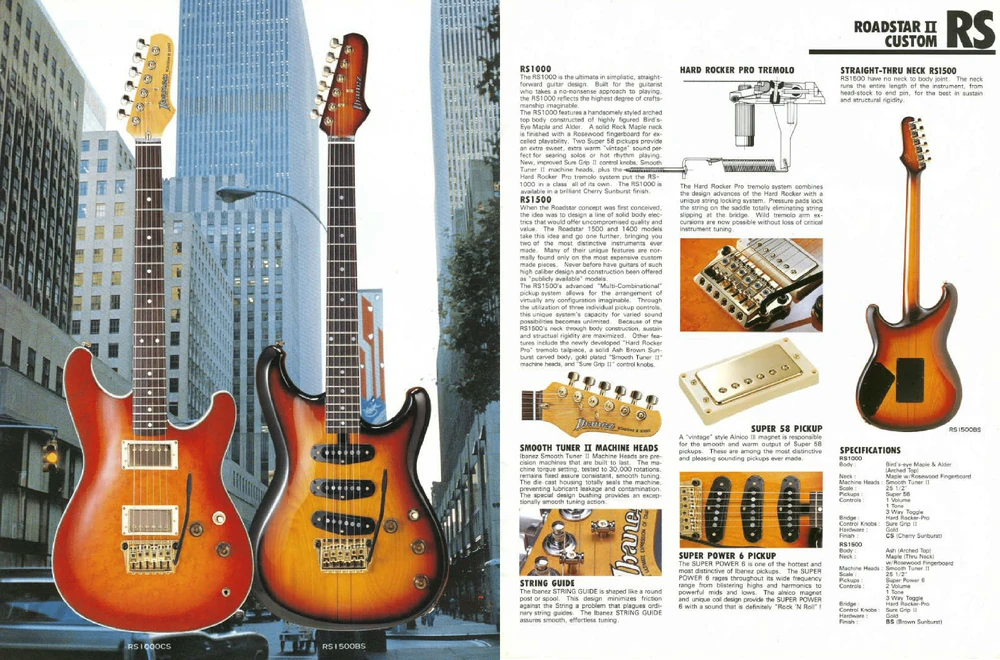
During the early 1980s, the Roadster evolved into the Roadstar II series. These guitars continued to refine the Strat-style concept while introducing additional Ibanez design elements.
Throughout the early 1980s, the Roadstar II series served as Ibanez’s primary platform for modern electric guitars. However, the musical landscape was rapidly changing, and the demands of guitarists were evolving as well.
The Rise of the Superstrat
By the mid-1980s, rock guitar playing had entered a new phase.
A generation of technically advanced guitarists began pushing the limits of electric guitar performance. Players associated with the emerging shred guitar movement demanded instruments that allowed faster playing, wider pitch manipulation, and greater tonal flexibility.
This led to the rise of the superstrat.
Superstrat guitars were essentially heavily modified versions of the Stratocaster concept. They typically included features such as:
- humbucking pickups
- locking tremolo systems
- flatter fingerboards
- thinner neck profiles
- extended fret ranges
Manufacturers such as Kramer, Charvel, and Jackson quickly gained popularity with these instruments.
Ibanez recognized that it needed a guitar capable of competing in this rapidly growing market. At the same time, the company began searching for an artist who could represent the brand within the modern rock guitar scene.
Steve Vai and the JEM: The Direct Path to the RG
Steve Vai’s Design Requirements
At the same time that Ibanez was considering its future direction, guitarist Steve Vai was developing his own ideas about guitar design.
Vai had already established himself as a remarkable guitarist through his work with Frank Zappa. In the mid-1980s he gained even greater visibility through performances with Alcatrazz and later with David Lee Roth.
While touring and recording, Vai began noticing limitations in many traditional guitar designs.
One of the most significant issues involved the number of frets available on most guitars. Many instruments offered only 21 or 22 frets, which limited access to higher notes. Even when higher frets were present, the shape of the guitar body often made them difficult to reach comfortably.
Vai also wanted a pickup configuration that could combine the power of humbuckers with the clarity of single-coil tones.
To achieve this, he experimented with custom guitars that incorporated several features he considered essential:
- 24 frets
- deep cutaways for upper-fret access
- humbucker–single–humbucker pickup layout
- five-way switching
- floating tremolo capable of wide pitch movement
These design ideas would later form the foundation of the guitars developed in collaboration with Ibanez.
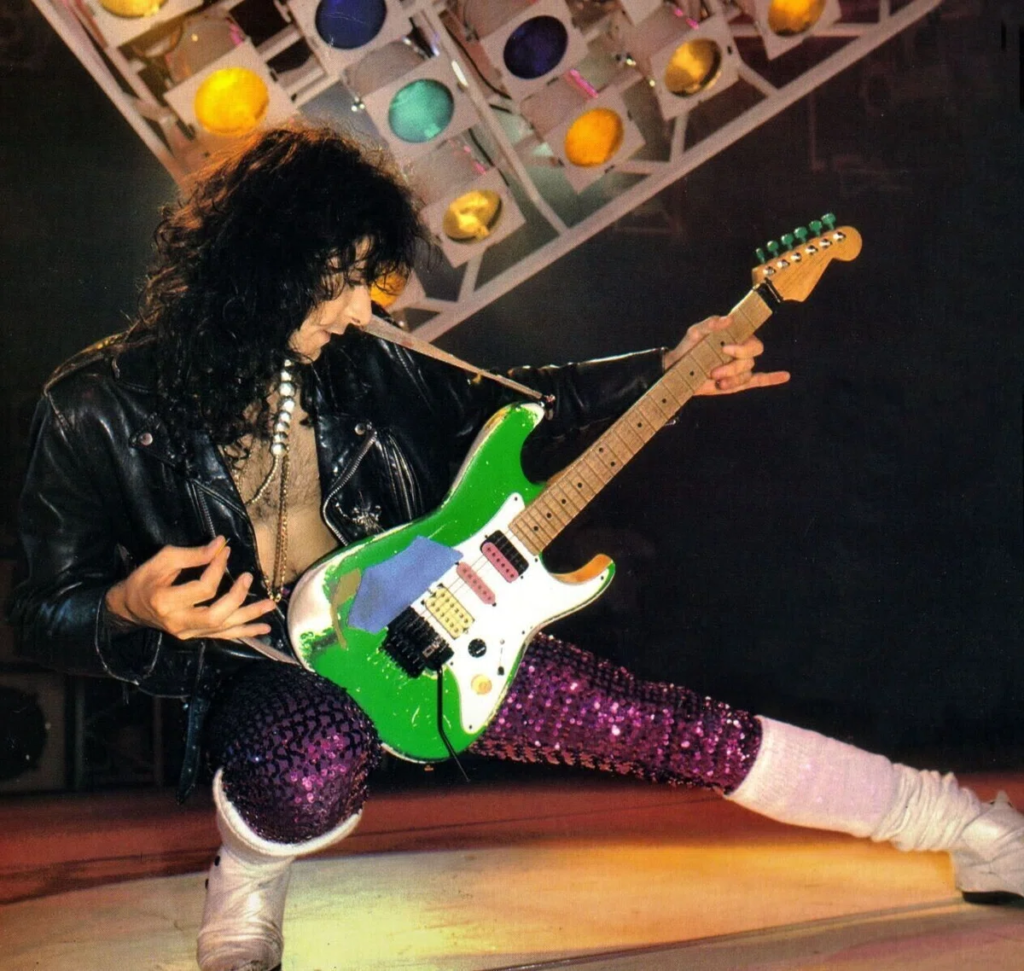
The Ibanez–Steve Vai Collaboration
In the mid-1980s, Ibanez began pursuing a collaboration with Steve Vai.
At that time the company had already worked with several respected musicians, but they were searching for a guitarist who could represent the brand within the modern rock scene. Vai’s rapidly rising profile made him a natural candidate.
Ibanez initiated contact through a series of connections and eventually delivered a guitar prototype to Vai’s family home during the Christmas season of 1986.
The gesture immediately caught his attention.
Vai had previously sent design specifications to several guitar companies, including Yamaha and Kramer. However, many of the guitars he received from those manufacturers were simply modified versions of existing models rather than instruments built specifically to his design ideas.
Ibanez took a different approach.
Working closely with Vai’s notes and sketches, the Ibanez design team developed prototypes that closely matched his specifications. When Vai received the guitars, he reportedly disassembled them to study their construction before reassembling them and approving the design with only minor adjustments.
This collaboration led directly to the creation of one of the most recognizable guitars ever produced.
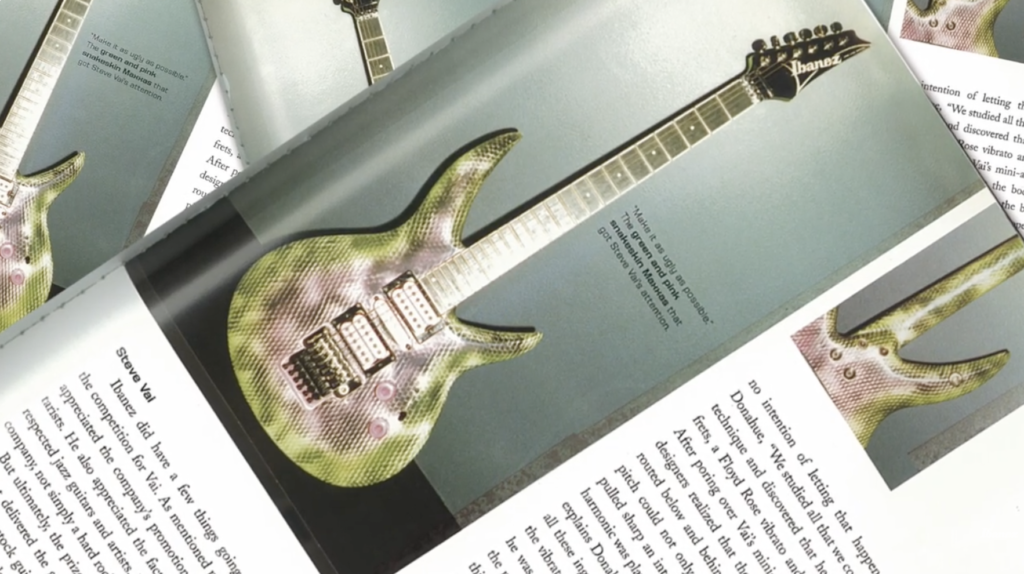
(Source: 30 years of the Ibanez JEM: Steve Vai explains how a Legend was Born)
The Birth of the Ibanez JEM
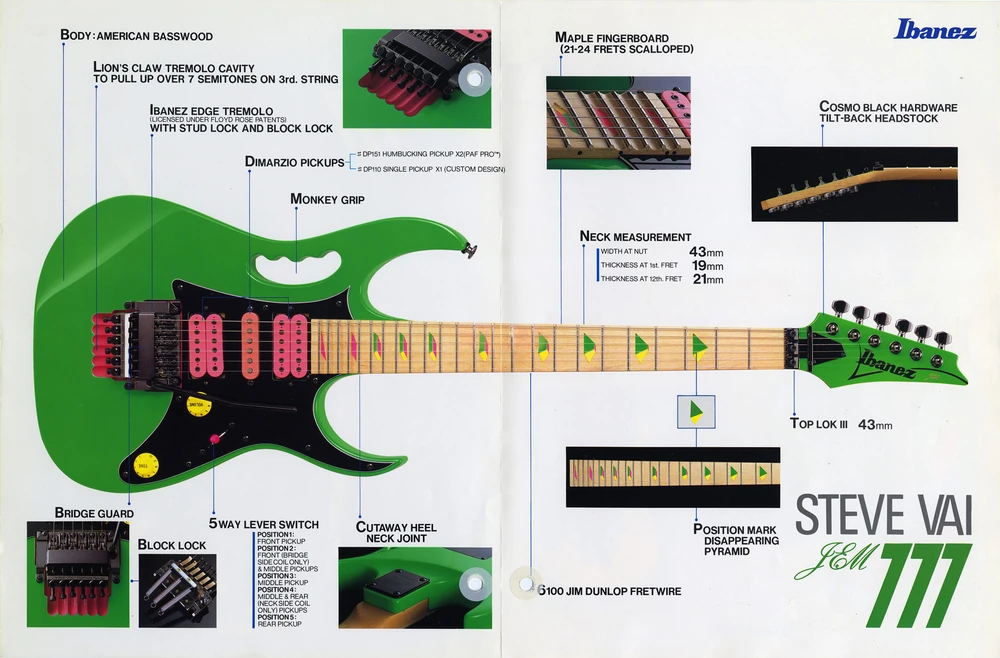
The result of the collaboration between Steve Vai and Ibanez was the Ibanez JEM, introduced in 1987.
The JEM incorporated several design features that were unusual at the time.
These included:
- basswood body
- 24 frets
- HSH pickup configuration
- scalloped upper frets
- deep double cutaways
- floating tremolo system
The guitar also featured distinctive visual elements that made it instantly recognizable.
One of the most famous was the Monkey Grip, a handle-shaped cutout in the body. Another was the Lion’s Claw, a routed cavity behind the tremolo bridge designed to allow greater upward pitch movement.
The first production run consisted of 777 guitars, released in bright fluorescent finishes such as Loch Ness Green, Desert Sun Yellow, and Shocking Pink.
These instruments quickly sold out.
Although the JEM was designed as Steve Vai’s signature model, the guitar also demonstrated the potential for a broader line of guitars built around the same performance-oriented design philosophy.
The Launch of the Ibanez RG550 and the Birth of the RG Series (1987)
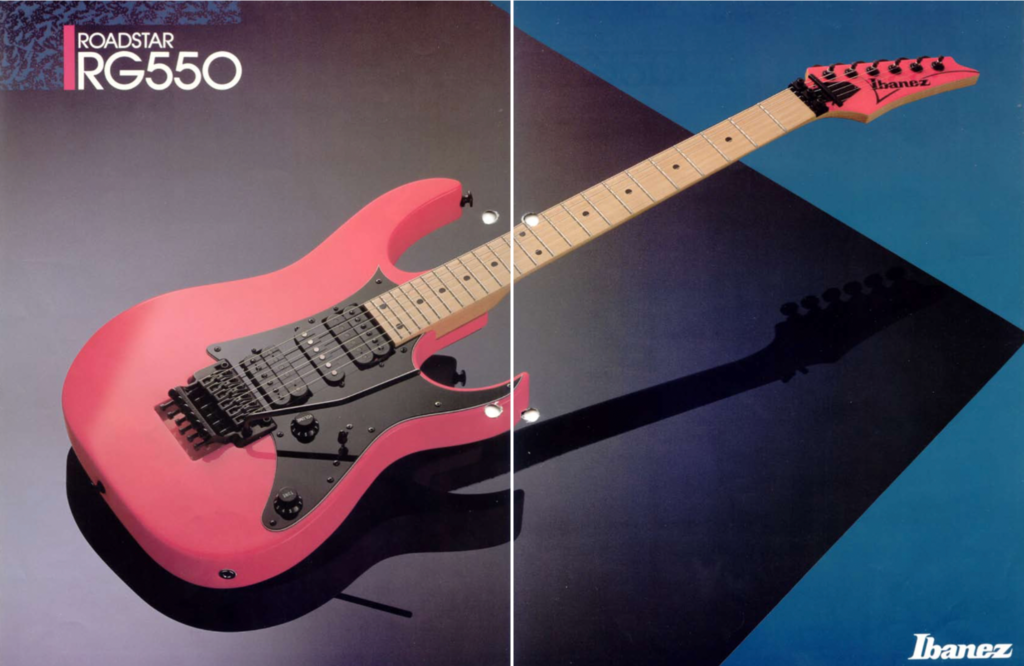
In the same year that the JEM appeared, Ibanez introduced a new production guitar that would become even more influential.
This guitar was the RG550.
The RG550 was essentially a simplified version of the JEM. While it removed several signature visual features, it preserved many of the performance elements that made the JEM so playable.
For example, the RG550 did not include:
- the Monkey Grip handle
- the Lion’s Claw tremolo cavity
- custom DiMarzio pickups
However, the RG550 retained the most important design characteristics:
- the aggressive superstrat body shape
- 24 frets
- humbucker-based pickup configuration
- floating tremolo bridge
The guitar was initially marketed as part of the Roadstar series, which explains the origin of the RG name.
RG originally stood for “Roadstar Guitar.”
Within a few years, the Roadstar name disappeared and the guitars became known simply as Ibanez RG models.
The introduction of the RG550 marked the beginning of a guitar platform that would eventually become one of the most prolific designs in electric guitar history.
Early Ibanez RG Models
| Model | Year | Main Features |
|---|---|---|
| RG550 | 1987 | 24 frets, Edge tremolo, HSH pickup configuration |
| RG570 | 1987 | Same platform as RG550 but without a pickguard |
| RG750 | Late 1980s | Higher-end RG model with upgraded pickups |
| RG770 | Late 1980s | Deluxe RG model with decorative inlays |
The Ibanez RG Design Philosophy
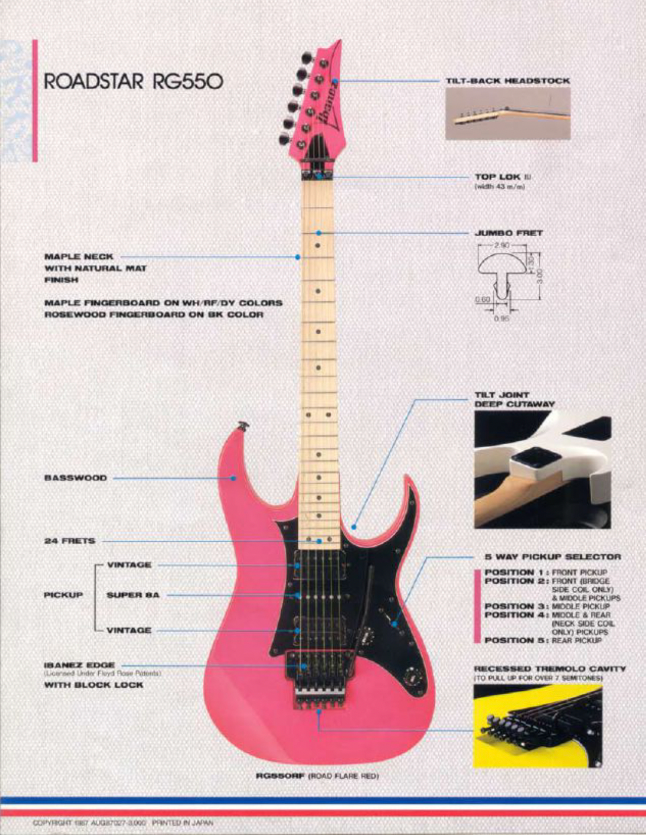
After the introduction of the RG550 in 1987, the RG series quickly established itself as a guitar designed around performance rather than tradition. While many electric guitars were based on designs created in the 1950s, the RG was clearly built for the playing styles that were emerging in the late 1980s.
The guitar retained the general outline of a Strat-style body but introduced several changes that made it distinct. The RG body features sharper horns, thinner edges, and deeper cutaways, creating a more aggressive silhouette while improving access to the upper frets. Because of these characteristics, the RG is often described as a superstrat, meaning a high-performance evolution of the classic Stratocaster concept.
Another defining element of the RG design was the neck. Many RG models featured extremely thin neck profiles combined with flat fingerboards and 24 frets. This design allowed players to perform wide bends, fast scale runs, and complex lead passages with minimal resistance.
These features made the RG especially attractive to guitarists involved in the shred, speed metal, and thrash metal movements that were gaining popularity during the late 1980s. The combination of fast necks, modern electronics, and a reliable tremolo system helped position the RG as one of the most versatile rock guitars available.
If you want to understand the differences between these two iconic Ibanez guitars, see our full comparison: Ibanez RG vs JEM.
The Wizard Neck
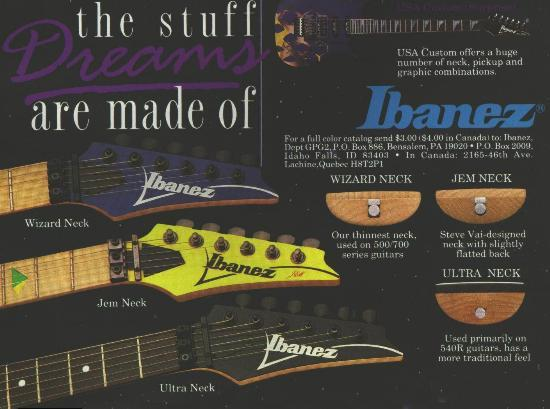
One of the most famous aspects of the RG series is the Wizard neck profile.
Ibanez designed the Wizard neck to be extremely thin compared with traditional electric guitar necks. The goal was to reduce hand fatigue and allow players to move across the fretboard quickly.
Typical Wizard neck characteristics include:
- very thin cross-section
- flat fingerboard radius
- wide fretboard
- 24 frets
Many players associate these characteristics with modern guitar techniques such as legato runs, sweep picking, and fast alternate picking.
Over time, Ibanez developed several variations of the Wizard neck, including:
- Wizard
- Super Wizard
- Wizard II
- Wizard III
Each version slightly adjusted the dimensions or construction methods. For example, modern Prestige models often use multi-piece neck construction, combining maple with walnut or wenge strips to improve stability.
The Wizard neck quickly became one of the defining features of the RG series and remains strongly associated with the Ibanez brand today.
Expansion of the IbanezRG Series
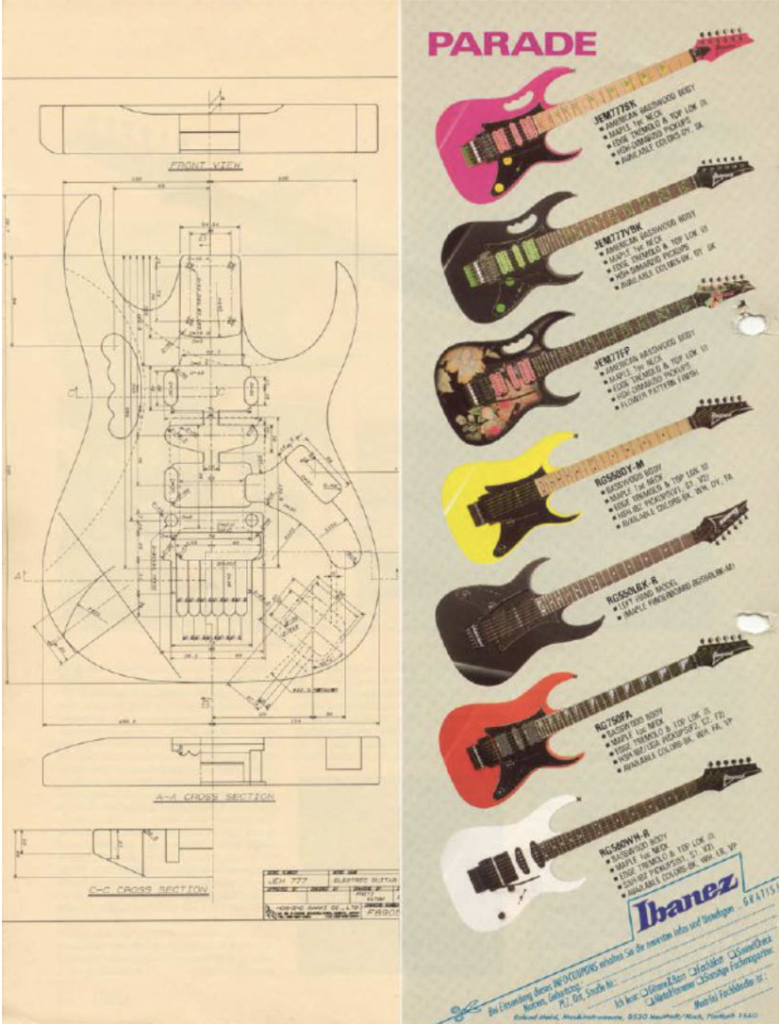
After the success of the original RG models, Ibanez rapidly expanded the lineup.
Early RG guitars were divided into several tiers. The RG500 series represented the standard models, while the RG700 series offered more upscale specifications.
Examples of early RG models included:
- RG550
- RG570
- RG750
- RG770
The RG550 and RG570 were closely related. The RG570 used the same platform as the RG550 but lacked a pickguard, giving it a cleaner appearance. Higher-end models such as the RG770 included upgraded features such as decorative inlays, bound fingerboards, and American-made pickups.
The expansion of the RG lineup allowed Ibanez to serve a wide range of players. While the overall design philosophy remained consistent, different models offered variations in pickups, finishes, and hardware.
Major RG Series Variants
Although RG models vary widely, many Ibanez RG guitars share a set of common design traits and specifications.
| Series | Main Feature | Introduced |
|---|---|---|
| RG | Standard superstrat design | 1987 |
| RGA | Arched top RG body | 2005 |
| RGT | Neck-through construction | 1990s |
| RGD | Longer scale for down tuning | 2010 |
| GRG (GIO) | Entry-level RG models | 2000s |
Budget Models and Global Production
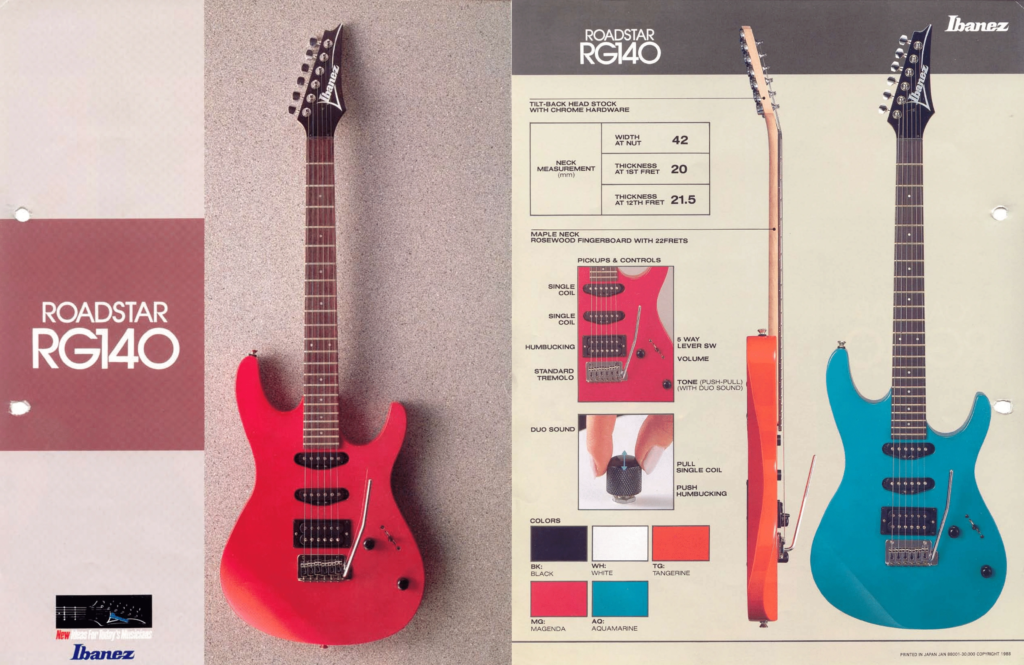
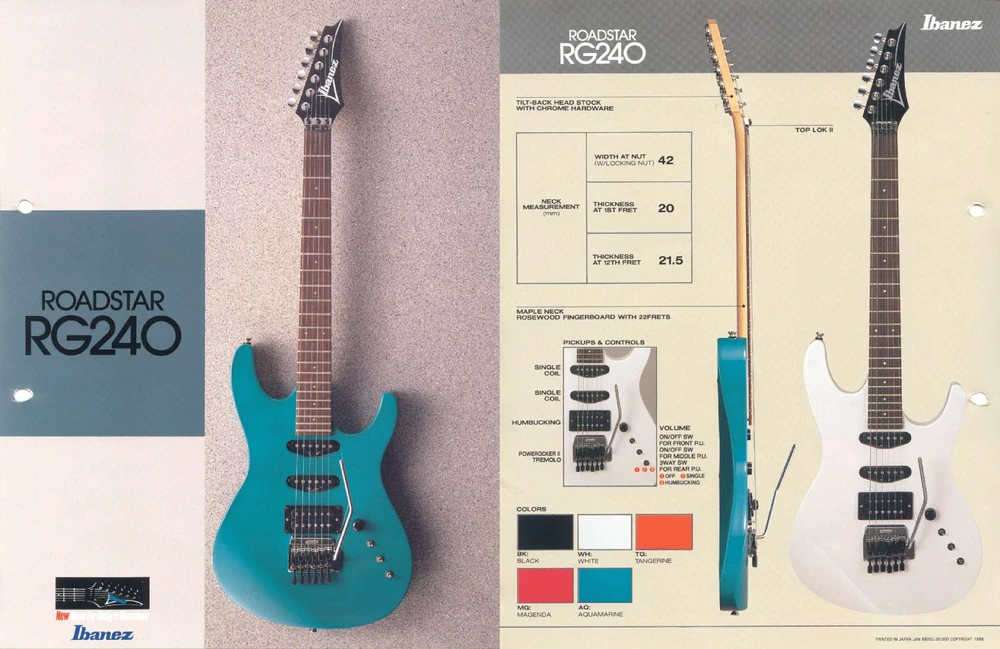
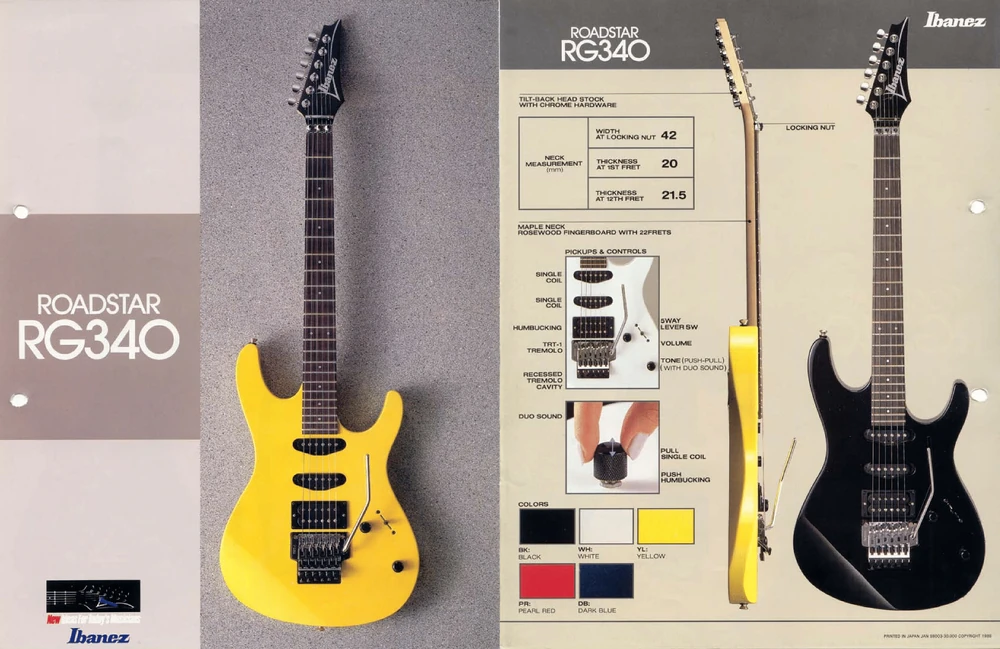
As the popularity of the RG series increased, Ibanez began introducing more affordable versions of the guitar.
In 1988, the company released several lower-priced models manufactured outside Japan. These included the RG140 series, RG300 series, and the EX series.
These guitars used the same general body shape as the original RG models but featured more economical components, such as simplified tremolo systems and less expensive pickups.
The EX series was particularly interesting because it used the RG body shape but avoided the RG name. Ibanez reportedly chose this strategy to protect the reputation of the RG line while still offering affordable instruments.
Later, these models evolved into the RX series and eventually into the entry-level GIO series, where RG-style guitars were labeled GRG models.
This strategy allowed Ibanez to offer the RG design at nearly every price level.
New Variants of the RG Platform
As the RG platform matured, Ibanez began developing several related guitar lines based on the RG concept.
One example is the RGT series, which features a neck-through construction. In this design, the neck runs through the entire body of the guitar, with body wings attached to the sides. Neck-through construction is often associated with improved sustain and resonance.
Another variation is the RGA series, which introduced an arched top body rather than the flat top found on standard RG guitars. This design created a slightly different aesthetic while retaining the overall RG silhouette.
Ibanez also introduced the RGD series, which uses a longer scale length. The longer scale helps maintain string tension when guitars are tuned down, making the series especially popular with modern metal players.
These variations allowed Ibanez to adapt the RG design to many different musical styles while preserving its core characteristics.
For a detailed explanation of Ibanez RG models, see this guide.
Prestige and J Custom
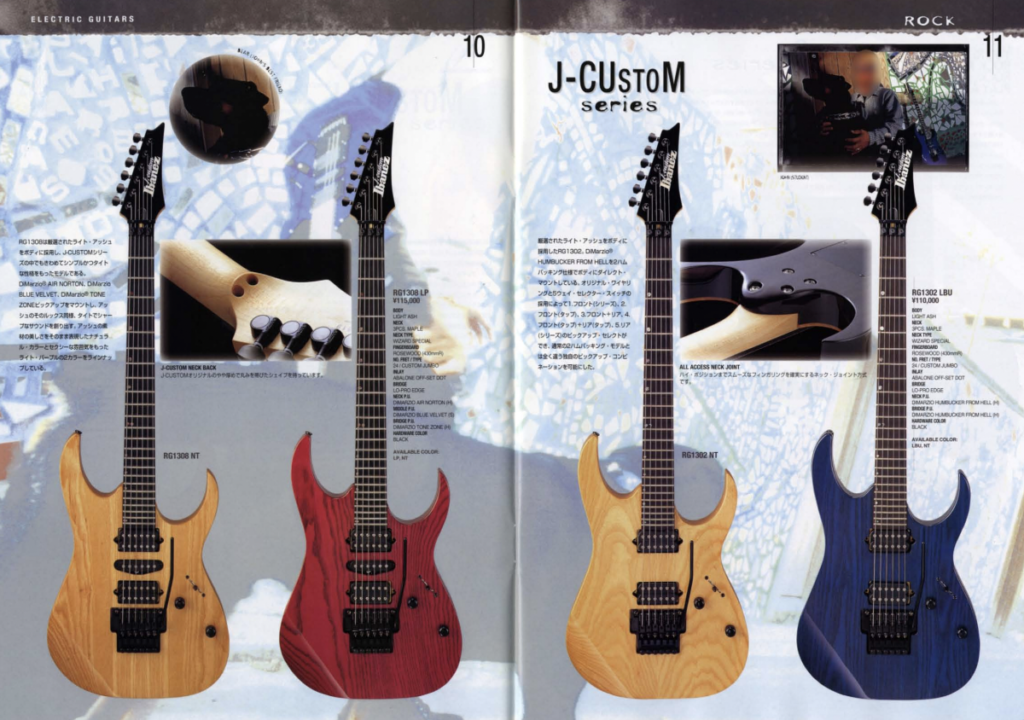
By the mid-1990s, Ibanez began introducing higher-end versions of the RG series.
Two of the most important lines were Prestige and J Custom, both introduced in 1996.
The Prestige series represents high-quality Japanese-made guitars built primarily at the FujiGen factory. These instruments typically feature upgraded materials, improved electronics, and more refined construction.
Typical Prestige features include:
- multi-piece neck construction
- improved hardware
- premium electronics
- enhanced finishing
The J Custom series, on the other hand, represents the most exclusive RG instruments. These guitars are often produced in limited quantities and feature elaborate finishes, premium tonewoods, and decorative inlays.
Many J Custom models are primarily sold in the Japanese domestic market, although some have appeared internationally.
These two product lines helped establish a clear hierarchy within the RG family, ranging from entry-level guitars to boutique-quality instruments.
Extended Range RG Guitars
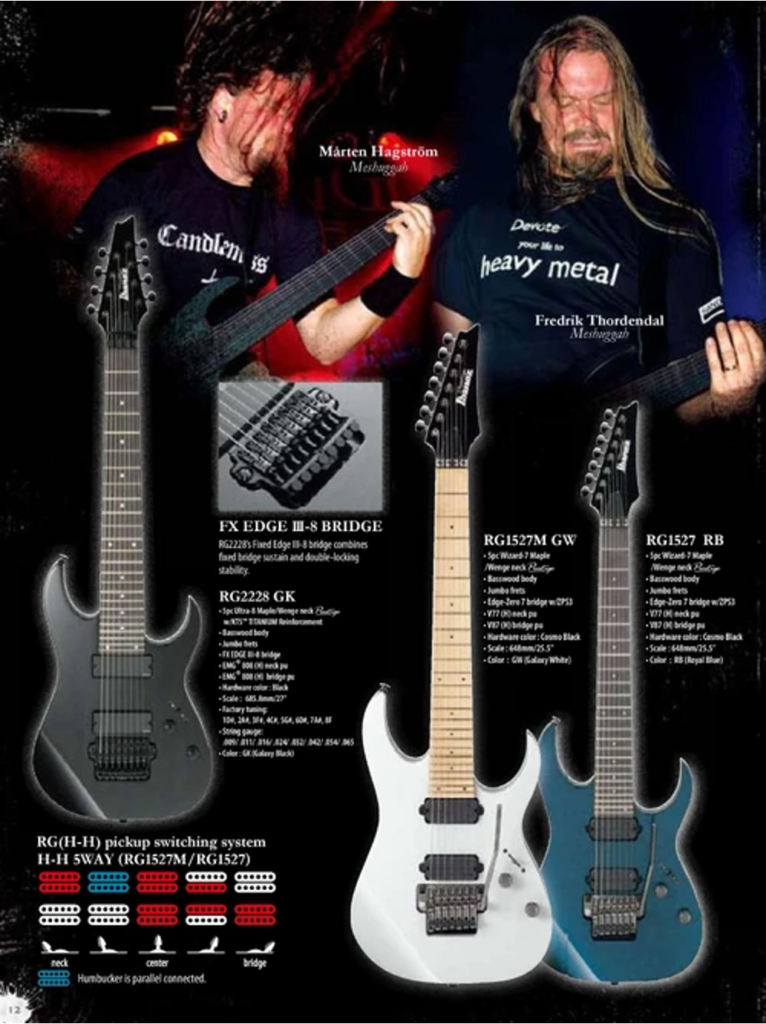
Another major milestone in the evolution of the RG series was the development of extended-range guitars.
In 1998, Ibanez released the RG7620 and RG7621, two seven-string guitars that quickly gained popularity among metal players.
Seven-string guitars allowed musicians to access lower notes without changing tuning systems, making them especially useful for heavy music styles.
Ibanez later pushed the concept even further.
In 2007, the company introduced the RG2228, one of the first commercially available eight-string electric guitars. This instrument expanded the range of the guitar even further and helped inspire a new generation of progressive metal and djent musicians.
The company later released nine-string models, including the RG9QM and RG90BKP, demonstrating how far the RG concept could be extended.
These instruments reinforced the RG’s reputation as a platform for innovation in modern guitar design.
Materials and Construction
Although the RG series has evolved over decades, several design characteristics have remained common.
One of the most widely used body woods for RG guitars is basswood. This wood became common in RG guitars beginning with the early models. Basswood is relatively lightweight and produces a balanced tonal response, making it suitable for high-gain electric guitar tones.
Other body woods used in RG guitars include:
- mahogany
- ash
- alder
- poplar
Many RG models also feature decorative tops made from figured maple, such as flamed maple or quilted maple.
Necks are typically constructed from maple, while fretboards are often made from rosewood, maple, or occasionally ebony.
These materials allow the RG series to maintain a balance between playability, tone, and durability.
Typical Ibanez RG Specifications
Although RG models vary widely, many Ibanez RG guitars share a set of common design traits and specifications.
| Feature | Typical Specification |
|---|---|
| Body shape | Superstrat double cutaway |
| Frets | 24 frets |
| Neck profile | Wizard thin neck |
| Body wood | Basswood, mahogany, ash |
| Fingerboard | Rosewood, maple, ebony |
| Pickup configuration | HSH / HH / HSS |
| Tremolo | Edge / Lo-Pro Edge / Edge Pro |
Hardware and Electronics
Hardware has also played an important role in the RG’s identity.
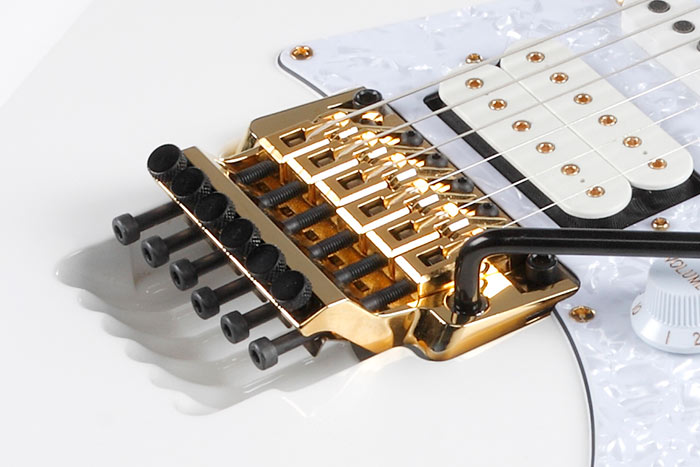
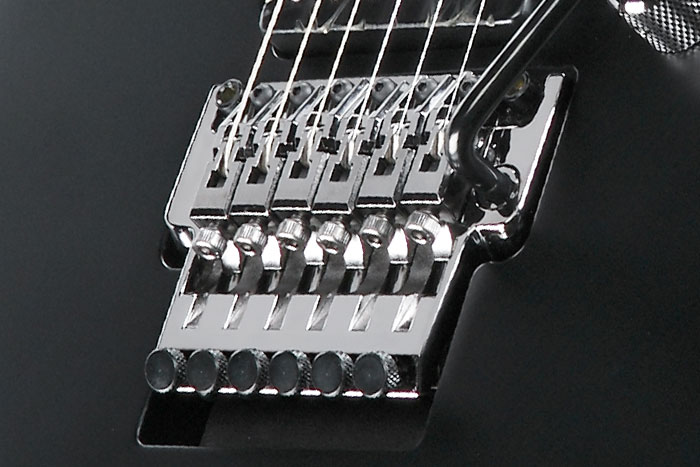
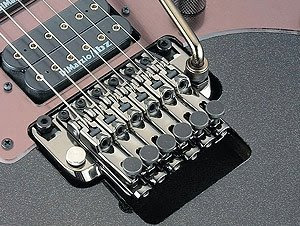
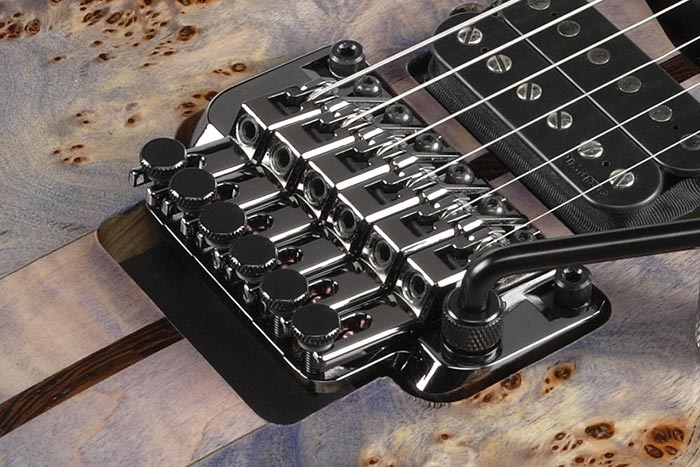
Many RG models feature floating tremolo systems derived from the Floyd Rose design. Ibanez developed its own versions of this bridge, including:
- Edge
- Lo-Pro Edge
- Edge Pro
- Edge Zero
These systems allow players to perform dramatic pitch bends while maintaining tuning stability.
RG pickup configurations typically include humbuckers and single coils in various arrangements. One of the most common layouts is HSH, meaning humbucker–single–humbucker.
Other configurations include:
- HH
- HSS
- SH
Ibanez has used both its own pickups and models produced by companies such as DiMarzio, Seymour Duncan, and EMG.
This flexibility allows the RG platform to accommodate many tonal styles.
The Ibanez RG as a Modern Guitar Platform
Over the decades, the RG series has become one of the most prolific electric guitar designs ever created.
Since the original RG550 appeared in 1987, Ibanez has produced hundreds of RG models across multiple product tiers and manufacturing locations.
The guitar’s popularity comes from a combination of factors:
- modern ergonomics
- fast neck profiles
- flexible pickup configurations
- advanced tremolo systems
Because of these characteristics, the RG became closely associated with genres such as:
- shred guitar
- thrash metal
- progressive metal
- modern rock
At the same time, the design has proven adaptable enough for many other musical styles.
Why the Ibanez RG Became One of the Most Influential Superstrats
The Ibanez RG became one of the most influential superstrat designs because it combined modern playability with mass production accessibility.
While many high-performance guitars of the 1980s were expensive boutique instruments, the RG550 offered similar features in a widely available production model. Its 24-fret neck, aggressive body shape, and floating tremolo system made it ideal for the technical guitar styles that were emerging during the late 1980s.
As shred guitar, thrash metal, and progressive metal grew in popularity, the RG platform provided a reliable instrument that could support fast playing, extended techniques, and heavy tones. Over time, Ibanez expanded the concept into multiple product tiers, ranging from affordable models to high-end Japanese instruments such as the Prestige and J Custom lines.
Because of this flexibility, the RG evolved from a single model into one of the most enduring electric guitar platforms in modern music.
Conclusion
The Ibanez RG series began as a derivative of Steve Vai’s JEM guitar but quickly developed into a platform of its own.
From its origins in the Roadstar guitars of the late 1970s to the release of the RG550 in 1987, the RG was shaped by both technological developments and the changing needs of guitarists.
Over time, the series expanded into a vast lineup that includes everything from beginner guitars to high-end Japanese instruments, as well as extended-range models that pushed the boundaries of electric guitar design.
Today, the RG remains one of the most recognizable and widely used modern electric guitars.
More than three decades after its introduction, the RG continues to evolve while maintaining the performance-oriented philosophy that defined the original instrument.
Why Watch This Video: To truly understand the RG’s legacy, seeing it in action is essential. This official documentary provides rare archival footage and firsthand insights from the designers at Hoshino Gakki, perfectly complementing the historical milestones detailed in this article.
FAQ
When was the first Ibanez RG released?
The first Ibanez RG model, the RG550, was introduced in 1987. It launched alongside Steve Vai’s Ibanez JEM and helped define the modern Ibanez “superstrat” platform.
What does “RG” stand for in Ibanez RG guitars?
RG originally stood for “Roadstar Guitar.” Early RG models were tied to the Roadstar/Roadstar II lineage before the “RG” name became the primary series name in the early 1990s.
How is the Ibanez RG related to the Ibanez JEM?
The RG550 was developed as a production-friendly derivative of the JEM concept. It kept key performance traits like the fast neck feel, 24 frets, and floating tremolo design approach, while leaving out some of the JEM’s signature visual features.
Why are Ibanez RG guitars considered “superstrats”?
RG guitars follow the superstrat idea: a Strat-style double-cut body refined for performance, typically with deeper cutaways, 24 frets, humbucker-based pickup layouts, and a tremolo system suited to modern rock and metal playing.
What are the most common Ibanez RG features?
Many RG models share three core traits: an aggressive double-cut body with strong upper-fret access, a thin and fast neck profile often associated with Wizard-style designs, and modern hardware such as double-locking tremolo systems (though hardtail models also exist).
When did 7-string and 8-string RG models become important?
RG-based extended-range models became especially notable from the late 1990s onward with widely adopted 7-string RG models. The platform later expanded into 8-string production models in the 2000s, reinforcing the RG as a foundation for modern heavy styles.
More Ibanez Articles

Ibanez RG vs JEM: Key Differences Explained
Ibanez RG Series Guide: Models, Lineup & Product Lines
Ibanez RG History: Origins, Evolution, and Modern RG Models
Ibanez IC420MFM Announced
Ibanez EHB600 / EHB605 Announced
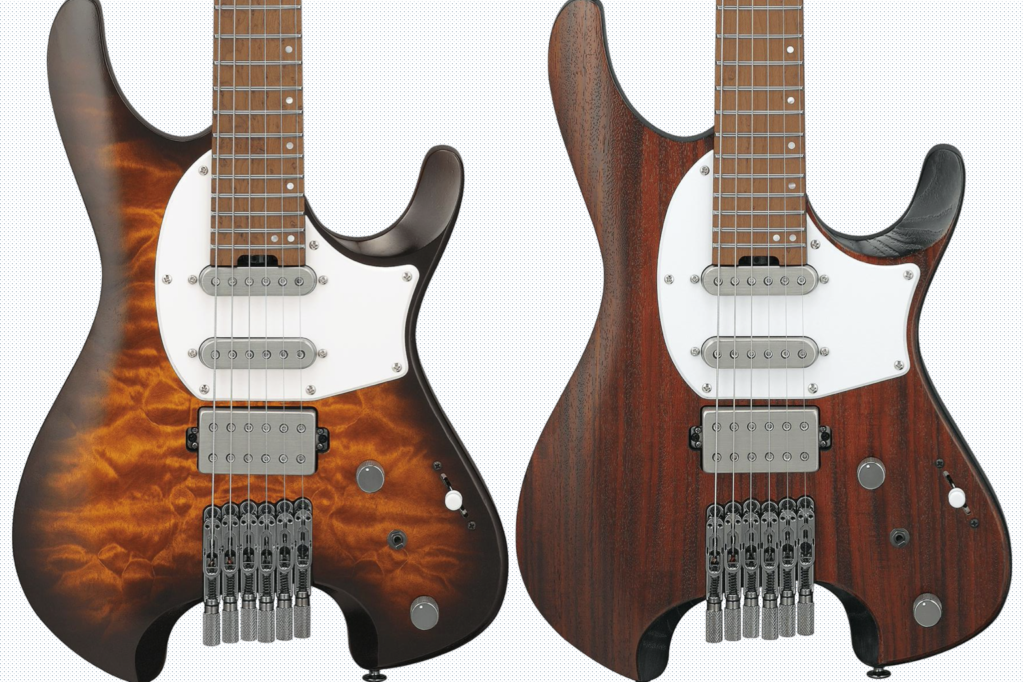
Ibanez Q54WQM-DEL & Q54WR-CNL – Figured Wood Q Series