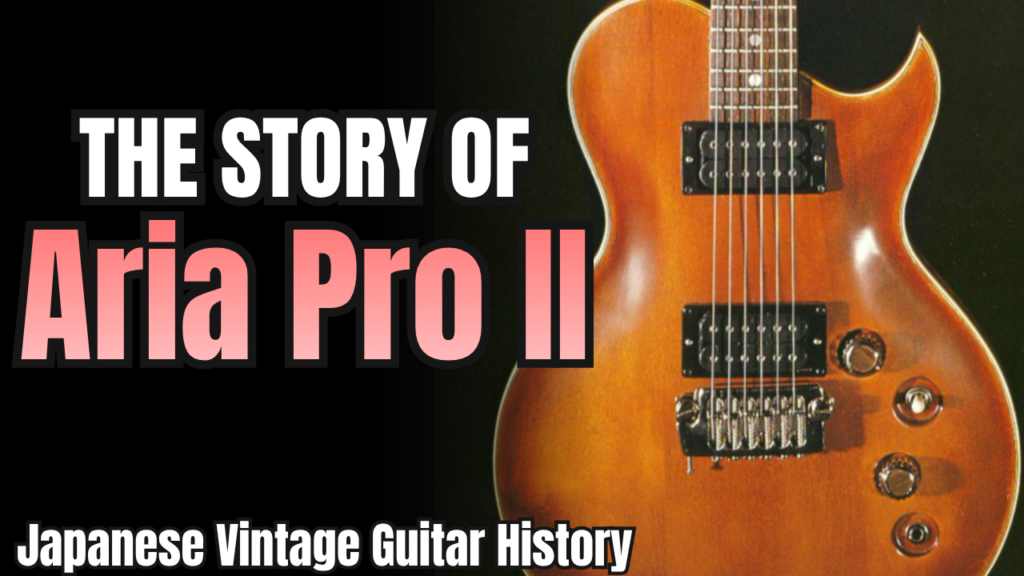
Aria Pro II is a Japanese guitar brand that grew from the Nagoya trading company Arai & Co. and, in the copy-dominated 1970s, broke away to build original instruments at the legendary Matsumoku factory, earning a place in the hands of world-class players like Cliff Burton and Yngwie Malmsteen.
Aria Pro II Quick Facts
- Brand launched: Aria Pro II name introduced in 1975
- Where it came from: Parent company Arai & Co., founded in Nagoya in 1955
- Built by: The Matsumoku factory, Nagano (until 1987)
- Signature models: PE-1500, PE-R80, RS-850, TS-800, SB-1000
- Notable players: Cliff Burton, Yngwie Malmsteen, Neal Schon, John Taylor
Prefer to watch? This article is based on my own video below.
The Birth of the Brand: From Importer to Guitar Maker
The story of Aria Pro II doesn’t begin with a guitar maker. It begins with one young man who loved the guitar. The founder, Shiro Arai, was a devoted classical guitarist who at one point aimed to turn professional. He gave up that dream, but not his passion, and around 1954 he began importing sheet music and classical guitars from overseas for his own use.
Shiro Arai and the First Imports
In 1950s Japan, most music shops stocked no guitars, no sheet music, not even strings. The instruments and accessories Arai brought in were exactly what his fellow players wanted. He was, in fact, the first person to import Augustine nylon strings into Japan, a brand still used by guitarists worldwide. As requests poured in from around the country, he answered them by founding Arai & Co. in Nagoya in 1955. Fittingly for a classical player, the company started with classical guitars, sheet music, and instructional books.
A Relentless Focus on Quality
Exports began in 1959, and with them came a wall. Japanese guitars shipped to America often arrived damaged, the dry climate cracking wood that had never been properly dried. Determined to fix it, Arai went from maker to maker in Nagoya preaching the importance of drying the timber. He even carried Japanese classical guitars to America himself to study how they cracked over two or three weeks, then fed the findings back to manufacturers. That patient obsession with quality became the foundation of the Aria brand, whose own classical guitars appeared around this same period.
Where the Name “Aria” Comes From
The name is an anagram of the founder’s surname, Arai. Swap the “i” and the “a” and you get Aria, a word that also happens to be a musical term for a solo song. A brand name that works as both the founder’s name and a piece of musical vocabulary is a genuinely rare thing.
Meeting Matsumoku
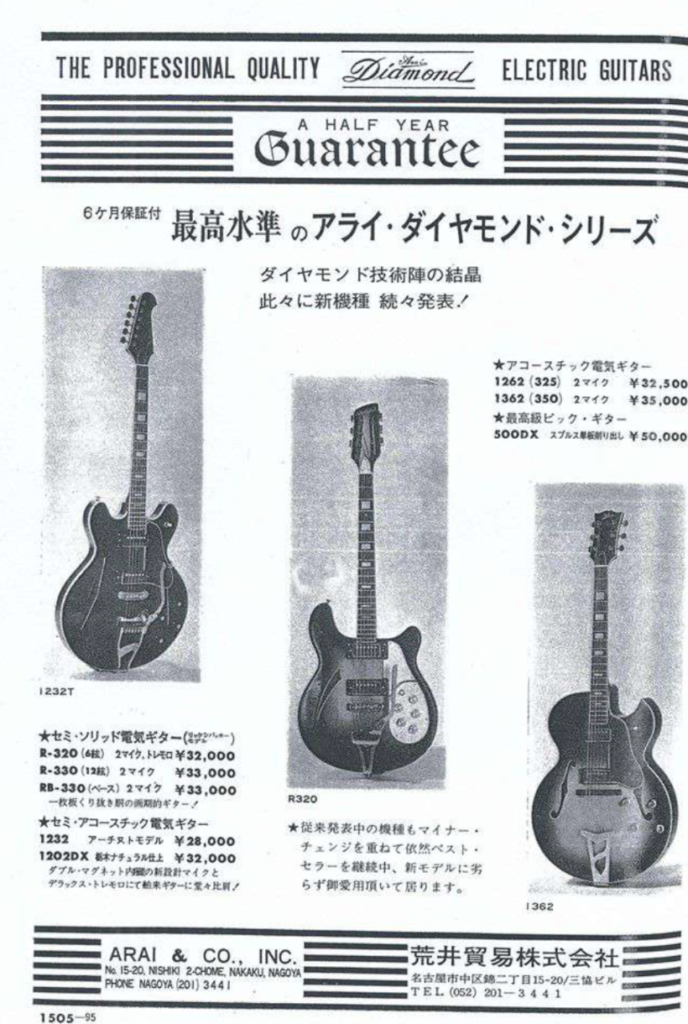
As the 1960s began, Arai moved into selling Japanese-made instruments domestically, just as the country’s first electric guitar boom hit and demand for solid guitars from makers like Guyatone and Teisco exploded. Sensing the next wave would be the semi-acoustic, Arai steered toward building them, and partnered with the Matsumoku company in Matsumoto City, Nagano. Matsumoku was then a subcontractor for FujiGen but wanted to build its own guitars. Arai’s wish and Matsumoku’s ambition lined up perfectly, and the first original electric was developed. Its name: Aria Diamond.
The “Arai Diamond” Trademark Detour
For a few years from around 1967, Aria Diamond was actually sold as “Arai Diamond.” The reason was a trademark: Kawai, the piano maker, already held the “Aria” name for a keyboard. Only after acquiring that trademark from Kawai could the brand call itself Aria again. Without that episode, this brand might still be “Arai” to this day.
Breaking Away from Copies
In 1968, Arai saw Gibson’s reissued Les Paul at an American guitar show and was struck by it. He tried building a Les Paul style guitar in Japan, but rather than a straight copy, he fitted an original blade-pole-piece pickup. It didn’t sell at all. Around 1969, Japan barely had proper copies yet, let alone originals with a twist. But as the 1970s brought a flood of domestic copies and the resulting patent problems, Aria, then counted among the big three Japanese brands alongside Greco and Fernandes, formed a firm conviction: break away from copies and pursue originals.
“Aria Pro II” Is Born
The turning point came in the mid 1970s. In 1975, to separate their electrics from their acoustics and to build more refined, pro-oriented instruments, they added “Pro,” for professional. They added “II” to signal guitar-making one step beyond the Aria era. And so Aria Pro II was born, its name carrying a quiet declaration: one step further than Aria. By the late 1970s, with Matsumoku building them, the lineup shifted toward originals like the PE guitars and SB basses, and these instruments were praised not just in Japan but worldwide. The company that began with one man’s love of a classical guitar had become a brand showing the world what a Made-in-Japan original could be.
The Masterpieces of the Japan Vintage Era
The models from the late 1970s into the 80s come from the era when Matsumoku did the building. Alongside FujiGen, Matsumoku was a pillar of Japanese guitar manufacturing, and the copies and originals it made are today prized as “Japan Vintage,” commanding high prices in good condition among collectors in Japan and abroad.
PE-1500: The Original That Started It All
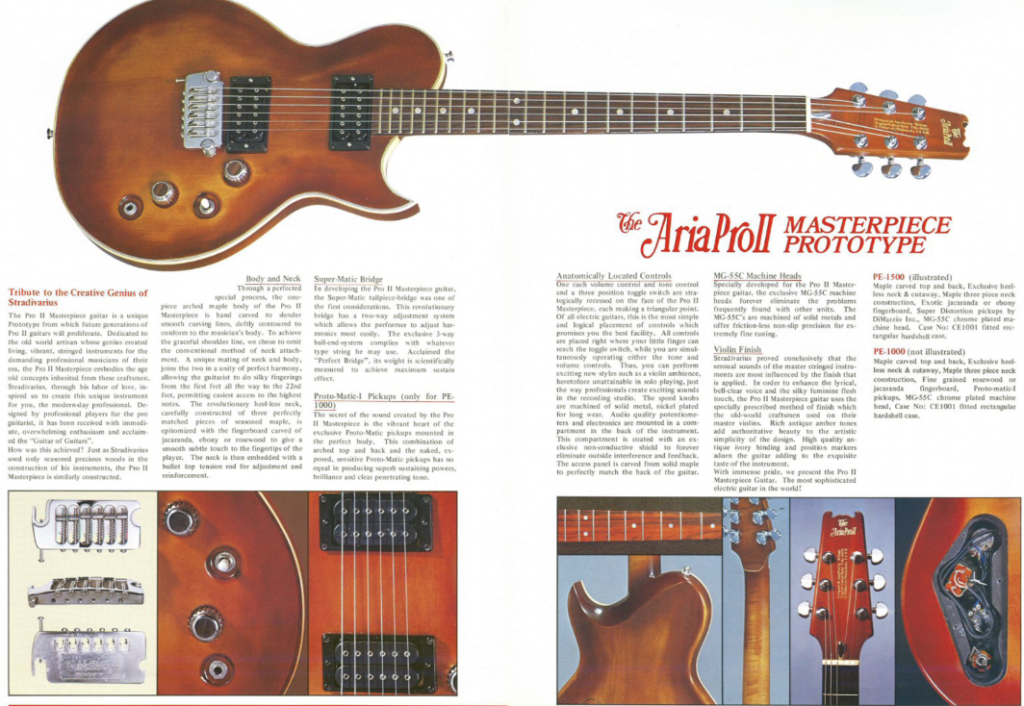
The one model you cannot skip is the PE-1500, the guitar that launched the entire PE series. Developed by Nobuaki Hayashi, a Matsumoku employee who later founded his own brand Atlansia, it was unveiled in 1976. Les Paul-like in shape but with a maple body, it featured a carved top and back, an unusual heel-less neck joint, and an original Super-matic bridge. The headstock read “Designed and Approved by H. Noble,” putting the designer’s name front and center, almost unheard of for a Japanese guitar. Some examples even had lacquer finishes, feeling less like guitars than works of traditional Japanese craft.
The carved top and heel-less cutaway became shared PE traits, giving a Les Paul style instrument astonishing upper-fret access, perfect for technical, lead-heavy rock. When the PE-1500 reached America the following year it sold for around 850 dollars, striking when you consider a Les Paul Custom went for about 800 dollars at the time.
The PE-R Series and PE-R80
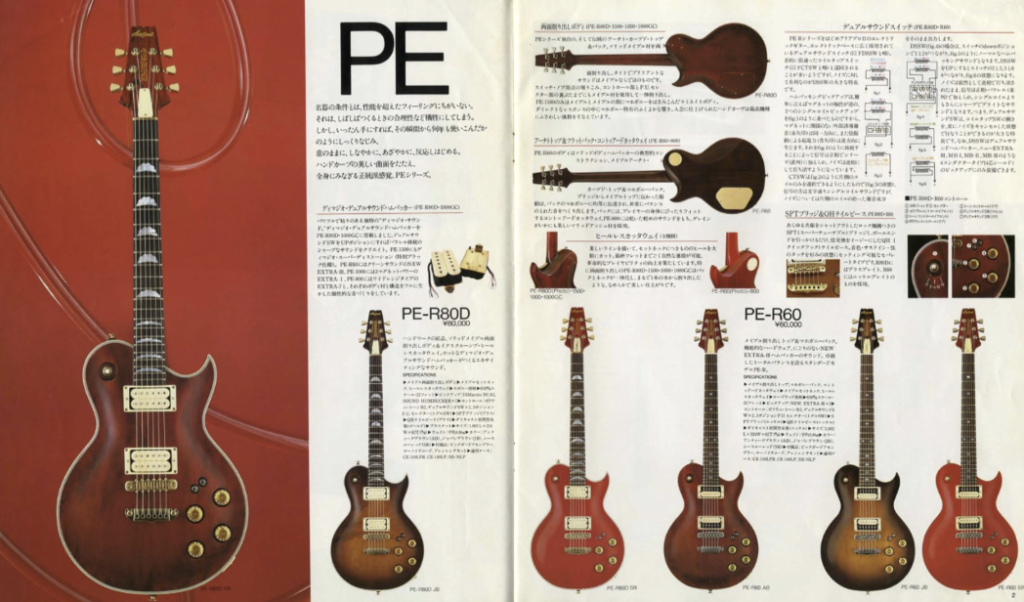
Success brought the PE-1000, PE-800, and PE-600, and from 1981 the celebrated PE-R series. The famous PE-R80 is often called a high point of completeness. Where the original PE used a 25.5-inch scale with controls grouped Strat-style, the PE-R moved closer to a Les Paul: a 24.75-inch Gibson scale and a two-volume, two-tone layout.
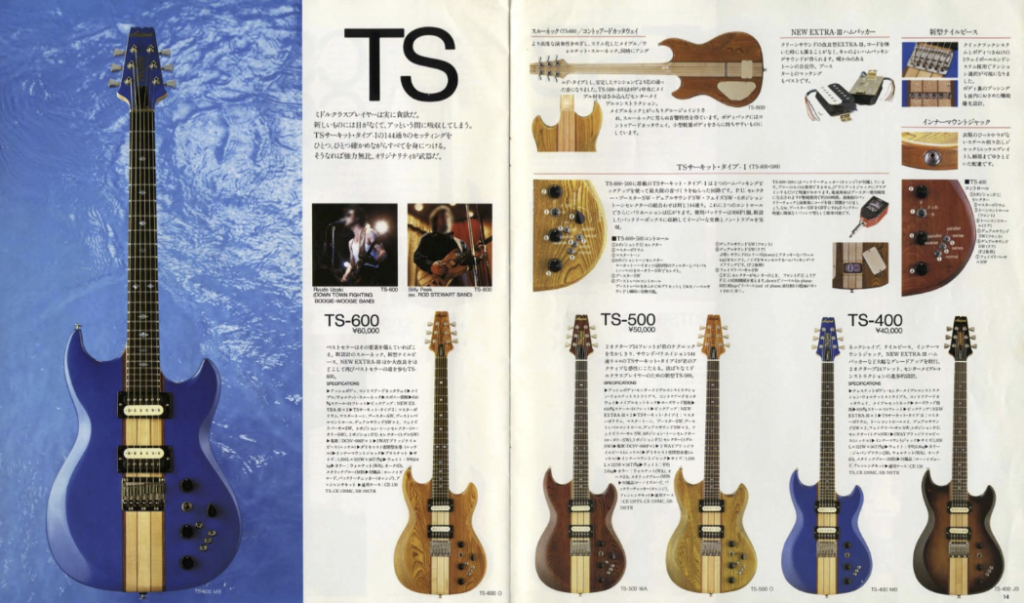
RS-850 and TS-800: The Active, Neck-Through Line
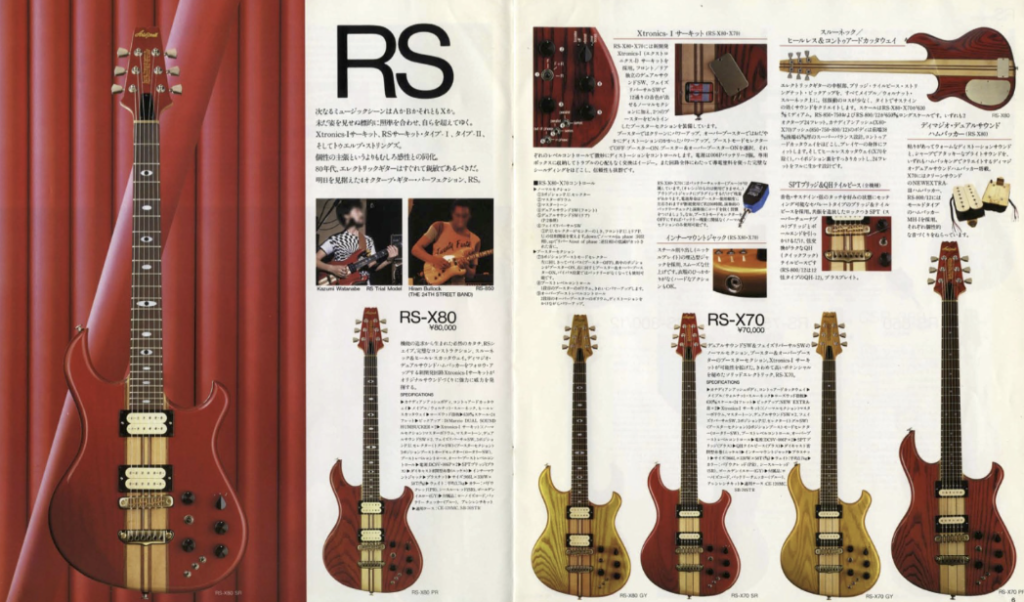
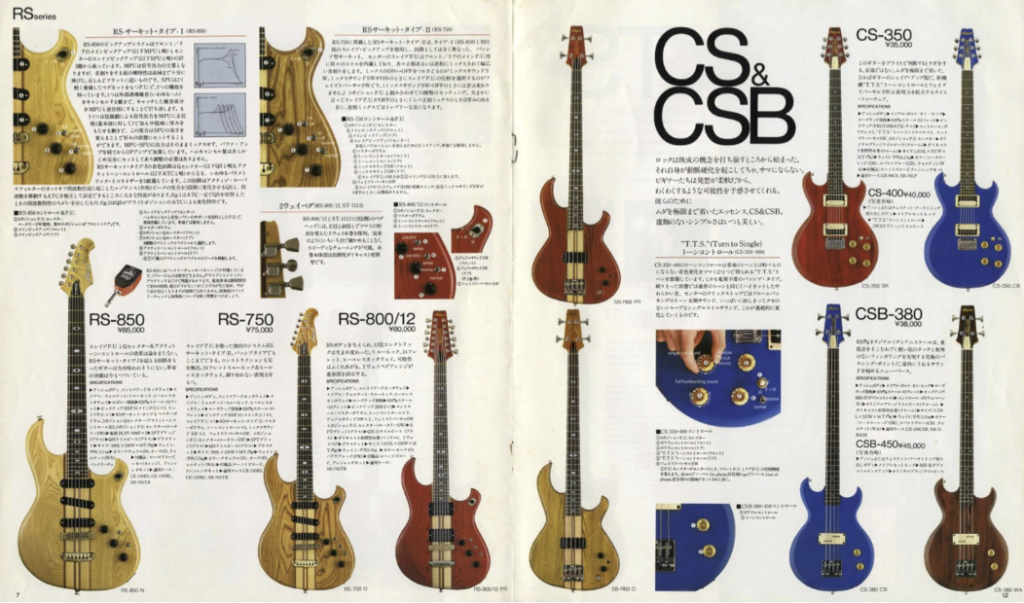
Around the same time, Aria Pro II ran a line with serious character. The RS-850 looks Strat-like yet keeps a hint of Gibson, with a dedicated slave pickup between its two single coils for noise cancellation and a booster circuit for a wide tonal range. The TS-800 carried DiMarzio humbuckers, more mini-switches, and an active circuit said to yield 144 sounds in theory. Now out of production, it’s a collector’s favorite that fetches steep prices. Both drew influence from Alembic and B.C. Rich, sharing neck-through construction and active circuitry that fought noise and shaped tone almost like an effect.
The Copy Models: LS, LC, and the Strat Line
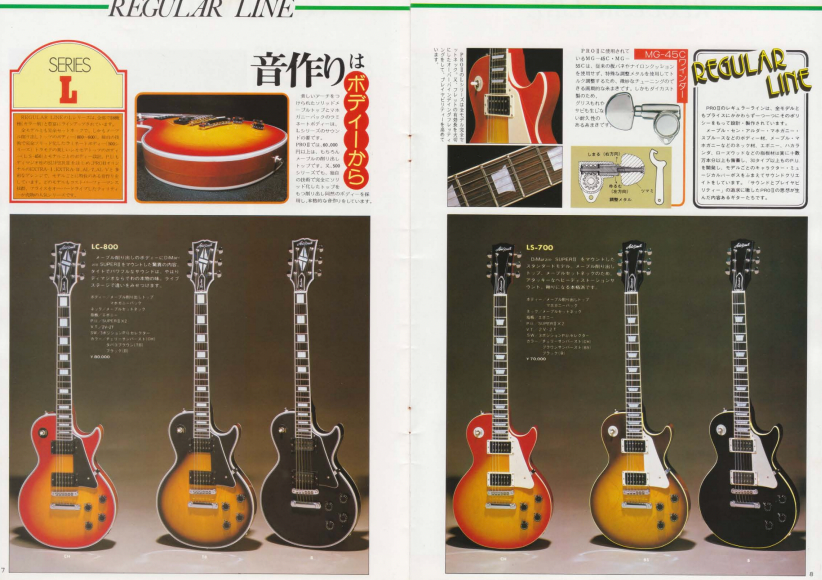
Alongside the originals, Aria Pro II built proper copies too. During Japan’s Lawsuit Era of the late 1970s, the LS-400, at 40,000 yen, offered a genuine set neck and solid body when most cheap copies only looked the part. The range ran wide, from the pancake-body LS-450 up through the LS-700 and 800 to the top LS-1800VP. Often overshadowed by Greco and Tokai, they’re a real sleeper pick thanks to Matsumoku build quality. The Strat copies, lines like Strikin’ Sound and Stagecaster, used “Japanese ash” (sen) or alder and put out a nicely aged tone still loved today.
SB-1000: The Bass That Went Global
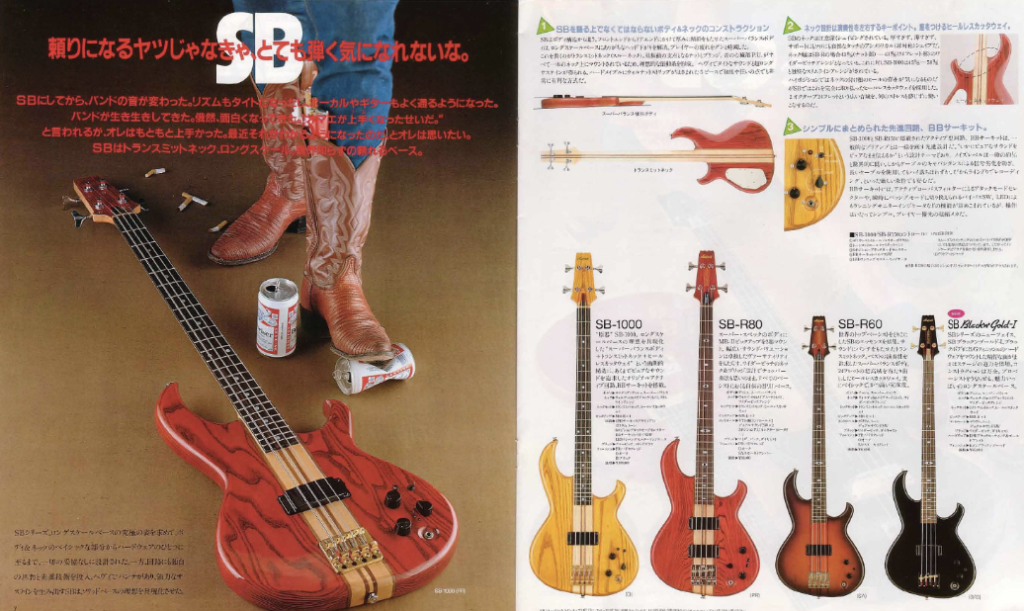
It wasn’t only guitars. Following the PE-1500 came the neck-through SB-1000 bass, which earned overwhelming praise led by overseas artists and became a huge hit. The lineup of players who used it is jaw-dropping.
The Great Players Who Used Aria Pro II
Aria Pro II didn’t stay just another copy maker because the world’s top artists actually played these instruments, on stage and in the studio.
Neal Schon (Journey)
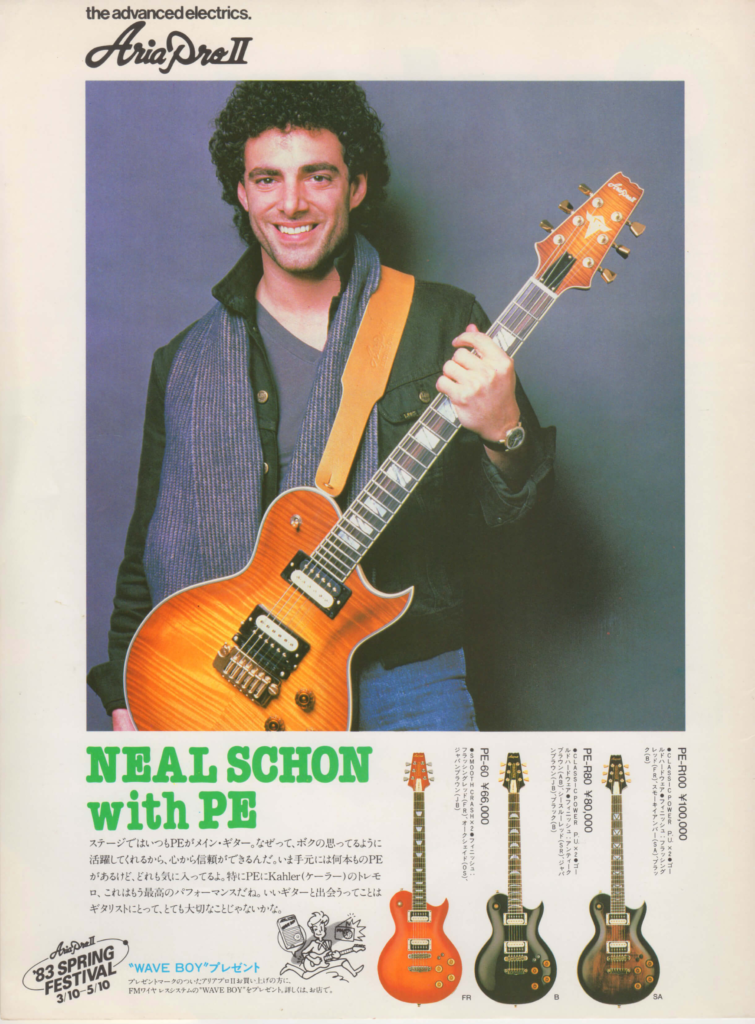
The leading overseas PE user was Neal Schon of Journey, then riding high on “Escape.” He played a custom PE with a built-in guitar synthesizer unit and, from the PE-R launch in 1981, helped push the PE into the ranks of Japan’s truly great instruments. His custom version was sold to the public too, often with a high-grade flame maple top.
Yngwie Malmsteen (Alcatrazz)
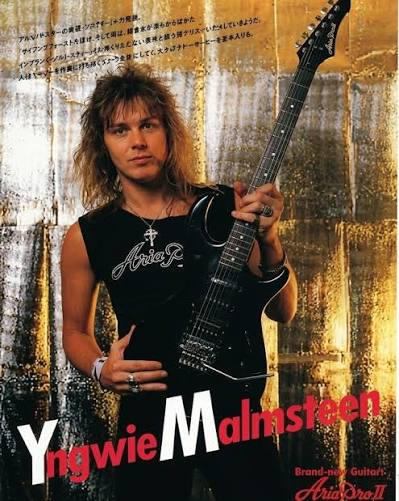
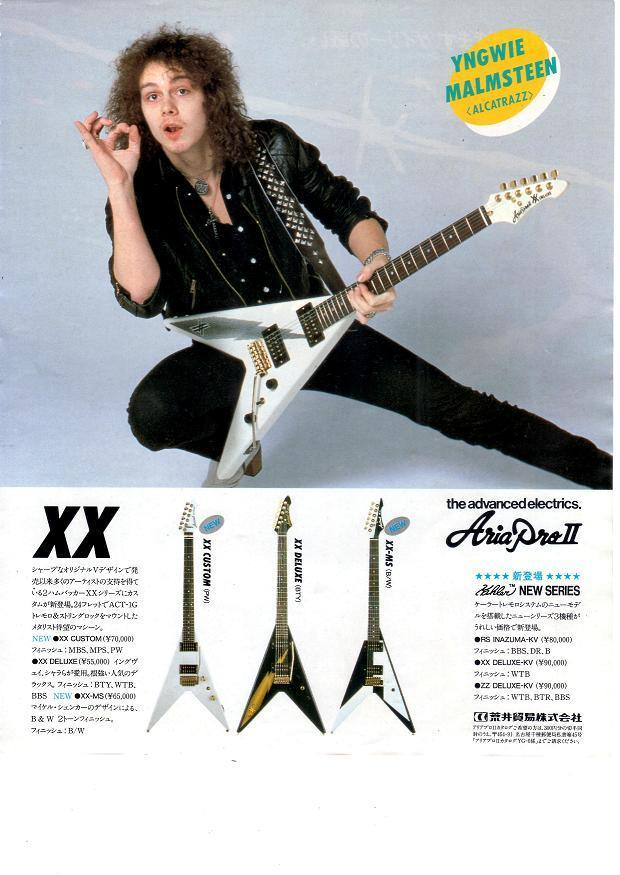
Yngwie Malmsteen was the poster boy for the RS, and plenty of that promotional material survives. But what he’s actually confirmed playing is different: at Alcatrazz’s 1984 Japan tour stop, he used Aria Pro II’s flying-V shaped XX series. That guitar originally had humbuckers, but single coils were mounted on almost as if tacked on, a look some found rough. Modified XX examples still turn up at auction, so it clearly has its fans.
Michael Schenker
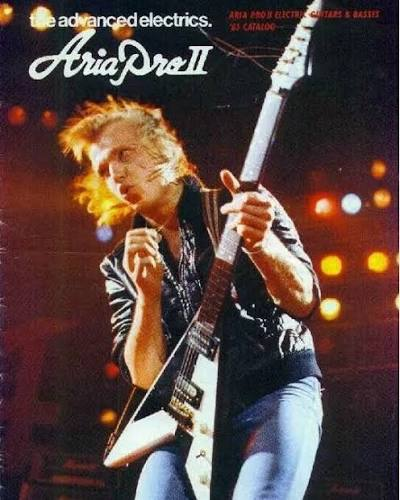
Hard rock and metal legend Michael Schenker was also an XX user, playing a custom XX in an iconic black-and-white finish. Alongside Yngwie, he was one of the faces of the XX series.
John Petrucci (Majesty / Dream Theater)
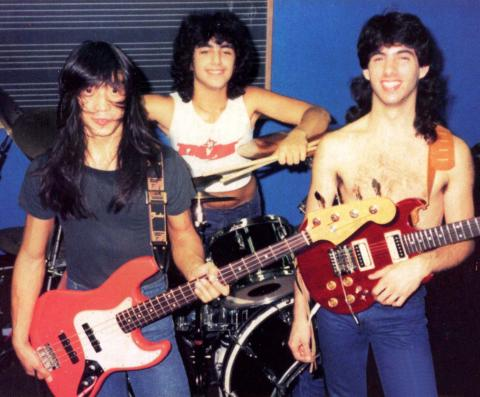
Here’s one many miss: John Petrucci of Dream Theater. Before Dream Theater formed, in his Majesty days, mid-80s cover videos show him with a CS Custom fitted with a Kahler. In America the PE was pricey, but the entry-level CS series was a steal for the spec, an accessible choice for a cash-strapped amateur.
Cliff Burton, John Taylor, and the SB-1000 Bassists
On bass, Cliff Burton of Metallica is about as iconic an SB-1000 user as you can get, and Aria has since shipped a Burton-inspired SB-CLB worldwide. Pop icon John Taylor of Duran Duran chose the very same SB-1000. Others include Marcus Miller, Rudy Sarzo of Whitesnake and Quiet Riot, and Sami Yaffa of Hanoi Rocks, a spread across genres that shows just how deep this bass’s range runs.
Aria Pro II Today: Where the Brand Stands Now
So where is Aria Pro II now? Alive and well, and not merely living off its past but genuinely redesigning these instruments as working tools for today.
How Production Changed After Matsumoku
When Matsumoku closed in 1987, Aria moved main production to Korea and outsourced some models within Japan. From the 90s, low-priced models were built in Korea and China while the high-end stayed domestic. Sold as beginner bundles with an amp, those cheap models saddled the brand with a “budget beginner” image for a time. Aria has since tidied its structure, splitting overseas copies into the separate Legend and Blitz names so that only originals carry the Aria Pro II badge.
The Current Guitar Lineup
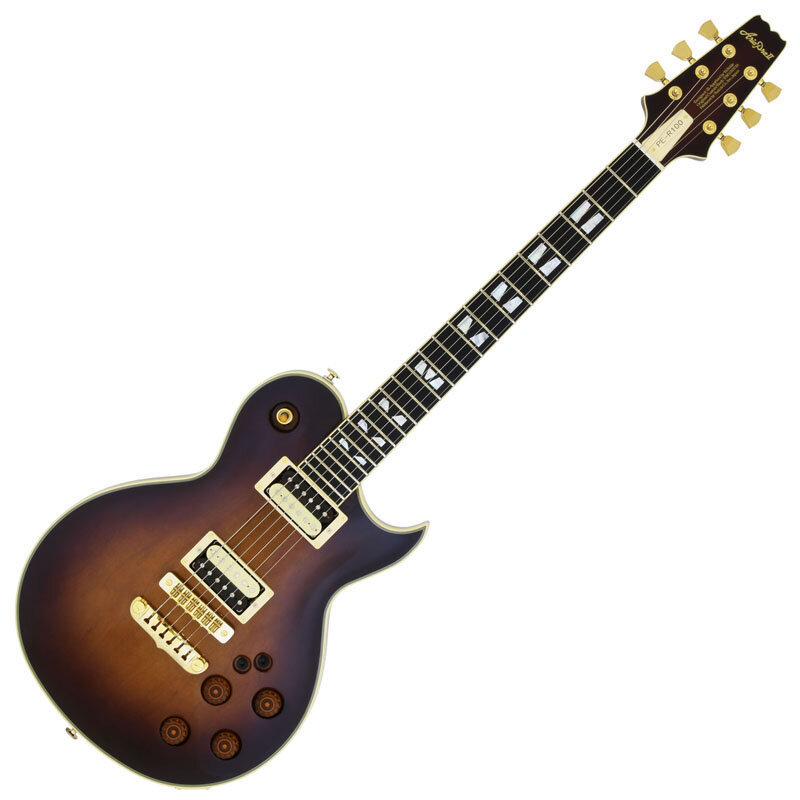
The flagship PE remains in production. Higher-end reissues of the PE-1500, PE-R80, and PE-R100 are Japan-made, while downgraded versions like the PE-480 come from China. Built around the PE-R80 spec, it keeps a medium scale plus the carved top and heel-less cutaway that define the PE. The RS has become a soloist-style guitar in the Jackson/ESP vein, with a Floyd Rose, Seymour Duncan pickups, and neck-through build aimed at hard rock and metal. The MA is a light, sleek dinky-type take on the Strat, 24 frets and bolt-on, good for technical players or smaller hands.
Entry Models and Beyond
The entry-class 714 and 615, from the AE (Aria Evergreen) series, are Strat and Telecaster types launched in 2020. At around 50,000 yen they surprise with a Wilkinson bridge, heel-less joint, and coil tap, standing out for value. Beyond them sit the offbeat RETRO CLASSICS, plus the Japan-made full-acoustic FA and semi-acoustic TA. On bass, the slim upright SWB series is still well regarded, and recent releases like the Cliff Burton SB-CLB continue the work of reviving old masterpieces.
Did Aria Pro II Shut Down? Clearing Up the Confusion
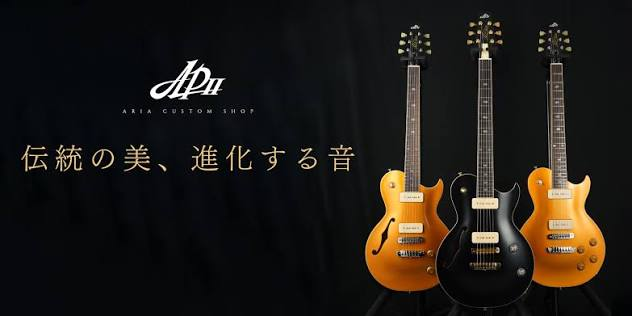
A rumor spread that Aria Pro II had ended. The cause was “AP II,” a high-end custom-shop line discontinued in 2025. Some mistook AP II for Aria Pro II itself and assumed the whole brand was gone, a misunderstanding helped along by Fernandes’s reported troubles the year before. In reality, only the AP II line ended. The Aria Pro II brand continues to this day, born from copies, going on to create world-recognized originals, and still innovating now.
Conclusion: Why Aria Pro II Still Matters
Aria Pro II’s story is the story of Japanese guitar-making itself, compressed into one brand. It began with a single classical guitarist importing strings for his friends, grew through a relentless obsession with quality, and found its footing at the Matsumoku factory. From there it did something few Japanese makers dared in the copy era: it stopped imitating and started designing. The PE-1500, the SB-1000, the RS and TS, these weren’t imitations of Gibson or Fender but original instruments with their own identity, good enough to end up in the hands of Cliff Burton, Yngwie Malmsteen, and Neal Schon.
That legacy is exactly why the Matsumoku-era models are prized as Japan Vintage today, and why they remain a genuine value next to their Greco and Tokai rivals. Just as importantly, Aria Pro II never became a museum piece. The brand is still building, still innovating, and still carrying the name that once declared itself “one step beyond Aria.” If you ever spot that carved top in the corner of a guitar shop, do yourself a favor and pick it up. You’ll be holding a piece of the moment Japan proved it could build guitars the whole world would want.
FAQ
Is Aria Pro II still in business?
Yes. The Aria Pro II brand is still active and its original models remain in production today. A separate high-end line called AP II was discontinued in 2025, which caused some confusion, but the main Aria Pro II brand continues.
Who made Aria Pro II guitars?
The brand belongs to Arai & Co., Inc. of Nagoya, Japan. Its classic guitars from the late 1970s and 1980s were built at the Matsumoku factory in Matsumoto City, Nagano, until Matsumoku closed in 1987.
What does the name “Aria” mean?
“Aria” is an anagram of founder Shiro Arai’s surname. Rearranging the letters of “Arai” produces “Aria,” which also happens to be a musical term for a solo song, making it work as both the founder’s name and a piece of musical vocabulary.
What is the most famous Aria Pro II model?
The PE-1500, the original model that launched the entire PE series in 1976, and the neck-through SB-1000 bass are the most celebrated. The SB-1000 is especially well known as Cliff Burton’s bass.
Are old Aria Pro II guitars valuable?
Matsumoku-era Aria Pro II models are prized as “Japan Vintage” and can command high prices in good condition. They still tend to be more affordable than comparable Greco or Tokai models, which makes them a strong value among collectors.
Which famous musicians played Aria Pro II?
On guitar, users included Neal Schon of Journey, Yngwie Malmsteen, Michael Schenker, and John Petrucci. On bass, the SB-1000 was played by Cliff Burton of Metallica and John Taylor of Duran Duran, among others.