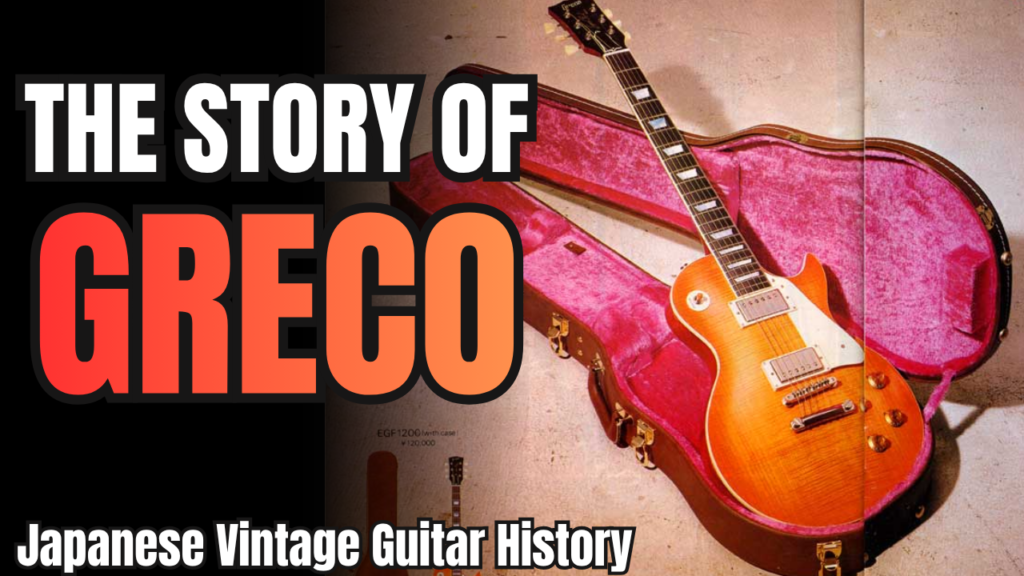
Greco is one of the most revered names in Japanese vintage guitars, evolving from a 1960s maker of Gibson and Fender copies into a brand whose craftsmanship eventually pushed Fender itself to establish Fender Japan in 1982. Its golden-age Super Real series remains a benchmark for vintage-accurate replicas.
Greco Guitars Quick Facts
- Became a Japanese brand: 1968 (run by Kanda Shokai, built by Fujigen)
- Breakthrough model: EG-360 (1971), Japan’s first serious Les Paul copy at 36,000 yen
- Golden age: Super Real series (1979–1982), featuring the Maxon-built Dry-Z pickup
- Greco trademarks: Order-Made System, Project Series (Custom Shop equivalent), vintage-accurate EG & SE replicas
- Industry milestones: Brian May’s BM900, the Mirage/Ibanez Iceman, and the founding of Fender Japan (1982)
Prefer to watch? This article is based on my own video below.
Greco’s Origins in the 1960s
How the Greco Brand Started
Greco’s history reaches back to the early 1960s, when the company sold both acoustic and electric guitars. Its early lineup even included an inventive model called the “Shrike,” which featured a patented, boomerang-shaped, L-split coil pickup.
The “Greco” name itself originated in America, born through a New York–based guitar maker called Goya. The Japanese side later took over the name. Exactly who founded or registered what—and when—remains somewhat unclear even today. But from 1968 onward, Greco had firmly become a Japanese brand: Kanda Shokai ran it, and Fujigen built the guitars. This is where Greco took shape as the brand most enthusiasts know today.
The First Catalog and Early Models
The very first catalog was titled Greco & Arai Diamond Electric Guitars, with the KF190, a Telecaster-type guitar, on the cover. It was likely designed from a photo alone, without the makers ever holding a real one. Its 3-on-a-side headstock oddly matched Fender’s own Telecaster prototype.
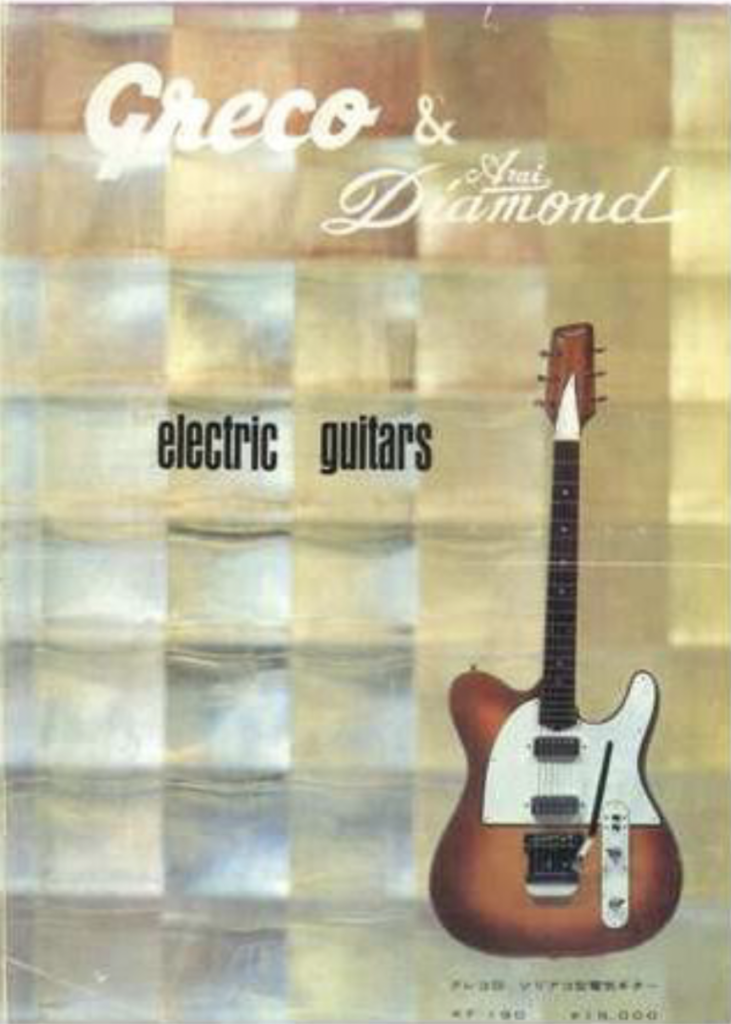
The EG135, an ES-335 copy, was similar—a full-hollow body dressed up to look like a semi-acoustic. But one early standout was the violin bass copies, the VB200 and VB300. Greco led the field on these, and the superior quality made them Fujigen Gakki’s biggest hit of the era.
The Copy Era and the EG-360
Why Greco Mattered in 1970s Japan
In 1970s Japan, American guitars like Gibsons and Fenders were extremely expensive. Young players were falling in love with overseas rock bands, but buying a genuine American guitar simply wasn’t realistic for most. Greco answered that demand by building guitars that captured the Gibson and Fender styles at prices Japanese players could afford. This is why the Les Paul–style EG series and the Stratocaster-style SE series caught on—placing Greco alongside Tokai, Burny, and Fernandes as defining names of the Japanese copy-guitar era.
The EG-360: Japan’s First Serious Les Paul Copy
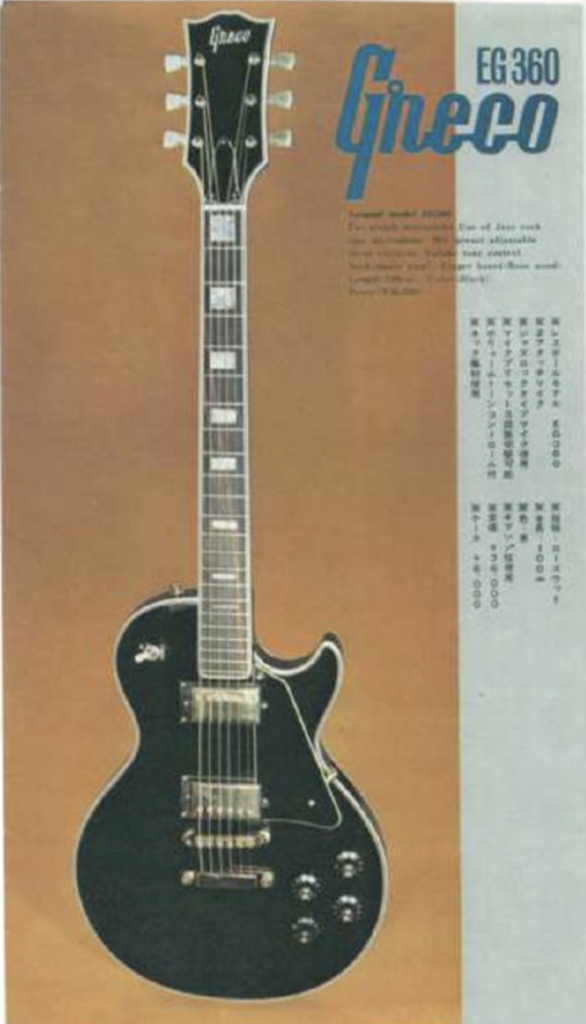
Released in 1971, the EG-360 was essentially the first serious Les Paul copy made in Japan. Earlier “kinda Les Paul-ish” attempts had been poorly made and expensive, and never caught on. The EG-360 was different: priced at an almost unbelievable 36,000 yen, with that instantly recognizable silhouette. It became a massive hit and launched Greco to the top of Japan’s domestic electric guitar world.
Underneath, however, it differed from the original—using a hollow arched-top body and a detachable bolt-on neck. It looked the part, but in sound and construction it was a very different animal.
The Narumo Model and the Order-Made System
After top guitarist Shigeru Narumo saw the EG-360 at a music show, he requested a custom version. Greco built a special EG-360 with a solid carved body, back contour, block inlays, semi-open humbuckers, and a set neck—the first “Narumo model.” From 1972, it became a regular product, the EG-800, lasting until early 1977.
The flood of modification requests that followed eventually choked normal production, prompting Greco’s revolutionary Order-Made System: customers chose from base patterns and specified their own details. Orders poured in from across Japan and overseas. These premium, near one-of-a-kind builds demanded high quality, which in turn pushed Greco’s craftsmanship even higher.
The Brian May Connection: The BM900
In the late 1970s, a customer used the Order-Made System to ask Greco to recreate the Red Special. After a Japanese magazine featured the resulting one-off, inquiries exploded, and Greco officially released the production BM900. Notably, the guitar was actually used by Brian May himself—visible in the music video for Queen’s “Good Old-Fashioned Lover Boy.”
The Greco Project Series
Greco’s Custom Shop Equivalent
Launched in 1976, the Project Series represented Greco at its absolute peak—the equivalent of a Gibson or Fender Custom Shop. It marked a clear move away from cheap copies toward high-end models built on the strength of the Greco name itself, aiming to surpass the quality of the brands it referenced.
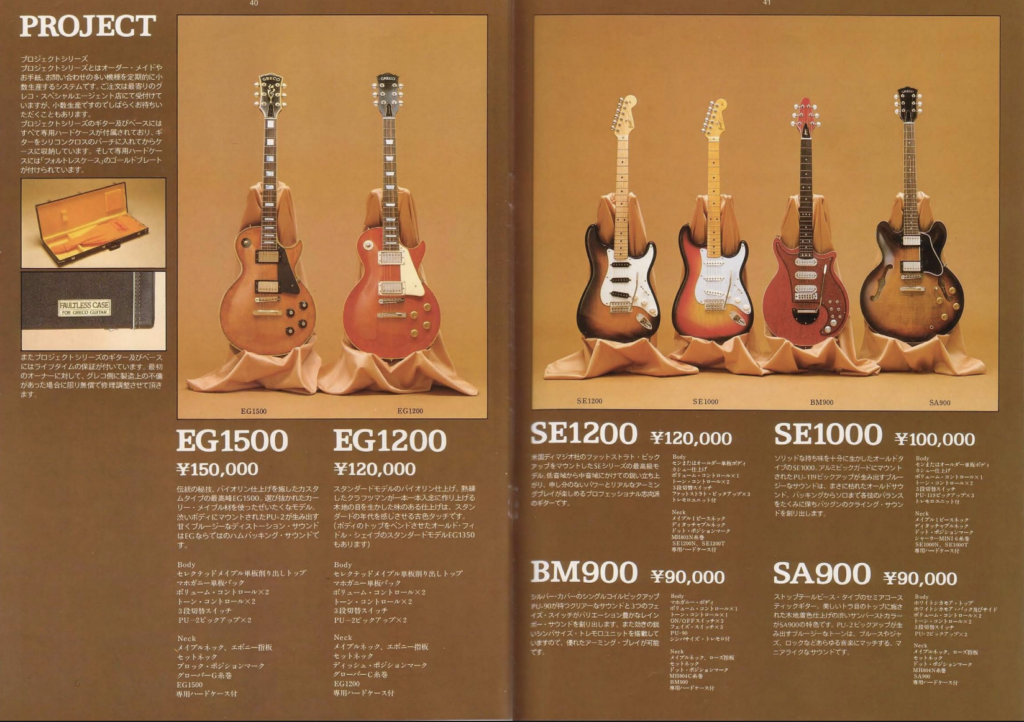
High-end Les Paul–type and 335-type models included the EG-1200, EG-1350, EG-1500, and SA-900, alongside Stratocaster-influenced models like the SE-1000 and SE-1200. As was standard then, the model number matched the price: the SA-900 cost 90,000 yen, the EG-1500 cost 150,000 yen—well out of reach for the average player.
The Pickups That Defined the Series
Japanese pickups, specifically Maxon, were evolving fast. The U-1000 humbucker spawned several versions, topped by the rare and expensive U-4000, fitted to very few models and still little understood today.
For single coils, the series used Maxon Excel PU-119 units—built in a traditional Fender style, delivering a bell-like chime and clear, cutting tone that keeps them in high demand. The top SE-1200 received the DiMarzio FS-1 Fat Strat pickup, which for Japanese players at the time was actually the more expensive option.
Greco’s Original Models
The RW-700 (Ron Wood Model)
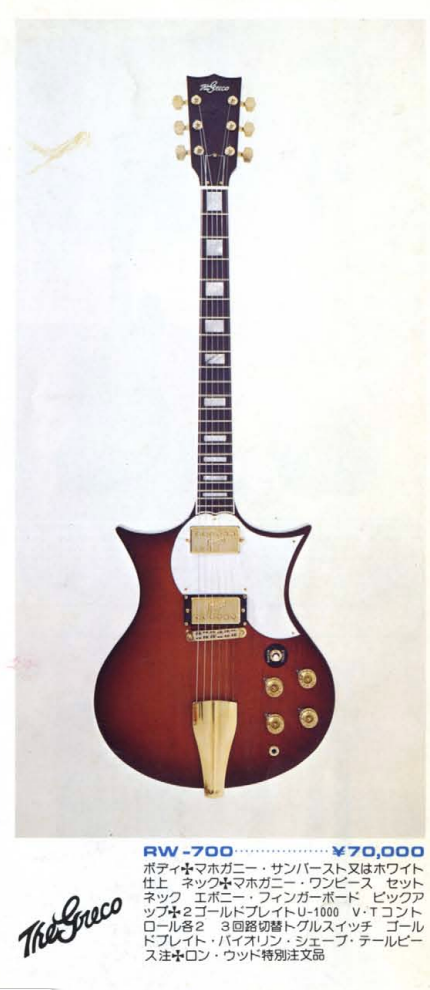
Released in 1974 and made only through 1975, the RW-700 was a signature model for Ron Wood, then huge with the Faces and later the Rolling Stones. Its headstock carries a special “The Greco” logo—likely a nod to the “The Gibson” logo used from the early 1900s into the 1930s.
The MR Series (Mick Ralphs Model)
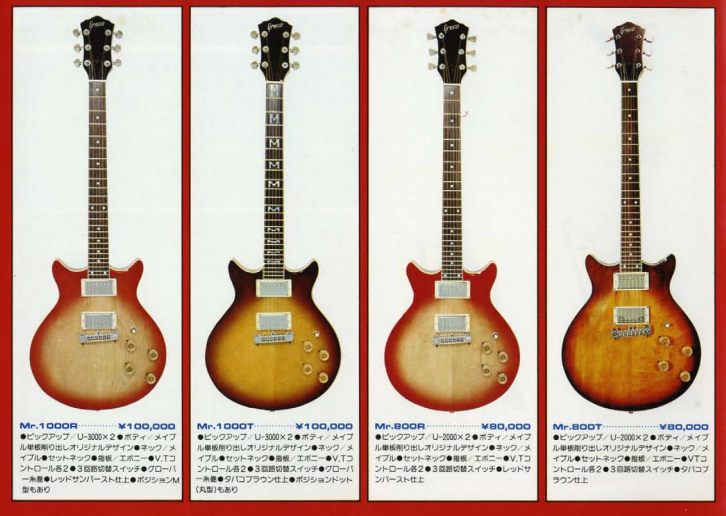
The 1975 MR series was Greco’s first true series of its own, growing out of an order from Bad Company guitarist Mick Ralphs. While keeping Gibson-style specs, it featured a bold symmetrical, double-cutaway body allowing easy reach all the way to the 24th fret.
The GO Series
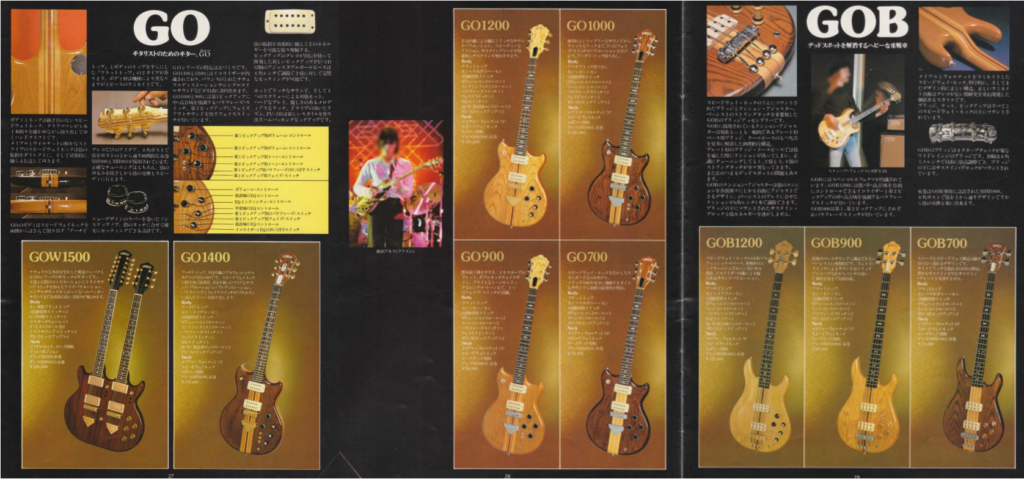
Arriving in 1977, the GO series featured advanced specs for its time, including neck-through construction and active circuitry—Greco heading in its own direction to handle styles from rock to fusion. The GO II followed in 1979 and the GO III in 1980.
The Mirage
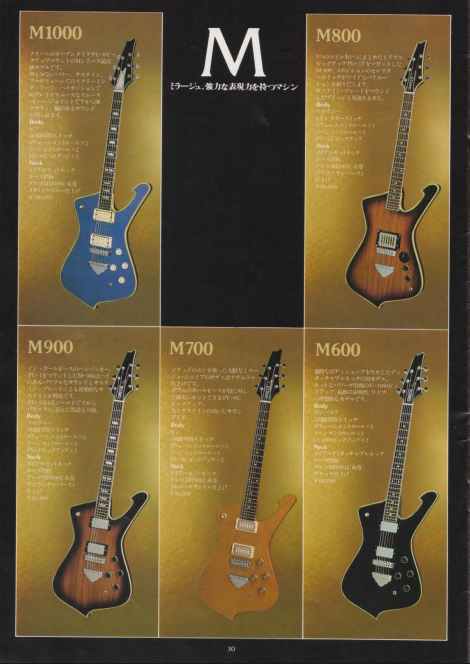
Launched in 1978, the Mirage was a Japanese-born explorer-style guitar developed jointly by Kanda Shokai, Hoshino Gakki, and Fujigen. Fujigen built it; Kanda Shokai sold it domestically as the Greco “Mirage,” while Hoshino Gakki sold it overseas as the Ibanez “Iceman.” The Iceman’s adoption by KISS’s Paul Stanley helped the Mirage take off at home.
The Boogie
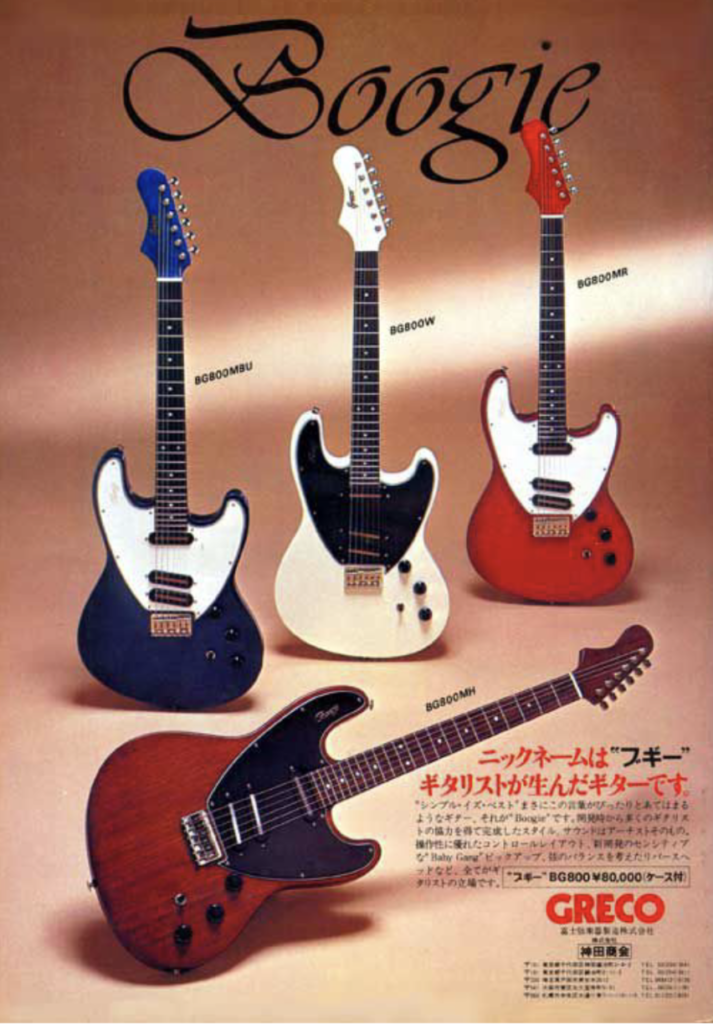
Born in 1979 with the fusion boom in mind, the Boogie had a Fender-ish but original design: a medium-scale neck (628mm), a wraparound pickguard, a reversed headstock, and an unusual 2-and-1 single-coil layout that’s actually an S-H setup. It was reportedly owned by Steve Lukather, Santana, the Eagles, and Jeff Beck.
The Super Real Series: Greco’s Golden Age
A Response to Tokai’s LS Series
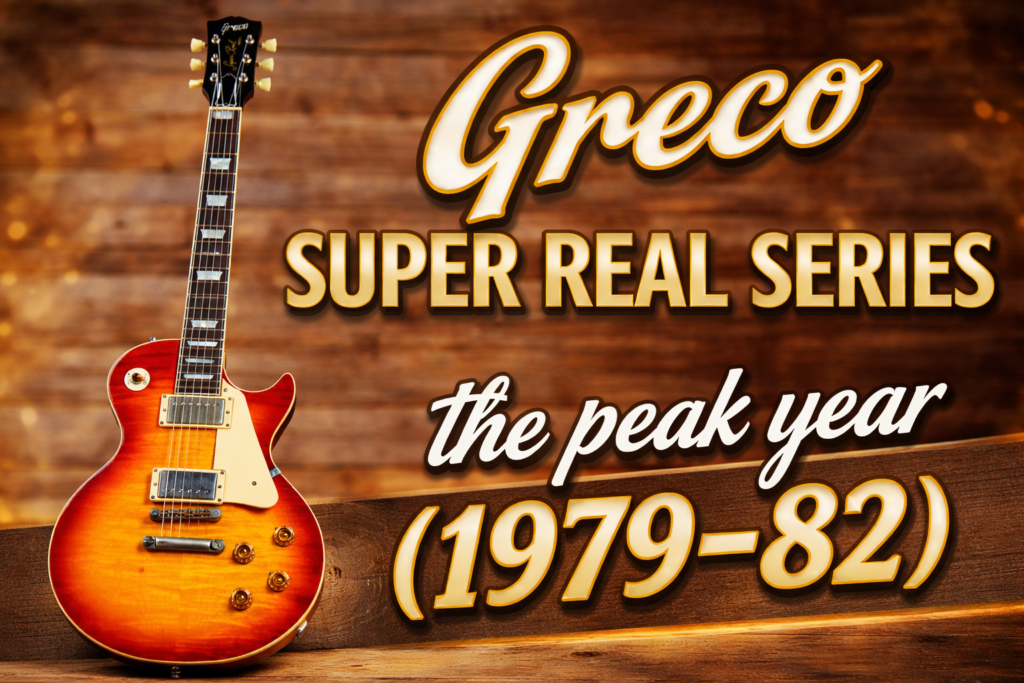
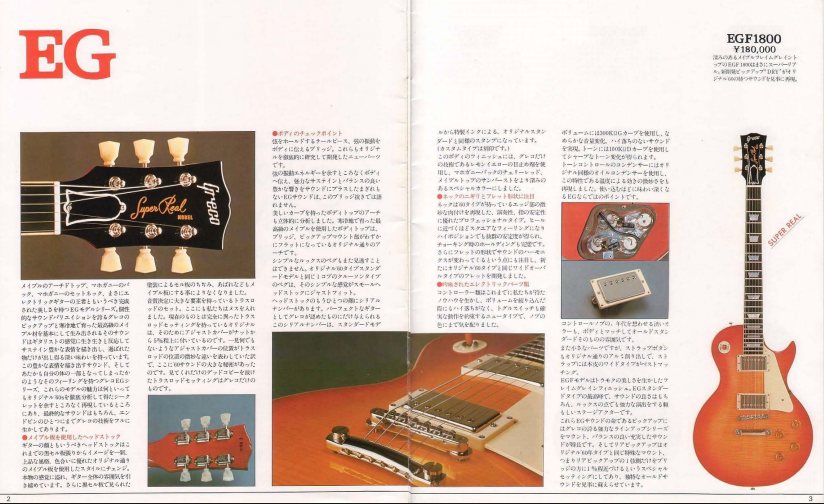
The Super Real series is considered Greco’s masterpiece—a thorough recreation of vintage guitars that defined its golden age. The catalyst was competition: in 1978, Tokai released its LS series with vintage accuracy good enough to rival real vintage models, openly declaring builds like “a recreation of the 1958 model.” To answer, Greco made a bold call—scrapping its entire existing EG lineup and starting over.
How Greco Recreated Vintage Guitars
According to the catalog, Greco completely disassembled original 1960s models and rebuilt them from the ground up—analyzing the headstock material, neck profile, truss-rod position, bridge and tailpiece, body arch, and even the exact pickup mounting angle. They even copied the diamond inlay from the top-of-the-line Les Paul Custom.
Every spec tied to tone and playability was scrutinized: the bridge and tailpiece as vibration transfer points, a three-dimensional analysis of the body arch, a ’60s-type neck profile with wide-oval frets, and electronics down to oil capacitors and toggle-switch action.
The Dry-Z Pickup
To set itself apart from Tokai’s DiMarzio-equipped top models, Greco developed its own domestic pickup aimed at recreating vintage tone: the Dry-Z, built by Maxon. Refined with input from famous musicians at home and abroad, the final version used U.S.A.-made coil wire and became the pinnacle of domestic humbuckers. In a neat detail, the rear pickup’s high-E side was mounted about 1mm closer to the bridge to chase that ’60s-type sound.
The EGF: Top of the Super Real Line
Within the Super Real EG models, the EGF stood at the top, with a flame-grain finish showing off the figured wood. Greco wasn’t just recreating sound—it aimed to recreate the whole Les Paul package of look, sound, and feel together.
The Super Real SE Series
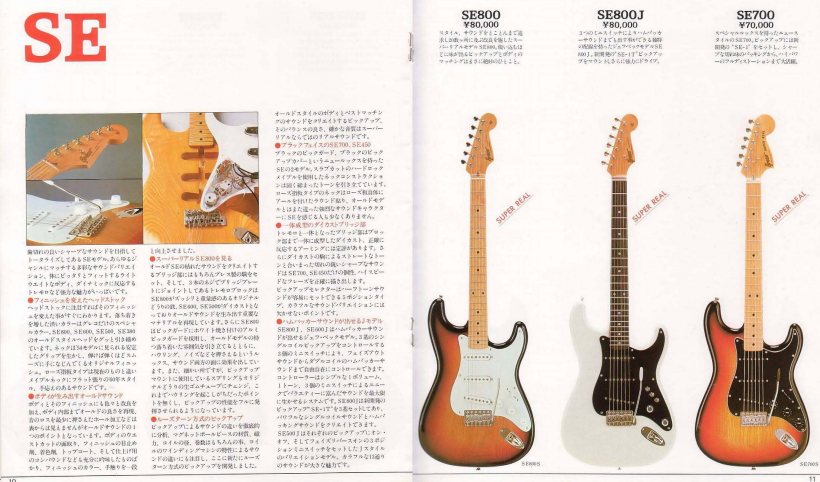
The Stratocaster-side SE series received its own careful spec revisions, chasing old-style recreation just as seriously. The lineup ran deep: the detail-faithful SE800, the 5-way SE700, the popular SE600/SE500/SE450, and the surprisingly high-grade SE380. Improvements included a more subdued headstock color, a 1954-style stable neck grip, flat-glued rosewood-board construction echoing 1960 style, plus pressed saddles, a steel tremolo block, and a white baked-enamel aluminum pickguard—all tied to sound and noise reduction.
The “J” Models (Jeff Beck Models)
The SE800J and SE600J were listed as Jeff Beck models, using three single coils with mini switches capable of phase-out and humbucker-like tones. The catalog walks through 13 tonal variations on the SE500J—proof that the Super Real SE series prioritized tonal range as much as faithful recreation. The Super Real series was highly praised, but produced only from 1979 to 1982.
1982: Fender Japan and the Mint Collection
The Founding of Fender Japan
The biggest shift came in 1982, when Kanda Shokai and Fujigen partnered with Fender to found Fender Japan. They could now build Strats under the official brand—but it also meant Greco’s Fender-style replicas were on their way out.
A persistent rumor held that early Fender Japan guitars were just rebadged Greco SEs. People involved have denied this. According to former Fujigen managing director Mr. Nakata and Mr. Sugimoto (now head of Sugi Guitars), a Greco SE1200 logo was swapped just once for show displays and catalog photos out of necessity—but the guitars that actually shipped were built from scratch, reworking specs and blueprints with cooperation from Fender’s headquarters.
Winding Down the Original Models
Alongside the partnership and the changing music trends of the 1980s, Greco’s original models were wound down—the Mirage, GO, GOB bass, GO II, and GO III. In 1984, the entire MR series dropped out of the catalog.
The Mint Collection
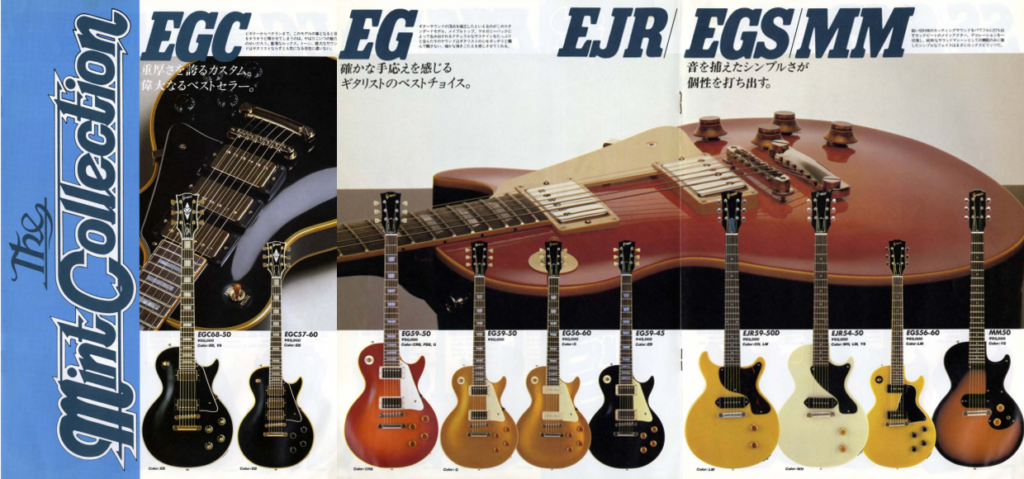
Also in 1982 came the Mint Collection, which carried on the Super Real spirit and supported Greco through the 1980s. With Fender Japan handling the Fender side, production centered on Gibson-style models. But from around 1980, Gibson began pressuring Japanese copy brands, forcing detail changes: a redesigned truss-rod cover, dropped “Super Real” headstock text, and on some models, omitted fret-edge binding or non-nitro finishes. Unavoidably, the series drifted away from being a faithful copy.
Greco Today
A Brand Beyond Its Copy-Era Image
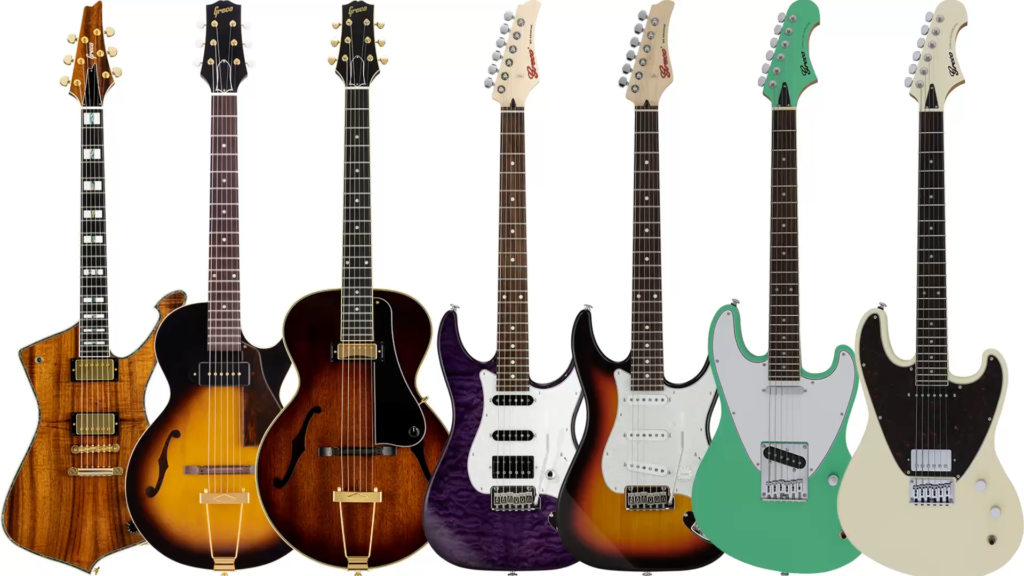
Today’s Greco puts its own character front and center rather than coasting on nostalgia. The wide lineup includes historical models updated to modern specs, beginner-friendly instruments, and archtop-style guitars—all made in Japan, with easy-handling necks, lightweight bodies, and reliable parts.
The GM Series (Modern Mirage)
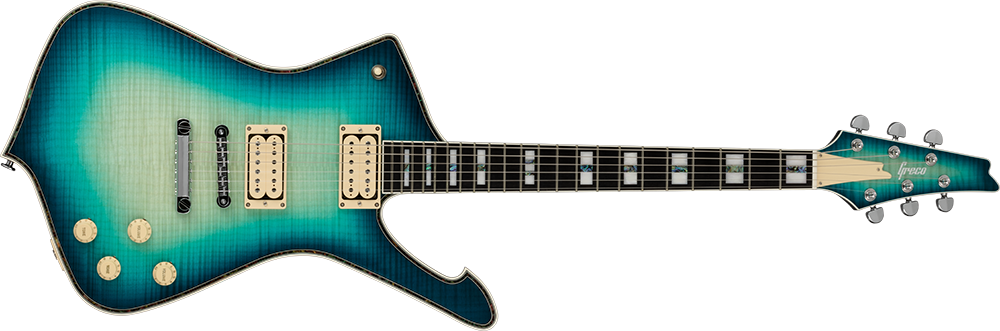
The GM-STD and GM-CST bring the classic Mirage up to modern spec: a mahogany body and neck, rosewood fingerboard, two volumes and two tones, and a pair of Alnico 5 humbuckers. The GM-CST adds multi-ply binding, gold parts, and a figured top. The thin (~40mm center), arched-top body looks deep but stays light. Hardware is dependable—GOTOH, Switchcraft, and CTS.
The BGW Series (Modern Boogie)
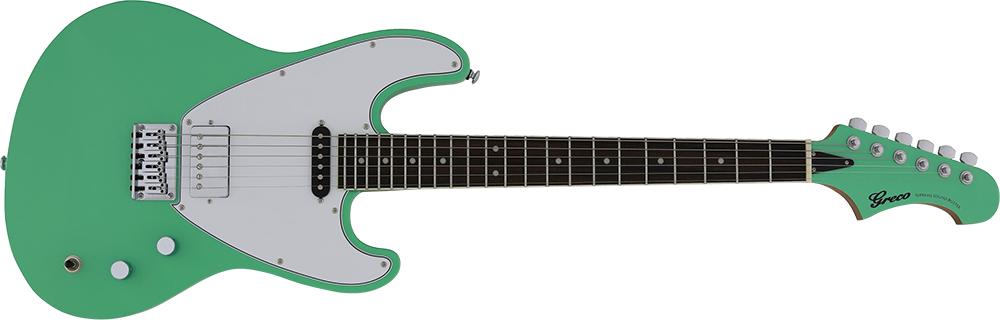
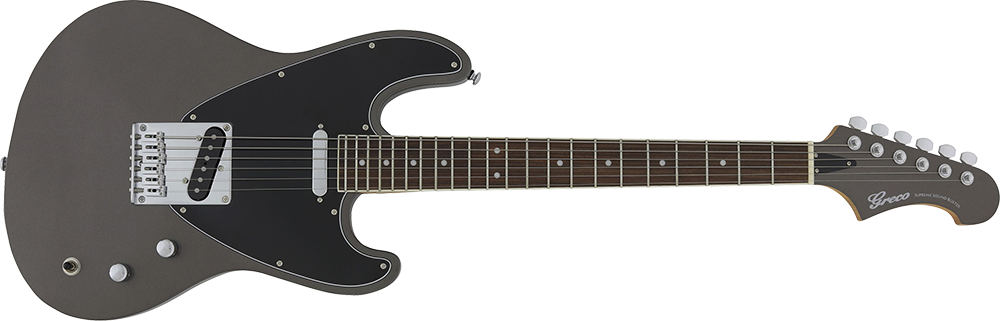
The BGW series updates the Boogie with an alder body, roasted maple neck, and pau ferro fingerboard on a bolt-on joint. The BGW22 SH runs a bridge humbucker with a push-pull coil split, while the BGWT22 goes the Telecaster route with two single coils. Both include locking tuners.
The WS Series
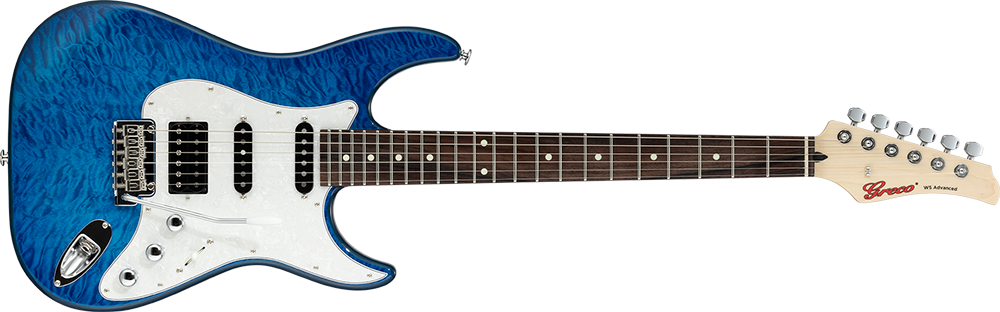
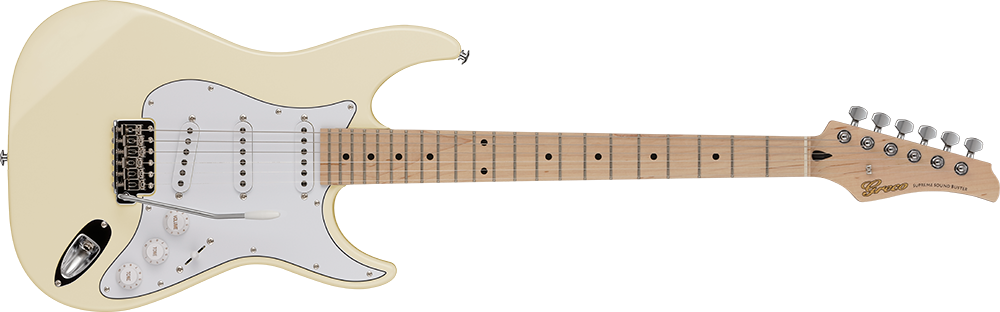
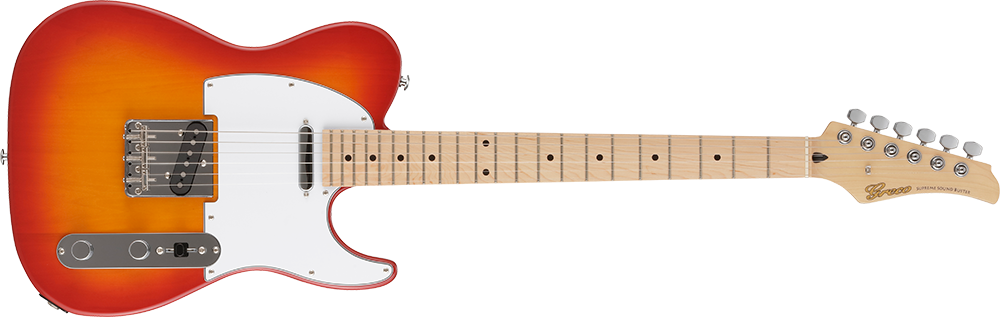
The WS series centers on easy playing, with a slim 40mm nut width that suits smaller hands or thumb-over players. The WS-STD is the Stratocaster type with a Fender scale and three single coils; the WST-STD is the Telecaster type. The step-up WS-ADV upgrades wood and parts—Switchcraft jack, CTS pots, Japanese-made components, and a 2-point tremolo.
The GES and GL Archtops
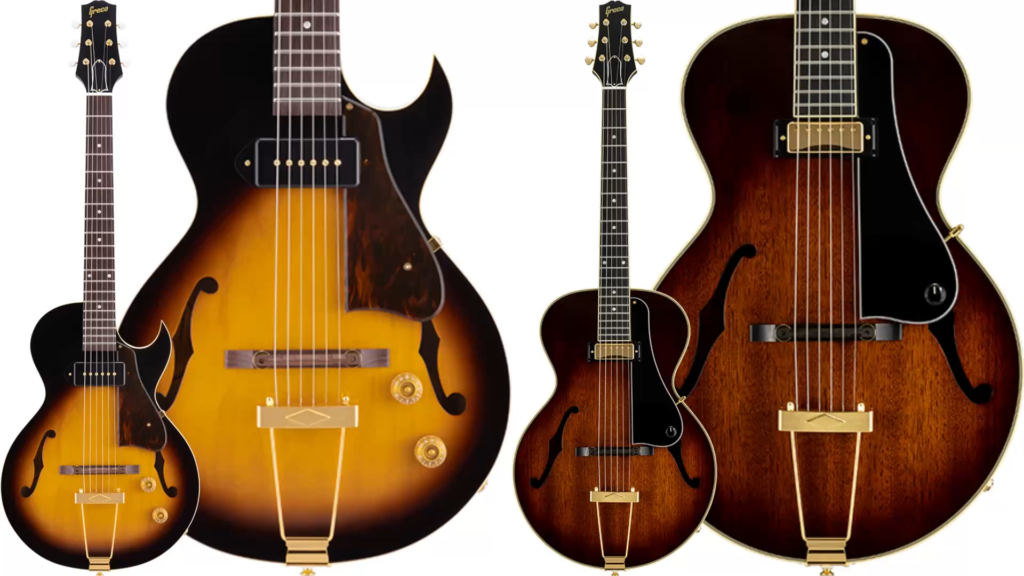
Greco’s archtops are full-hollow guitars with an old American flavor. The GES-AT looks back to the 1950s with a thin hollow maple body and a single dog-ear pickup, while the GL-AT reaches back to the 1920s—a small but deep all-mahogany body with a single mini-humbucker. Together they prove Greco isn’t just about solid bodies.
Conclusion: Why Greco Endures
Greco is famous as a Japanese vintage name, but today’s brand has grown past its vintage-copy image into a Japanese guitar maker with genuine originality and everyday usability. From the EG-360 that launched it, through the masterpiece Super Real series, to a modern all-Japan-made lineup, Greco’s commitment to quality is what keeps the name alive.
FAQ
When did Greco become a Japanese guitar brand?
Although the “Greco” name originated in America through a New York–based maker called Goya, Greco became a Japanese brand from 1968 onward. It was run by Kanda Shokai and the guitars were built by Fujigen, which is the form most enthusiasts know today.
What was Greco’s first serious Les Paul copy?
The EG-360, released in 1971, was essentially Japan’s first serious Les Paul copy. Priced at just 36,000 yen with an instantly recognizable silhouette, it became a massive hit and launched Greco to the top of Japan’s domestic electric guitar world.
What is the Greco Super Real series?
The Super Real series (1979–1982) is widely considered Greco’s masterpiece and defined its golden age. Created partly in response to Tokai’s vintage-accurate LS series, it involved completely disassembling original 1960s Gibson and Fender models and rebuilding them with close attention to tone and playability.
What is the Greco Dry-Z pickup?
The Dry-Z is a domestic humbucker built by Maxon and developed for the Super Real series to recreate vintage tone. Refined with input from famous musicians, the final version used U.S.A.-made coil wire and is regarded as a high point of Japanese-made humbuckers.
How is Greco connected to Fender Japan?
In 1982, Kanda Shokai and Fujigen partnered with Fender to found Fender Japan. This allowed them to build Strats under the official Fender brand, but it also led to Greco’s Fender-style SE replicas being discontinued.
Did Greco make its own original models?
Yes. Beyond copies, Greco produced original designs including the RW-700 (Ron Wood model), the MR series (from a Mick Ralphs order), the GO series with neck-through construction, the explorer-style Mirage, and the fusion-oriented Boogie.
Are Greco guitars still made today?
Yes. The modern Greco lineup is made entirely in Japan and includes historical models updated to modern specs, such as the GM series (Mirage) and BGW series (Boogie), the easy-playing WS series, and the GES and GL archtops.
More Greco Guitars Article