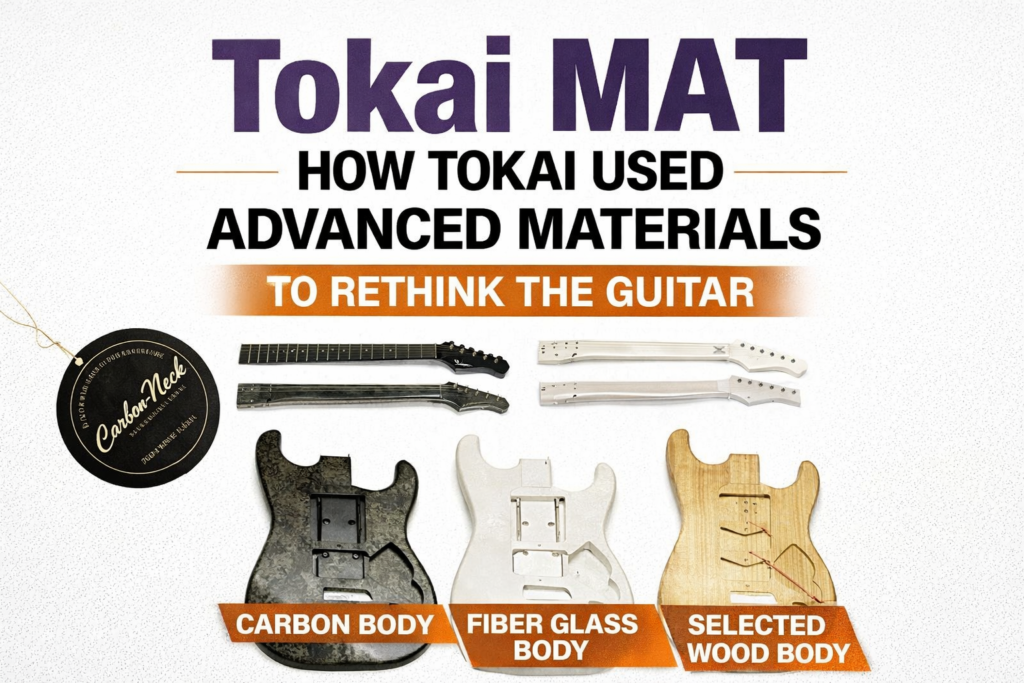
The Tokai MAT is one of the most unusual guitar projects to come out of 1980s Japan, combining carbon-based materials, advanced electronics, and multiple series built around Tokai’s idea of a more engineered electric guitar.
Tokai MAT Quick Facts
- MAT meaning: Most Advanced Technology
- Launch period: Around 1985
- Main concept: A Strat-style guitar platform built around carbon-based materials, advanced electronics, and engineered construction
- Top models: M-2001 and M-2002 with full TOKAI-GRAPHTECH body and neck
- Core materials: TOKAI-GRAPHTECH and TOKAI-FIBERTECH
- Advanced features: Coil tap switching, low-impedance buffer circuits, and hybrid body-neck construction
- Why it matters: One of Tokai’s clearest attempts to move beyond copy models and rethink the guitar itself
- What the Tokai MAT Was Trying to Do
- Tokai MAT Series Overview
- M-2001 / M-2002 Series: The Flagship MAT Models
- M-451 / M-452 / M-453 Series: Affordable but High Performance
- M-551 / M-552 / M-553 Series: Tremolo-Focused Performance Models
- M-601 / M-602 / M-603 Series: Original Buffer Circuit Models
- M-801 / M-802 / M-803 Series: Mirror Finish and Buffer Electronics
- M-1001 / M-1002 / M-1003 Series: Hybrid Construction with Super Detachable System
- M-1201 / M-1202 / M-1203 Series: The Highest-End Hybrid MAT Models
- CM Series (CM-801 to CM-1003): Visible Cut-Fiber High-Tech Design
- W-1201 / W-1202 Series: Wood and New-Material Hybrid Models
- What the MAT Lineup Reveals About Tokai’s Thinking
- MAT Materials and Construction
- MAT Electronics Were Just as Important as the Materials
- Final Thoughts on the Tokai MAT
- FAQ
- More Tokai Guitars Article
What the Tokai MAT Was Trying to Do
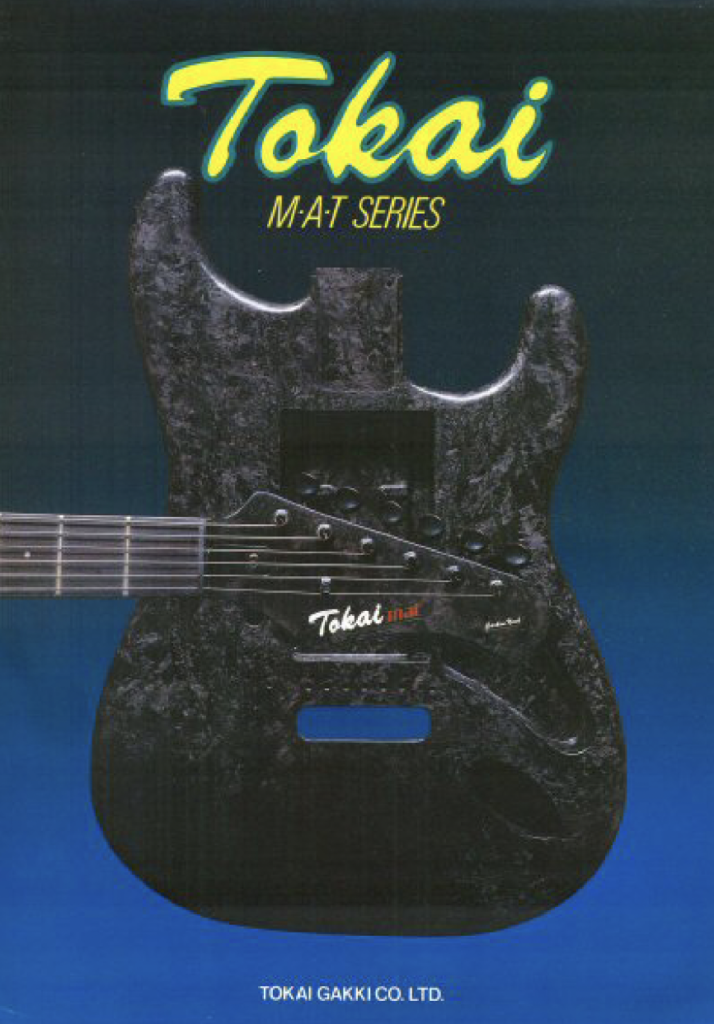
The core idea behind MAT was not just to build a guitar with different materials. Tokai was trying to create an instrument whose behavior could be controlled more deliberately through design, construction, and electronics.
A Guitar Built Around Carbon-Based Materials
Although MAT looked fairly conventional from the outside, it was already built around carbon-based materials. That alone made it unusual for the time. Tokai was moving away from the normal logic of wooden guitar construction and toward something more technical and system-driven.
More Than Just a Material Experiment
MAT was not only about body and neck materials. Tokai also incorporated new electronics, buffer circuits, and model-specific hardware concepts. That broader approach is what makes the project so interesting. The company was not simply replacing wood. It was rethinking the entire instrument.
Tokai’s Another Challenge to Wood:
Tokai MAT Series Overview
One of the most interesting things about the Tokai MAT project is that it was not limited to a single model. Tokai developed MAT as a full lineup, with each series exploring a slightly different idea through materials, electronics, and hardware. Some models were positioned as flagships for professional players, while others focused on affordability, tremolo performance, onboard electronics, hybrid construction, or more experimental finishes.
M-2001 / M-2002 Series: The Flagship MAT Models
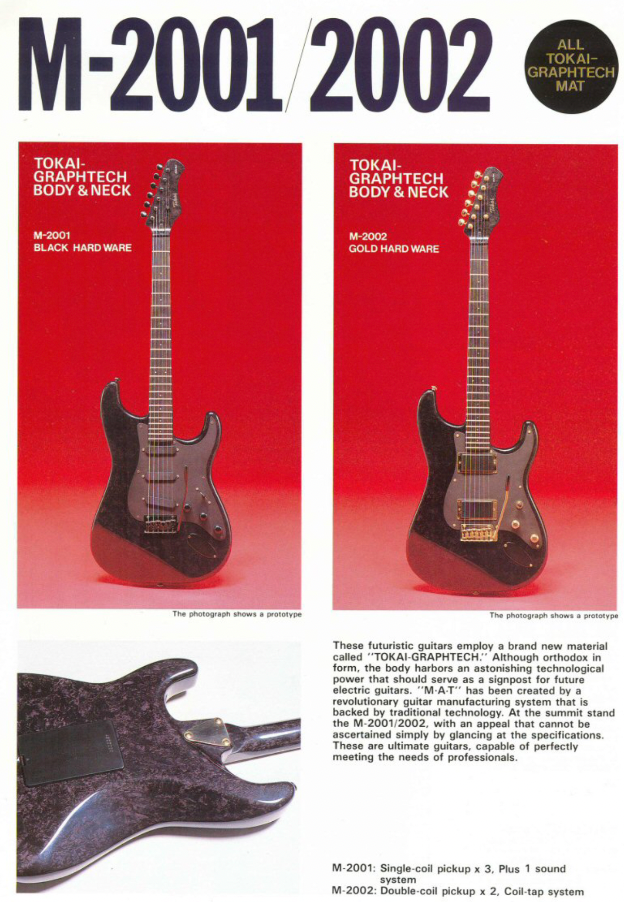
The M-2001 and M-2002 sat at the top of the MAT lineup and used TOKAI-GRAPHTECH for both the body and neck. These were positioned as the ultimate MAT models, built to meet professional needs and to represent the most advanced version of the concept.
The M-2001 featured a three-single-coil layout with the Plus 1 system, while the M-2002 used two humbuckers with coil tap switching. Together, they formed the clearest statement of Tokai’s high-end vision for MAT: advanced materials, flexible electronics, and a fully engineered approach to guitar design.
M-451 / M-452 / M-453 Series: Affordable but High Performance
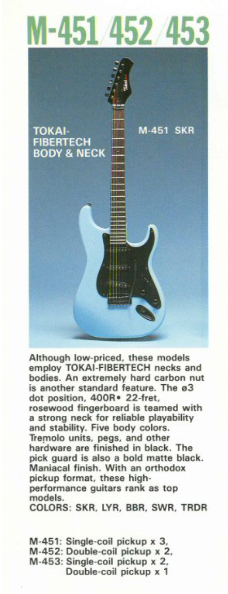
The M-451, M-452, and M-453 used TOKAI-FIBERTECH for both body and neck. Although these sat lower in the price range, Tokai still presented them as high-performance instruments rather than stripped-down entry models.
Features such as a carbon nut and a 22-fret rosewood fingerboard show that even the more affordable MAT models were built with serious performance in mind. This series is important because it shows Tokai trying to bring the MAT concept to a broader audience without abandoning its technical ambitions.
M-551 / M-552 / M-553 Series: Tremolo-Focused Performance Models
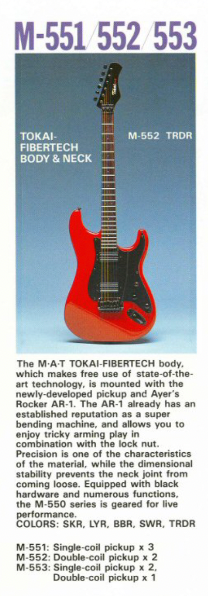
The M-551, M-552, and M-553 also used TOKAI-FIBERTECH for both body and neck, but their defining feature was the newly developed Ayer’s Rocker AR-1 tremolo unit.
This series was clearly aimed at players who used more aggressive tremolo techniques and wanted a guitar that could handle harder live performance. In other words, Tokai was not only experimenting with materials. It was also tailoring different MAT series to specific playing styles.
M-601 / M-602 / M-603 Series: Original Buffer Circuit Models
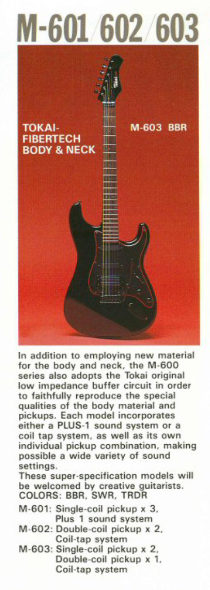
The M-601, M-602, and M-603 continued with TOKAI-FIBERTECH body and neck construction, but added one of the most technically important MAT features: an original low-impedance buffer circuit.
Tokai’s aim here was to reproduce the characteristics of the materials and pickups more faithfully. That makes the 600 series especially revealing within the MAT lineup, because it shows how seriously Tokai treated electronics as part of the overall design concept rather than as a secondary feature.
M-801 / M-802 / M-803 Series: Mirror Finish and Buffer Electronics
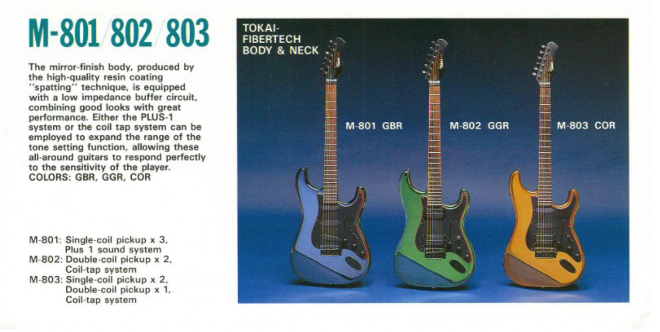
The M-801, M-802, and M-803 also used TOKAI-FIBERTECH for both body and neck, but stood out visually thanks to their mirror-finish body created through a special sputtering process.
These models were not only about appearance, though. They also included the buffer circuit, which meant Tokai was still balancing visual experimentation with functional performance. The 800 series is one of the best examples of MAT combining futuristic looks and advanced electronics in the same package.
M-1001 / M-1002 / M-1003 Series: Hybrid Construction with Super Detachable System
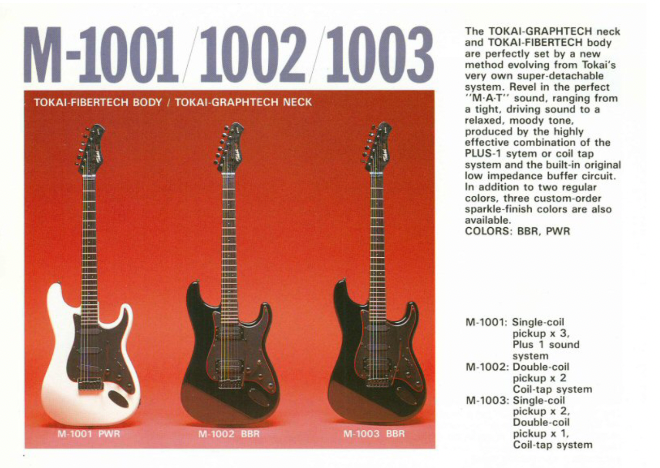
The M-1001, M-1002, and M-1003 combined a TOKAI-FIBERTECH body with a TOKAI-GRAPHTECH neck, making them one of the key hybrid ranges within the MAT project.
These models used Tokai’s own Super Detachable System for the neck, featured an ebony fingerboard, and included a buffer circuit designed to cover a broad tonal range, from tighter and more focused sounds to darker, moodier tones. This series shows Tokai moving beyond simple full-composite construction and into more specialized structural concepts.
M-1201 / M-1202 / M-1203 Series: The Highest-End Hybrid MAT Models
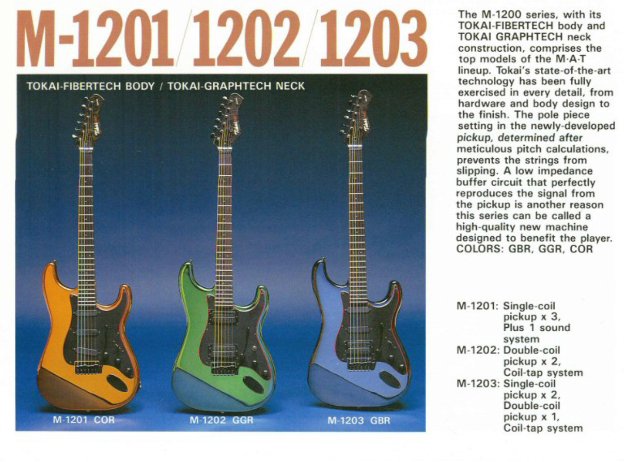
The M-1201, M-1202, and M-1203 also used a TOKAI-FIBERTECH body with a TOKAI-GRAPHTECH neck, but represented the top-end hybrid models in the MAT lineup.
These guitars pushed the concept further with new pickups, carefully designed pole-piece spacing to reduce string drop-out, and a high-quality buffer circuit. If the M-2001 and M-2002 represented the top full-GRAPHTECH concept, the 1200 series represented Tokai refining the hybrid MAT idea to its highest level.
CM Series (CM-801 to CM-1003): Visible Cut-Fiber High-Tech Design
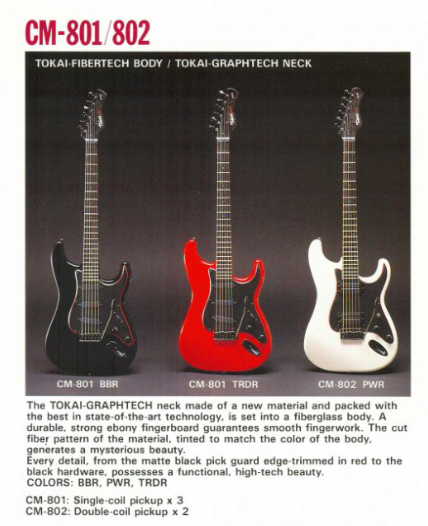
The CM series, ranging from CM-801 to CM-1003, combined a fiberglass body using TOKAI-FIBERTECH with a TOKAI-GRAPHTECH neck.
Its most distinctive feature was visual. The body surface revealed the material’s cut-fiber pattern, giving the guitars a striking and almost mysterious appearance. Combined with the ebony fingerboard, the CM series captured one of the most overtly high-tech looks in the MAT lineup.
W-1201 / W-1202 Series: Wood and New-Material Hybrid Models
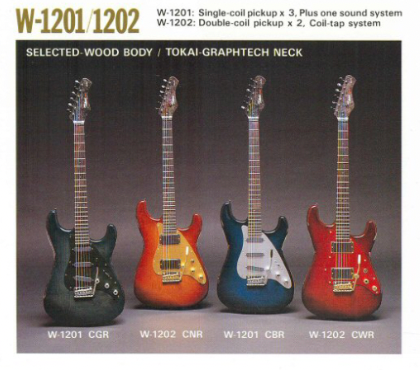
The W-1201 and W-1202 may be among the most revealing MAT models of all. These guitars combined a selected wood body, either ash or alder, with a TOKAI-GRAPHTECH neck.
Rather than rejecting wood completely, Tokai used this series to explore a hybrid concept: combining the more human and familiar tonal character of a wooden body with the stability and advanced playability of a new-material neck. In that sense, the W series shows that MAT was not about simple replacement. It was also about finding new combinations.
What the MAT Lineup Reveals About Tokai’s Thinking
Looking across the full lineup, what stands out is just how systematic the MAT project really was. Tokai was not offering a single experimental guitar and leaving it at that. It was developing a structured family of instruments that tested different combinations of materials, electronics, hardware, and visual identity.
That is what makes MAT so significant. It was not just one strange model from the 1980s. It was a full-scale attempt to rethink the guitar as a designed system.
MAT Materials and Construction
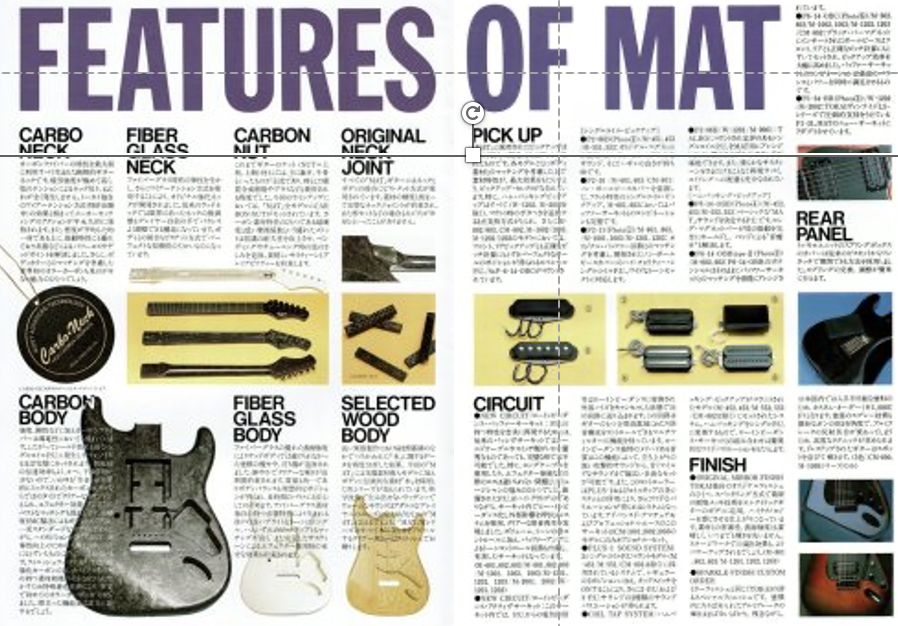
What made MAT especially interesting was that Tokai was exploring more than one advanced material path at the same time.
TOKAI-GRAPHTECH
TOKAI-GRAPHTECH is a cutting-edge material introduced by Tokai Gakki in their M・A・T (Most Advanced Technology) series, defined as a hybrid of Carbon-fiber and Glass-fiber.
This material was designed to provide “astonishing technological power” and serve as a “signpost for future electric guitars”. In the MAT lineup, it is utilized in the following ways:
- Full Construction: The flagship M-2001 and M-2002 models feature both a body and neck made entirely of TOKAI-GRAPHTECH. These are described as “ultimate guitars” capable of perfectly meeting the needs of professionals.
- Hybrid Construction: For high-end models like the M-1001/1002/1003, M-1201/1202/1203, CM, and W-1201/1202 series, the material is used specifically for the neck.
- Performance Benefits: When used in the neck, it is often paired with a durable, strong ebony fingerboard to guarantee smooth fingerwork and “greater playability”.
In series like the W-1201/1202, TOKAI-GRAPHTECH is combined with traditional wood bodies to create a “hybrid of brand new and traditional materials,” offering a modern feel while maintaining a warm, “human” tone.
TOKAI-FIBERTECH
TOKAI-FIBERTECH is a specialized material used in the Tokai MAT (Most Advanced Technology) series, defined technically as Fiberglass Reinforced Plastics (FRP). It was developed as part of Tokai’s “revolutionary guitar manufacturing system” to create high-performance instruments that move beyond traditional wood construction.
Key characteristics and uses of this material include:
- Usage in Construction: It is used for both bodies and necks in several models, such as the M-450, M-550, M-600, and M-800 series. In higher-end models like the M-1000 and M-1200 series, a TOKAI-FIBERTECH body is paired with a TOKAI-GRAPHTECH neck.
- Precision and Stability: One of the primary characteristics of the material is its precision. Its dimensional stability is a significant advantage, as it prevents critical areas like the neck joint from coming loose over time.
- Reliability: Even in entry-level models like the M-451/452/453, the use of TOKAI-FIBERTECH ensures “reliable playability and stability”.
- Versatile Aesthetics: The material allows for unique finishes, such as the high-quality mirror-finish produced by a resin coating “spatting” technique found on the M-801/802/803 models.
- Sound Quality: When combined with Tokai’s original low-impedance buffer circuits, TOKAI-FIBERTECH bodies can produce a wide range of “M・A・T sounds,” from tight and driving to relaxed and moody tones.
In summary, TOKAI-FIBERTECH provided Tokai with a durable, stable, and versatile alternative to wood, allowing for the creation of guitars with “maniacal finishes” and “high-tech beauty
Hybrid Designs
The W series is especially revealing because it shows that Tokai was not thinking in simple oppositions. MAT was not just about replacing wood with new materials. It was also about testing where the two approaches could meet. That willingness to experiment with hybrid construction says a great deal about how open-ended the MAT project really was.
MAT Electronics Were Just as Important as the Materials
One reason MAT still feels ahead of its time is that Tokai was not focused on materials alone. The electronics were just as important to the concept.
Coil Tap Switching and Buffer Circuits
Higher-end MAT models included features such as coil tap switching and built-in low-impedance buffer circuits. For the mid-1980s, those were highly advanced specifications. This was not simply a guitar with unusual body materials. Tokai was redesigning the electrical side of the instrument as well.
A More Engineered Guitar Concept
That combination of advanced materials, specialized electronics, and deliberate construction is what makes MAT feel so modern even now. Tokai was treating the guitar almost like a complete system, where structure, sound, and performance characteristics could all be shaped intentionally.
Final Thoughts on the Tokai MAT
The Tokai MAT is fascinating because it hides its radicalism behind a familiar shape.
On the surface, it looked like a conventional Strat-style guitar. In reality, it was a deeply experimental project built around carbon-based materials, advanced electronics, and a far more engineered concept of what the guitar could be.
That is why the MAT still deserves attention now. It was not only unusual for its time. It was one of the clearest examples of Tokai trying to move beyond imitation and imagine a different future for the instrument.
Do you think the Tokai MAT deserves to be re-evaluated?
FAQ
What does “MAT” mean in Tokai MAT guitars?
MAT stands for “Most Advanced Technology.” Tokai used the name for a mid-1980s guitar project built around advanced materials, engineered construction, and new onboard electronics.
When was the Tokai MAT released?
The Tokai MAT appeared around 1985, during a period when Tokai was experimenting aggressively with original designs, carbon-based materials, and more advanced electronics.
What materials were used in the Tokai MAT?
The Tokai MAT lineup used materials such as TOKAI-GRAPHTECH and TOKAI-FIBERTECH, with some models also combining wood bodies with GRAPHTECH necks. The project was built around carbon-based and composite-style construction rather than traditional all-wood design.
What made the Tokai MAT different from a normal Strat-style guitar?
Although the Tokai MAT looked like a familiar Strat-style guitar at first glance, it used advanced materials, hybrid body-neck construction, coil tap switching, and low-impedance buffer circuits. Tokai approached it as a more engineered guitar system rather than a conventional wooden electric.
What were the top Tokai MAT models?
The flagship MAT models were the M-2001 and M-2002, which used TOKAI-GRAPHTECH for both body and neck. The M-2001 used a three-single-coil Plus 1 system, while the M-2002 used two humbuckers with coil tap switching.
Did the Tokai MAT include advanced electronics?
Yes. Higher-end Tokai MAT models included features such as coil tap switching and built-in low-impedance buffer circuits, which were highly advanced for the mid-1980s and show that Tokai was rethinking electronics as well as materials.
Why did the Tokai MAT not become more popular?
The Tokai MAT arrived too early for the guitar market. Its carbon-based materials, composite construction, and advanced onboard electronics were ambitious ideas, but the guitar world was still fairly conservative and not ready to embrace that kind of design on a wide scale.
Why does the Tokai MAT still matter today?
The Tokai MAT matters because it shows Tokai trying to move beyond copy models and define its own identity through materials, electronics, and construction. Rather than being just one unusual guitar, it was a full lineup built around a radically different way of thinking about the instrument.
More Tokai Guitars Article

Tokai Talbo: How Tokai Challenged the Wooden Guitar with Aluminum

Tokai Guitars — The Art of Japanese Timeless Sound and Craftsmanship