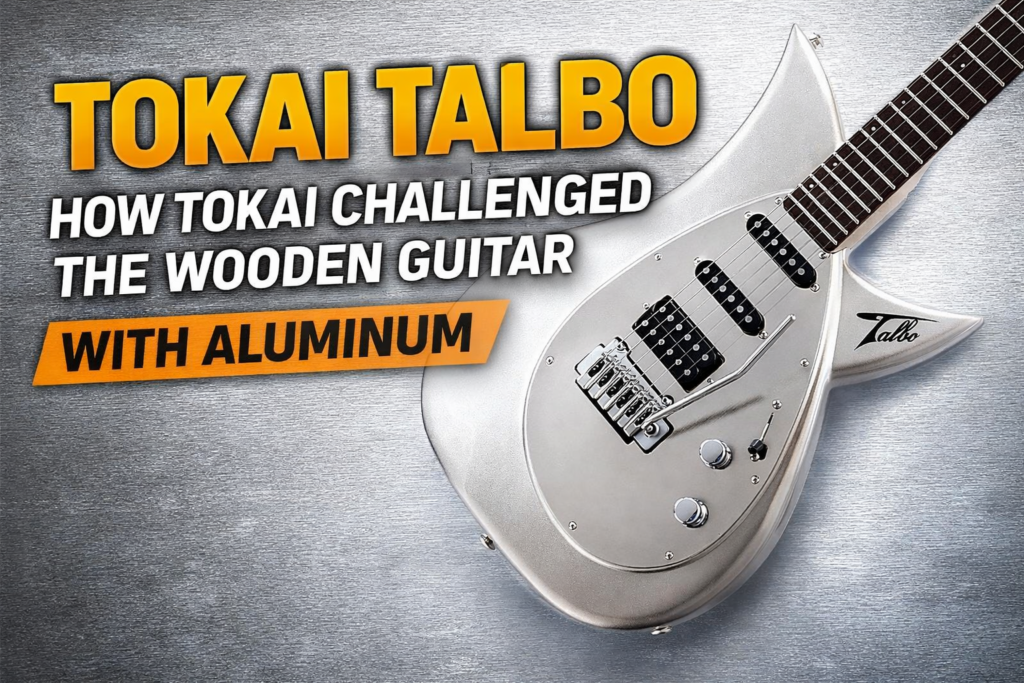
The Tokai Talbo is one of the boldest guitar designs to come out of Japan, launched in 1983 as an aluminum-body electric that broke away from wood at a time when most guitars still followed traditional construction and copy-model logic.
Tokai Talbo Quick Facts
- First Talbo model: Talbo A-series (1983)
- Name meaning: “T-ALLOY-BODY”
- Main concept: Aluminum body designed for shielding, fast response, and long sustain
- Early construction: Two-piece cast aluminum body, welded and foam-filled
- 1980s sales: Around 1,300 units before production stopped
- Revival: Rediscovered unused 1980s bodies in 1994, followed by a restart in 1996
- Modern milestone: Re:A-700 Talbo (2024), built from recycled Shinkansen N700 aluminum
The Tokai Talbo Was a Crazy Idea for 1983
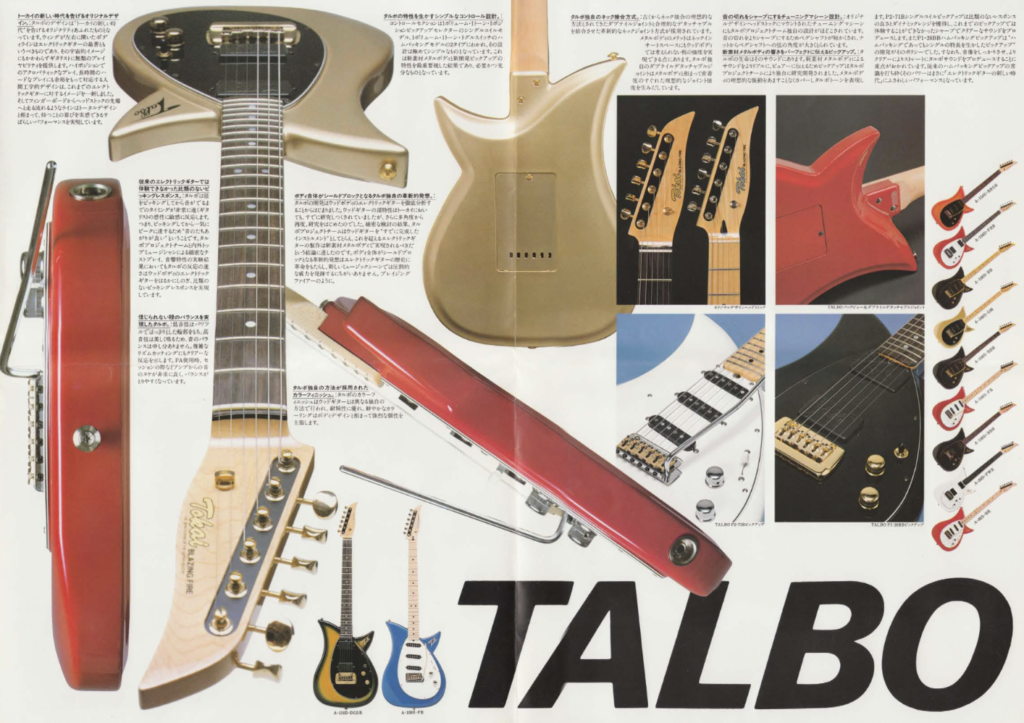
The Tokai Talbo launched in 1983, right after the Lawsuit Era, when Japanese brands were gradually shifting away from replica-style instruments and toward original designs. In a market still dominated by traditional wooden guitars, Talbo stood out immediately.
What “Talbo” Means
Even the name made the concept clear. Talbo stood for T-ALLOY-BODY. That name was more than branding. It directly reflected the guitar’s identity. Tokai was telling players from the start that this was a guitar defined by its material.
Why Tokai Used Aluminum
This was not metal for decoration. Tokai used aluminum as the structural core of the instrument. The idea was simple but radical: the metal body could act as a shield against noise, while also producing a brighter, sharper sound with long sustain.
Rather than making a slightly improved version of the traditional wood guitar, Tokai was trying to rethink what the guitar could be when wood was no longer the starting point.
How the Early Talbo Was Built
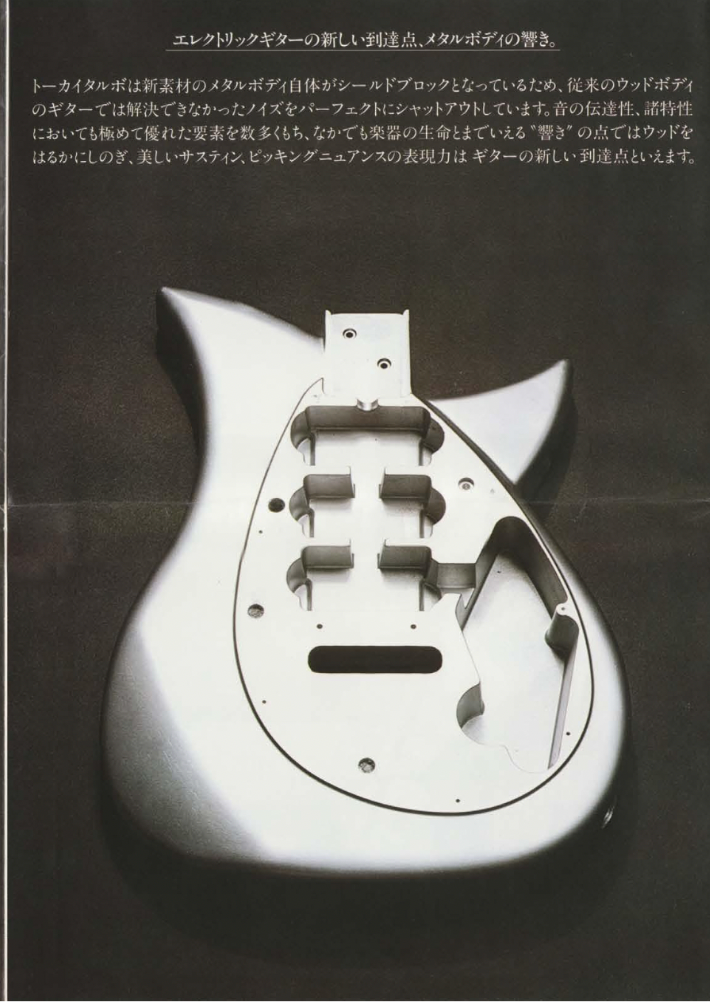
One of the most remarkable things about the early Talbo is just how industrial its construction was.
Two-Piece Aluminum Body Construction
Early Talbos used a two-piece aluminum body cast at around 800 degrees, welded together, and filled with foam inside. This was essentially an automotive-style casting process applied to a guitar. Even by the standards of the 1980s, that was an extreme design choice.
Why the Body Was Foam-Filled
The Talbo was not simply a hollow metal shell. The interior was filled with foam material, which helped control resonance and stabilize the structure. That detail matters, because it shows Tokai was not chasing aluminum for visual impact alone. The entire body design was part of an effort to shape the instrument’s response and sound.
Tokai Talbo Sound Characteristics
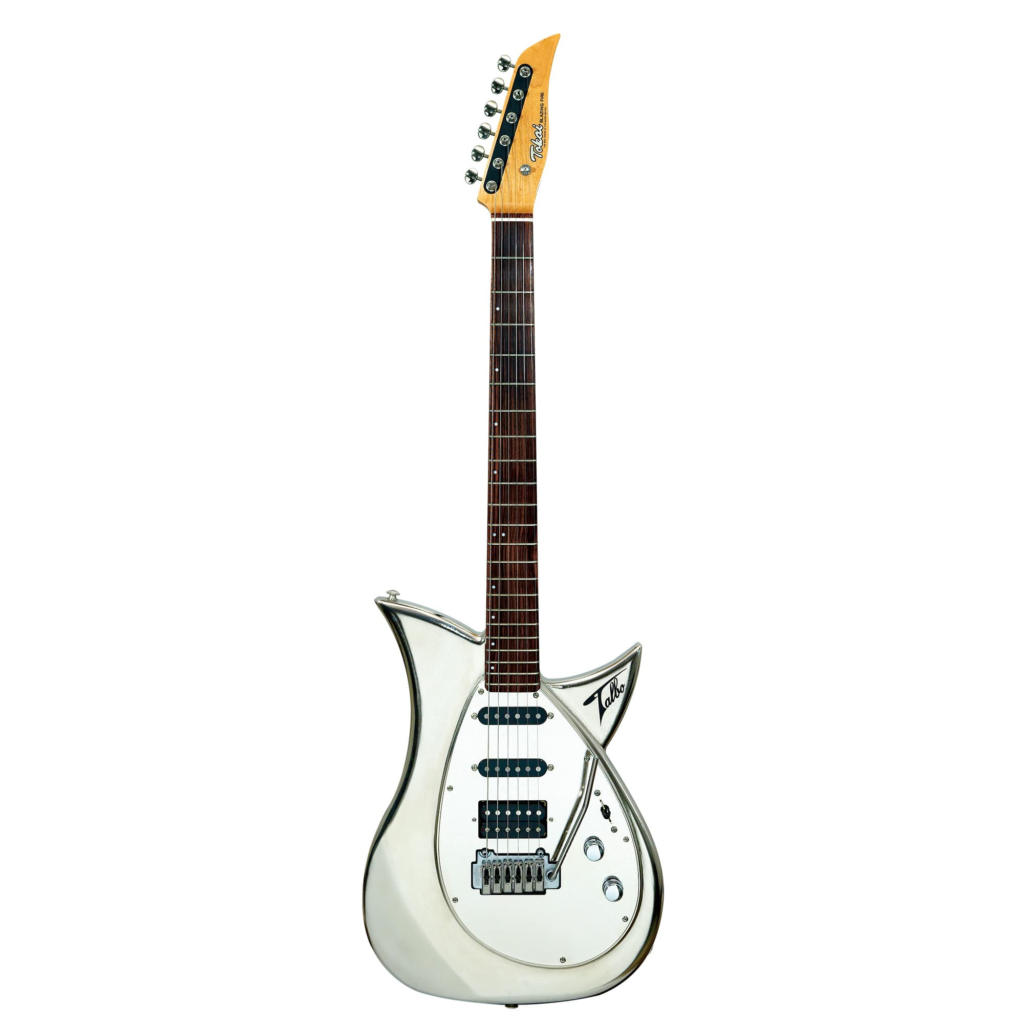
The Talbo sounded as unusual as it looked.
Bright, Sharp, and Fast in Response
According to Tokai’s own presentation, and consistent with the guitar’s construction, the Talbo was bright, direct, sharp, and fast in response. It did not behave like a normal wooden guitar, and that was exactly the point.
Long Sustain Was Central to the Concept
Long sustain was also part of the Talbo identity. Tokai was not just promoting a metal guitar with a different visual style. It was presenting a guitar with a noticeably different attack, clarity, and decay profile.
The Two Talbo Catalog Graphs Explained
One of the most fascinating aspects of the original Talbo is that Tokai tried to explain the guitar scientifically. The catalog included two graphs to show why Talbo was different.
Faster Attack and Smoother Decay
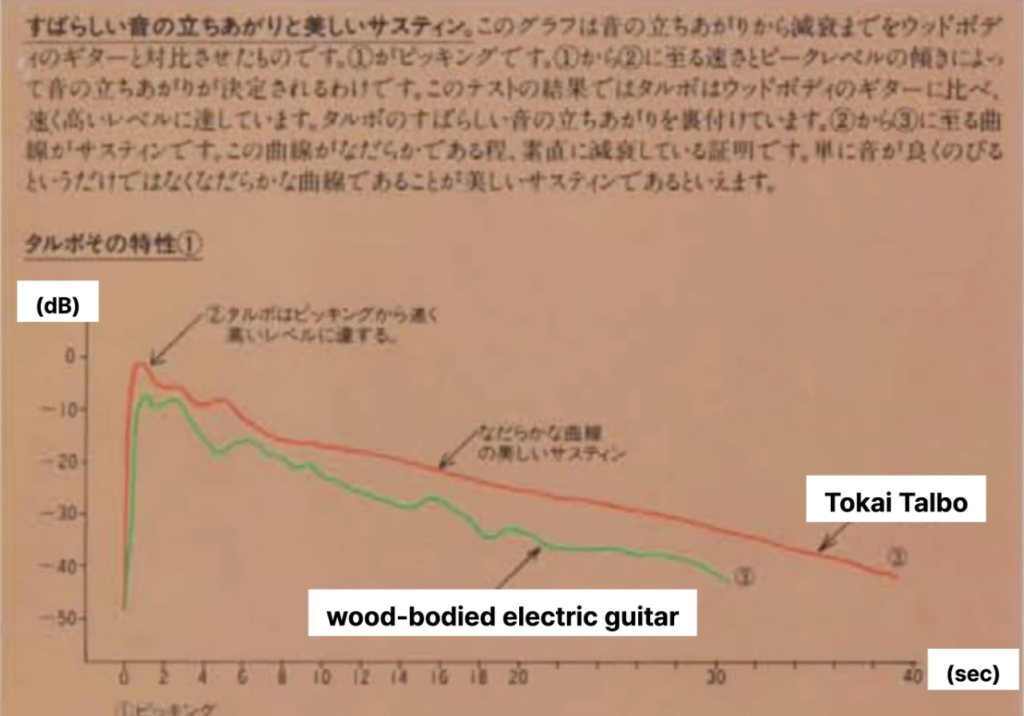
The first graph showed how the sound rose and decayed from the moment a note was picked. Tokai’s message was clear: the Talbo reached its peak faster, suggesting a sharper attack and quicker response. The decay curve was also shown as smoother and more gradual, supporting the idea of longer sustain and a more controlled fade.
Lower Internal Energy Loss
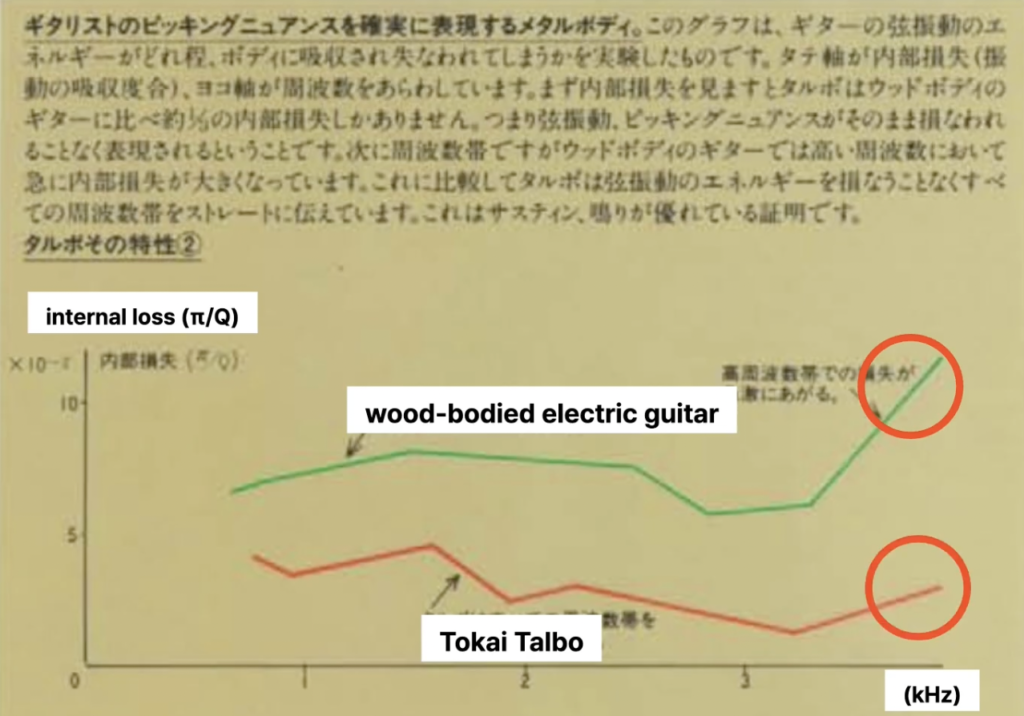
The second graph focused on how much vibrational energy was lost inside the body itself. In Tokai’s comparison, the wooden guitar showed greater energy loss, especially in the higher frequencies, while the Talbo showed lower internal loss across the range. Tokai linked this directly to clarity and sustain, arguing that more of the string vibration was being preserved.
What These Graphs Actually Tell Us
Taken at face value, these graphs make the Talbo look overwhelmingly superior to a wooden guitar. But I think they are more useful when read a little more carefully.
They tell us a lot about how Tokai wanted to present the Talbo, and they clearly explain why the instrument felt so radical at the time. Fast response and long sustain were obviously central to its appeal. At the same time, that does not automatically mean Talbo was simply better than wood in every possible sense.
Some players are drawn to speed, clarity, and a sharp attack. Others still prefer the softer, more organic response of a wooden guitar. In that sense, the graphs are less about proving that Talbo replaced wood and more about showing that Tokai was trying to redesign the guitar from a completely different angle.
Why the First Talbo Did Not Succeed Immediately
For all its originality, the Talbo arrived too early.
Slow Sales in the 1980s
The market was not ready for such a radical design. Sales in the 1980s were slow, with only around 1,300 units sold, and production eventually stopped. For a time, the Talbo looked less like the future of guitar design and more like a short-lived experiment.
Why Timing Mattered
That does not mean the concept itself was weak. In many ways, Talbo simply appeared before players were ready to accept a guitar that looked, sounded, and behaved so differently from the wooden standard.
How the Tokai Talbo Came Back
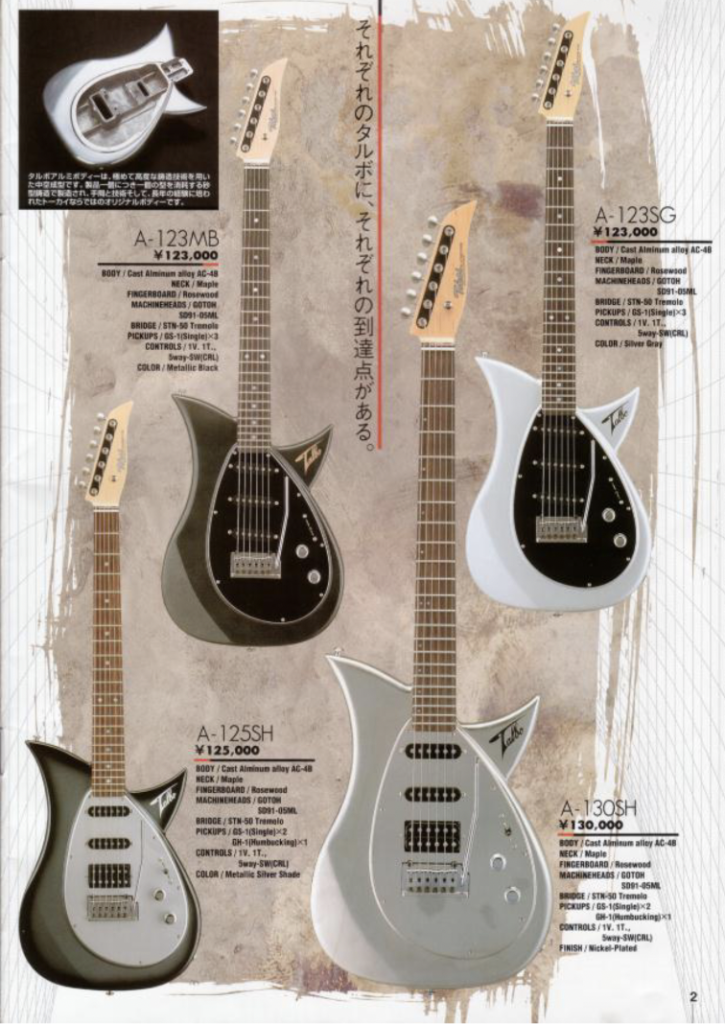
The Talbo story did not end with its first production run.
The 1994 Rediscovery
In 1994, Tokai found more than one hundred unused Talbo bodies from the 1980s sitting in a factory. These were released as limited models and sold out almost immediately. That success brought Talbo back.
Full Restart in 1996
By 1996, Tokai had fully restarted the model, and the concept became even bolder. This is one of the reasons Talbo matters so much. It was not just an abandoned experiment. It returned because there was still something compelling about the idea.
The Talbo Expanded Beyond a Single Model
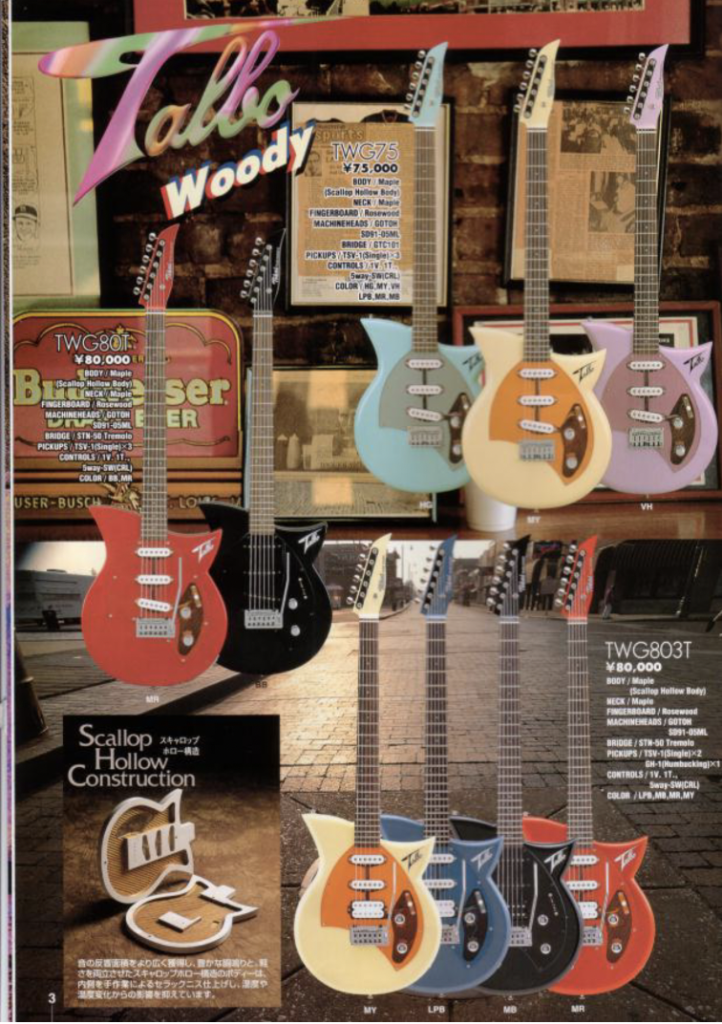
Once Talbo returned, it stopped being just one unusual aluminum guitar.
Talbo Woody, Tarbosaurus, and Acrylic Models
The lineup grew to include the Talbo Woody with a wood body, the aggressive Tarbosaurus, and even clear acrylic versions that glowed under stage lights. At that point, Talbo had become more than a single model. It had become a platform for experimentation.
A Platform Rather Than a One-Off Experiment
That shift is important. It shows Tokai was no longer treating Talbo as a novelty. The company was using it as a space to keep testing new materials, new visual ideas, and new forms of guitar design.
The 2024 Re:A-700 Talbo and the Shinkansen Connection
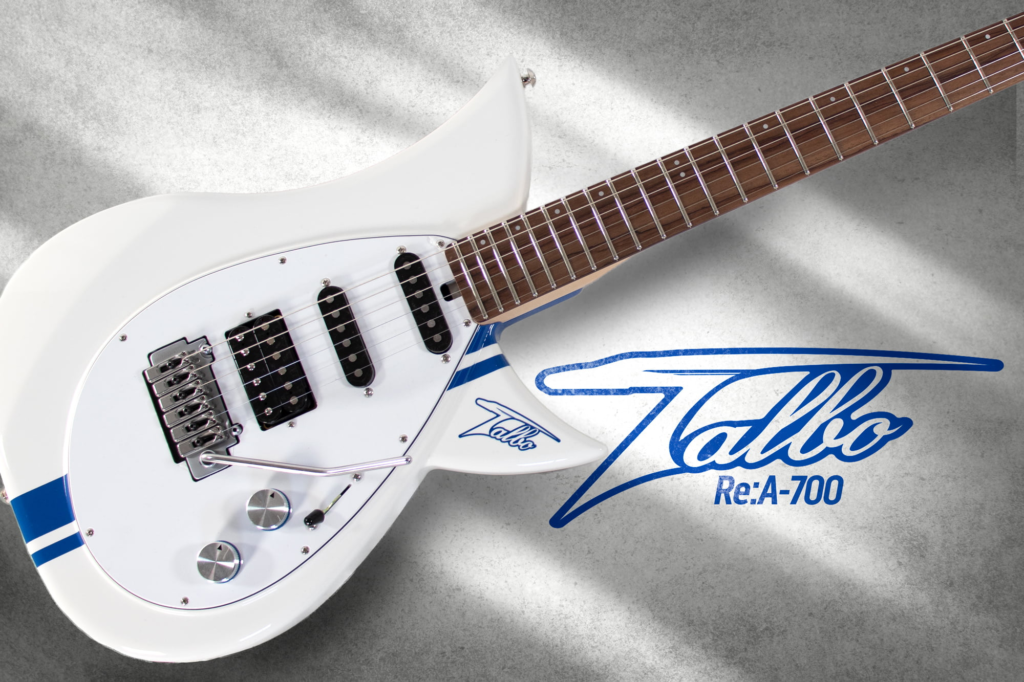
One of the most striking modern Talbo examples is the 2024 Re:A-700 Talbo.
Built from Recycled Shinkansen Aluminum
Tokai built this model from recycled aluminum taken from Tokaido Shinkansen N700 bullet train cars. Only sixty units were made, and they sold out instantly.
Why This Model Matters
That detail says a lot. From aluminum to bullet train metal, Talbo shows just how far Japanese guitar design was willing to go. By this point, Talbo was no longer just a guitar made from an unusual material. It had become a symbol of engineering, experimentation, and a willingness to rethink the instrument itself.
Why the Tokai Talbo Still Matters
Commercially, the Talbo did not become the new standard. But historically, I think it matters a great deal.
More Than a Strange Side Project
I do not see the Talbo as a random oddity from the 1980s. To me, it represents the point where a Japanese brand realized imitation was no longer enough and started asking much bigger questions.
A Key Moment in Japanese Guitar Design
That is why Talbo remains so interesting now. It captures a moment when Japanese builders were willing to experiment, take risks, and rethink the basic assumptions behind the electric guitar.
Tokai’s Another Challenge to Wood:
Final Thoughts on the Tokai Talbo
The Tokai Talbo was never just about aluminum. It was about a different way of thinking.
Instead of accepting wood as the unquestioned starting point, Tokai asked what would happen if the guitar were rebuilt around another logic entirely. The result was one of the boldest material experiments in Japanese guitar history.
FAQ
What is the Tokai Talbo?
The Tokai Talbo is an electric guitar launched in 1983 that became known for its aluminum body construction. Unlike traditional wooden guitars, it was built around metal as the core of the instrument, making it one of Tokai’s boldest original designs of the post-Lawsuit Era period.
What does “Talbo” mean?
Talbo stands for “T-ALLOY-BODY.” The name reflects the guitar’s defining concept: an electric guitar built around an alloy body rather than conventional wood construction.
Why did Tokai use aluminum for the Talbo?
Tokai used aluminum because it believed a metal body could act as a shield against noise while also producing a brighter, sharper sound with long sustain. The Talbo was not designed as a decorative metal guitar, but as a serious attempt to rethink how the instrument itself could work.
How was the early Tokai Talbo constructed?
Early Talbo models used a two-piece cast aluminum body formed at around 800 degrees, welded together, and filled with foam inside. This automotive-style casting approach was highly unusual for guitar building in the early 1980s.
How did the Tokai Talbo sound compared with wooden guitars?
Tokai presented the Talbo as bright, direct, sharp, and fast in response, with long sustain. Catalog materials also suggested lower internal energy loss than a wooden guitar, although that should be understood as part of Tokai’s technical presentation rather than proof that Talbo was universally better than wood in every musical context.
Why did the original Tokai Talbo stop production?
The Talbo was a radical design for its time, and the market was not fully ready for it. Sales in the 1980s were relatively slow, at around 1,300 units, and production eventually stopped despite the guitar’s originality.
How did the Tokai Talbo return in the 1990s?
In 1994, Tokai rediscovered more than one hundred unused Talbo bodies from the 1980s in a factory. These were released as limited models and sold out quickly, leading to a full restart of the Talbo line in 1996.
What is the Re:A-700 Tokai Talbo?
The Re:A-700 Talbo is a 2024 Talbo model built from recycled aluminum taken from Tokaido Shinkansen N700 bullet train cars. Only 60 were made, making it one of the most distinctive modern Talbo releases.
More Tokai Guitars Article
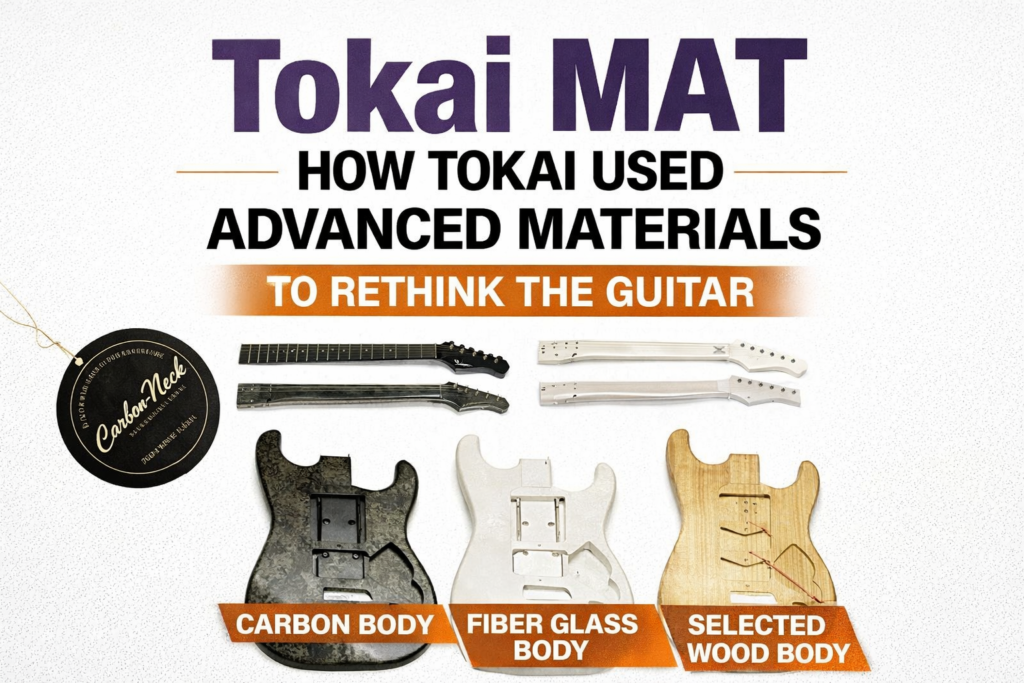
Tokai MAT: How Tokai Used Advanced Materials to Rethink the Guitar
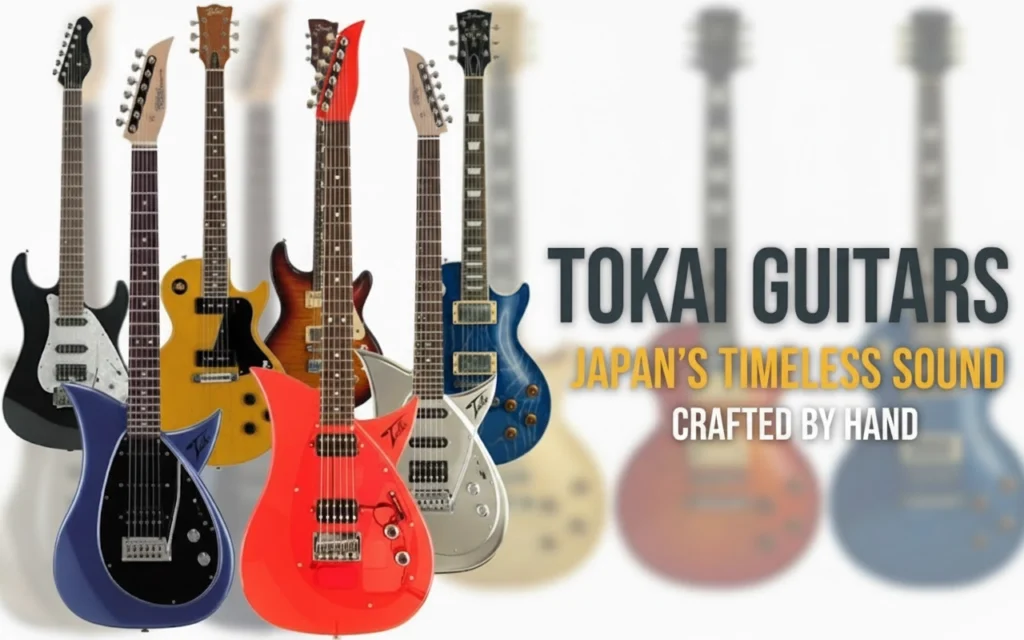
Tokai Guitars — The Art of Japanese Timeless Sound and Craftsmanship