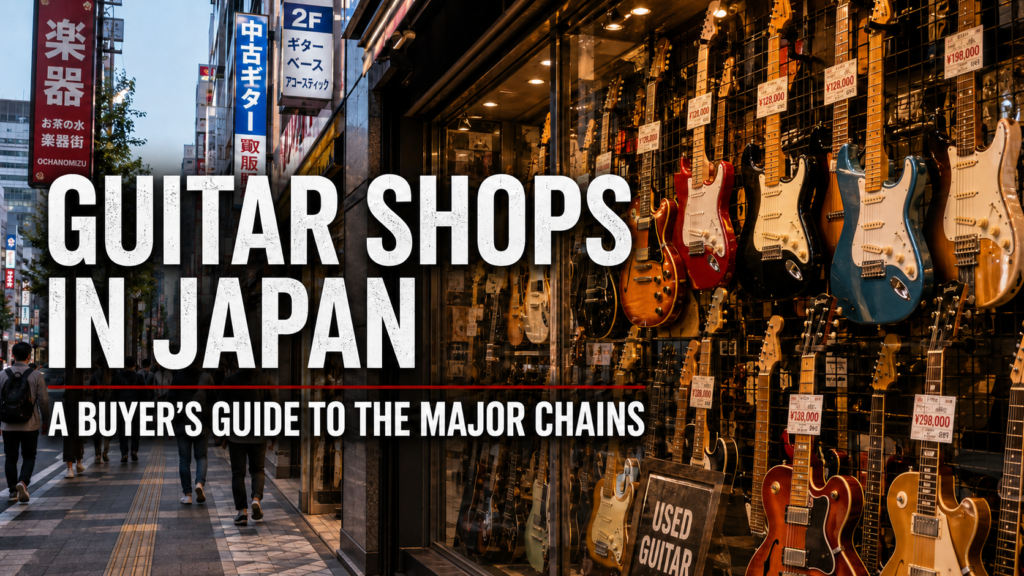
If you’ve spent any time browsing Yahoo Auctions, Mercari, or Digimart for a Japanese-made guitar, you’ve probably run into the same handful of store names over and over: Shimamura, Ishibashi, Kurosawa, Ikebe. These are the guitar shops in Japan that matter most — the country’s largest musical instrument retailers — and each has a distinct personality shaped by decades of history. Knowing what each chain is known for — and what it isn’t — will save you time when you’re trying to work out where a good deal is likely to come from, and what kind of guitar you’re likely to find there.
This guide to guitar shops in Japan covers the four largest nationwide chains, plus a couple of smaller specialty shops that come up constantly in vintage and used-gear circles, particularly around Tokyo’s Ochanomizu “guitar street” and the Ikebukuro–Shibuya corridor.
It’s worth understanding these differences before you start browsing, because the chain behind a listing tells you something about the instrument before you’ve even read the description. A guitar from a store with an in-house repair and buyback program has usually already been through an inspection process; a guitar from a tiny independent shop might be a one-owner instrument the proprietor knows the full history of; a guitar on a general marketplace with no store name attached is the one case where you genuinely know nothing until you ask. None of these are better or worse across the board — they’re just different starting points for the questions you should ask next.
Shimamura Music (島村楽器) — Japan’s Largest, By Far
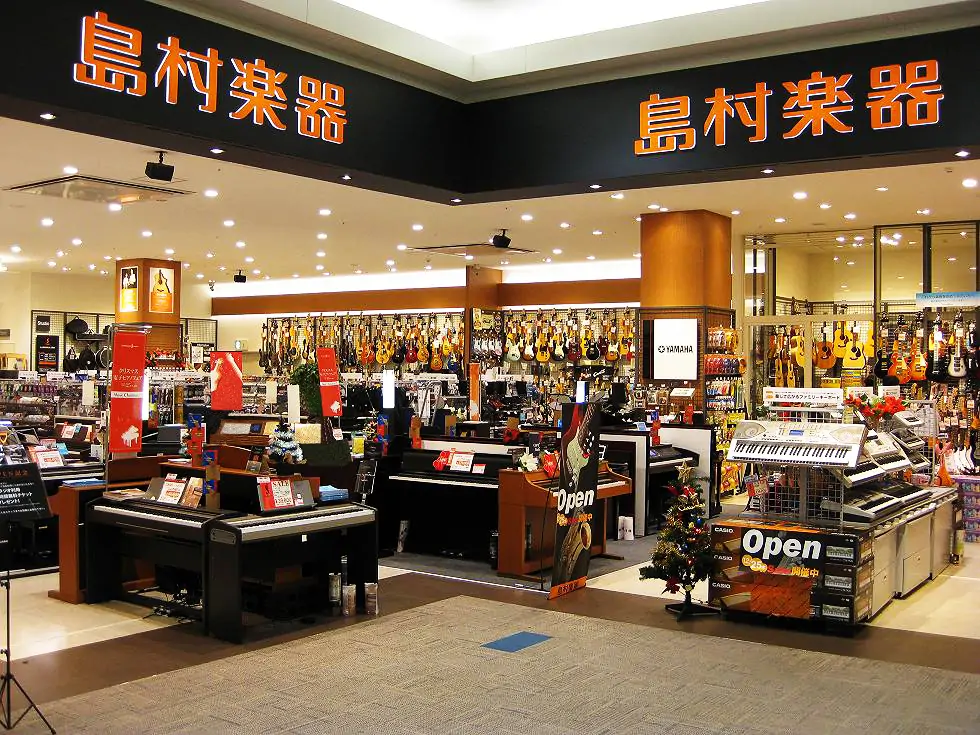
Shimamura is the giant of the industry. With roughly 190 stores spread across the 41 prefectures it currently operates in, it is by a wide margin the largest musical instrument retailer in Japan, and one of the largest in the world. If a town in Japan has any music store at all, there’s a good chance it’s a Shimamura.
Because of that scale, Shimamura functions more like a full-line department store for musicians than a specialist shop. You’ll find new guitars from every major Japanese and international brand, a large in-house lesson business, sheet music, drums, keyboards, and accessories, all under one roof. Its used and vintage selection exists, but it varies enormously from branch to branch — a suburban location might have two or three used guitars on the wall, while a flagship store in a city center might have a genuinely interesting rack.
For overseas buyers, Shimamura is most useful for two things: spotting new-production, Japan-only models (domestic boutique lines and limited-run colors that never get exported), and cross-checking retail pricing, since its nationwide presence makes its listed prices a reasonable benchmark for what a “fair” new price looks like.
Ishibashi Music (石橋楽器店) — The Export-Friendly Specialist
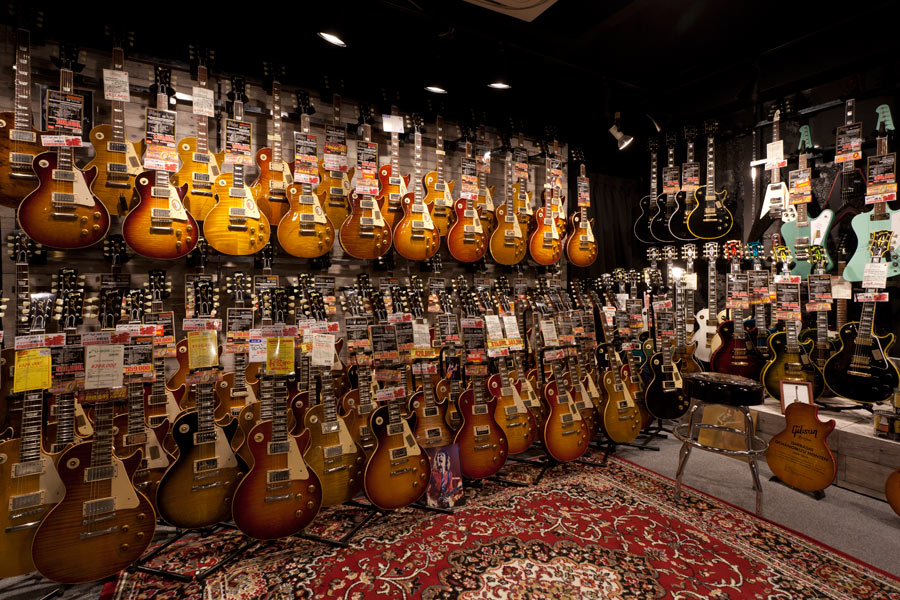
Ishibashi operates a much smaller footprint than Shimamura — around 10 to 12 stores, concentrated in Tokyo, Kanagawa, Aichi, Osaka, and Fukuoka — but it punches well above its size in the overseas market. Ishibashi runs a dedicated international division built specifically to sell and ship to buyers outside Japan, and it maintains an active presence on platforms like Reverb and eBay.
That overseas-facing infrastructure makes Ishibashi one of the easier chains to buy from directly if you don’t read Japanese or don’t have a forwarding address in Japan. Its used and vintage sections are also a consistent draw — Ishibashi has a long-standing reputation among Japanese players for carrying interesting secondhand electrics and basses, not just new stock.
Kurosawa Gakki (黒澤楽器店) — The Fretted-Instrument Specialist
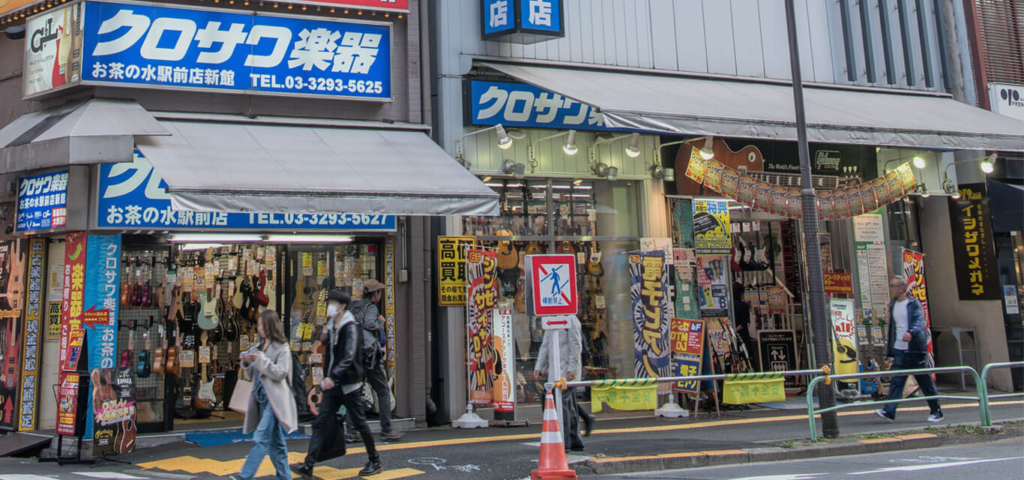
Kurosawa is smaller still, with about 13 stores centered on Tokyo plus two wholesale offices in Tokyo and Osaka, but it has an outsized reputation among guitar and bass players specifically. Its flagship store in Ikebukuro is known for keeping something like 1,200 fretted instruments in stock at any given time, spanning new, used, and vintage tiers.
Kurosawa has been part of Tokyo’s music retail landscape since well before the current vintage-guitar boom, and it shows in the depth of its used inventory. If you’re hunting for a specific era of Japanese-made instrument rather than just “a guitar,” Kurosawa is one of the first names serious collectors mention.
Ikebe Gakki (池部楽器店) — Scale Plus a Dedicated Reuse Arm
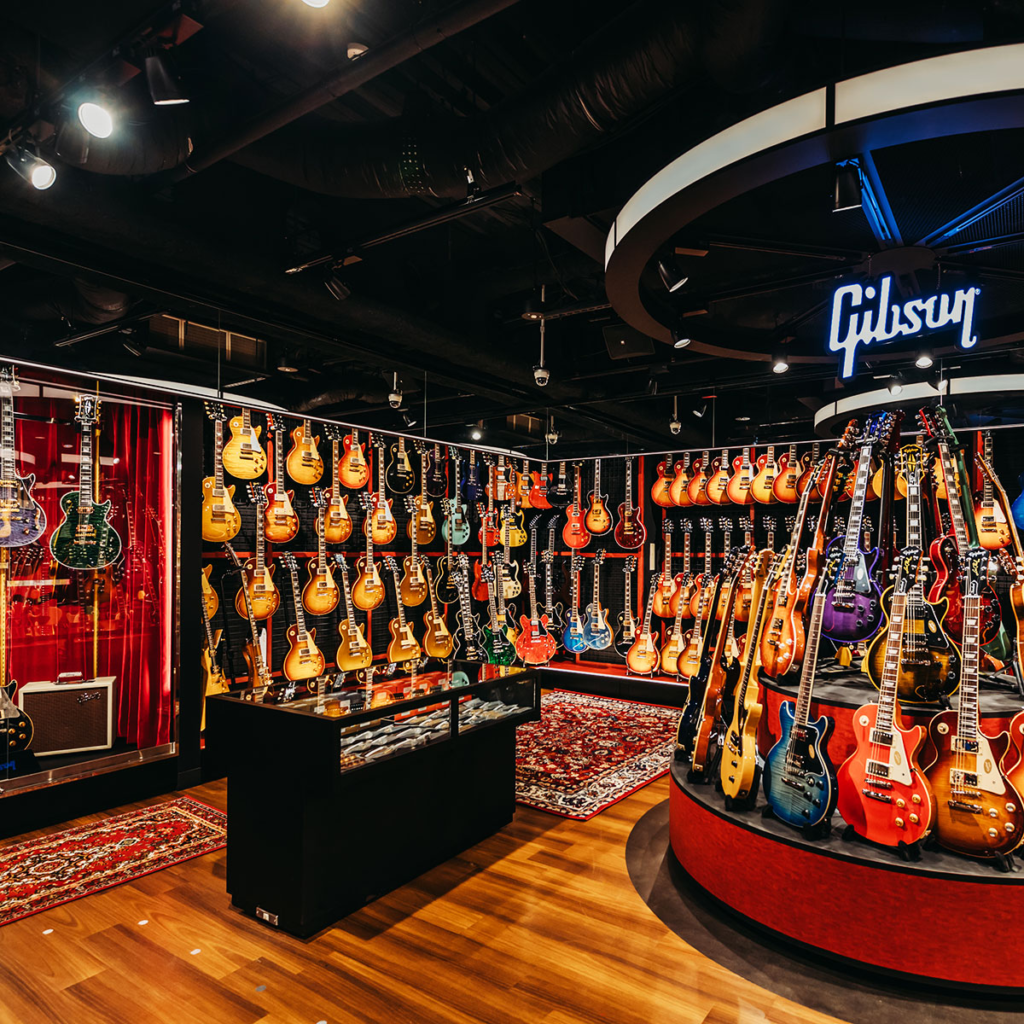
Founded in 1975 and now marking its 50th anniversary, Ikebe operates roughly 27 to 31 stores concentrated in Tokyo’s Ikebukuro, Shibuya, and Akihabara districts, with a further presence in Osaka. Its Shibuya flagship, IKESHIBU, groups multiple specialty shops — electric guitar, acoustic, effects, recording gear — into one complex.
What sets Ikebe apart for used-gear buyers is Ikebe Reuse, a dedicated secondhand retail arm with its own storefronts separate from the main new-gear shops. Every instrument that comes through Ikebe Reuse is inspected, cleaned, and serviced by staff before it goes back on sale, which is a meaningfully different process from a private seller listing a guitar as-is.
Guitar Shops in Japan at a Glance
| Chain | Approx. Stores | Known For | Best For |
| Shimamura | ~190 | Nationwide reach, full product line | New gear, Japan-only models, price benchmarking |
| Ishibashi | ~10–12 | Overseas-ready sales, used/vintage | Buyers without a Japan address |
| Kurosawa | ~13 | Huge fretted-instrument inventory | Vintage and collector-grade hunting |
| Ikebe | ~27–31 | Dedicated Ikebe Reuse used-gear arm | Inspected, serviced used instruments |
Smaller Specialty Shops Worth Knowing
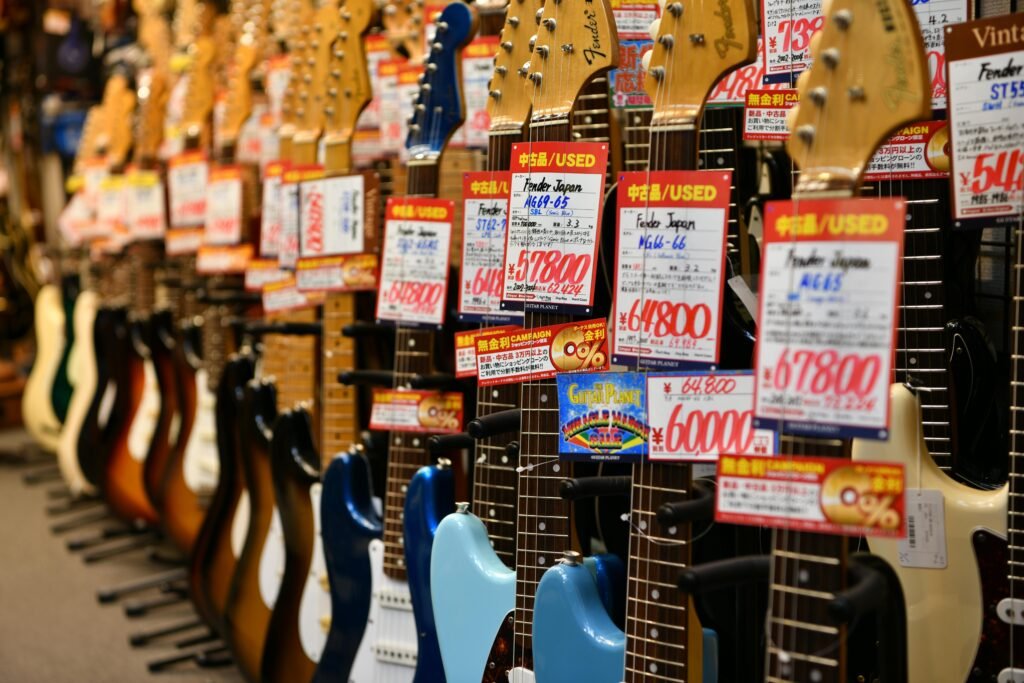
Beyond the big four, a handful of smaller shops come up constantly in forums and Digimart listings:
- Rock Inn — a well-regarded chain with locations in Shinjuku and Shibuya, known for a strong used inventory in busy, high-traffic areas.
- Guitar Planet — based in Ochanomizu, the Tokyo neighborhood nicknamed “Guitar Street” for its density of instrument shops; its upstairs floor is dedicated to secondhand gear.
Ochanomizu itself is worth knowing as a destination rather than a single store — it’s a several-block stretch packed with independent guitar shops, making it the closest thing Tokyo has to a walkable guitar district.
How to Search Across All of Them at Once
Rather than checking each chain’s website individually, most serious buyers — Japanese and overseas alike — use Digimart (digimart.net), a marketplace aggregator that pulls current listings from hundreds of Japanese music stores, including all of the chains above, into one searchable database. It’s the closest thing to a single source of truth for “what’s actually for sale in Japan right now,” and the fastest way to compare the same model across multiple sellers.
If you find something you like through a smaller shop that doesn’t obviously ship overseas, a polite, well-written inquiry email is often all it takes to open the door to an international sale — see our related guides on buying a guitar from Japan and writing a Japanese-language inquiry email.
Regional Access: Not Every Chain Is Everywhere
One practical point that’s easy to overlook: because Ishibashi, Kurosawa, and Ikebe are concentrated around Tokyo and a handful of other major cities, a guitar you find through one of them was very likely inspected, priced, and photographed by staff in Tokyo, Osaka, or one of the other big metro areas, even if the model itself was made somewhere else in Japan. Shimamura is the exception — with roughly 190 locations, it’s the only one of the four chains you’ll realistically find in smaller cities and regional towns, which is also why its used selection is so inconsistent from branch to branch. If you’re specifically looking for something unusual or regional, it’s worth checking Shimamura’s smaller branches on Digimart rather than assuming everything interesting is in Tokyo.
FAQ
Do all of Japan’s guitar shop chains ship overseas?
Not automatically. Ishibashi is the most overseas-ready of the major chains, with a dedicated international division. Shimamura, Kurosawa, and Ikebe primarily serve the domestic market, though individual branches will often arrange international shipping if you ask — especially through a forwarding service or a polite direct inquiry.
Which guitar shop in Japan is best for vintage-specific hunting?
Kurosawa’s Ikebukuro flagship and the independent shops around Ochanomizu (including Guitar Planet) have the strongest reputations among collectors for vintage and rare used instruments.
Is the price on the tag negotiable at Japanese guitar shops?
Large chains generally sell at marked price with little room to negotiate, though trade-in credit and bundled accessories are common. Smaller independent shops have more flexibility.
Can I trust a store’s “used” condition grading?
Chain stores that run their own buyback and reuse programs — Ikebe Reuse being the clearest example — typically inspect and service instruments before resale, which is a more reliable baseline than an unverified private listing. It’s still worth asking directly about any cosmetic or mechanical issues before you buy.
Do I need to speak Japanese to buy from these stores?
It helps, but it isn’t strictly necessary. Ishibashi’s international division operates in English by design. For the domestic-focused chains, a short, polite email in simple Japanese — or even English, at larger city-center branches — is often enough to get a response, particularly for a specific, well-identified instrument rather than a general inquiry.