Browse enough Japanese guitar listings — on Digimart, Yahoo Auctions, Mercari, or a shop’s own site — and you’ll start running into the same handful of Japanese guitar terms over and over, words that don’t translate cleanly into English and that machine translation tends to mangle. Three in particular come up constantly enough that it’s worth learning them properly: ガリ (gari), 反り (sori), and 鳴り (nari). None of them are obscure or technical to a Japanese player — they’re everyday guitar vocabulary — but they describe things English-speaking buyers usually phrase very differently, which means a listing that mentions them can be easy to misread or miss entirely if you don’t know what you’re looking at.
What makes these three worth learning specifically, rather than just running every listing through a translator, is that they’re exactly the kind of words machine translation handles worst: short, colloquial, and dependent on guitar-specific context. A translator will happily render ガリガリ as a description of crunching food, or leave 鳴り as a vague reference to “sound,” because outside of an instrument listing, those are perfectly reasonable readings. Once you know the three terms below, though, you’ll recognize them instantly, and you’ll be able to read a raw Japanese listing almost as easily as a translated one.
ガリ (Gari) — Crackle, Not Damage
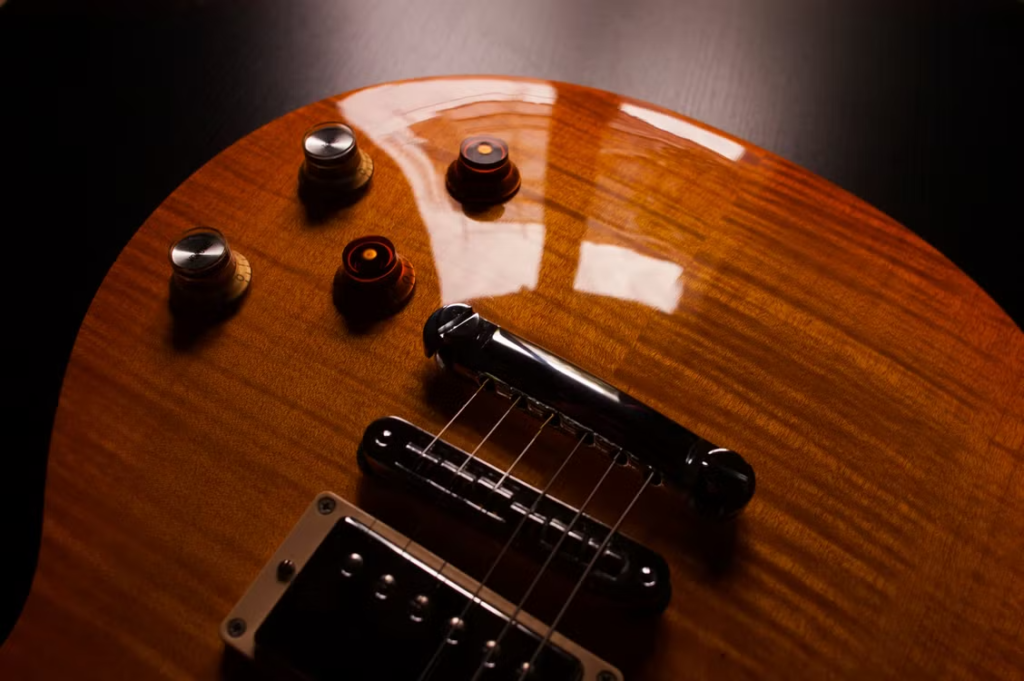
Gari (more fully, garigari, ガリガリ — a Japanese sound-word, or onomatopoeia, for a dry, scratchy, grinding noise) refers to the crackling or scratching sound that comes through an amp when you turn a volume or tone knob, jiggle a cable, or flip a pickup selector. It’s caused by oxidized or dirty contacts inside a potentiometer, switch, or jack — a textbook case of electrical contact resistance, not anything structurally wrong with the guitar.
In listings, you’ll see it phrased as things like ガリあり (gari ari — “has gari,” i.e., there is crackle present) or ガリなし (gari nashi — “no gari,” i.e., the electronics are clean). It’s one of the most commonly disclosed issues on used Japanese gear, precisely because it’s so easy to check and so honestly reported — a seller turning every knob and flipping every switch before listing an instrument is standard practice.
The good news for buyers: gari is usually a minor, fixable issue. A round of contact cleaner and some exercising of the pot or switch resolves it in most cases; a full pot or switch replacement is inexpensive if it doesn’t. It’s worth asking about before you buy, but it’s rarely a reason to walk away from an otherwise good instrument — more a negotiating point than a red flag.
反り (Sori) — Neck Warp, in Either Direction
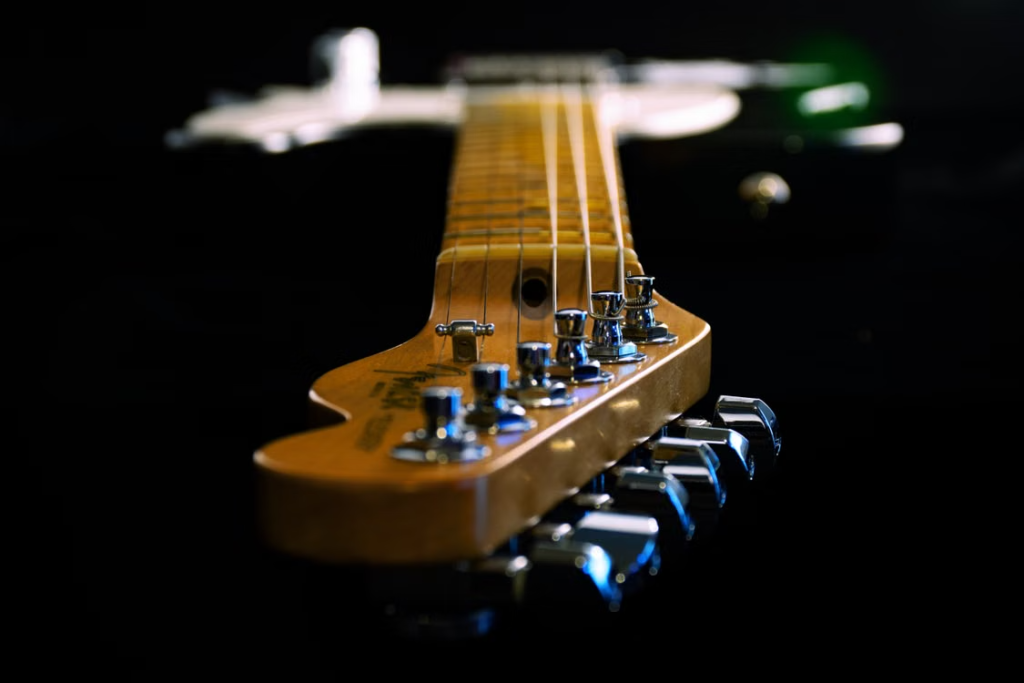
Sori literally means “warp” or “bend,” and in a guitar context it almost always refers to the neck. A neck that isn’t perfectly straight is described with sori, and Japanese listings and repair descriptions get more specific with two compound terms:
- 順反り (jun-zori) — “forward bow,” where the neck curves away from the strings, low in the middle. A small amount is actually normal relief that most necks need on purpose; excess is the problem.
- 逆反り (gyaku-zori) — “back bow,” where the neck curves the other way, causing buzzing and playability issues — generally the more serious of the two.
Neck warp happens for the same reasons everywhere — usually humidity and temperature swings acting on the wood over time, sometimes truss rod issues — but it’s a term you’ll see disclosed unusually often in Japanese listings, again reflecting a general habit of inspecting and reporting playability issues honestly before a sale. A description might read ネック反りなし (nekku sori nashi — “no neck warp”) or note a small amount as わずかに順反りあり (“slight forward bow present”).
You may also see the related word うねり (uneri, “twist” or “wave”) used for a neck that isn’t warped end-to-end but has an uneven, wavy feel along its length — a separate and generally rarer issue from straightforward sori, and usually harder to correct with a truss rod alone.
For overseas buyers specifically, sori is worth paying extra attention to for a reason that has nothing to do with the seller: shipping a guitar from Japan’s climate into a very different one — a dry winter in North America, for instance — can introduce new warp or relief changes in transit or shortly after arrival, even in a guitar that measured perfectly straight when it left the store. It’s not a defect in the instrument or a sign of a bad sale; it’s a normal consequence of wood responding to a different environment, and it’s usually correctable with a simple truss rod adjustment once the guitar has acclimated for a week or two.
鳴り (Nari) — The Hardest of the Three to Translate
Nari is the trickiest term of the three, because it doesn’t map onto a single English word — the closest attempts are “resonance,” “acoustic voice,” or the way a guitar “breathes,” but none of them fully capture it. Literally, nari means “ringing” or “sounding,” and in guitar contexts it usually appears as 生鳴り (nama-nari) — the sound an electric guitar makes acoustically, unplugged, just from the vibration of the body and strings.
Japanese players and sellers talk about nari constantly, often in fairly subjective, almost poetic terms — a guitar with good nari “sings” or “breathes” when you play it unplugged, with a lively, resonant quality that (the theory goes, though it’s genuinely debated even among Japanese builders and players) often correlates with how the instrument responds and sustains once it’s plugged in. You’ll see it in listing copy as 鳴りが良い (nari ga ii — “has good nari/resonance”) or 生鳴りの良いギター (a guitar with good acoustic resonance).
It’s worth knowing the term specifically because it’s genuinely contested even within Japan — plenty of experienced builders and players argue that unplugged resonance is a poor predictor of amplified tone, while others swear by it as a first check on any guitar they pick up. Either way, if you see nari mentioned favorably in a listing, treat it as a seller’s subjective (and generally positive) impression of how alive the instrument feels to play, not a measurable spec.
Other Japanese Guitar Terms You’ll Run Into
A few related Japanese guitar terms worth recognizing, even if they come up less often than the three above:
- キズ (kizu) — a scratch, ding, or blemish; often quantified (小キズあり, “has small scratches”).
- サビ (sabi) — rust, usually on hardware like frets, bridge saddles, or tuners.
- ジャンク (janku) — “junk”; a listing category for non-working or heavily damaged instruments sold as-is, cheap.
- 現状渡し (genjō-watashi) — “as-is”; sold in current condition with no guarantee.
Learning even a handful of these terms makes a real difference when you’re reading listings directly rather than relying on machine translation, which tends to render gari, sori, and nari as literal nonsense rather than the specific, well-understood guitar vocabulary they actually are.
Putting It Together: Reading a Real Listing
A typical used-guitar listing on a Japanese site might include a condition line like this: 全体的に綺麗な状態です。ガリなし、ネック反りなし、生鳴りも良好です。小キズあり。 A word-for-word translation gets you most of the way there, but knowing the vocabulary tells you exactly what’s being claimed: the guitar is in generally clean condition, the electronics are quiet (no gari), the neck is straight (no sori), it resonates well unplugged (good nari), and it has some minor cosmetic scratches (kizu). That’s a genuinely useful, specific condition report — far more informative than the generic “good condition” you’d get from a listing that doesn’t use this vocabulary, and worth exactly as much as the seller’s reputation behind it.
FAQ
Is gari a dealbreaker when buying a Japanese guitar?
Usually not. It’s a common, inexpensive fix — contact cleaner or a pot/switch swap — and most Japanese sellers disclose it honestly rather than hide it.
Should I avoid any guitar described as having sori?
Not necessarily. Minor forward relief (jun-zori) is normal and often adjustable via the truss rod. Back bow (gyaku-zori) is more serious and worth asking more questions about, including whether the truss rod still has adjustment range.
Can I rely on “nari” as a guitar-buying criterion?
Treat it as a seller’s subjective impression rather than a hard spec. It’s a genuinely debated concept even among Japanese players, and unplugged resonance doesn’t always predict how a guitar will sound through an amp.
Are these Japanese guitar terms used the same way for basses and acoustic guitars?
Yes, all three apply just as naturally to basses (gari and sori especially) and acoustic guitars (nari especially, since the whole instrument is essentially a resonating body). You’ll see the same vocabulary in bass and acoustic listings without any change in meaning.