Orville vs Orville by Gibson is the first question to answer before you buy one. Both were Gibson-sanctioned, Japanese-made lines sold from 1988 to 1998, but the “by Gibson” guitars came with Gibson USA pickups and nitro finishes, and they sell for much more today. This guide shows four ways to tell them apart, plus what each one sells for in Japan and overseas. For the full brand story, see the Orville Brand Guide.
Orville vs Orville by Gibson Quick Facts
- Orville by Gibson: Gibson USA pickups, nitro finish, US pots and switches
- Orville: Japanese pickups, thin polyurethane finish, added in the mid-1990s
- Quickest check: “by Gibson” under the headstock logo
- Serials: G = Terada, number only = FujiGen, J and K = Orville
- Price gap: the same guitar often sells for about half as much in Japan as on Reverb in the US
Orville by Gibson vs Orville: The Short Answer
The brand launched as “Orville by Gibson,” and in the mid-1990s a more affordable line under the standalone “Orville” name was added. The big differences are the pickups and the finish: Orville by Gibson pairs Gibson USA ’57 Classics with nitro finishes — specs faithful to a real Les Paul — while standard Orvilles use Japanese pickups and polyurethane, closer to a typical Asian budget spec.
| Spec | Orville by Gibson (OBG) | Orville |
|---|---|---|
| Pickups | Gibson USA (’57 Classic; some Bill Lawrence “The Original” HB-R/HB-L) | High-quality Japanese-made |
| Finish | Nitrocellulose (especially Reissue series) | Thin polyurethane |
| Pots & switches | US-made (Orange Drop capacitors, Switchcraft) | Japanese-made |
| Bridge & tailpiece | Gotoh (both tiers) | |
Both tiers use Gotoh hardware for the bridge and tailpiece. Gotoh is Japan’s gold standard, offering excellent tuning stability and tonally neutral bridges.
Check 1: Look for “by Gibson” on the Headstock
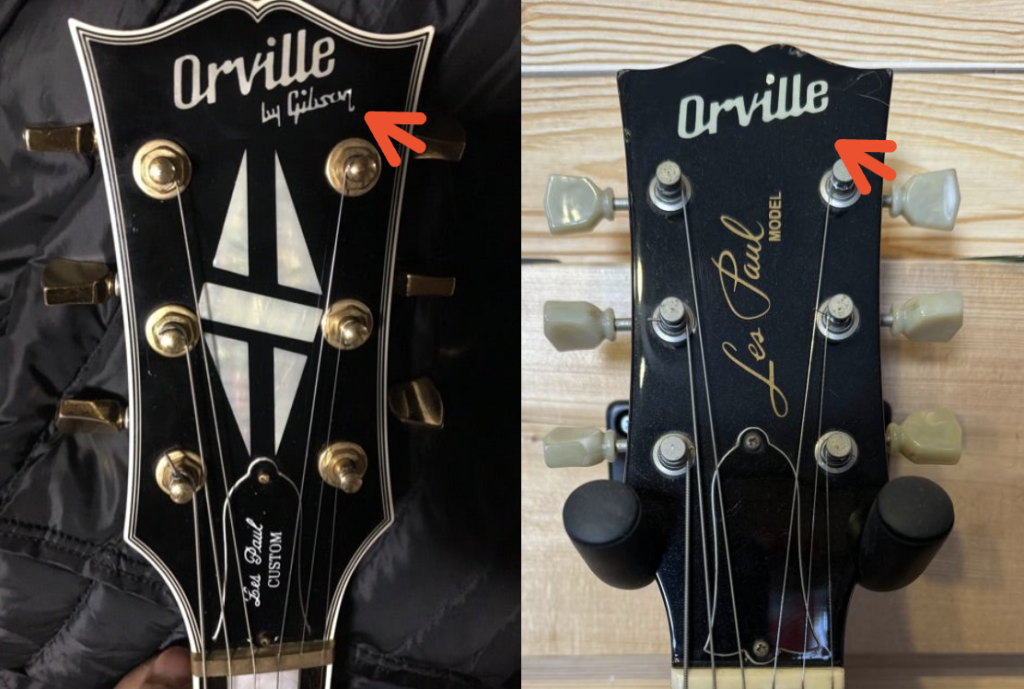
The fastest check is the headstock. Orville by Gibson guitars carry “by Gibson” in small script under the Orville logo; standard Orvilles don’t. Both share the open-book headstock and the “Les Paul Model” silkscreen, so the small script is what matters.
Check 2: Pickups and Finish
If the headstock has been refinished or the photos are unclear, look inside. Gibson USA pickups (usually ’57 Classics, sometimes Bill Lawrence units on early guitars), US-made pots and Switchcraft parts point to Orville by Gibson. Japanese pickups and a thin poly finish point to the standard Orville. Pickups are easy to swap, though, so use this as a second check, not the only one.
Check 3: Read the Serial Number
You can also identify a guitar by its serial number:
| Brand | Serial Format | Factory / Notes |
|---|---|---|
| Orville by Gibson | G + 6 digits (e.g., G88xxxx) | Terada, 1988–1993. First digit after “G” = year (8 = 1988). |
| Orville by Gibson | No letter + 6 digits (e.g., 210xxx) | FujiGen, from c. 1992. First digit = year (2 = 1992). |
| Orville | J + 6 digits | Terada. |
| Orville | K + 6 digits | K series (Kanda Shokai). Often printed logo instead of inlay. |
| Orville | No letter + 6 digits | Late FujiGen, 1993 onward. First digit = year. |
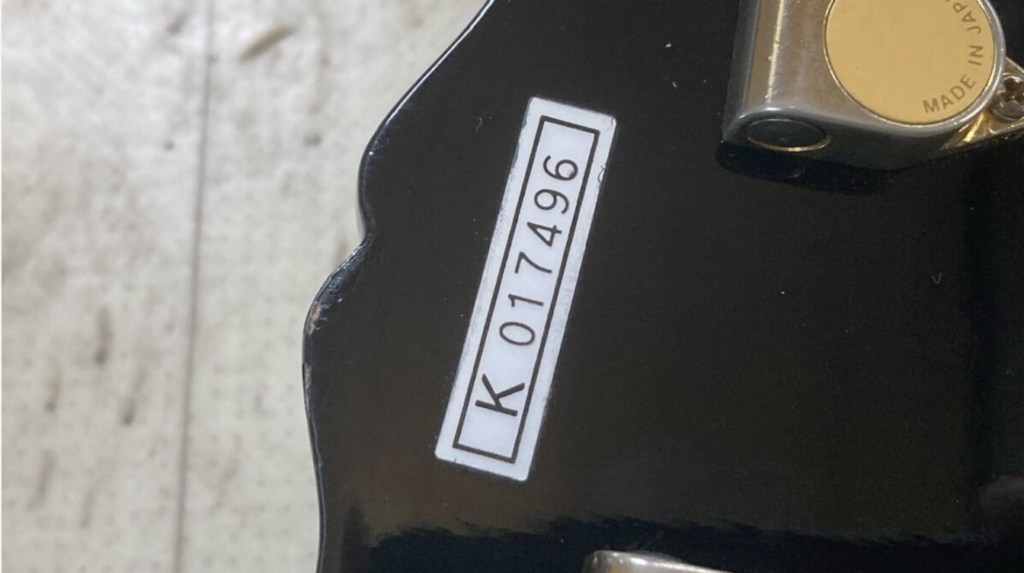
Both lines are, of course, made in Japan. Or at least, that’s what we’d like to say definitively. Rumors have long circulated that some Orvilles were made in Korea. Serials beginning with “K” were long believed to be Korean-made, but in recent years that theory has been largely rejected — the prevailing view now is that these were Japanese-made as well. Opinions vary, so if you know more, let us know in the comments.
Check 4: Terada or FujiGen?
From 1988 to around 1993, production was handled by Terada Gakki; from 1992 onward, FujiGen took over.
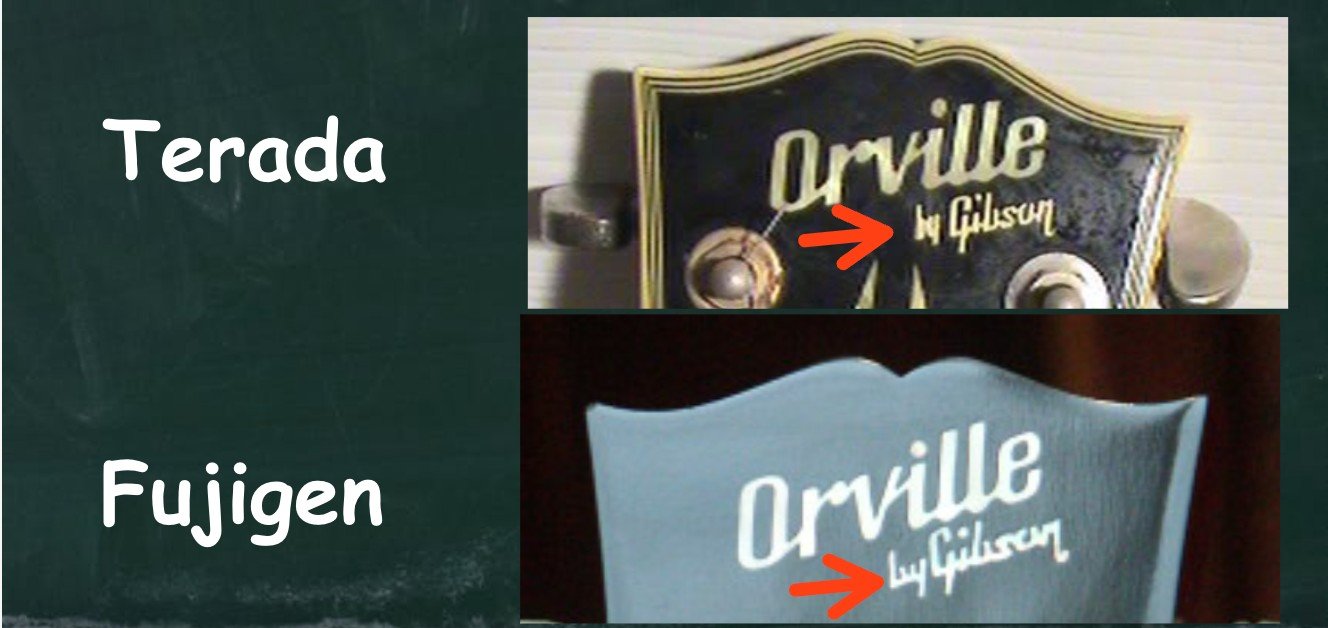
On “by Gibson” models, the logo differs between factories — the “by” lettering is the easiest tell (e.g., a 1994 FujiGen logo vs. a 1991 Terada logo).
There’s also said to be a difference in neck construction. Terada-era guitars used a short tenon, matching the Les Paul Standard spec of the early ’90s. FujiGen guitars used a long tenon, closer to Gibson’s 1950s specification.
FujiGen also built Greco’s Les Pauls, which is why many players see an Orville as a close cousin of a Greco. The Tokai vs Greco vs Burny comparison covers that background.
What They Sell For Today: Japan vs Overseas
I checked recent sold listings on Yahoo! Auctions Japan (August to October 2026) and on Reverb. Conditions vary a lot, so treat these as ranges, not price tags. US dollar figures are approximate, at about ¥158 and C$1.42 to the dollar (October 15, 2026).
| Guitar | Sold in Japan (Yahoo! Auctions) | Sold on Reverb |
|---|---|---|
| Orville by Gibson Les Paul Standard / Custom | About ¥90,000–¥230,000 (US$570–$1,460) | About US–,350––,900 from US sellers, most around –,900––,100 |
| Rare Orville by Gibson (e.g. TV Yellow Junior) | Up to ¥300,100 (about US$1,900) | About US$2,200–$3,500 |
| Orville Les Paul | About ¥55,000–¥130,000 (US$350–$820) | About US$1,450–$1,700 (LPS-75, LPS-80F) |
A few real examples from Japan: an Orville by Gibson LPS-59R sold for ¥160,200, an LPC-57B Les Paul Custom for ¥228,800 and a 1993 LPS-59 Reissue for ¥198,000. On the standard Orville side, LPC-75 Customs went for ¥54,505–¥72,131.
The gap is the story. When I lived in Japan about 15 years ago, used Orvilles were everywhere in guitar shops. Today many of them have moved overseas, and the same guitar often sells for roughly twice as much on Reverb as it does in Japan. If you can buy from Japan through a proxy service, it is still the cheaper route, even after shipping.
Which One Should You Buy?
| You want… | Look for |
|---|---|
| The closest thing to a Gibson-made Les Paul from Japan | Orville by Gibson, ideally with original Gibson USA pickups |
| A long-tenon neck closer to 1950s spec | FujiGen-era Orville by Gibson (number-only serial, from c. 1992) |
| A well-made Japanese Les Paul on a budget | Standard Orville (LPS-75, LPS-80, LPC-75) |
Final Thoughts
Orville and Orville by Gibson look almost the same in a photo, but the “by Gibson” script, the pickups and the serial tell you which one you are looking at, and that difference shows up clearly in the price. Check all three before you buy.
FAQ
What is the difference between Orville and Orville by Gibson?
Orville by Gibson guitars have Gibson USA pickups, nitro finishes and US electronics. Standard Orvilles, added in the mid-1990s, use Japanese pickups and a thin polyurethane finish.
How can I tell if an Orville is ‘by Gibson’?
Look for ‘by Gibson’ in small script under the Orville logo on the headstock, then confirm with the pickups and the serial number.
Are K-serial Orvilles made in Korea?
That was a long-standing theory, but the prevailing view today is that K-serial Orvilles were also made in Japan. Opinions still vary.
Was my Orville made by Terada or FujiGen?
G-plus-six-digit serials point to Terada (1988-1993); number-only serials point to FujiGen, from about 1992.
How much is an Orville by Gibson Les Paul worth?
In recent sales, about 90,000-230,000 yen in Japan and roughly US$1,350-2,900 on Reverb from US sellers, depending on model and condition.
More Orville guitar articles
Japanese Les Paul Copies: Tokai vs Greco vs Burny (1978-1982)
Japanese Les Paul copies from the late 1970s are some of the most faithful Les…
Orville by Gibson: Les Paul, SG and Which Orville to Buy
Orville was Gibson’s officially sanctioned Japanese-made line, sold in Japan from 1988 to 1998 and…