
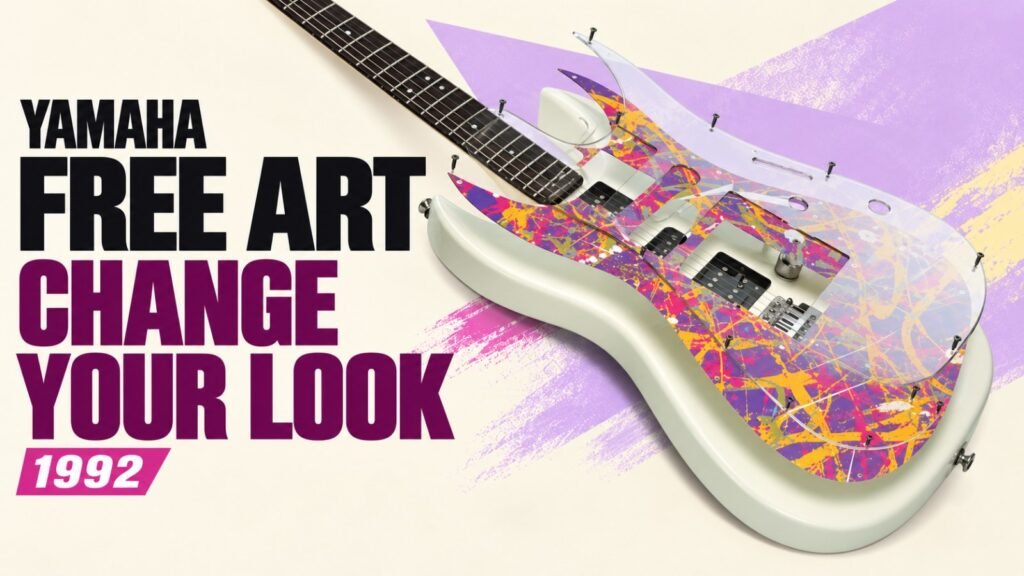
In Yamaha’s 1992 catalog there was a guitar that looked like just another graphic superstrat. But the Yamaha Free Art Model hid a clever idea: a clear pickguard where you could slip in your own design. This guide explains how it worked, why it faded so fast, and why it feels about 30 years ahead of its time. For the brand as a whole, see our Yamaha Brand Guide.
Yamaha Free Art Model Quick Facts
- Appeared in: Yamaha’s 1992 catalog
- Models: RGX321FP and RGX121FP
- Idea: A clear pickguard with a design sheet slipped underneath
- Extras: Design sheets came with the guitar, and more were sold separately
- Buzz: A design competition in Japan drew 1,408 entries
- Why it faded: No home printers, the rise of grunge, and a sustain rumor
- Today: A forgotten idea that fits the smartphone age
Prefer to watch? This article is based on my own video below.
What Was the Yamaha Free Art Model?
At first glance the Free Art Model was one more early-90s superstrat with a bold graphic. The difference was the pickguard: it was clear, and the “graphic” was a printed sheet sitting underneath it.
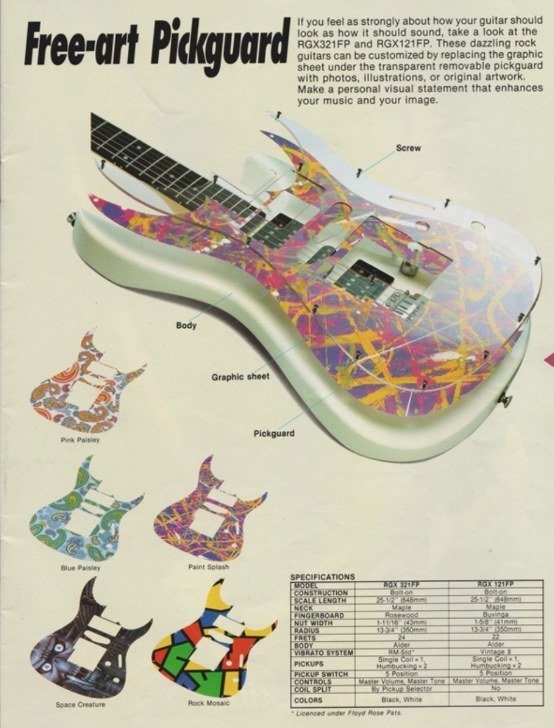
That meant the look was not fixed. Swap the sheet and you had a different guitar. In a decade of loud finishes, Yamaha turned the graphic into something the player controlled.
How the Free Art Pickguard Worked
| Step | What you did |
|---|---|
| 1 | Remove the clear pickguard |
| 2 | Slip a design sheet underneath: one of Yamaha’s, or your own |
| 3 | Screw the pickguard back on, and the guitar has a new look |
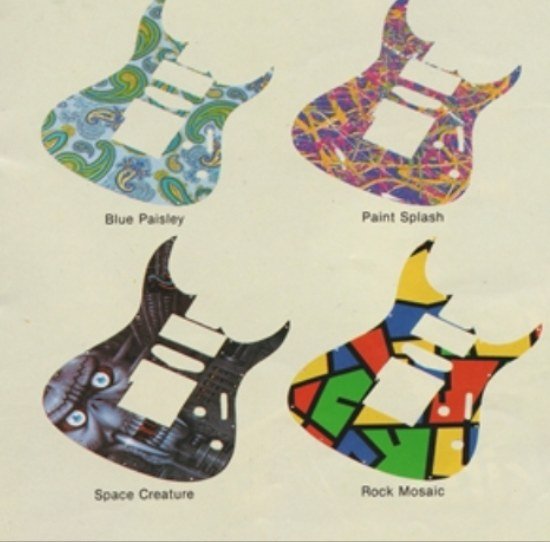
The catalog showed five designs: Pink Paisley, Blue Paisley, Paint Splash, Space Creature and Rock Mosaic. Yamaha bundled two extra sheets with the guitar and sold more as accessories, and you could also use photos, illustrations or your own artwork.
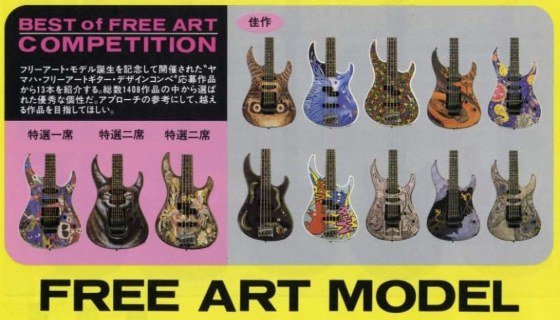
The idea caught some buzz for letting players show their own style. Yamaha even held a design competition in Japan, the “Yamaha Free Art Guitar Design Competition”, which drew 1,408 entries.
RGX321FP vs RGX121FP: The Two Free Art Models
The 1992 catalog offered the Free Art pickguard on two RGX superstrats. Both had a bolt-on maple neck, an alder body, a 25.5″ scale and an HSH pickup layout; the 321FP was the better-equipped of the two.
| RGX321FP | RGX121FP | |
|---|---|---|
| Fingerboard | Rosewood, 24 frets | Bubinga, 22 frets |
| Vibrato | RM-Std (licensed Floyd Rose) | Vintage S |
| Pickups | 1 single-coil + 2 humbuckers | 1 single-coil + 2 humbuckers |
| Coil split | Yes, via the pickup selector | No |
| Colors | Black, White | Black, White |
| Best for | Dive bombs and wider tonal options | A simpler, more affordable Free Art |
Why the Free Art Model Faded So Fast
The popularity did not last. Looking back, three things worked against it.
| Problem | Why it mattered |
|---|---|
| No home PCs or printers | In the early 90s few people could design and print their own sheet, so most players never used the main feature |
| Grunge arrived | Flashy superstrats suddenly felt outdated almost overnight |
| A sustain rumor | Some said the paper under the guard killed sustain, and the rumor spread fast |
Did the paper really kill sustain?
In my view it is hard to believe a thin sheet under a plastic pickguard made much difference. But in the pre-internet 90s, a rumor like that was enough to hurt a guitar’s reputation.
A Guitar 30 Years Too Early
Today you can design almost anything on your phone and get it printed in a day. The Free Art idea would make far more sense now than it did in 1992.
It would be great to order custom sheets with your own artwork. Or, crazier still, imagine a thin display inside the guitar that changes the visuals with every song. Thirty years later, maybe this idea deserves a second chance.
Buying a Yamaha Free Art Model Today
| Check | Why |
|---|---|
| Original design sheets included | They are the whole point of the model and are hard to replace |
| Clear pickguard condition | Cracks, scratches or yellowing show over the design |
| Pickguard screws and holes | The guard was meant to come off; check for stripped holes |
Final Thoughts
The Free Art Model is a reminder that Yamaha was always willing to try something new, even when the timing was wrong. The idea was sound; the world just was not ready to print its own guitar art.
If one turns up with its original sheets, it is a fun piece of early-90s Japanese guitar history.
FAQ
What is the Yamaha Free Art Model?
It was the Free Art pickguard version of Yamaha’s RGX321FP and RGX121FP from the 1992 catalog, with a clear pickguard. You could slip a design sheet underneath to change the guitar’s look.
Did the Yamaha Free Art Model come with design sheets?
Yes. Yamaha bundled extra design sheets with the guitar and sold more as accessories, and you could also use your own design.
Why did the Yamaha Free Art Model fail?
Few players had home PCs or printers to make their own designs, grunge made flashy superstrats feel dated, and a rumor spread that paper under the guard killed sustain.
Does a sheet under the pickguard affect sustain?
That rumor spread in the 90s, but it is hard to believe a thin sheet under a plastic pickguard makes much difference.
Is the Yamaha Free Art Model rare?
It was only popular briefly in the early 1990s, so examples with their original design sheets are hard to find today.
More Yamaha guitar articles

Yamaha BB Bass: The Legendary Broad Bass From the 1977 BB1200 to Today
The Yamaha BB bass has been one of the most trusted working basses since 1977….
Yamaha Pacifica: The Session Guitar That Became Everyone’s First Electric (1990-Today)
The Yamaha Pacifica is the guitar many players own as their first electric, but it…
Yamaha Revstar: The Cafe Racer Guitar Explained, From 2015 to the Second Generation
The Yamaha Revstar is Yamaha’s modern electric guitar, designed around the look of 1960s London…
Yamaha Logo: Why the Guitar and Motorcycle Logos Are Surprisingly Different
Look closely at the Yamaha logo on a guitar and on a motorcycle, and you…
Yamaha SX Series: The Forgotten 1970s Yamaha Played by Tommy Bolin (1974-1979)
The Yamaha SX is one of the forgotten Yamaha electrics of the 1970s. Built for…
Yamaha SG History: From the 1966 SG-2 to the Legendary SG-2000 and Today’s SG1820
When people talk about Yamaha’s legendary guitars, the Yamaha SG usually comes up first, thanks…
