
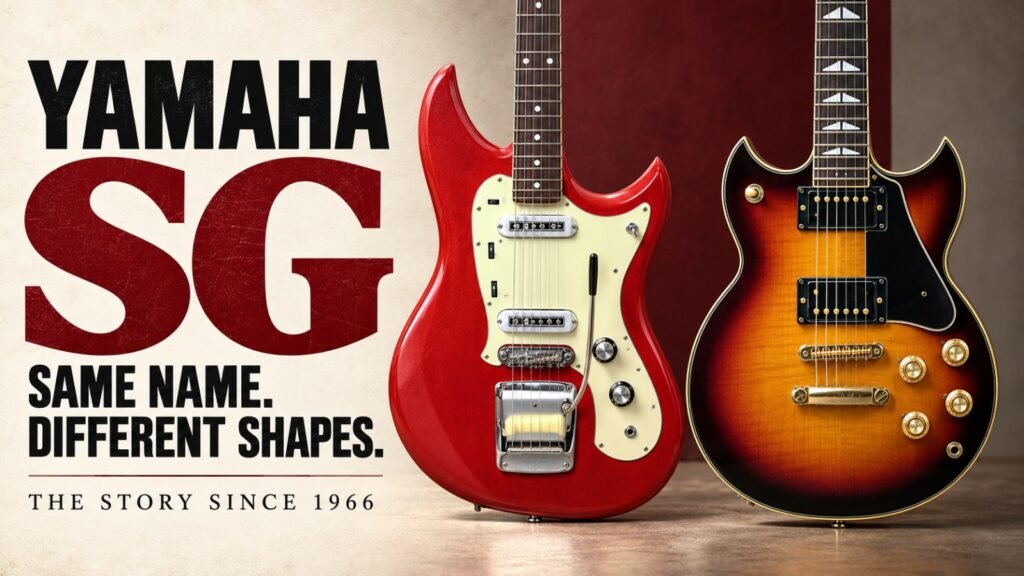
When people talk about Yamaha’s legendary guitars, the Yamaha SG usually comes up first, thanks to players like Carlos Santana and Masayoshi Takanaka. But the first Yamaha SGs from 1966 looked nothing like the guitar you picture today. This guide follows the full Yamaha SG history, from the offset SG-2 to the SG-2000, SG-3000 and today’s SG1820. For the brand as a whole, see our Yamaha Brand Guide.
Yamaha SG History Quick Facts
- Period covered: 1966 to today
- First SG: April 1966: S-201 and S-302, renamed SG-3 and SG-2 a month later
- What SG means: Solid Guitar, not a body shape
- Today’s shape: Set by the SG-175 in 1974
- Flagships: SG-2000 (1976) and SG-3000 (1982)
- Current models: SG1820, SG1802 and SG1820A, made in Japan
Prefer to watch? This article is based on my own video below.
- SG Means "Solid Guitar", Not a Shape
- 1966: SG-2 and SG-3, Yamaha's First Electric Guitars
- 1966: SG-5 and SG-7, the "Blue Jeans Custom"
- 1969-1973: Yamaha Searches for a New SG Shape
- 1974: SG-175, the Yamaha SG Shape We Know Today
- 1976: SG-2000 and the SG-1000
- 1982: SG-3000, the Custom Flagship
- Neck-Through Meets Arched Top: Why the SG-2000 Is So Unusual
- 2010-Today: SG1820 and the Modern Yamaha SG
- Yamaha SG Timeline at a Glance
- Which Yamaha SG Should You Look For?
- Final Thoughts
- FAQ
- More Yamaha guitar articles
SG Means “Solid Guitar”, Not a Shape
As with Gibson, Yamaha used SG to mean Solid Guitar. It never referred to one body shape, which is why the Yamaha SG name has covered offsets, single-cuts and double-cuts over the years.
| Era | Shape | Key models |
|---|---|---|
| 1966-1971 | Offset, Jazzmaster-like | SG-2, SG-3, SG-5, SG-7 |
| 1969 | Asymmetric, one horn | SG-2C, SG-3C |
| 1972 | Single-cut, Les Paul-like | SG-85, SG-65, SG-45 |
| 1973 onward | Double-cut | SG-35, then SG-175, SG-2000, SG1820 |
1966: SG-2 and SG-3, Yamaha’s First Electric Guitars
The story begins in April 1966, when Yamaha released the S-201 and S-302, its first electric guitars. Just a month later they were renamed SG-3 and SG-2. Yamaha marketed them as guitars designed around Japanese players, including their body and hand size.
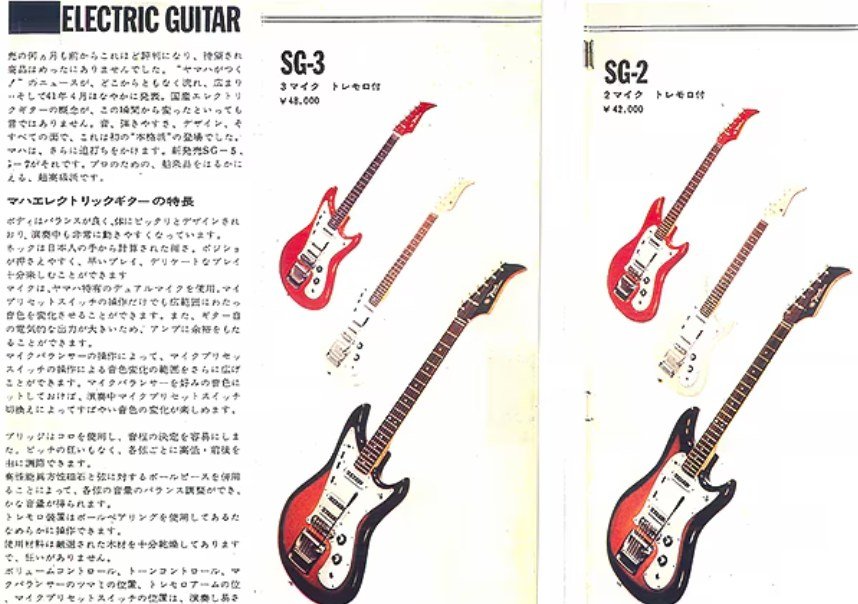
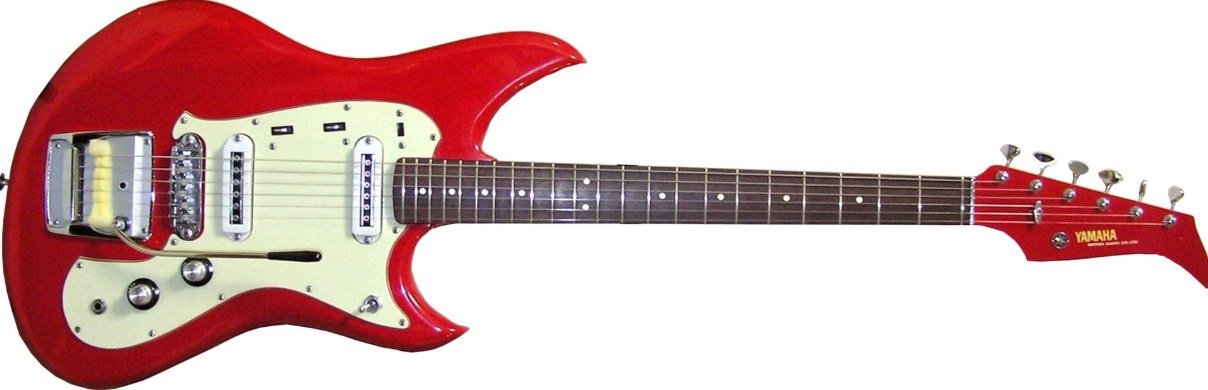
They looked more like a Fender Jazzmaster than a Les Paul, with an unusual switch layout and two separate circuits. Yamaha also used its own tremolo, neck joint and pickups, so the very first SG was already an original design. Around the same time Yamaha released the SB-2, its first electric bass.
1966: SG-5 and SG-7, the “Blue Jeans Custom”
Only three months later, in August 1966, Yamaha added the SG-5 and SG-7: simplified versions of the SG-2 and SG-3 with a more straightforward control layout. The SG-7 had gold hardware and the SG-5 chrome, which seems to have been the main difference.
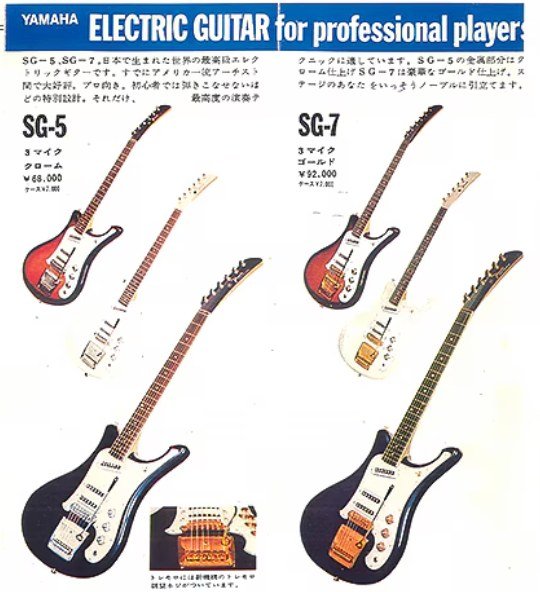
The SG-7 became known in Japan as the “Blue Jeans Custom”, after Takeshi Terauchi and the Blue Jeans, one of the top Japanese guitar bands of the era. It even appeared in Japanese films, and became one of the defining Japanese electric guitars of the 1960s boom.
How rare are they?
Estimates put production of these first-generation SGs at around 3,000, with only about 600 to 700 of them SG-5 and SG-7 models. Yamaha later reissued the SG-7 for its 20th anniversary in 1986 and again in the 1990s.
1969-1973: Yamaha Searches for a New SG Shape
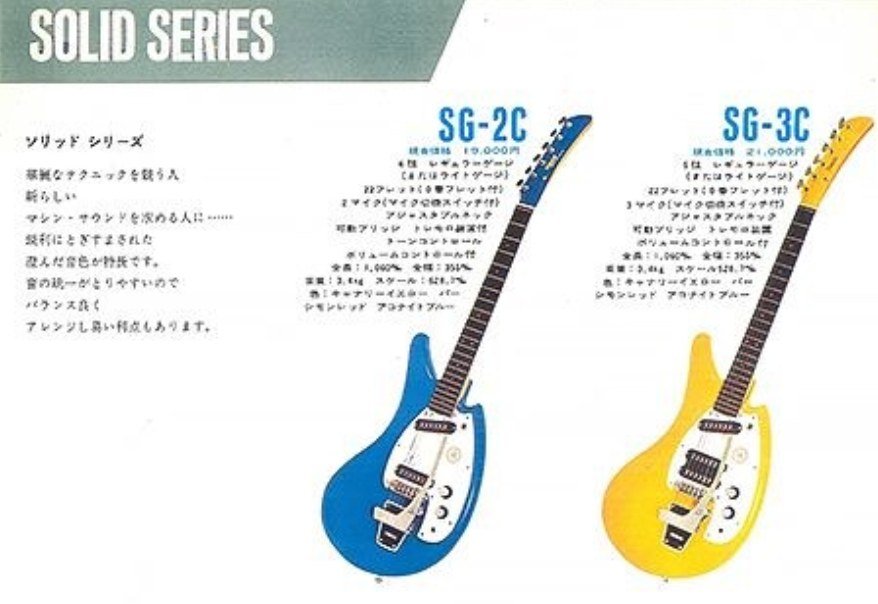
In 1969 Yamaha released the SG-3C and SG-2C, with a fully asymmetric body and a horn on the bass side only. Simpler controls and a simpler tremolo brought the price down, but Japan’s electric guitar boom was already cooling, and they did not sell well.
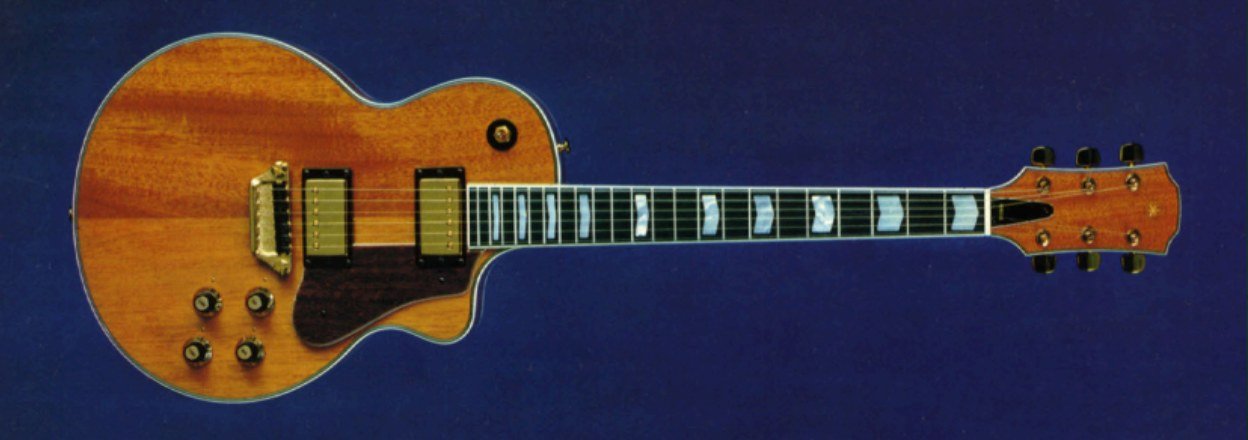
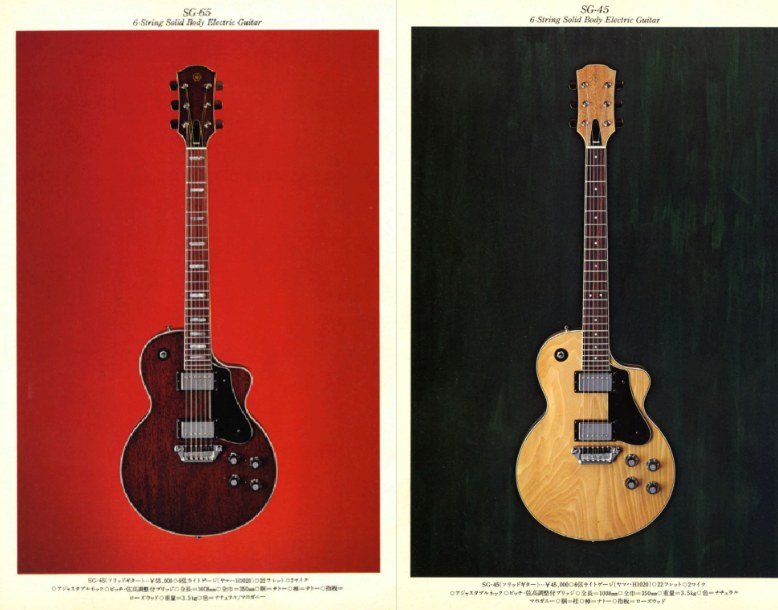
In 1972 came the SG-85, three years in development and now a single-cut with a Les Paul-like look, plus the cheaper SG-65 and SG-45. They did not take off either.
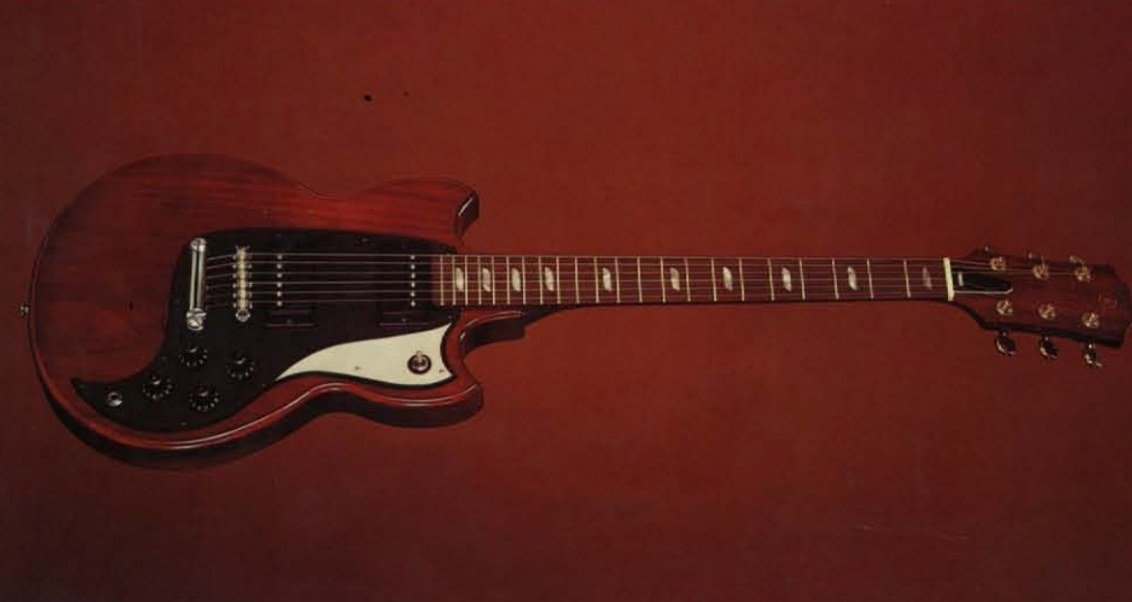
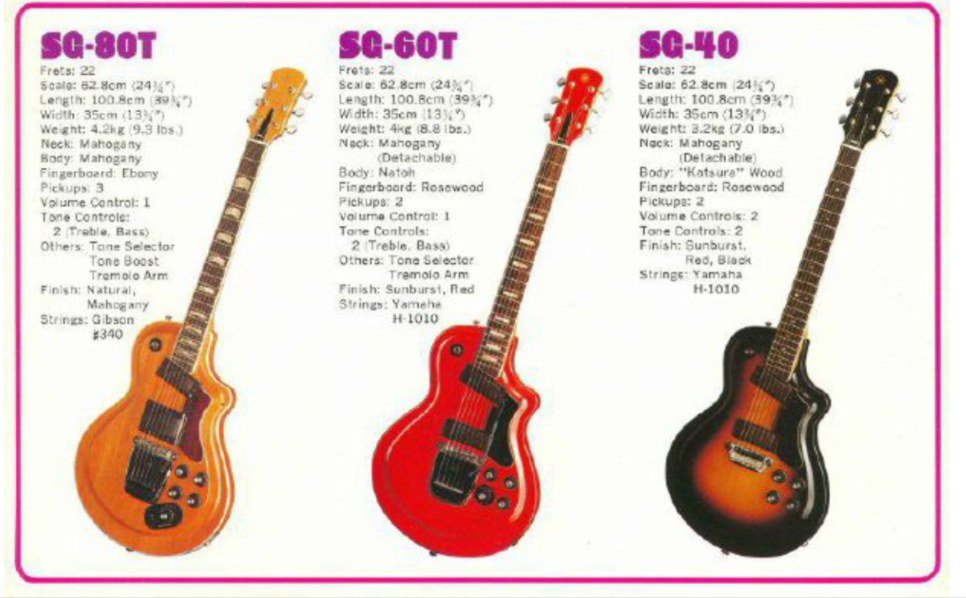
In 1973 the SG-35 switched to a double-cutaway, the first step toward the Yamaha SG we know today. Single-cut models like the SG80T and SG60T still carried a tremolo and pickup layout reminiscent of the original SG-2 and SG-3.
1974: SG-175, the Yamaha SG Shape We Know Today
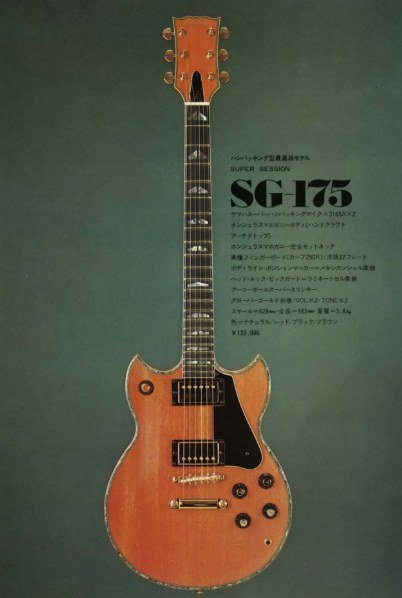
The SG-175 of 1974 was a completely new flagship. Its symmetrical double-cut body and arrow position markers became the symbols of the Yamaha SG, and Yamaha calls it the forerunner of the current SG series.
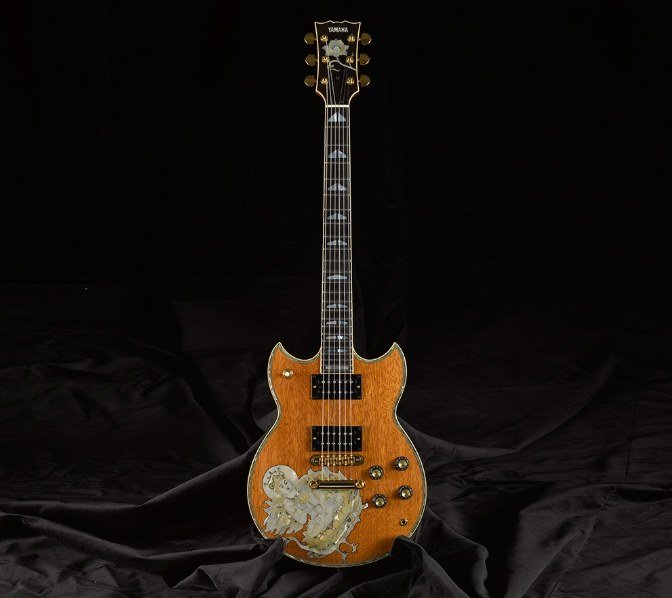
It also started the Santana story. Yamaha showed the SG-175 to Carlos Santana in Japan in 1974; he asked for more sustain, a thicker low-mid punch and 24 frets. About a year later Yamaha delivered the SG-175 Buddha, with a T-Cross one-piece neck, a sustain plate under the bridge and OPG-1 pickups. You can hear that sustain in Santana’s 1976 London performance of “Europa”. The full story is in our Yamaha SG2000 article.
1976: SG-2000 and the SG-1000
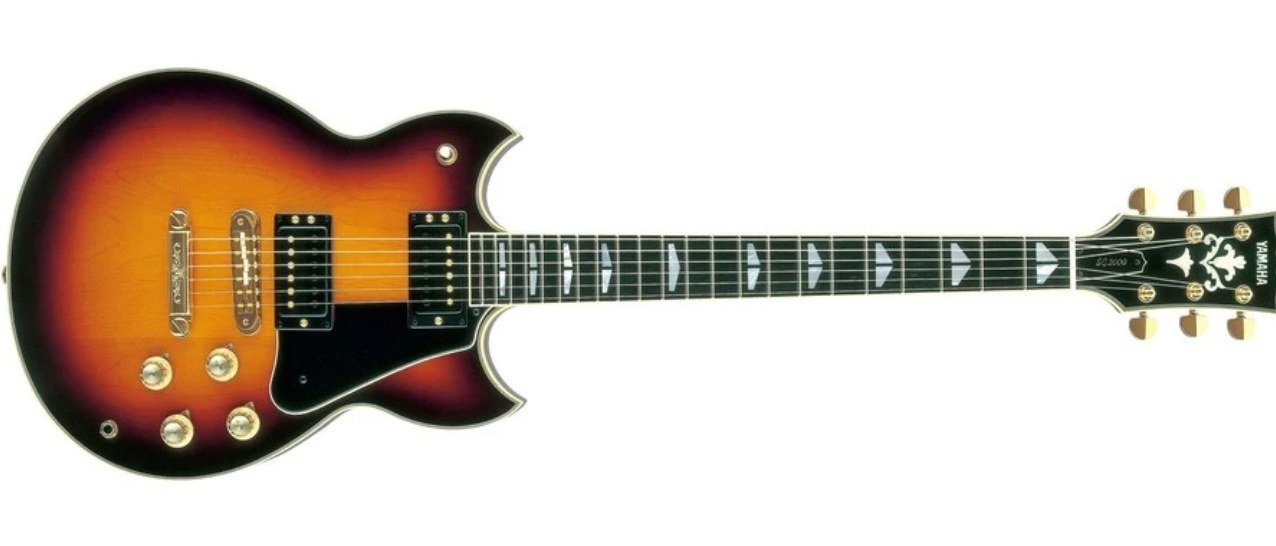
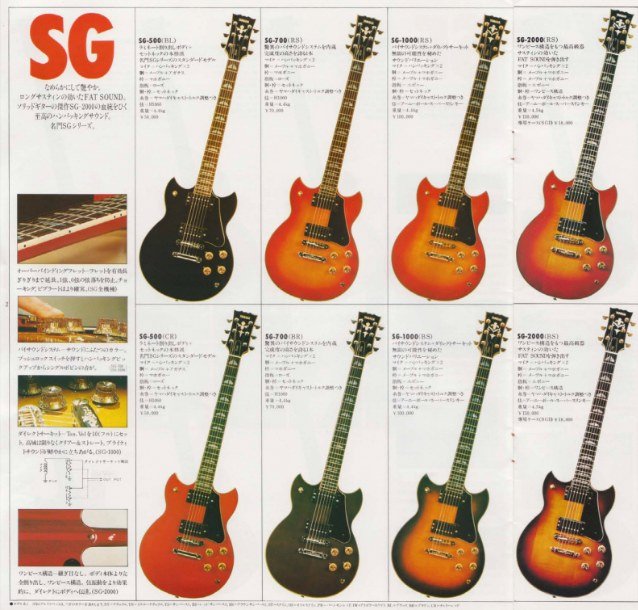
Requests for a production version of Santana’s guitar poured in, and in 1976 Yamaha released the SG-2000, widely seen as the completed form of the Yamaha SG. About half a year later the series grew with the SG-500, SG-700 and SG-1000.
| Model | Neck | What stands out |
|---|---|---|
| SG-2000 | T-Cross neck-through | Sustain plate, long sustain, the flagship sound |
| SG-1000 | Set neck | Bi-Sound coil-split and Direct Circuit; one of the most popular SGs |
| SG-500 / SG-700 | Set neck | More affordable models in the same shape |
1982: SG-3000, the Custom Flagship
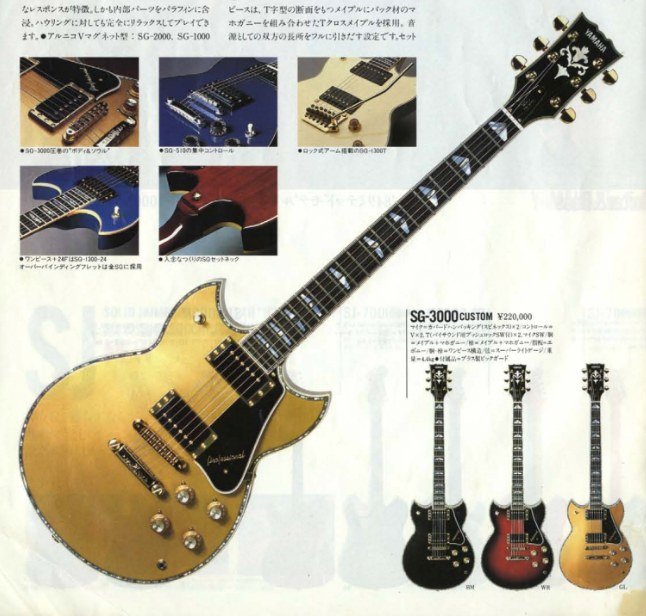
In 1982 Yamaha released the SG-3000, the highest-end SG and a flagship carrying the Custom name. Heavy metal was rising and rigs were getting louder, so Yamaha built it for the new era.
| Change | What it does for you |
|---|---|
| New pickups with Yamaha’s Spinex magnets and nickel silver baseplates | A fresh voice for heavier music |
| Fully covered, wax-potted pickups | Less feedback at high volume |
| Narrower bridge and lighter build | Easier to play for a long set |
| Abalone binding and new arrow markers | The look of a true top-line model |
Neck-Through Meets Arched Top: Why the SG-2000 Is So Unusual
The SG-2000 and SG-3000 used Yamaha’s T-Cross neck-through construction: the neck runs the length of the body, with wings on each side. Doing that on an arched-top body takes a lot of extra work.
Yet these were not short-lived specials. Both stayed in Yamaha’s catalog for around 30 years, and few guitars from other makers combined neck-through construction with an arched top in the same way.
2010-Today: SG1820 and the Modern Yamaha SG
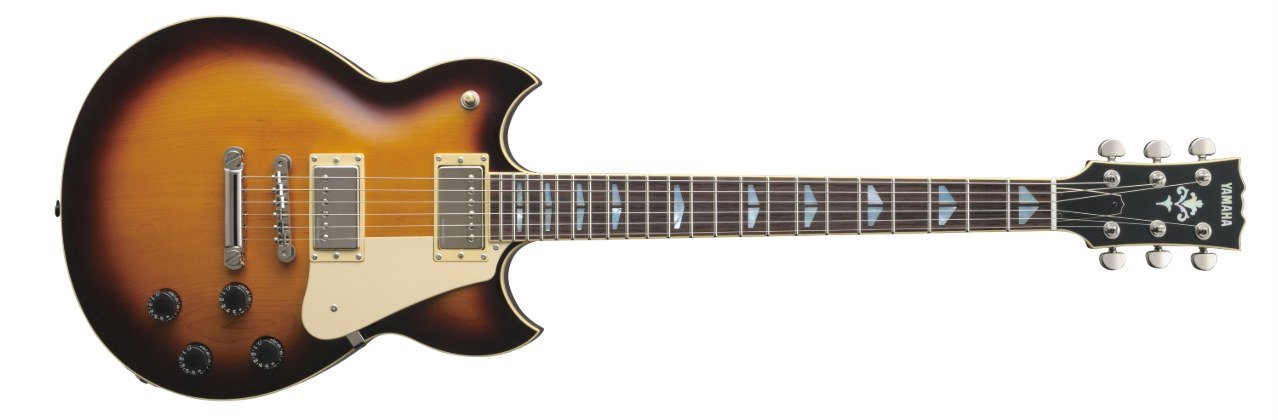
In 2010 Yamaha released the SG1820. It still looks like a Yamaha SG, but the T-Cross neck-through and the sustain block are gone in favor of a handmade set neck, and the SG-2000 and SG-3000 left the catalog around the same time.
| Current model | Pickups | Best for |
|---|---|---|
| SG1820 | Seymour Duncan ’59 humbuckers | The classic SG sound |
| SG1802 | Seymour Duncan P-90 style | A brighter, more open tone (Gold Top) |
| SG1820A | EMG 81 / 85 active | Modern high gain |
In my view, the SG1820 is best seen as a modern SG-1000 rather than a cut-down SG-2000. The SG-2000 chased extreme sustain and became heavy enough that some players joke it hurts your shoulder. For a practical, stage-friendly SG, the SG1820 makes a lot of sense.
Yamaha SG Timeline at a Glance
| Year | Model | Milestone |
|---|---|---|
| 1966 | SG-2 / SG-3 | Yamaha’s first electric guitars |
| 1966 | SG-5 / SG-7 | Simplified controls; the “Blue Jeans Custom” |
| 1969 | SG-2C / SG-3C | Asymmetric budget models |
| 1972 | SG-85 | Single-cut, Les Paul-like |
| 1973 | SG-35 | First double-cut SG |
| 1974 | SG-175 | Today’s SG shape; the Santana connection |
| 1976 | SG-2000 / SG-1000 | The flagship and the best-seller |
| 1982 | SG-3000 | The Custom flagship |
| 2010 | SG1820 | The modern, set-neck SG |
Which Yamaha SG Should You Look For?
| You want… | Look for |
|---|---|
| The legendary sustain | SG-2000 (used) |
| The ultimate vintage SG | SG-3000 (used) |
| A classic SG at a fairer price | SG-1000 (used) |
| A new, lighter SG made in Japan | SG1820 / SG1802 |
| 1960s Japanese guitar boom history | SG-5 / SG-7 (rare) |
Final Thoughts
The Yamaha SG was never a simple copy. The T-Cross neck, the sustain plate, Yamaha’s own pickups, the Bi-Sound circuit and the Direct Circuit all show a company trying to build something with its own identity.
So if you ever see a Yamaha SG in a guitar shop, pick it up. Feel the weight, feel the sustain, and feel more than half a century of Yamaha’s design in one guitar.
FAQ
What does SG mean on a Yamaha guitar?
SG stands for Solid Guitar. It does not refer to one body shape, which is why early Yamaha SGs were offsets and later ones single-cuts and double-cuts.
When did Yamaha make its first SG?
In April 1966 Yamaha released the S-201 and S-302, its first electric guitars, which were renamed SG-3 and SG-2 a month later.
What is the difference between the Yamaha SG-2000 and SG-1000?
The SG-2000 uses T-Cross neck-through construction and a sustain plate. The SG-1000 uses a set neck and adds the Bi-Sound coil-split and Direct Circuit.
When was the Yamaha SG-3000 released?
In 1982, as the highest-end Custom flagship of the SG series, with new covered, wax-potted pickups and a lighter build.
Is the Yamaha SG-2000 still made?
No. The SG-2000 and SG-3000 left the catalog around 2010, when Yamaha introduced the set-neck SG1820.
Are current Yamaha SG guitars made in Japan?
Yes. Yamaha lists the SG1820 and SG1802 as handmade in Japan.
More Yamaha guitar articles
Yamaha BB Bass: The Legendary Broad Bass From the 1977 BB1200 to Today
The Yamaha BB bass has been one of the most trusted working basses since 1977….
Yamaha Pacifica: The Session Guitar That Became Everyone’s First Electric (1990-Today)
The Yamaha Pacifica is the guitar many players own as their first electric, but it…
Yamaha Revstar: The Cafe Racer Guitar Explained, From 2015 to the Second Generation
The Yamaha Revstar is Yamaha’s modern electric guitar, designed around the look of 1960s London…
Yamaha Logo: Why the Guitar and Motorcycle Logos Are Surprisingly Different
Look closely at the Yamaha logo on a guitar and on a motorcycle, and you…
Yamaha Free Art Model: The 1992 Guitar With a Pickguard You Could Redesign
In Yamaha’s 1992 catalog there was a guitar that looked like just another graphic superstrat….
Yamaha SX Series: The Forgotten 1970s Yamaha Played by Tommy Bolin (1974-1979)
The Yamaha SX is one of the forgotten Yamaha electrics of the 1970s. Built for…
