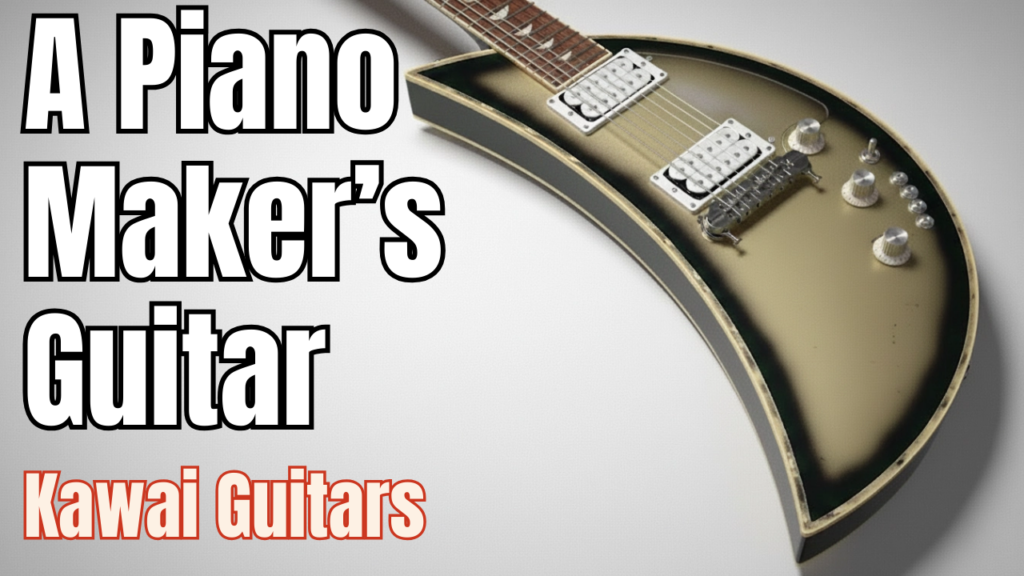
Most people know Kawai as a piano maker, but Kawai guitars from the 1980s are some of the boldest electric guitars ever made in Japan: a crescent-moon guitar called the Moon Sault, and the F series, neck-through guitars and basses packed with onboard preamps, built-in distortion and switches you will not find anywhere else.
This guide is built from Kawai’s own catalogs. It covers where Kawai guitars came from, the Moon Sault and F series in detail, the more conventional RG superstrats of 1990, and what to look for if you want one today.
Kawai Guitars Quick Facts
- Company: Kawai Musical Instruments (河合楽器製作所), the Japanese piano maker
- Founded: 1927, as the Kawai Musical Instrument Research Laboratory
- Where it’s made: Japan
- Known for: The Moon Sault, the F series with onboard preamps, and owning the Teisco name
- Status: Kawai is known today for pianos; Kawai guitars are found on the used market
Start here
- Moon Sault: the crescent-moon guitar
- The F Series: neck-through guitars and basses with built-in preamps
- The 1990 Lineup: RG, RGT and PG superstrats
- Which Kawai Should You Look For?: the quick finder
From Pianos to Electric Guitars
Kawai was founded in 1927 in Hamamatsu, the same city that is home to Yamaha and Tokai. Pianos were, and still are, the core of the business, but Kawai guitars have a long history of their own (Kawai official site).
Its biggest move came in 1967, when Kawai bought Teisco, one of the big names of Japan’s 1960s electric guitar boom. Teisco guitars were sold all over the world, including as Teisco Del Rey in the US, and one of them was Eddie Van Halen’s first guitar, as covered in our article on famous guitarists who played Japanese guitars.
Kawai also crossed paths with another big Japanese guitar name. When Arai and Company launched its guitars in the 1960s, Kawai already owned “Aria” as a keyboard trademark, so for a few years from around 1967 the guitars were sold as Arai Diamond until Arai bought the name from Kawai. The full story is in our Aria Pro II history.
The 1980s: Kawai’s Original Guitars
The catalogs below are from the 1980s, and they show Kawai at its most original. Almost everything shares a few ideas: neck-through construction, Grover tuners, German-made Badass bridges, and, above all, electronics. Many models have a preamp built in, with switches that turn the guitar into a booster or a distortion box, so in a way, Kawai put the effects pedal inside the guitar.
Moon Sault: The Crescent-Moon Guitar
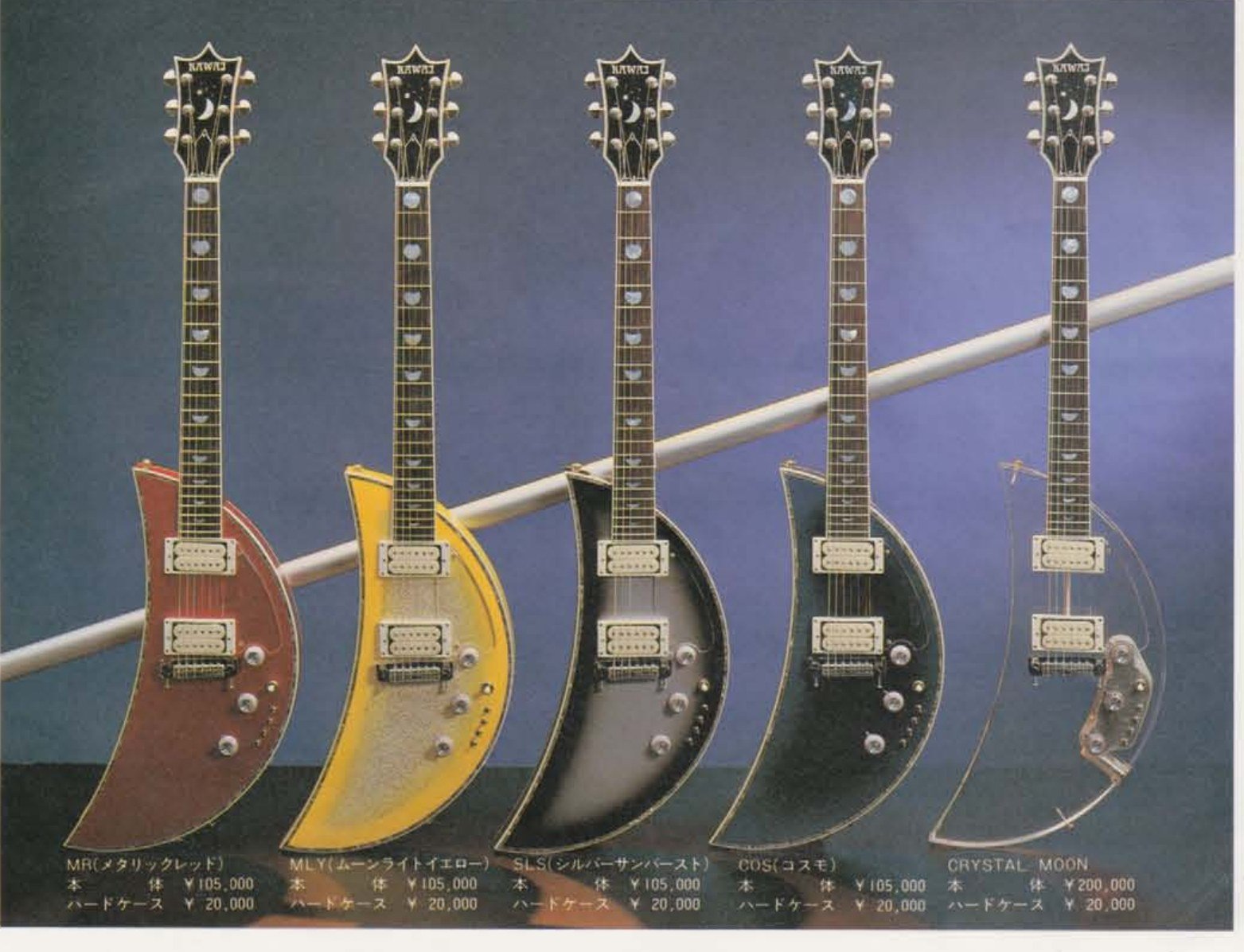
The Moon Sault is the guitar Kawai is remembered for. Its body is a crescent moon, and the theme runs through every detail: the position markers follow the phases of the moon up the neck, and the headstock carries a crescent moon and stars in white mother-of-pearl, with a rocket-shaped truss rod cover.
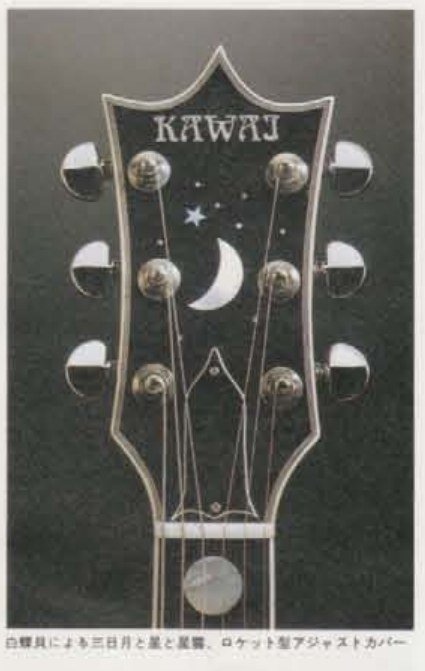
Under the look is a serious guitar. The catalog lists a one-piece mahogany body, a set mahogany neck with 22 frets, two Kawai DSU humbuckers, Grover 102N tuners, a German-made Badass bridge and Mexican abalone binding. The preamp gives you a power booster or distortion at the flip of a switch, and there is a dual-sound switch for single-coil tones and a phase switch on top.
The catalog boasts that, despite the strange shape, the strap balance is better than you would imagine, and calls the Moon Sault a truly original electric guitar born in Japan. The standard colors were ¥105,000, while the Crystal Moon, with a clear acrylic body and a bolt-on neck, was ¥200,000.
My Take
What draws me to the Moon Sault is the design: nothing else looks like it, and it obviously stands out on stage. But it isn’t only about looks. It was designed with ergonomics in mind, and I like that thinking.
The F Series: Neck-Through Guitars With Built-In Effects
If the Moon Sault was the showpiece, the F series was the engine room. These were neck-through guitars and basses with laminated bodies, and they carried Kawai’s most ambitious electronics.
F-I: The Flagship
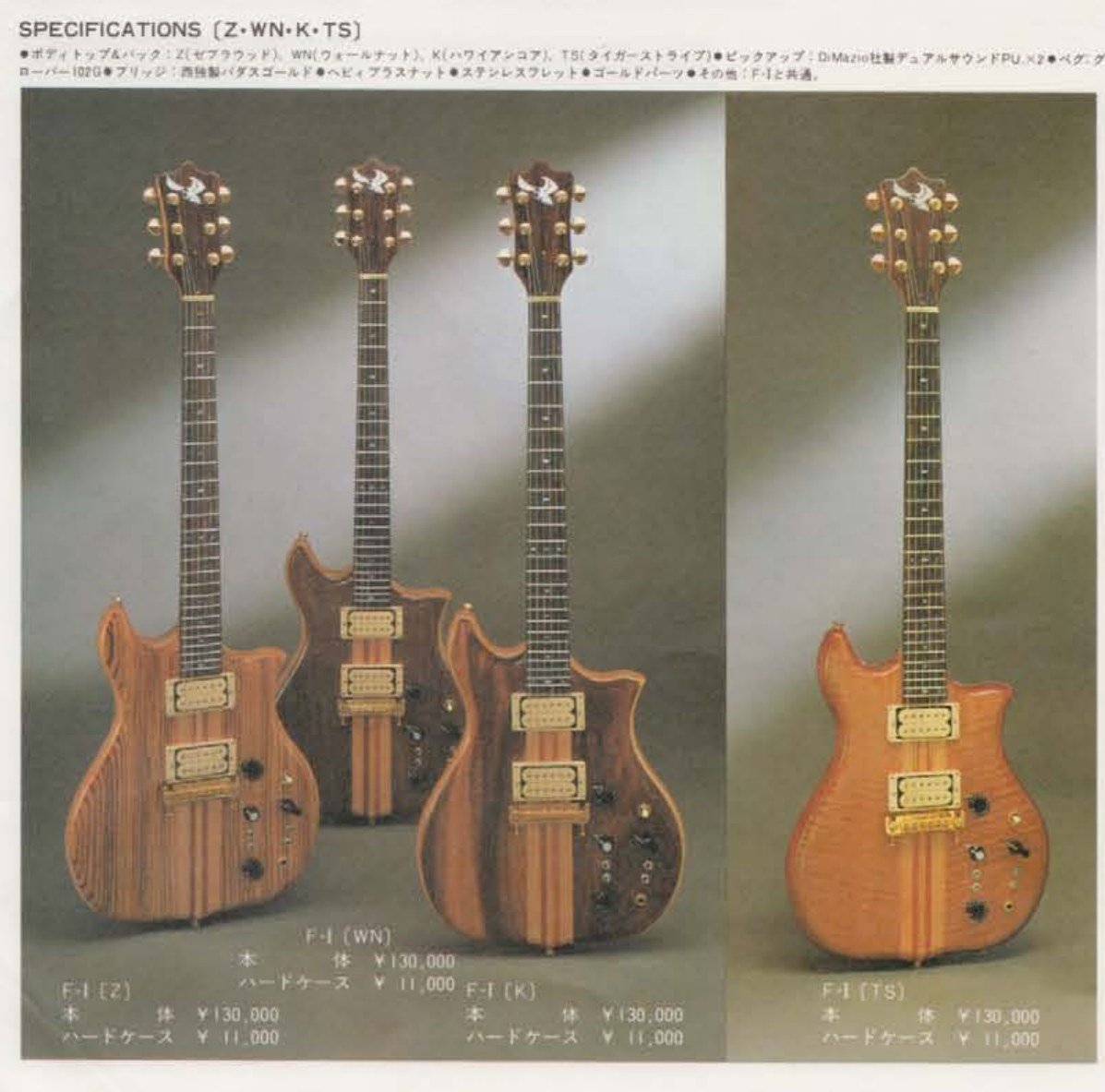
The F-I was called “the ultimate work of art” in the catalog. It has a three-piece laminated body (maple and mahogany), a five-piece neck-through with 24 frets, Grover 102N tuners and a Badass bridge. The control list is long:
| Control | What it does |
|---|---|
| Preamp on/off | Switches the built-in preamp in or out; the guitar still works with no battery |
| Booster / distortion switch | Chooses a power booster or a distortion from the preamp |
| Preamp level | Sets the boost or distortion level, so you can preset two sounds and switch between them |
| 6-step varitone | An LC filter that cuts five different frequencies, plus normal |
| Dual sound switch | Turns both humbuckers into single coils at once |
| Phase switch | Reverses the phase of the rear pickup when both pickups are on |
Kawai also tackled noise. The whole circuit cavity is shielded in aluminum, and the DSU humbuckers have aluminum boxes around each coil, an answer to the extra noise of open humbuckers. The standard F-I in natural or black was ¥120,000. Versions with zebrawood, walnut and Hawaiian koa tops cost ¥130,000, a tiger-stripe version ¥138,000, and these wood-top models swapped in DiMarzio Dual Sound pickups.
F-I 12 and F-I W: Twelve Strings and Two Necks
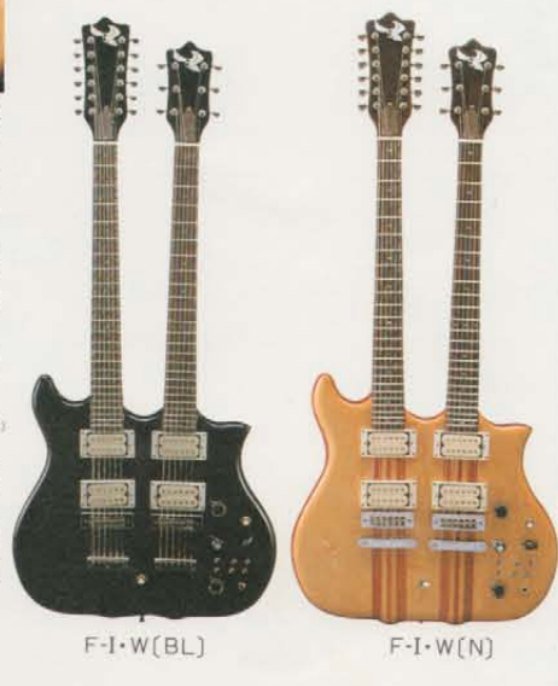
The F-I 12 (¥120,000) was a solid-body 12-string, something the catalog itself calls rare for an electric. It even suggests removing strings to turn it into a 10-string, or a 9-string with only the high octave strings doubled.
The F-I W (¥138,000), billed as a “double-headed eagle,” combines a 12-string and a 6-string neck on one neck-through body, each with its own dual-sound and phase switches. It also appears in our guide to Japanese double-neck guitars.
F-I Jr: Fruit Colors and 15 Sounds
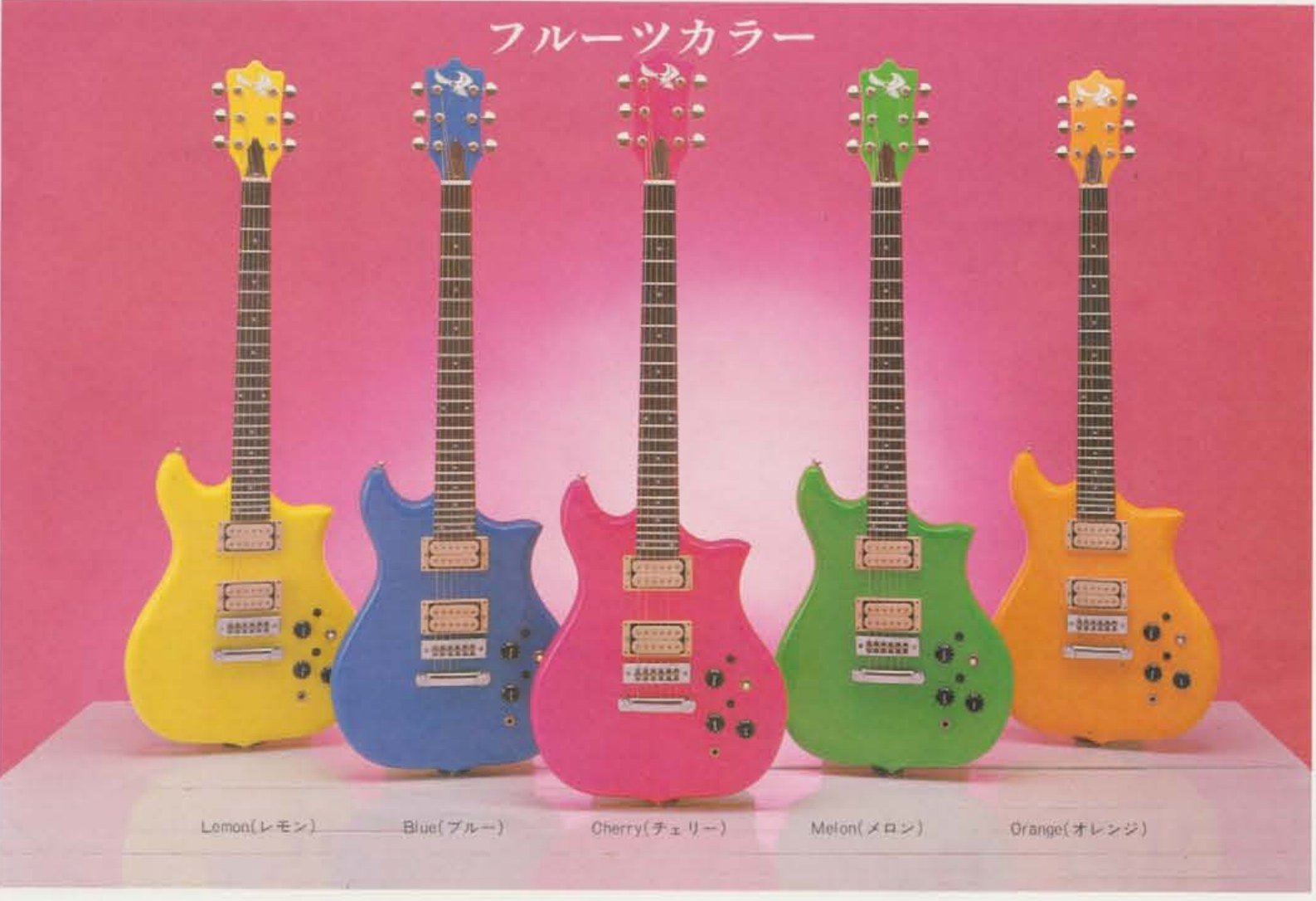
The F-I Jr (¥60,000) brought the F-I idea down in price. It kept the neck-through construction on a one-piece sen ash or mahogany body, and came in natural, black and five bright “fruit colors.” Each pickup has its own three-way mini switch: up for humbucker, center for single coil and down for a “funky” sound. Combined with the pickup selector, Kawai counted 15 different sounds.
F-III: The Preamp Inside the Pickup
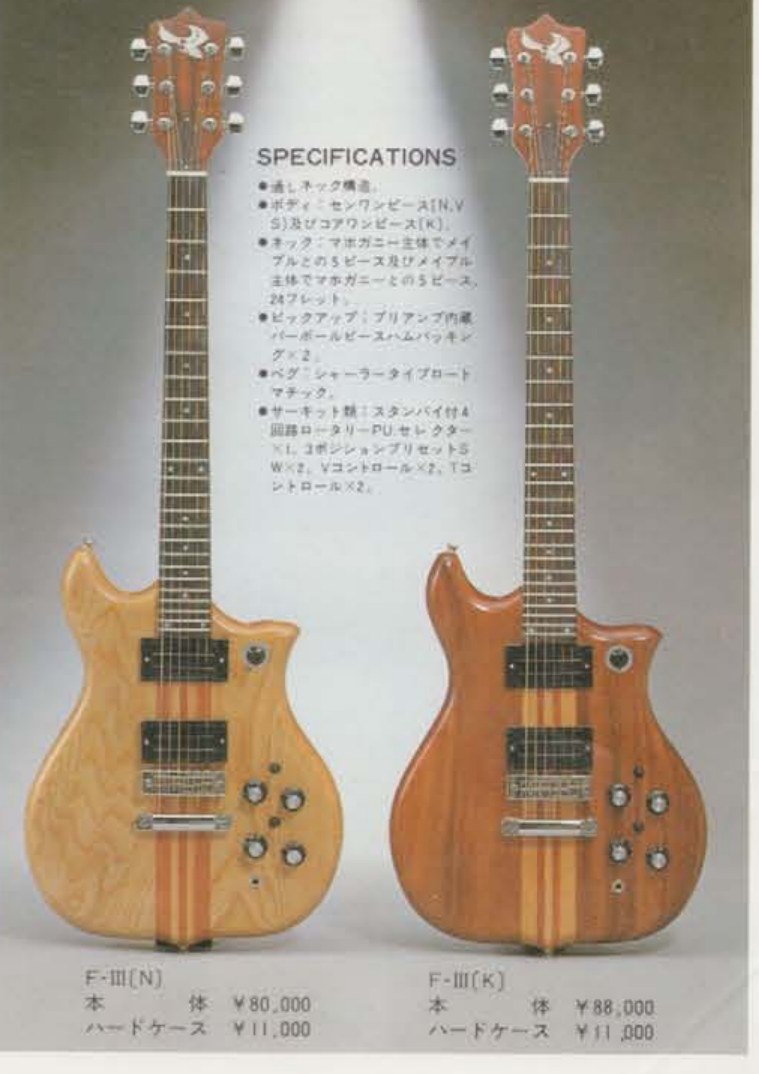
The F-III (¥80,000 to ¥88,000) took the preamp idea further and put it inside the pickup itself, molded in resin to keep noise out. Each bar-pole humbucker has a three-position switch for normal, power boost and distortion, and the normal setting bypasses the preamp, so a dead battery does not leave you silent. The rotary pickup selector even has a standby position that mutes the guitar between songs.
F-II B and F-I B: The Basses
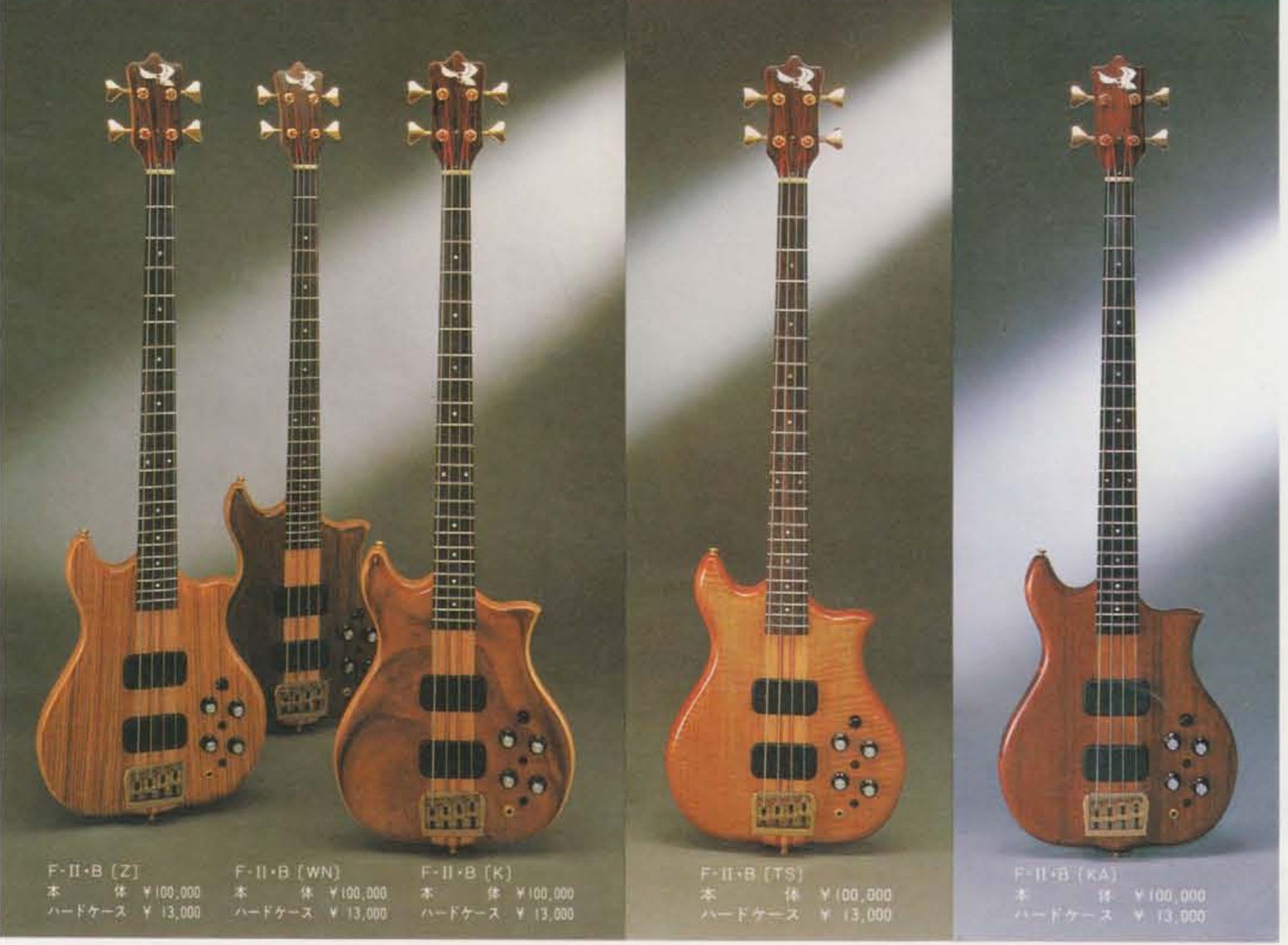
Kawai called the F-II B its “super bass.” It has a three-piece laminated body, a five-piece neck-through with 22 frets, two preamp-equipped pickups and a standby rotary selector. Each pickup has a three-position preset switch for broad, normal and tight sounds.
The hardware is the highlight. A heavy all-brass tailpiece weighs about three-quarters of a pound, and the strings pass through the body from four ferrules set into the back of the neck-through, so the nut, pickups, bridge and string anchors all sit on one piece of wood for long sustain. The wood-top versions also had stainless steel frets, which Kawai said were harder than standard nickel-silver frets. Prices were ¥90,000, or ¥100,000 for the zebrawood, walnut, koa, tiger-stripe and karin tops.
The simpler F-I B (¥60,000) is a one-pickup bass with a three-position preset switch.
1990: The RG Series and a More Conventional Kawai
By the 1990 catalog, the Moon Sault and the F series are gone. In their place is a lineup of superstrats that looks much more like the rest of the market at the time, built around playability rather than unusual shapes and circuits.
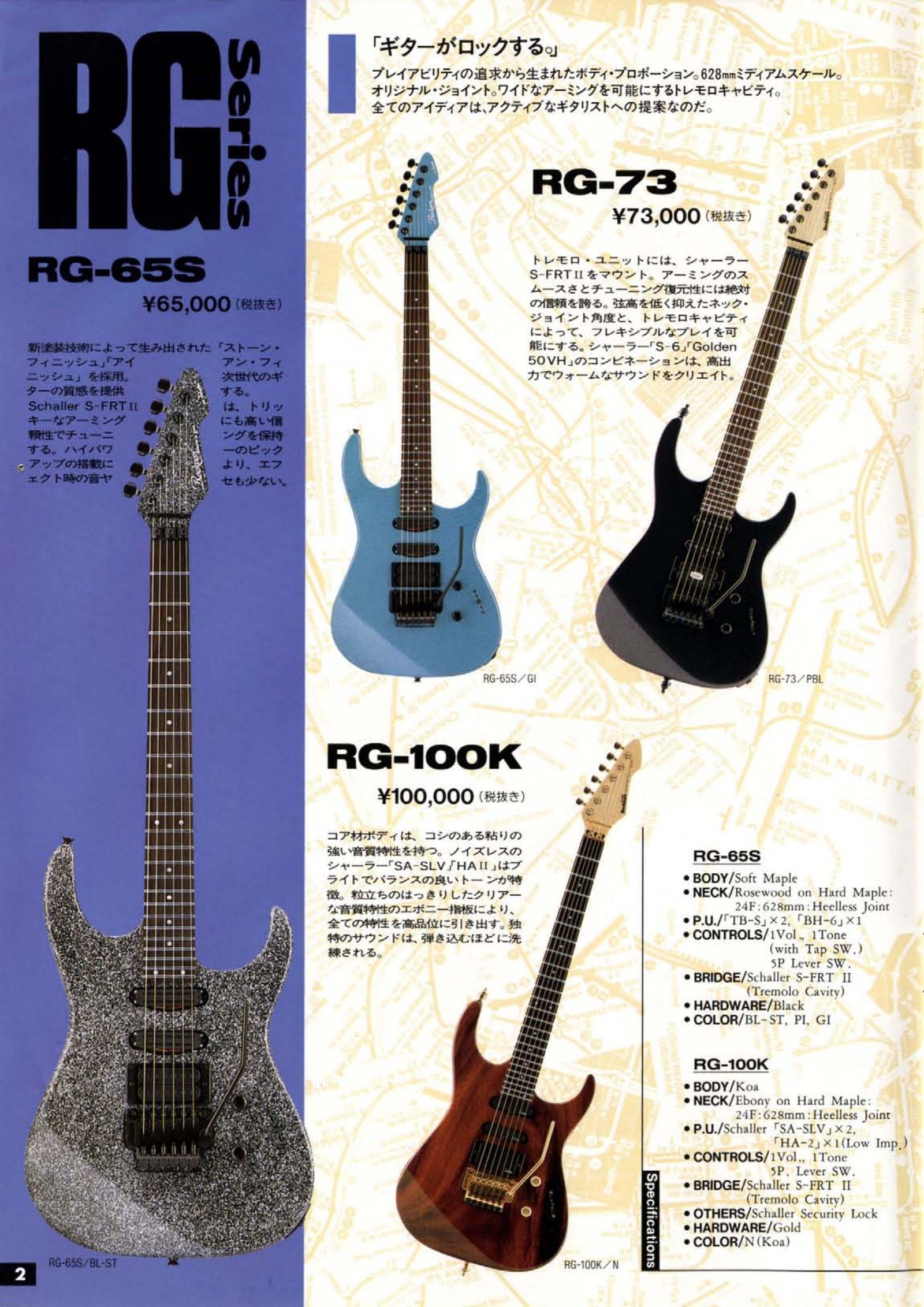
| Model | Price | Key specs |
|---|---|---|
| RG-65S | ¥65,000 | Soft maple body, Schaller S-FRT II locking tremolo, three pickups with a tap switch, new textured “stone” and “iron” finishes |
| RG-73 | ¥73,000 | Two Schaller S-6 single coils and a Golden 50VH humbucker, Schaller S-FRT II, Schaller strap locks |
| RG-100K | ¥100,000 | Koa body, ebony fingerboard, Schaller SA-SLV and HA-II pickups, gold hardware |
| RGT-50S / 50H | ¥50,000 | SSH or HSH pickups, Rockoon roller tremolo, pickguard to protect the body |
| PG-69 | ¥69,000 | Swamp ash or sen body, Schaller STM bridge and fine-tuning tailpiece, locking nut with no tremolo |
All of them share a 628mm medium scale and 24 frets on a rosewood-over-maple neck with an original heelless joint, and the catalog stresses a wide tremolo cavity for arm work. The PG-69 is the odd one out: it pairs a locking nut with a fine-tuning tailpiece but no tremolo, for tuning stability without a trem.
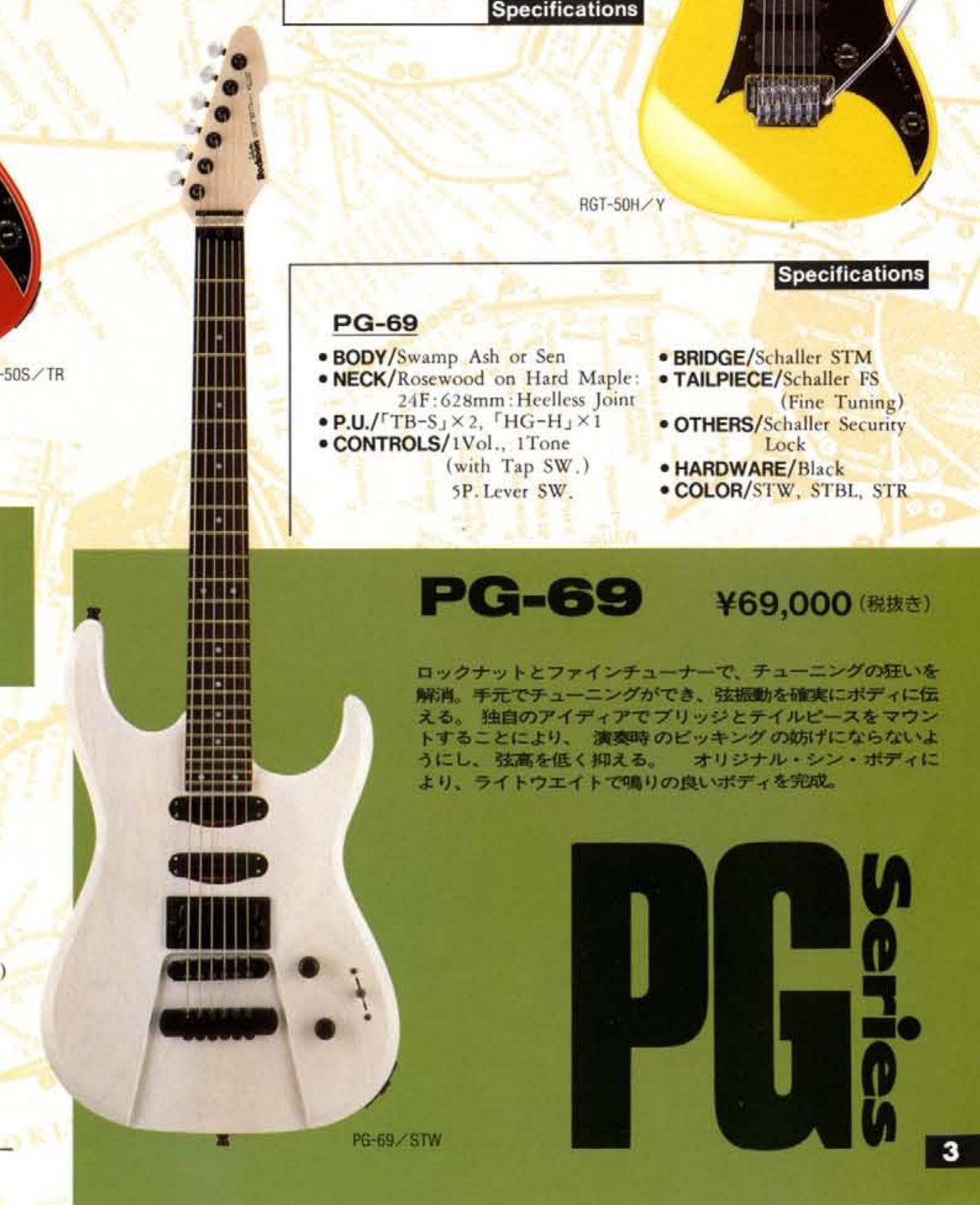
These are good, practical guitars, but they are no longer the Kawai that built crescent moons and preamp pickups. If you want the original Kawai spirit, the 1980s catalog models are the ones to look for.
My Take
Seeing the Moon Sault and the F series give way to ordinary superstrats is a little sad. But I understand it: that was simply what the market wanted.
Which Kawai Guitar Should You Look For?
| You want… | Kawai pickmodel | Whywhat you get |
|---|---|---|
| Something no one else hasthe showpiece | Moon Sault | Crescent body, moon-phase markers, preamp |
| The flagshipneck-through, exotic woods | F-I (Z, WN, K or TS) | DiMarzio Dual Sounds and the full control set |
| A fun, cheaper Kawaibright colors | F-I Jr | Neck-through, 15 sound combinations |
| A rare bassneck-through | F-II B | Preamp pickups, string-through brass tailpiece |
| A practical player1990 superstrat | RG or PG series | Schaller hardware, 628mm scale |
Kawai guitars rarely come up outside Japan, and many have aging preamp electronics, so check that every switch works, and ask whether the battery-powered circuits have been serviced, before you buy.
My Take
Today I’d call these collector’s guitars more than everyday players’ tools.
Final Thoughts
Kawai is a piano company, and that makes its guitars even more surprising. In the 1980s it put boosters, distortion, varitones and even standby switches inside neck-through guitars, and wrapped one of them in a crescent moon. By 1990 it had moved on to conventional superstrats, but the Moon Sault and the F series remain some of the most original guitars Japan ever produced.
Frequently Asked Questions
Does Kawai make guitars?
Kawai is best known today for pianos. In the 1980s it made original electric guitars and basses such as the Moon Sault and the F series, and by 1990 it was making RG series superstrats.
What is the Kawai Moon Sault?
A crescent-moon-shaped guitar with a mahogany body, two humbuckers, a built-in preamp with booster and distortion, and moon-phase position markers. The clear acrylic version is called the Crystal Moon.
Did Kawai own Teisco?
Yes. Kawai bought Teisco in 1967.
What is special about the Kawai F series?
Neck-through construction and onboard electronics: preamps with booster and distortion, a six-step varitone, dual-sound and phase switches, and on some models a preamp built into the pickup itself.
Why was Aria once spelled Arai?
Kawai already owned Aria as a keyboard trademark, so Aria guitars were sold as Arai Diamond for a few years until the name was bought from Kawai.
How much did a Moon Sault cost new?
In the catalog, the standard colors were ¥105,000 and the Crystal Moon was ¥200,000, plus ¥20,000 for the hard case.