When people talk about Japanese guitars, the conversation usually turns to Fender Japan, Ibanez or ESP. But Japan also has a deep bench of bass builders whose instruments are trusted by top session players and touring bassists. Here are five Japanese bass brands worth knowing, with an overview of each one, what sets it apart, and a closer look at a representative model, based on each maker’s official information.
| Brand | Base | Known for |
|---|---|---|
| ATELIER Z | Japan | Jazz Bass-style basses with active circuits |
| Sugi | Matsumoto, Nagano | Handcrafted basses with exotic woods |
| Moon | Japan | The JJ bass and custom orders |
| TUNE | Japan | Slap-friendly active basses and in-house preamps |
| Phoenix | Japan | Artist models presented alongside TUNE |
Prefer to watch? This article is based on my own short below.
1. ATELIER Z
According to the company, ATELIER Z traces back to 1989, when Kokichi “Johnny” Motohashi founded DAY’S CORPORATION, the company behind the ATELIER Z brand. From the start, it developed instruments together with leading Japanese bassists, beginning with Tomohito Aoki. In 2019 the company took the name ATELIER Z Guitar Works. Official site: atelierz.co.jp.
What Sets ATELIER Z Apart
- Built with working bassists. Its models were developed through feedback from professional players, starting with Tomohito Aoki.
- Active circuits. ATELIER Z became known for active basses, and later added passive models and the “j note” line.
- A Jazz Bass foundation. Much of the lineup builds on the Jazz Bass shape and sound, refined for modern stages and studios.
Representative Model: ATELIER Z M#245

The M#245 is ATELIER Z’s take on the orthodox Jazz Bass. The company describes it as combining vintage-style clarity with a clear, defined attack for slap playing. Under the hood, a Bartolini XTCT preamp with ATELIER Z’s Spectrum Boost works with two in-house JBZ-4 pickups.
| Spec | |
|---|---|
| Scale | 34″ |
| Body | Ash 2P, JB “M” type |
| Neck / frets | Maple 1P, 240R, 20 frets, bone nut |
| Pickups | ATELIER Z JBZ-4 x2 |
| Preamp | Bartolini XTCT with Spectrum Boost |
| Hardware | Gotoh GB528 tuners, ATELIER Z BB419 bridge |
| Price (Japan) | ¥363,000 incl. tax |
2. Sugi
Sugi Musical Instruments is based in Matsumoto, Nagano, one of Japan’s historic guitar-making towns. It was established on June 6, 2002 by Makoto “Nick” Sugimoto, who had been involved in guitar design and production since 1976, mostly at one of Japan’s premier makers. Official site: sugiguitars.com.
What Sets Sugi Apart
- No-compromise handcraft. Sugi says its focus is handcrafted instruments with no compromise in craftsmanship, sound or playability.
- Exotic woods. Sugi basses are known for striking figured tops, like the burl on the NB5 below.
- A compact bass lineup. The bass range centers on the NB4, NB5 and NB6, plus the RMB and the NB4/NB5 Standard models.
Representative Model: Sugi NB5 (Night Breeze 5)
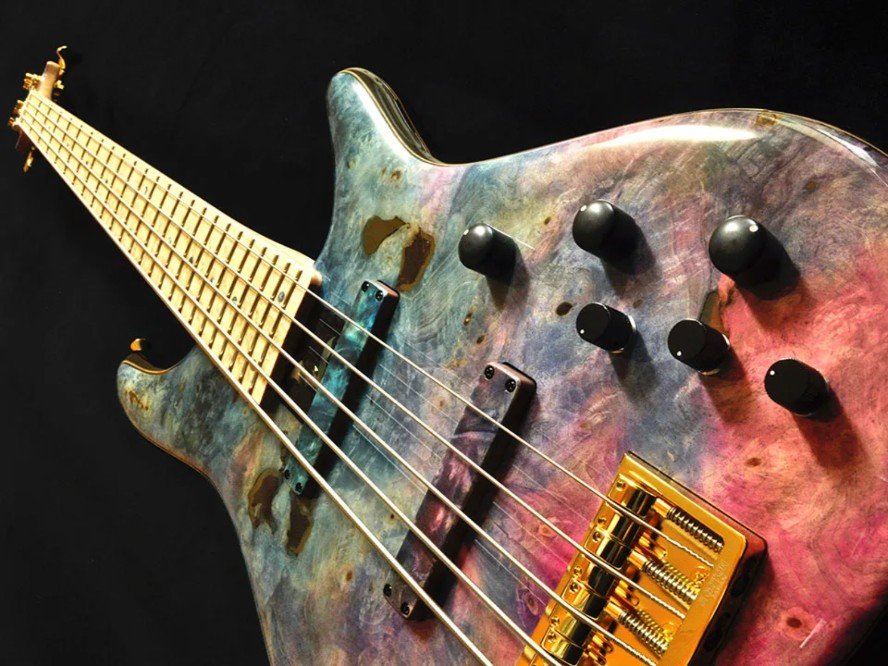
The NB5 is Sugi’s five-string “Night Breeze.” Its concept, in Sugi’s words, is passive control, good resonance and high playability. It is offered in 33”, 34” and 35” scales, and the official page highlights its solid low-string image.
| Spec | |
|---|---|
| Scale | 35″ (33″ / 34″ also offered) |
| Body | Exotic maple top, swamp ash back |
| Neck | 5-ply maple/walnut, cocobolo fingerboard, 500R |
| Pickups | Sugi WJ5 single coils |
| Controls | Volume x2, master Tone (passive) |
| Hardware | Gotoh GB350S tuners, Gotoh 304SBO-5 bridge |
3. Moon
Moon Guitars, led by president Hitoshi Yamazaki, describes its mission as delivering a true “friend” to every player. Alongside its regular lineup, Moon is known in Japan for custom orders built to each player’s request. Official site: moon-guitar.co.jp.
What Sets Moon Apart
- The JJ bass. Moon’s JJ Bass has been around for about 25 years, and the official page lists Larry Graham, Victor Bailey and Darryl Jones among its users.
- Custom orders. Moon builds instruments to order, so a player can spec a bass around their own style.
- Modern multi-string designs. The CLIMB series covers five- and six-string basses for contemporary technical playing.
Representative Model: Moon JJ-4

The JJ-4 is the current form of the JJ Bass. It uses a heelless neck joint, and Moon changed the design from an overhanging 21st fret to a deep-joint 21-fret neck to tighten up the low end. The electronics are built around a Bartolini XTCT preamp.
| Spec | |
|---|---|
| Strings | 4 |
| Neck joint | Heelless, deep joint |
| Frets | 21 |
| Preamp | Bartolini XTCT |
Also Worth a Look: Moon CLIMB-5H
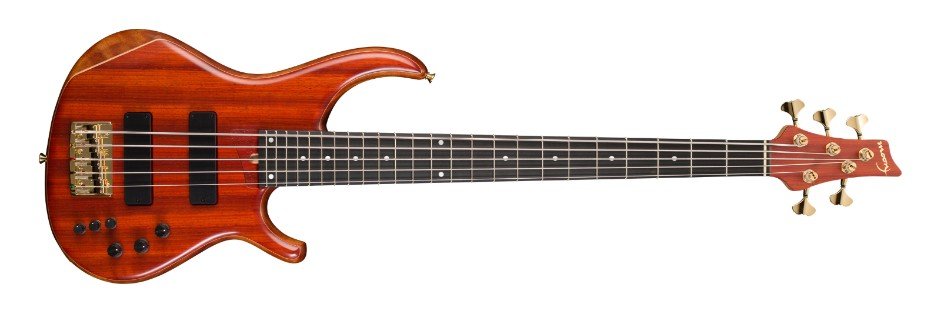
For players who need more range, the CLIMB-5H and CLIMB-6H are Moon’s multi-string basses. Moon says the body is balanced so the neck does not dive, and the 24-fret ebony board and active/passive switching make it a flexible modern instrument.
| Spec | |
|---|---|
| Strings | 5 (6-string CLIMB-6H also available) |
| Scale | 34″, deep joint |
| Fingerboard | Ebony, 24 frets |
| Pickups | H.Y.G H5 (H6 on the 6-string) |
| Preamp | Bartolini NTMB with passive switch |
| Hardware | Gotoh GB707-5 tuners, Gotoh 404BO-5 bridge |
4. TUNE
TUNE is a Japanese bass brand whose official TUNE GUITAR MANIAC site covers TUNE basses together with Phoenix basses and Psychedelic Guitars. The site’s artist pages include Yoshihiro “Narucho” Naruse of Casiopea, Matatabi of Onmyoza, Akihito Tokunaga of doa, Naoya Izumi and Yusuke Morita. Official site: tuneguitars.com.
What Sets TUNE Apart
- Built for slap and funk. The lineup includes a dedicated Hot Slapping SWV model.
- Artist lines. TUNE offers models tied to its players, such as the Casiopea TWX line.
- In-house electronics. TUNE also lists its own GMP5 preamp in the product range.
Representative Model: TUNE Hatsun’s TWB

The Hatsun’s TWB line is one of the core TUNE basses, offered as the TWB43, TWB53 and TWB63. Its curved, sculpted body and figured top are a good example of the TUNE look. Other current lines include the TWBT Custom, Hatsun’s TWBZ, Supernova Zi7, the WB-Fretless and the Bass Maniac TBJ, plus a Custom Shop.
| Spec | |
|---|---|
| Line | Hatsun’s TWB |
| Variants | TWB43 / TWB53 / TWB63 |
5. Phoenix
Phoenix basses are presented on the same TUNE GUITAR MANIAC official site as TUNE. The lineup leans heavily on artist models, including Naoya Izumi’s “Song Bird,” Akihito Tokunaga’s TAB-344 and a Narucho model.
What Sets Phoenix Apart
- Artist models. Several Phoenix basses were made with or for specific players.
- A wide range of designs. Besides the NPH, the lineup includes the PH-2/3/4/9, the PWB Wood Bass and the Bomberbass BB-4/BB-5.
- Exotic tops. The NPH is offered with figured tops such as burl poplar or cocobolo.
Representative Model: Phoenix NPH-4

The NPH-4 combines an exotic top over an alder body with a 3-piece maple neck and an ebony fingerboard. The electronics pair EMG pickups with a GZP-2 preamp, and the official page lists the price as quote on request.
| Spec | |
|---|---|
| Scale | 34″ |
| Body | Alder with burl poplar or cocobolo top |
| Neck | 3-piece maple, ebony fingerboard |
| Pickups | EMG J or PJ |
| Preamp | GZP-2 (Volume, Balance, 3-band EQ) |
| Hardware | Gotoh GB707 tuners, Hipshot A-style bridge |
| Price | Quote on request |
Final Thoughts on Japanese Bass Brands
Each of these five brands has its own personality: ATELIER Z refined the Jazz Bass with working pros, Sugi brings Matsumoto handcraft and exotic woods, Moon pairs the JJ bass with custom orders, TUNE leans into slap-ready active basses, and Phoenix carries a strong lineup of artist models. If you are looking for a high-end bass made in Japan, any of them is worth a closer look.
Frequently Asked Questions
What are the best Japanese bass brands?
Five well-known Japanese bass brands are ATELIER Z, Sugi, Moon, TUNE and Phoenix, each with its own focus, from Jazz Bass-style instruments to handcrafted exotic-wood basses.
Who founded ATELIER Z?
Kokichi “Johnny” Motohashi founded DAY’S CORPORATION, the company behind ATELIER Z, in 1989.
Where are Sugi basses made?
Sugi Musical Instruments is based in Matsumoto, Nagano, Japan, and was established in 2002 by Makoto “Nick” Sugimoto.
Who plays Moon basses?
Moon’s official JJ-4 page lists Larry Graham, Victor Bailey and Darryl Jones among the users of its JJ bass.
Are TUNE and Phoenix related?
Both are presented on the same official TUNE GUITAR MANIAC website.