
If you look at the pedalboards of top session and touring guitarists, there is a good chance you will spot a gold-colored box from Tokyo. That is VEMURAM, and the pedal is usually the Jan Ray. Few Japanese pedal makers are as well known outside Japan.
VEMURAM does not chase heavy saturation or unusual effects. Its pedals are built to work with a good amp instead of covering it up. This guide explains that approach, walks through the current pedals and the signature models of the past, and helps you decide whether a VEMURAM belongs on your board.
VEMURAM Quick Facts
- Company: Tri-Sound Inc., Tokyo
- Founded: Not stated on the official site; its website dates back to 2008
- Where it’s made: Tokyo, Japan, built by hand
- Known for: The Jan Ray, brass enclosures and the internal Saturation trimmer
- Status: Active, with dealers in the US, Canada, Europe, Asia and Oceania
Start here
- What Sets VEMURAM Apart: brass, hand-building and the trimmer
- The Current Lineup: Jan Ray, Butter Machine, Las Lunas and more
- Signature Pedals of the Past: Myriad, Oz, DJ1 and the Shanks fuzzes
- Is a VEMURAM Worth It?: who gets the most out of one
- Which VEMURAM Should You Start With?: the quick finder
A Pedal Brand Built Around the Amp
VEMURAM’s motto is simply “For Musicians.” The official site credits the designs to a veteran technician who spent years servicing vintage amps and pedals, and says the first VEMURAM went through three years of development and hundreds of samples tested by working players.
That background explains the sound. Most overdrives are designed to be the tone. VEMURAM pedals are designed to sit in front of an amp you already like and make it play better, so they behave less like a typical drive pedal and more like an extra preamp stage.
My Take
To me, the real appeal of VEMURAM is that it works almost like a preamp. It doesn’t kill your amp’s character; it pushes the sweetest range of your guitar forward.
What Sets VEMURAM Apart
The Internal Trimmer
Here is a problem every guitarist knows: the same Gain knob setting sounds completely different on a Strat into a clean Fender than on a humbucker guitar into a pushed amp. A fixed knob range is a compromise for everyone. VEMURAM’s answer is an internal trimmer that sets the range of the gain control itself. You tune it once for your guitar and amp, and from then on the whole sweep of the knob is usable.
My Take
The trimmer is a brilliant idea, and it just makes sense. The right amount of gain depends on your pickups, your amp and how you play, so letting each player set the range is the logical solution.
Brass Instead of Aluminum
The gold look is not paint. VEMURAM enclosures are solid brass, which the company chose for better noise shielding and for weight that keeps the pedal from sliding around on stage. The trade-off is that they are heavy: a Jan Ray is 428g, and the two-channel SPIRITONE is 815g.
Hand-Built and Hand-Modified
Rather than populating boards straight from a schematic, VEMURAM says it places parts by ear and modifies every finished circuit board by hand. That is part of why the pedals cost more than mass-produced drives.
The Current Lineup
Jan Ray: Where to Start

The Jan Ray is the pedal that built VEMURAM’s reputation. Its target is the clear, punchy voice of a 1960s blackface Fender amp. At low gain it works as a boost that adds body and sustain, and with more gain it becomes a light overdrive that still keeps the sound of your guitar. Separate Bass and Treble knobs make it easy to match to different amps.
| Spec | Jan Ray |
|---|---|
| Type | Boost-overdrive |
| Controls | Level, Gain, Bass, Treble; internal Saturation trimmer |
| Power | 9V (center negative); 18V works but is not recommended |
| Size and weight | 70 x 113 x 50mm, 428g |
| Current draw | 5mA |
My Take
If you’re new to VEMURAM, start with the Jan Ray.
Butter Machine: More Gain, Same Clarity
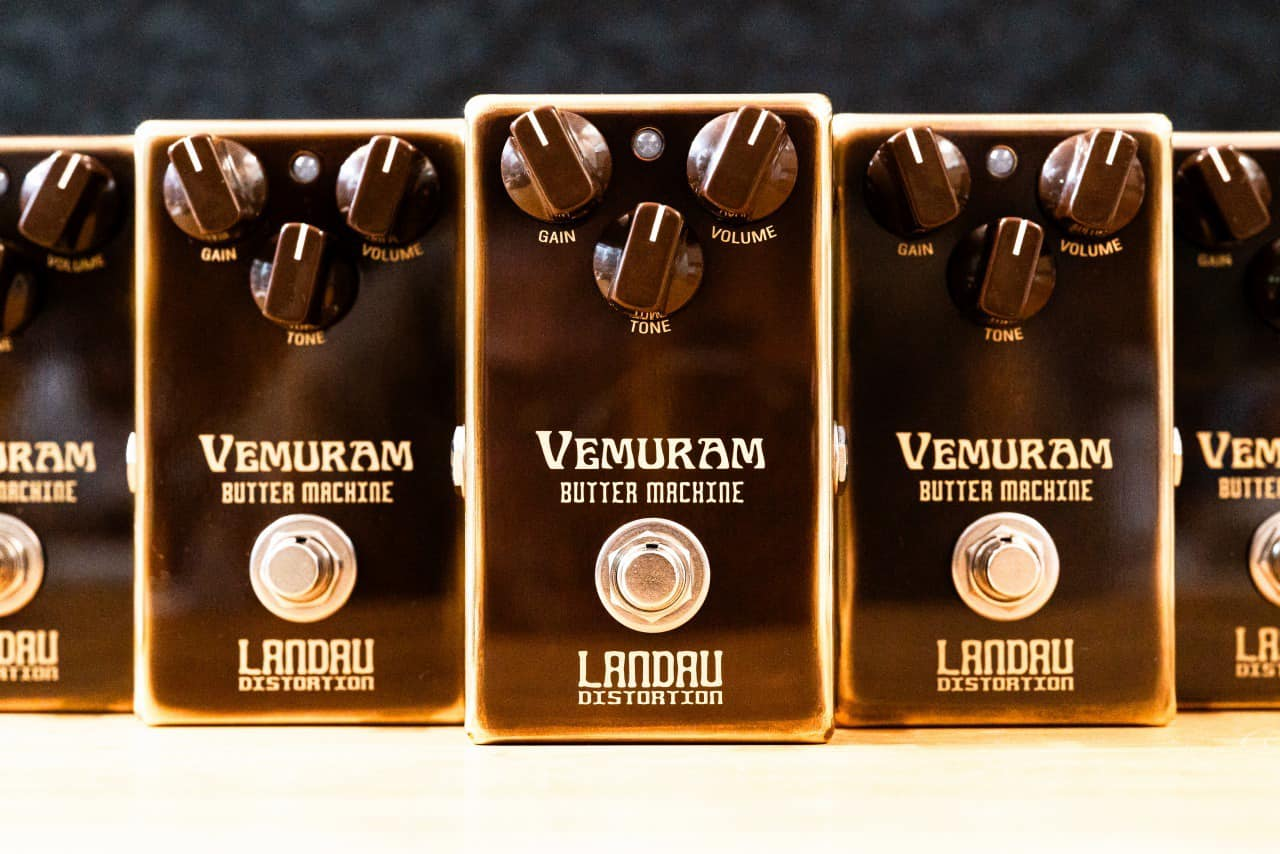
The Butter Machine is VEMURAM’s distortion, made with Michael Landau, a longtime Jan Ray user. Landau wanted something with the feel of his old Ibanez SD9 but without its harsh, compressed top end, and he road-tested prototypes on tour in 2022 and 2023. On the official site he calls the result “the best distortion pedal that I have ever played through.”
For anyone who finds the Jan Ray too polite, this is the next step. Two trimmers, Sparkle and Low-Mid, let you shape the top and bottom end, and it cleans up well from the guitar’s volume knob.
Las Lunas: Late-70s Distortion

Las Lunas is the newest VEMURAM and the one most clearly aimed at a specific era: the distortion sounds of the late 1970s and early 1980s. A 3-band passive EQ adds the low end many distortions lack, and a toggle gives two voices, a warmer DIST A and a sharper DIST B. Note that it runs on 9V only.
Budi-G: A Boost with Some Grit
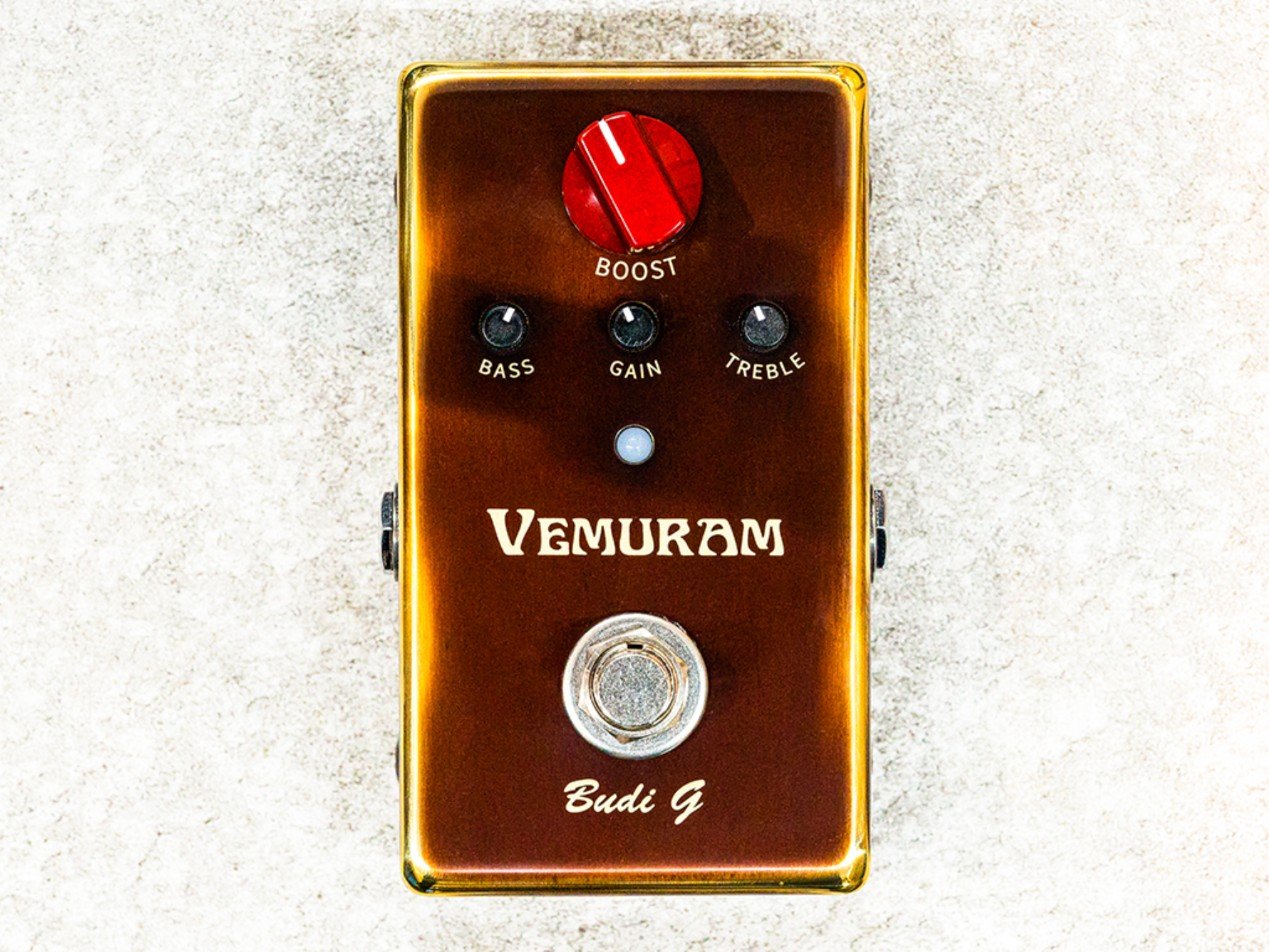
The Budi-G replaces the old Budi clean boost. It has lots of headroom, and its Gain knob adds a touch of dirt, so it is best thought of as a tool for pushing a tube amp or stacking in front of another drive rather than a pure clean boost.
SHANKS ODS-1 and SPIRITONE
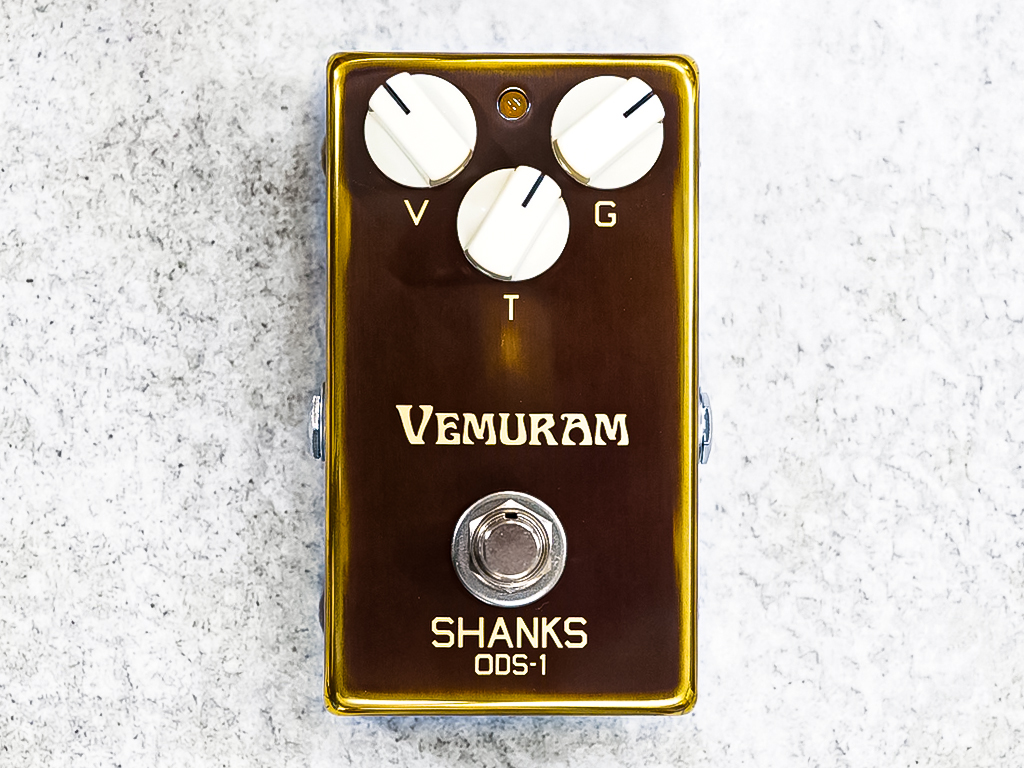
The SHANKS ODS-1, made with producer and guitarist John Shanks, is a wide-range transparent overdrive that goes from a gentle push to a solo tone. SPIRITONE is a two-channel overdrive developed with a veteran Japanese guitarist, built from research on Klon Centaur units plus the boost character of the Roland CE-1 and Watkins Copicat. It has a vintage main channel, a brighter B channel and a buffer switch.
Signature Pedals of the Past

The list of discontinued VEMURAMs doubles as a list of the players the brand has worked with. These pedals now turn up only on the used market:
| Pedal | Type | Note |
|---|---|---|
| Myriad Fuzz / Myriad | Hybrid fuzz (Myriad adds a loop with mix) | Josh Smith signature |
| Oz | Silicon fuzz | Oz Noy signature |
| DJ1 | Bass overdrive | Darryl Jones signature |
| Jan Ray for MA | Boost-overdrive | Mateus Asato signature |
| SHANKS II, 3K and 4K | Silicon and germanium fuzzes | Produced by John Shanks |
| Neoplex | Boost | Uses the TIS58 preamp of the Maestro Echoplex EP-3 |
| Karen | Overdrive-distortion | Marshall-type |
| Galea, Rage e, Budi | Overdrive, overdrive-distortion, clean boost | Earlier VEMURAM designs |
VEMURAM in Japan and Around the World
In Japan, VEMURAM is not a hard-to-find boutique name. Larger music stores commonly stock it alongside the big brands. It has also spread far beyond Japan through its professional users, and the official site lists dealers in the US, Canada, Central America, Europe, Asia and Oceania.
My Take
VEMURAM is one of the flagship names in Japanese boutique pedals. Larger stores in Japan carry it as a matter of course, and with so many players using it outside Japan, it should not be hard to find in your country either.
Is a VEMURAM Worth It?
VEMURAM pedals cost more than most overdrives, and the extra money does not buy more features. What it buys is a pedal that lets your amp do the talking. If your amp sounds mediocre on its own, a Jan Ray will not transform it. If your amp already sounds great, VEMURAM is built to bring that out.
My Take
The better your amp sounds, the more a VEMURAM is worth. If you love the sound of your amp, VEMURAM is for you.
Which VEMURAM Should You Start With?
| You want… | VEMURAM pickpedal | Whywhat you get |
|---|---|---|
| Your first VEMURAMlow-gain overdrive | Jan Ray | The flagship, blackface-style clarity |
| A boost that stackspush your amp | Budi-G | Wide headroom with a little grit |
| Transparent drivemild to solo | SHANKS ODS-1 | Wide range, internal trimmers |
| Higher gainoverdrive to distortion | Butter Machine | Clear at lower volume, Sparkle trimmer |
| Classic late-70s distortiontwo voices | Las Lunas | 3-band passive EQ, A/B switch |
Where to Buy
VEMURAM lists its dealers by region on its official site. The same company also makes cables and plugs under its Allies brand.
Final Thoughts
VEMURAM built a whole brand on one idea: a pedal should serve the guitar and the amp, not replace them. Brass boxes, hand-modified circuits and the gain-range trimmer all follow from that. For players who already have a sound they love, that is exactly why a Jan Ray ends up on so many professional boards.
Frequently Asked Questions
Where are VEMURAM pedals made?
In Tokyo, Japan, by Tri-Sound Inc. The pedals are built by hand.
What does the Jan Ray sound like?
A low-gain boost-overdrive voiced after the clear, punchy tone of 1960s blackface Fender amps. It keeps the character of your guitar and amp.
What is the VEMURAM trimmer?
An internal trimmer that sets the range of the gain control, so you can match the pedal to your pickups, amp and playing style.
Why are VEMURAM pedals made of brass?
VEMURAM says brass shields noise better than aluminum, and the weight keeps the pedal stable on stage.
Can I run VEMURAM pedals at 18V?
Many tolerate 18V, but VEMURAM designs them for 9V and does not recommend it. Some, such as the Las Lunas and SPIRITONE, are 9V only.
Who uses VEMURAM?
Signature and produced models include Michael Landau, Josh Smith, Oz Noy, Darryl Jones, Mateus Asato and John Shanks.