Small, colorful and built to last: BOSS pedals are everywhere. Even if you have never owned one, you know the shape, the single footswitch and the candy-colored enclosure. This article follows the BOSS story from its 1973 roots in Osaka through the CE-1, OD-1 and DS-1, the digital era, Waza Craft and the PX-1, and explains why the brand has stayed at the center of the pedal world for more than fifty years.
BOSS Quick Facts
- Roots: MEG Electronics, founded in Osaka in 1973 (now BOSS Corporation)
- First product: B-100 acoustic guitar preamp (1974, US only)
- First effect pedal: CE-1 Chorus Ensemble (1976), based on the Roland JC-120’s chorus
- First compact pedals: OD-1, PH-1 and SP-1 (1977)
- Best-selling compact: DS-1 Distortion, over one million sold; MT-2 Metal Zone is second
- Warranty: 5 years on all compact pedals since April 1, 2014
- Today: merged into Roland in 2018; BOSS is the group’s guitar and bass brand
Prefer to watch? This article is based on my own video below.
- 1973 to 1976: MEG Electronics, the B-100 and the CE-1
- 1977 to 1978: The Compact Pedal Is Born
- 1979 to 1984: SD-1, the First Chromatic Tuner and the DD-2
- 1987 to 1996: Multi-Effects, Metal Zone and Blues Driver
- 2007 to 2016: Fender Legend Series, Waza Craft and Katana
- 2017 to 2025: 40th Anniversary, EURUS and the PX-1
- BOSS Timeline at a Glance
- What Defines BOSS
- Final Thoughts
- Frequently Asked Questions
- More BOSS Articles
1973 to 1976: MEG Electronics, the B-100 and the CE-1
BOSS traces back to MEG Electronics, an effects company founded in Osaka in 1973 and closely tied to Roland. By 1974 its products were carrying the BOSS name.
The very first BOSS product was not a stompbox. The B-100 was an acoustic guitar preamp, sold only in the United States.
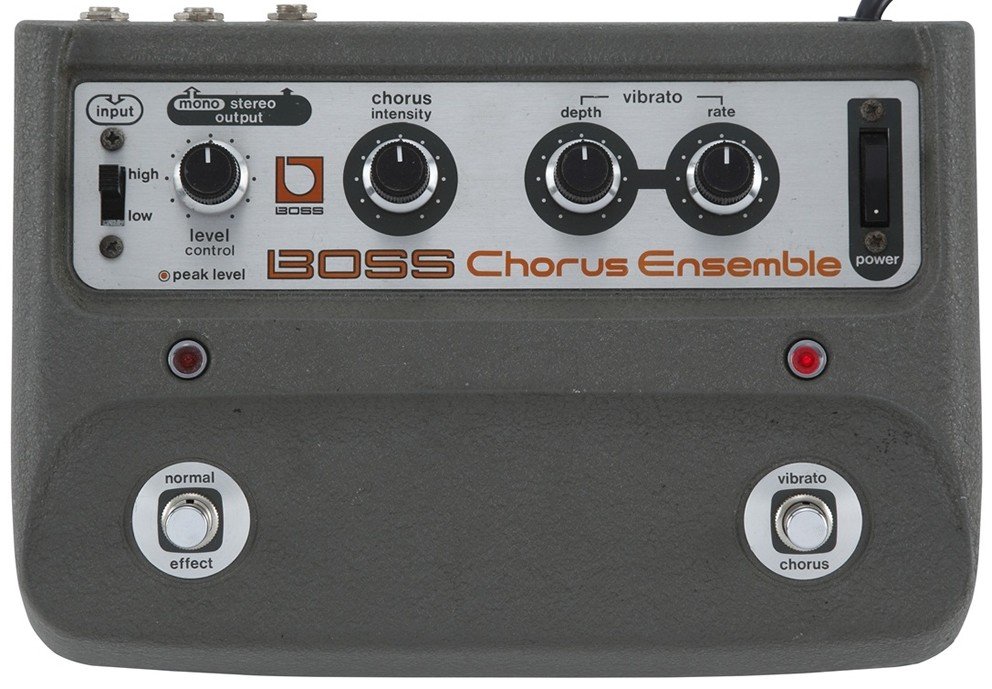
That changed in 1976 with the CE-1 Chorus Ensemble. It took the chorus and vibrato from the Roland JC-120 Jazz Chorus, a solid-state amp known for its clean, sharp voice, and put them in a box you could use with any amp. The CE-1 was a hit, and it is where the BOSS name started to travel worldwide.
1977 to 1978: The Compact Pedal Is Born
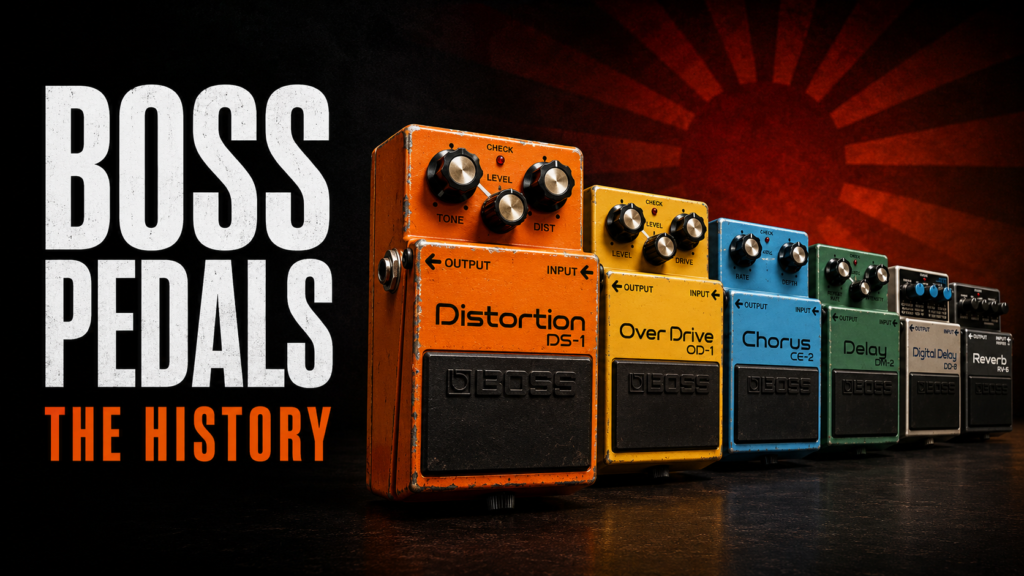
In 1977 BOSS released three pedals at once: the OD-1 Over Drive, the PH-1 Phaser and the SP-1 Spectrum. They introduced the compact enclosure that still defines the brand. You can spot a BOSS pedal from across a stage by its shape alone.
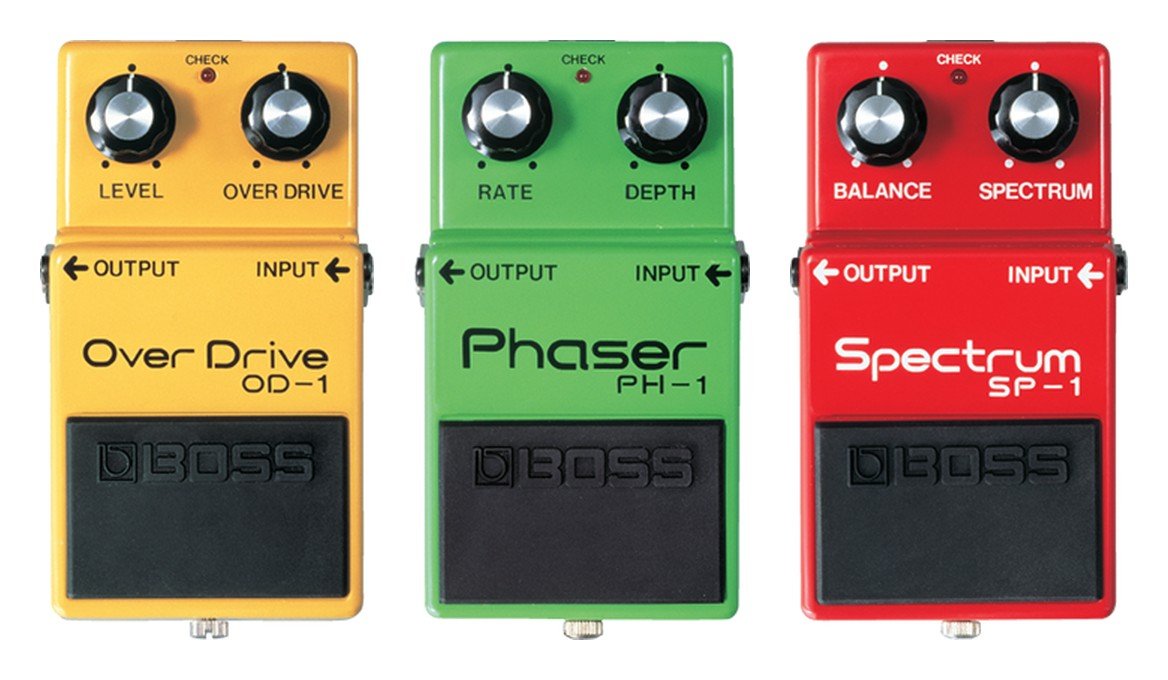
The OD-1 is widely regarded as the first compact overdrive pedal. Players still use it both to shape their core tone and as a boost in front of a driven amp.
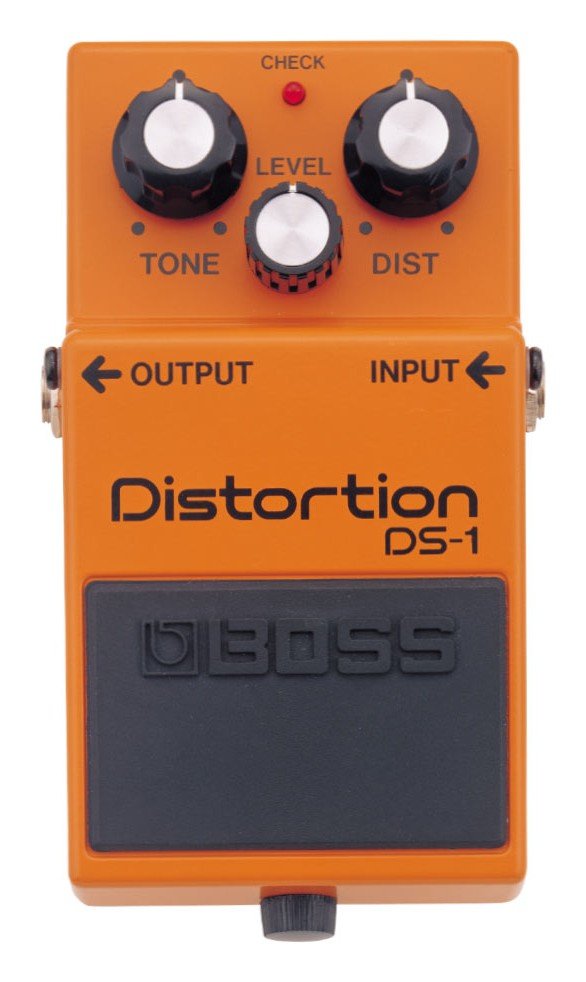
In 1978 came the DS-1 Distortion. It became the best-selling BOSS compact pedal, with over one million units sold, and you can hear it across almost every style of music. The same year BOSS moved into delay with the DM-1 Delay Machine, its first delay unit.
Why Early Japan-Made Units Are Collectible
Most early models were made in Japan until the late 1980s. Parts and specs changed along the way, so two units of the same model can sound different depending on when they were built. Collectors call the earliest ones the silver screw models, and they are valued both for their tone and as collector’s pieces.
1979 to 1984: SD-1, the First Chromatic Tuner and the DD-2
In 1981 BOSS introduced the SD-1 Super OverDrive, an evolution of the OD-1 that added a tone control while keeping its core character. From here BOSS was not only adding models but refining existing ones, which built its reputation for consistency.
The SD-1 is often compared with the Ibanez Tube Screamer. Both work well as a main drive or as a boost, and neither is simply better. It comes down to your amp, your guitar and the music you play.
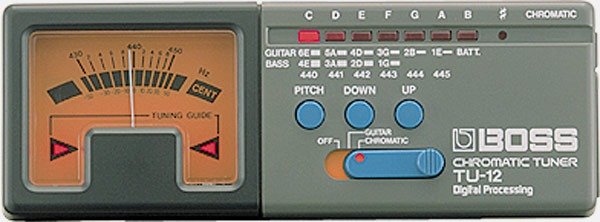
In 1982 BOSS released the TU-12, which BOSS calls a world first: an automatic chromatic tuner that showed pitch in real time. The same year it started building an ecosystem around its pedals, with the BCB-6 carrying box (which also fit the TU-12) and the SCC-700 Sound Control Center, an early ancestor of today’s switching systems.
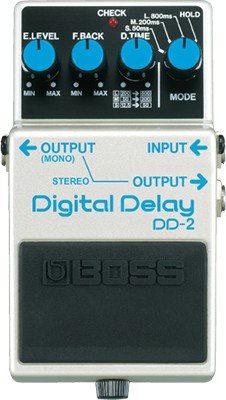
As rock got heavier, BOSS answered with the HM-2 Heavy Metal in 1983. It is famous for the chainsaw tone of Swedish death metal, but it covers far more styles than that reputation suggests. In 1984 the DD-2 Digital Delay put digital delay, then mostly found in large rack units, into a compact pedal anyone could carry.
1987 to 1996: Multi-Effects, Metal Zone and Blues Driver
By the late 1980s digital technology made multi-effects practical. Roland had built rack systems, but BOSS went for the floor: the 1987 ME-5, which BOSS describes as the world’s first floor-based multi-effects unit. Some analog tones were still hard to recreate digitally, but convenience won, and players could store and recall presets instantly for the first time.
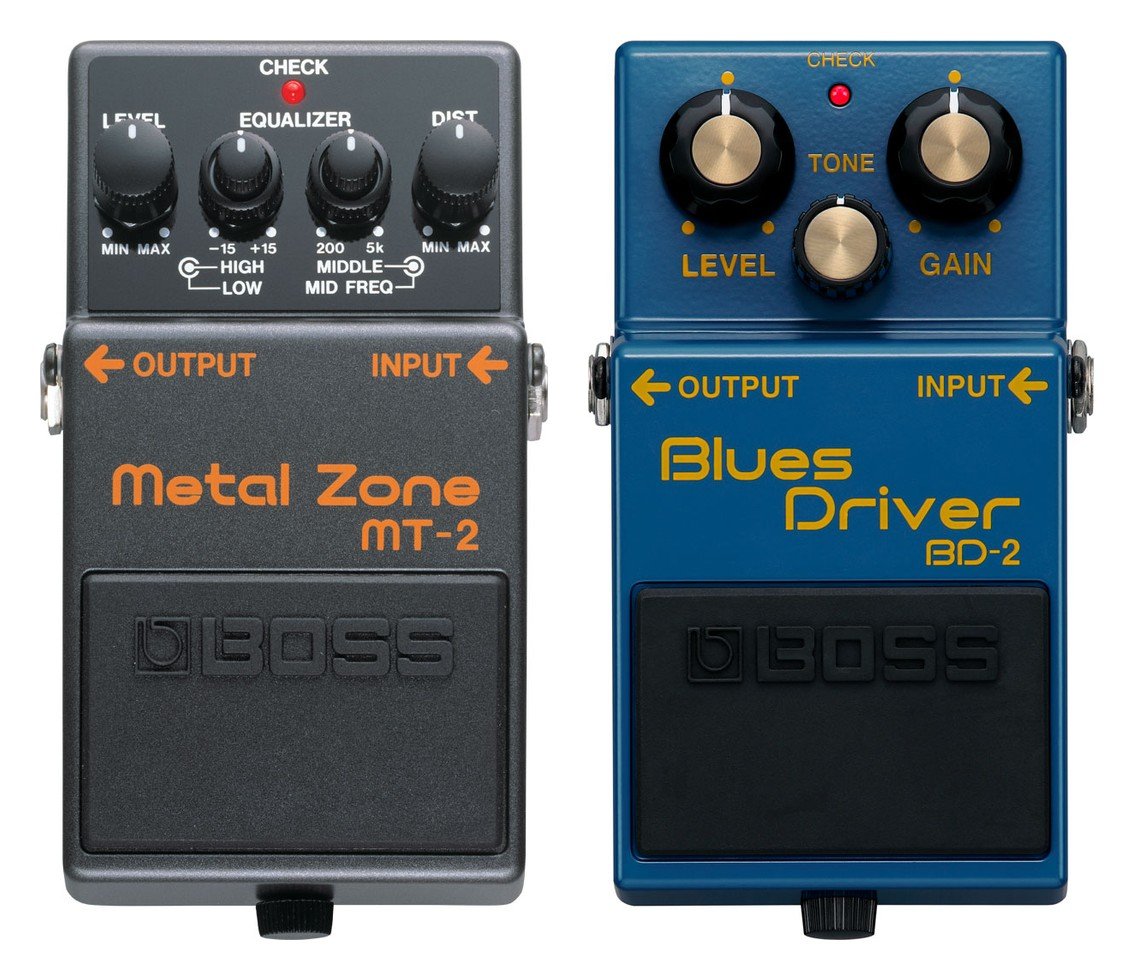
The 1991 MT-2 Metal Zone brought high gain and a powerful EQ, and it is the second best-selling BOSS compact after the DS-1. The 1995 BD-2 Blues Driver was designed to respond like a tube amp, and despite the name it works in many styles beyond blues.
In 1996 the GT-5 started the long-running GT series. With a wide range of effects, presets, an expression pedal and amp simulation in one floor unit, it is where the modern multi-effects processor starts to look familiar.
2007 to 2016: Fender Legend Series, Waza Craft and Katana
As amp modeling took off, BOSS did something few brands could: in 2007 it released the Legend series, officially licensed by Fender, including the FBM-1 (’59 Bassman) and FDR-1 (’65 Deluxe Reverb). Most competitors could only offer pedals “inspired by” those amps.
In 2013 the TE-2 Tera Echo became the 100th model in the compact series. In 2014 BOSS launched two new lines:
| Line | Approach | Who it suits |
|---|---|---|
| Waza Craft | Classic analog circuits fully redesigned with selected parts; many have a mode switch for a second voice | Players who want the classic BOSS sounds, refined |
| X Series | Digital processing used to expand classic effects into something new | Players who want a modern take on a familiar effect |
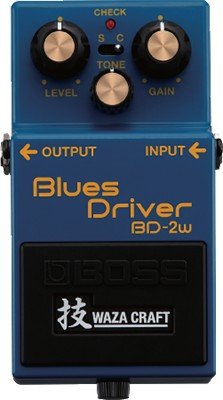
From April 1, 2014, BOSS also extended the warranty on its entire compact pedal series from one year to five. In 2016 the Katana amplifiers arrived, covering vintage cleans to modern high gain in formats from full-size combos to compact and headphone-friendly models.
2017 to 2025: 40th Anniversary, EURUS and the PX-1
For the compact series’ 40th anniversary in 2017, BOSS released a limited box set reissuing the original three, OD-1, PH-1 and SP-1, built on a special production line in Japan. Collaborations followed, such as the JB-2 Angry Driver with JHS Pedals, which combines the Angry Charlie and the Blues Driver in one pedal.
In 2018 BOSS Corporation was merged into Roland, and BOSS continues as the group’s guitar and bass brand. The lineup has kept widening since: the 200 series, a Tone Bender recreation with Sola Sound, Space Echo pedals, guitar synthesizers and the SDE-3000EVH with EVH.
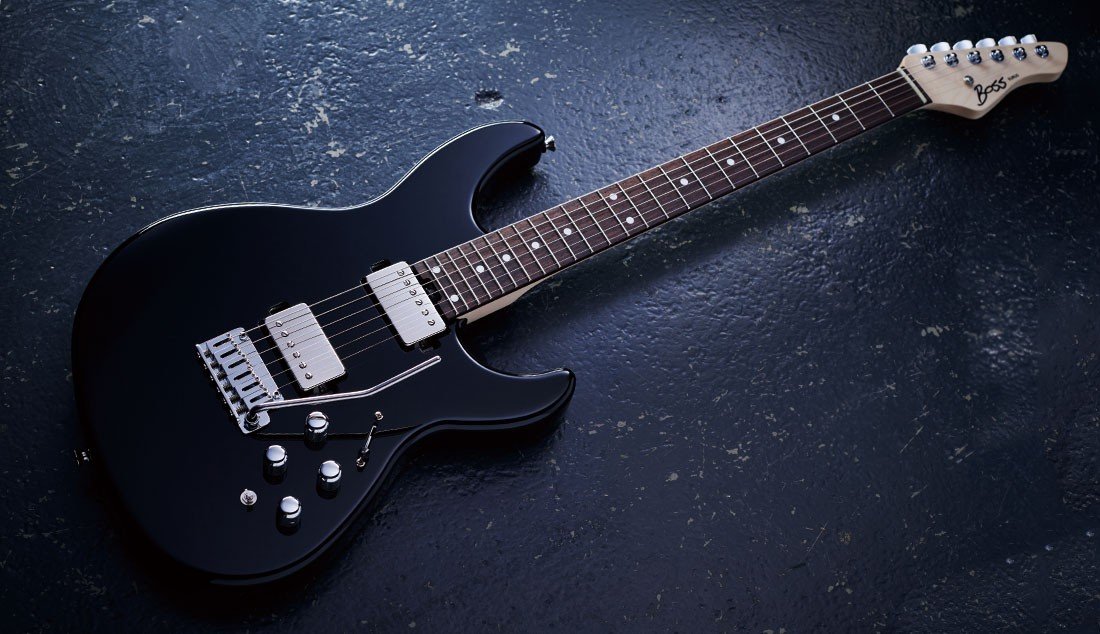
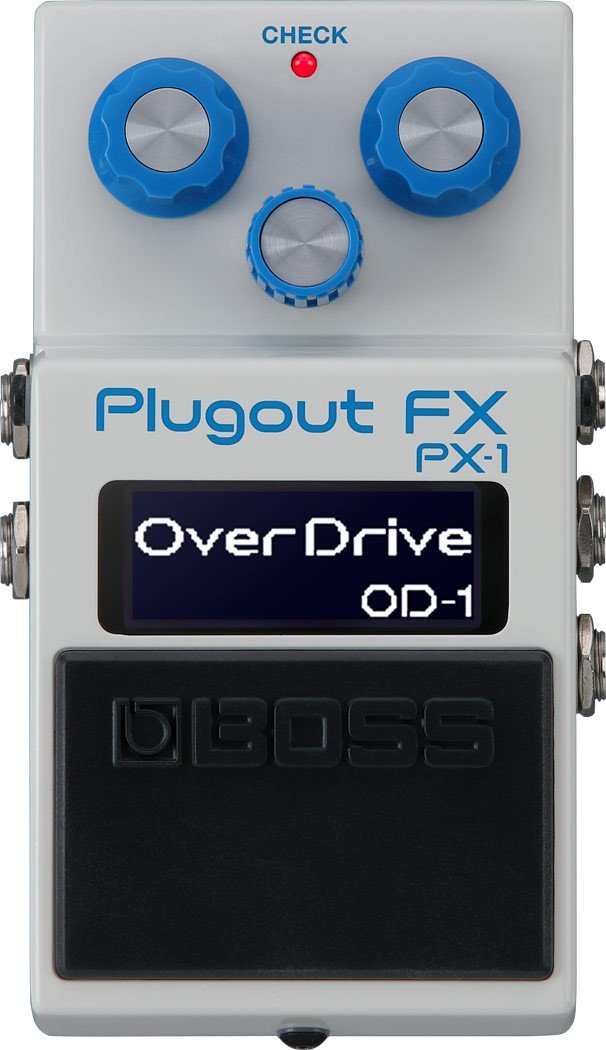
Then came the unexpected: in 2021 BOSS released its first guitar, the EURUS GS-1, a Japan-made instrument with built-in synth sounds. BOSS marked its 50th anniversary in 2023 with limited editions and special finishes, and in 2025 it introduced the PX-1 Plugout FX, a single pedal that loads digital recreations of classic BOSS compacts one at a time. It ships with 16 effects, including the OD-1, DS-1, CE-2 and DD-2.
BOSS Timeline at a Glance
| Year | Milestone | Why it mattered |
|---|---|---|
| 1973 | MEG Electronics founded in Osaka | The company that became BOSS |
| 1974 | B-100 acoustic preamp | First BOSS product, US only |
| 1976 | CE-1 Chorus Ensemble | JC-120 chorus in a pedal; first global hit |
| 1977 | OD-1, PH-1, SP-1 | First compact pedals |
| 1978 | DS-1 Distortion, DM-1 Delay Machine | Best-selling compact; first BOSS delay |
| 1981 | SD-1 Super OverDrive | OD-1 evolution with a tone control |
| 1982 | TU-12, BCB-6, SCC-700 | Auto chromatic tuner; first pedal ecosystem |
| 1983 | HM-2 Heavy Metal | Heavier gain for the metal era |
| 1984 | DD-2 Digital Delay | Digital delay in a compact pedal |
| 1987 | ME-5 | First floor-based multi-effects |
| 1991 | MT-2 Metal Zone | Second best-selling compact |
| 1995 | BD-2 Blues Driver | Amp-like response |
| 1996 | GT-5 | Start of the GT series |
| 2007 | Legend series (FBM-1, FDR-1) | Officially licensed Fender amp tones |
| 2013 | TE-2 Tera Echo | 100th compact model |
| 2014 | Waza Craft, X Series, 5-year warranty | Refined classics, new digital takes |
| 2016 | Katana amplifiers | Modeling amps in many formats |
| 2017 | 40th Anniversary box set | Japan-made reissue of the first three compacts |
| 2018 | Merged into Roland | BOSS becomes the group’s guitar and bass brand |
| 2021 | EURUS GS-1 | First BOSS guitar, made in Japan |
| 2023 | 50th anniversary | Limited editions and special finishes |
| 2025 | PX-1 Plugout FX | Classic compacts recreated digitally in one pedal |
What Defines BOSS
| Strength | What it means for you |
|---|---|
| Variety | More than a dozen drive pedals alone, so you can usually find the sound you want without boutique prices |
| Analog and digital | Classic analog circuits stay in the lineup while new models push digital forward |
| Shared design | Solid enclosure, quiet switching and a footswitch that doubles as the battery cover and protects the switch; learn one and you can use them all |
| 5-year warranty | On every compact pedal, for gear that gets stepped on every night |
| Availability | Sold almost everywhere, with many models in production for decades; easy to replace on tour |
Power Supply: PSA vs ACA
Current draw varies a lot by model. The analog DS-2 draws 15 mA and runs about 42 hours on an alkaline battery, while the digital DS-1X draws 45 mA and lasts about 9 hours. An adapter gives stable power and one less thing to worry about.
| Adapter | Used by | Note |
|---|---|---|
| PSA | Current BOSS compact pedals | The standard for modern boards |
| ACA | Some older BOSS pedals | No longer made; these pedals may not work properly on other supplies, so check Roland’s guidance first |
Final Thoughts
Some players avoid BOSS because it is so common. To me, that is exactly the point. It is a sound almost every guitarist has heard, which makes the BOSS catalog something close to a reference point for the whole pedal world.
The same brand built the first compact overdrive, a digital delay in a compact pedal, the first automatic chromatic tuner, a licensed Fender line, a guitar with a synth inside and a pedal that reloads its own classics. If a model catches your interest, try it yourself rather than reading another opinion about it.
Frequently Asked Questions
Is BOSS the same company as Roland?
BOSS began as MEG Electronics in Osaka in 1973, closely tied to Roland. BOSS Corporation was merged into Roland in 2018, and BOSS now operates as Roland’s guitar and bass brand.
What was the first BOSS pedal?
The first BOSS product was the B-100 acoustic guitar preamp in 1974. The first BOSS effect pedal was the CE-1 Chorus Ensemble in 1976, and the first compact pedals were the OD-1, PH-1 and SP-1 in 1977.
What is the best-selling BOSS pedal?
The DS-1 Distortion, with over one million units sold. The MT-2 Metal Zone is second.
What is the difference between Waza Craft and the X Series?
Waza Craft pedals are redesigned versions of classic analog circuits, often with a mode switch. X Series pedals use digital processing to expand classic effects into something new.
What power supply do BOSS pedals need?
Current BOSS compact pedals use PSA adapters. Some older pedals were designed for the ACA adapter, which is no longer made, so check Roland’s guidance before using a modern supply.
How long is the BOSS warranty?
Five years on all compact pedals, effective April 1, 2014.
More BOSS Articles
BOSS Pedals: Compact, Waza Craft, 200 Series and Which One to Buy
BOSS is the guitar and bass brand of Roland, the Japanese company behind the JC-120…