This article contains affiliate links. If you buy through them, I may earn a small commission at no extra cost to you. Learn more.
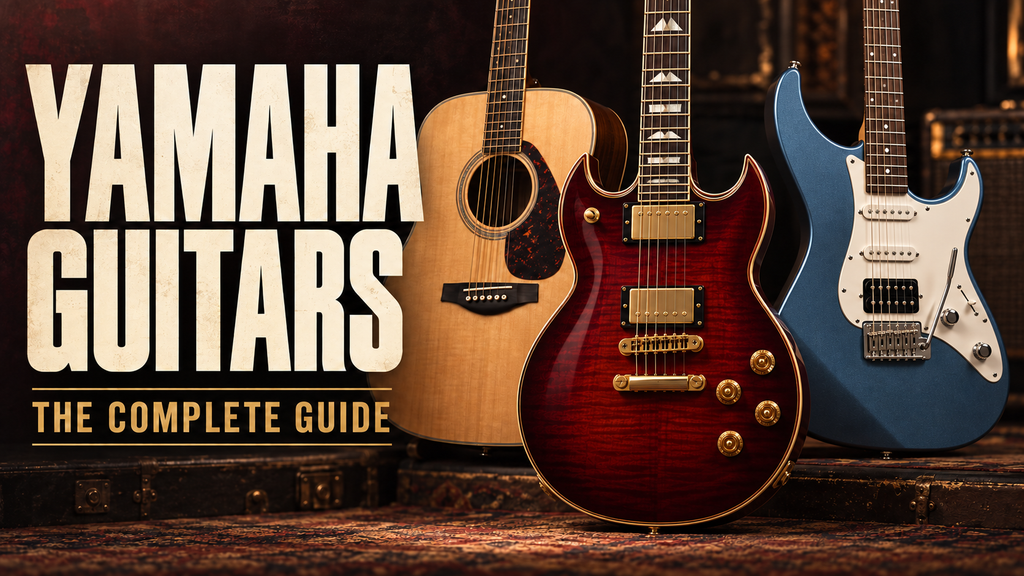
Yamaha is a Japanese instrument manufacturer (Yamaha Corporation, founded as Nippon Gakki in Hamamatsu in 1897) whose story began with a single organ repair in 1887. It entered the guitar world in earnest in 1966, launching folk guitars, electric guitars and electric basses in the same year. Today it is known for the FG180, the SG-2000, the BB bass and the Pacifica, which may be the most recommended first electric guitar anywhere.
Yamaha Quick Facts
- Founded: 1887 (first organ) / Nippon Gakki founded 1897, Hamamatsu
- First guitar: The Dynamic Guitar (pre-1966); full guitar lineup from 1966
- Claim to fame: FG180, which Yamaha calls Japan's first domestically made folk guitar
- Breakthrough artists: Carlos Santana, Billy Sheehan, Nathan East, Mike Stern
- Signature models: FG, L Series, SG, BB, Pacifica, Revstar
- Brand family: Yamaha Guitar Development (LA); Yamaha Guitar Group (Line 6, Ampeg, Córdoba, Guild)
- Yamaha History in Brief
- What Makes Yamaha Guitars Different
- The Yamaha Guitar Lineup
- FG Series: The Folk Guitar That Started Japan's Acoustic Boom
- L Series: Luxury Acoustics That Open Up Like Fine Wine
- SG-2000: The Santana-Tuned Double-Cut Built for Sustain
- BB Series: The 1977 Bass Design That Still Holds Up
- Pacifica: The LA Studio Guitar That Became Everyone's First Electric
- Revstar: A Cafe Racer You Can Plug In
- The Yamaha Brand Family
- Notable Yamaha Players
- Buying a Yamaha Guitar
- Final Thoughts
- FAQ
- More Yamaha guitar articles
Yamaha History in Brief
It all started in 1887, when Torakusu Yamaha repaired a broken organ at an elementary school in Hamamatsu and then built one of his own. He founded Nippon Gakki in 1897, and piano production followed in 1900. Along the way Yamaha also built aircraft propellers, which took the same precision as piano work, and after the war it moved into motorcycles with the YA-1 of 1955. That is why Yamaha Motor, a separate company today, still shares the tuning-fork logo.
| Year | Milestone |
|---|---|
| 1966 | FG180/FG150 folk guitars, SG-2/3/7 electrics and SB-2 bass launch together |
| 1974-75 | L Series luxury acoustics, SG-175 and the L Series “Big Four” |
| 1976-77 | SG-2000 and SG-1000, then the BB1200 bass |
| 1990 | PACIFICA912, developed in Los Angeles |
| 2015 | Revstar |
| 2026 | 60th anniversary: RSP20B 60TH and FG9 60TH |
Prefer the full story? Watch my video on the history of Yamaha guitars below.
What Makes Yamaha Guitars Different
The Company That Builds Pianos and Motorcycles Builds Your Guitar
Yamaha’s biggest strength is bringing technology from other fields into instrument making. Reading through Yamaha’s own Japanese-language histories, I kept noticing the same pattern: its big guitar decisions come out of testing and data rather than tradition. That thread runs through everything below.
A Broken-In Guitar on Day One: A.R.E. and IRA
A.R.E. (Acoustic Resonance Enhancement, 2008) ages wood in a short time, bringing out the open sound of a well-played instrument. Unlike roasting, it leaves the wood looking almost untouched, so you get the tone without a baked-looking top.
IRA (Initial Response Acceleration) works on the finished guitar. Yamaha applies specific vibrations to release stress between wood and finish, neck and fingerboard, and body and hardware. The claim: a brand-new guitar that responds like one that has already been played in.
Designing Resonance with Data: Acoustic Design
Yamaha analyzes great-sounding guitars, recreates their vibration in 3D models, runs simulations, then refines prototype after prototype with artist feedback. Instead of chasing tone by feel alone, it designs the resonance first. You can hear the result in the second-generation Revstar’s chambered bodies.
A Workshop Run on Session Players’ Feedback: YGD
Yamaha Guitar Development (YGD) in Los Angeles works much like Yamaha’s US custom shop. It turns feedback from working professionals into production models, including the Pacifica, the Weddington (advertised with Stevie Salas) and Billy Sheehan’s Attitude bass. One catch: it builds mainly for artists and does not take orders from the public.
The Yamaha Guitar Lineup
FG Series: The Folk Guitar That Started Japan’s Acoustic Boom
The FG180 and FG150 of October 1966 are what Yamaha calls Japan’s first domestically made folk guitars. They arrived at the height of Japan’s folk music boom, and a whole generation learned on an FG. In Japan, a “folk guitar” simply means a steel-string acoustic smaller than a dreadnought with a deep waist, roughly Martin 00 to 000 size.
- Laminated body (after the very earliest units), lacquer finish: stable and tough, yet carefully built and good-sounding
- Label color (Red Label, then Light Green Label): the quickest way to date an early FG
- FG1500 / FG2000 (1971): Yamaha’s best materials and handwork of the day for a more refined voice; the FG2500 is the 12-string
- FG350E (1972): a built-in pickup, so you can plug straight into a PA
How to choose: Want vintage Japanese character for little money? Get a Red Label FG180. Want the top-grade build of the era? Hunt for an FG1500 or FG2000.
Fun detail: the model number was the price. The FG180 sold for ¥18,000.
L Series: Luxury Acoustics That Open Up Like Fine Wine
The “L” stands for Luxury. Launched in 1974 with the handmade L-31, the series sat above the FG line. In 1975 came four models fans now call the Big Four, very expensive for the time and reportedly built with little concern for profit.
- L-51, asymmetrical body: designed sound-first for a balanced, delicate voice
- L-52, jumbo body with white double pickguards: clear, crisp chords
- L-53, abalone headstock inlay and herringbone-style binding: a luxurious look with a focused tone that cuts through
- L-54, detailed inlay and original pickguard: bright, clear and powerful
How to choose: Fingerstyle players should look at the L-51; strummers and singer-songwriters will love the L-52. For an L without vintage prices, go for the current series, redesigned in 1985 and again in 2004.
The developer behind the 2004 redesign compared the L sound to wine: modest at first, but the more you play it, the richer the low end becomes.
SG-2000: The Santana-Tuned Double-Cut Built for Sustain
The 1966 SG-2 looked more like a Jazzmaster than today’s SG. The shape kept evolving until the SG-175 of November 1974, with Honduras mahogany, an ebony fingerboard and a floating pickguard, combining Gibson and Fender ideas with Yamaha parts. Carlos Santana played one on his 1974 Japan tour, and his feedback shaped the SG-2000 and the set-neck SG-1000 of July 1976. I cover that story in detail in Yamaha SG2000: The Guitar Shaped by Santana’s Ideas.
- T-cross construction (neck and body center as one piece): long, even sustain
- Metal sustain plate under the bridge: even more sustain and a firm attack
- SG1820 (2010): set neck, rosewood board, deeper carve, no back contour: a punchier rock voice, with humbuckers (SG1820), P-90s (SG1802) or EMGs (SG1820A)
How to choose: For the classic Santana and Takanaka sound, find a vintage SG-2000; the SG-1000 is the budget route to the same look. For a modern rock workhorse, the SG1820 fits, though it divides purists.
BB Series: The 1977 Bass Design That Still Holds Up
The BB launched in 1977 with the neck-through BB1200, and its basic design has barely changed since. It has served jazz, fusion, rock and pop players alike.
- Neck-through (BB1200 / BB2000): sustain and even response up the neck
- BB2000 (1978), extra rear pickup with bar magnets: a much wider tonal range than the one-pickup BB1200
- 2017 redesign, bolt-on neck on every model and A.R.E. on higher-end models: chosen after 20 to 30 prototypes because bolt-ons sat best in a band
How to choose: Vintage fans should look for a BB2000. Working bassists should start with the current bolt-on BB. Five-string players can trace the line back to the BB5000 of 1984.
Paul McCartney used a left-handed BB1200, which is not a bad reference.
Pacifica: The LA Studio Guitar That Became Everyone’s First Electric
The Pacifica was the first Yamaha guitar planned and developed in the US, at YGD in North Hollywood, where session players wanted one dependable guitar for any genre. It began as an experiment until headquarters put the PACIFICA912 into production in 1990.
- Bolt-on neck: snappy attack and easy servicing
- Single-single-humbucker pickups: single-coil sparkle and humbucker gain in one guitar
- Pacifica Professional (made in Japan) and Standard Plus (2024): modern pro-spec builds, so popular at launch that production could not keep up
How to choose: Beginners: the PAC112, built to take on Fender’s affordable models. Serious players: the Standard Plus, or the Professional if you want a Japanese build. Fusion fans: Mike Stern’s PAC1511MS, in the lineup since 1997.
Revstar: A Cafe Racer You Can Plug In
Launched in 2015, the Revstar was inspired by 1960s London cafe racers, motorcycles stripped of anything that did not make them faster. The goal was a simple, beautiful guitar with nothing extra, and it has won awards including the Red Dot and iF Design Awards.
- Headstock taken from the 1966 SA15: a visible link to Yamaha’s own heritage
- 2022 second generation, chambered bodies designed with Acoustic Design: lighter weight and more resonance
- New switching circuits: more usable tones from each pickup set
- Left-handed models: lefties finally covered
How to choose: For the top build, get the Revstar Professional (RSP20), made in Japan. Collectors should look at the 2026 RSP20B 60TH, released alongside the FG9 60TH acoustic to mark 60 years of Yamaha guitars.
The Yamaha Brand Family
| Brand | Positioning |
|---|---|
| Yamaha | Acoustics, electrics, basses, THR amps and the Silent Guitar |
| Yamaha Guitar Development (YGD) | LA workshop for artist builds and prototypes; no public orders |
| Line 6 | Digital modeling; part of Yamaha since 2014 |
| Ampeg | Bass amps; acquired in 2018 |
| Córdoba / Guild | Nylon-string and American acoustic brands within Yamaha Guitar Group |
Notable Yamaha Players
| Player | Yamaha connection |
|---|---|
| Carlos Santana | SG-175 on his 1974 Japan tour; his “Buddha SG” led to the SG-2000 |
| Masayoshi Takanaka | Japanese fusion guitar icon and former Sadistic Mika Band member, famous for the instrumental “Blue Lagoon”; a longtime SG player |
| Kyoji Yamamoto | Guitarist of BOW WOW, one of Japan's pioneering hard rock bands; had his own Yamaha signature model in the 1980s |
| Billy Sheehan | Attitude Limited bass (1990); still plays an evolved version |
| Nathan East | BB-NE (1994), the first BB with an active circuit |
| Bob Marley / Paul McCartney | SG / left-handed BB1200 |
Buying a Yamaha Guitar
Vintage Yamaha prices swing a lot between Japan and overseas, and the high-end models mostly stay in Japan. Here is the picture from recent listings (USD at roughly ¥150 = $1):
| Model | Typical used price |
|---|---|
| FG180 Red Label | ¥30,000-100,000 in Japan (about $200-670); around $550-600 on Reverb |
| L Series “Big Four” (L-52 Custom etc.) | ¥1,000,000-1,650,000 at Japanese vintage dealers (about $6,700-11,000) |
| SG-2000 (1970s-80s) | Around $2,200 mid-market on Reverb (about ¥330,000) |
| BB2000 | ¥120,000-230,000 in Japan (about $800-1,540); around $1,000 on Reverb |
| Pacifica Professional (new) | $2,199.99 at major US retailers |
- New: Sweetwater for current US-market models
- Vintage and used: Reverb and eBay
- Japan-market and vintage stock: Ishibashi Music, which ships internationally
Dating tips: on early FGs, start with the label color (Red Label, then Light Green Label). On electrics and basses, check the serial number against period catalog specs.
Final Thoughts
More than 130 years of Yamaha history started with one organ repair. Skills honed on pianos, propellers and motorcycles gave us the FG180, the L Series, the SG, the BB, the Pacifica and the Revstar. In every era, Yamaha has been at the heart of Japanese guitar culture. The next time you pick one up, it might look a little different to you.
FAQ
Are Yamaha guitars made in Japan?
Some are. The Revstar Professional and Pacifica Professional are made in Japan, and so were classics like the early FGs, the L Series and the SG-2000. Other lines, such as the Pacifica Standard Plus (Indonesia), are made elsewhere.
Is a Yamaha FG180 Red Label worth buying?
Yes, if you want vintage Japanese character on a budget. Most sell for well under $1,000, and they are known for sounding great despite the laminated body.
What is the difference between the Yamaha SG and the Gibson SG?
They are different designs. The Yamaha SG-2000 uses a carved top, T-cross neck-through construction and a metal sustain plate for long sustain.
Is the Yamaha Pacifica good for beginners?
Yes. The PAC112 was designed as an affordable first electric, and its single-single-humbucker layout covers almost any genre.
Does Yamaha have a custom shop?
Yes. Yamaha Guitar Development (YGD) in Los Angeles works much like one, but it mainly builds for artists and does not take public orders.
What are the Yamaha L Series Big Four?
The L-51, L-52, L-53 and L-54 of 1975: handmade flagship acoustics that are now highly sought after in Japan.
More Yamaha guitar articles
Yamaha Guitars History: From an Organ Repair to 60 Years of Icons
Yamaha is a name almost everyone knows, even people who have never touched a guitar….
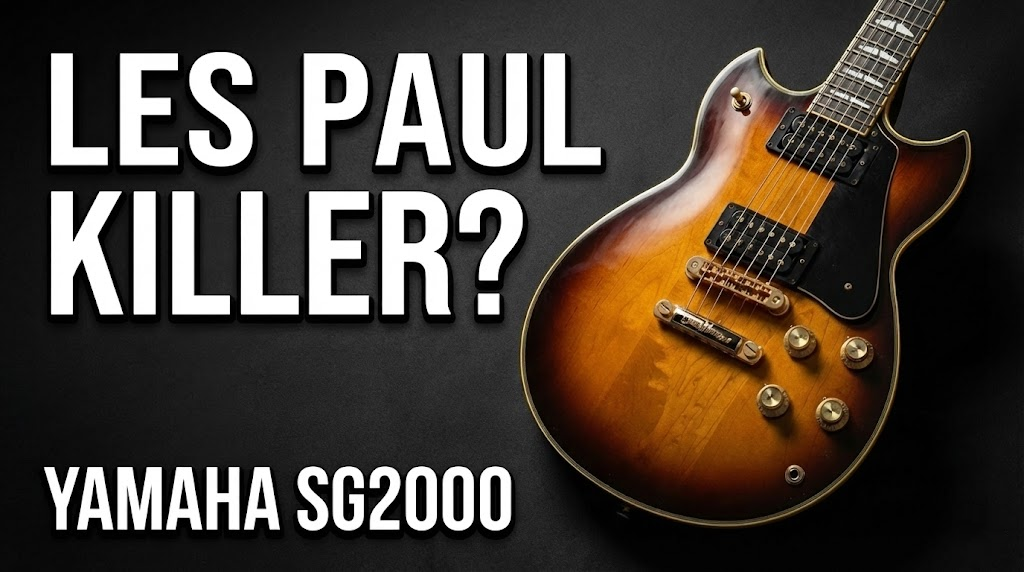
Yamaha SG2000: The Guitar Shaped by Santana’s Ideas
The Yamaha SG2000 is often seen as one of the most iconic electric guitars to…
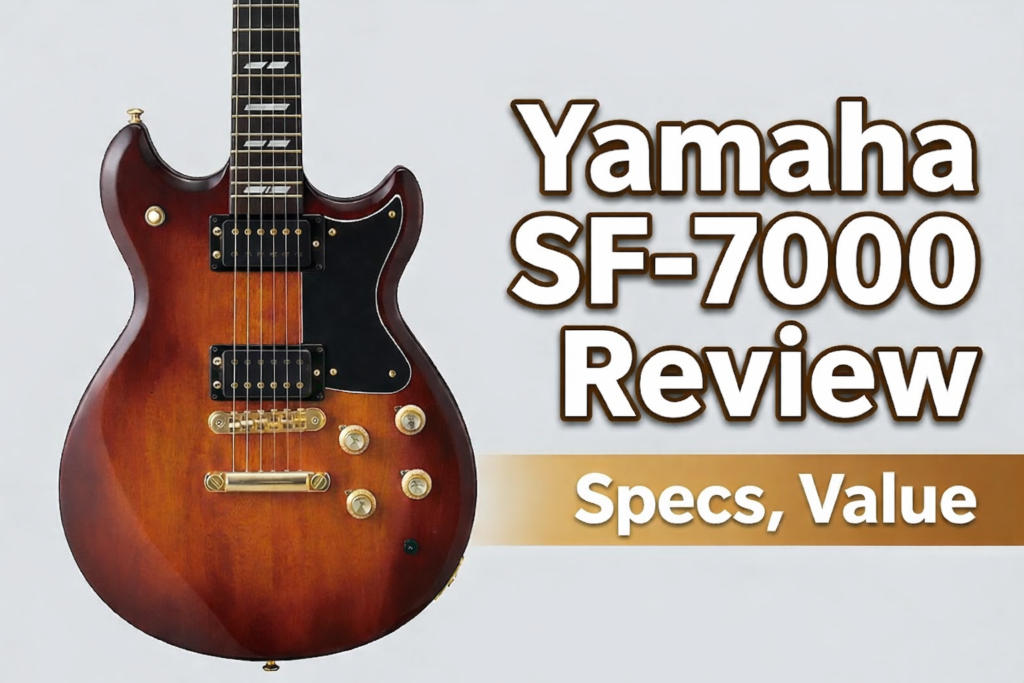
Yamaha SF-7000 Review: Specs, Value & SG Comparison
Overview & Key Points The Yamaha SF-7000 is a late 1970s to early 1980s Japanese…