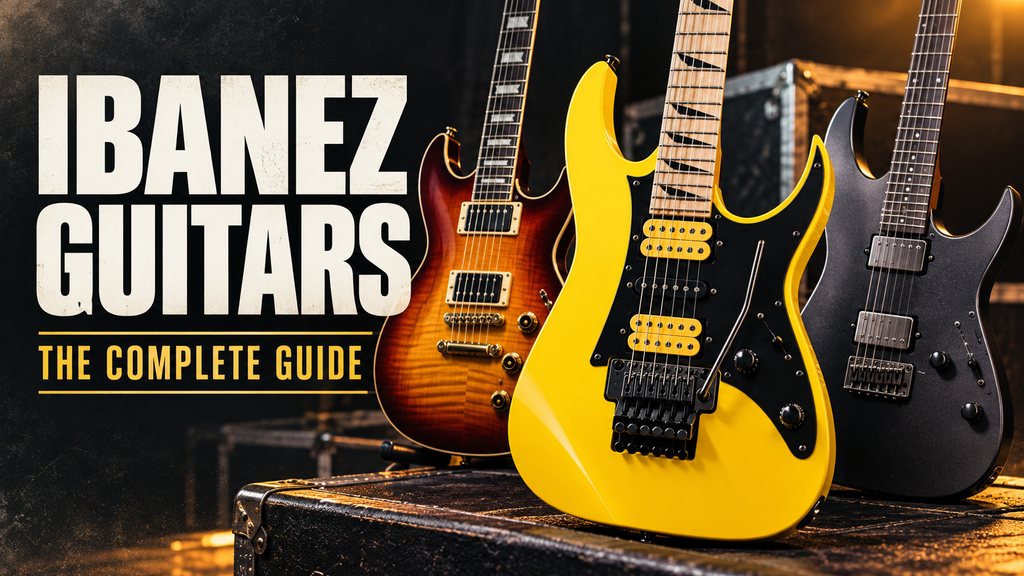
Ibanez guitars come from Hoshino Gakki, a Nagoya company that grew out of a bookshop’s instrument department opened in 1908. The Ibanez name has been in use since 1929, and it’s best known worldwide for shred-ready super strats like the RG and JEM, the 7-string revolution, and the Tube Screamer. The twist: Hoshino designs and sells, but doesn’t own a guitar factory.
This page is the hub: how Ibanez works as a company, what makes its guitars different, how the lineup and grades fit together, who plays them, and what to know before you buy one.
Ibanez Guitars Quick Facts
- Parent company: Hoshino Gakki, Nagoya (instrument department of Hoshino Shoten opened 1908)
- Brand name: From Spanish luthier Salvador Ibanez, whose guitars Hoshino imported from 1929
- Business model: Design and sales only; production contracted out, with Fujigen as the core Japanese partner
- Claim to fame: RG and JEM super strats, Wizard necks, the first widely produced 7-string and the first mass-produced 8-string
- Signature shapes: RG, S, AZ, AR, JEM, Iceman, Destroyer, Talman, SR bass
- Breakthrough artists: Steve Vai, Joe Satriani, Paul Gilbert, Korn, George Benson, Pat Metheny
- Brand family: TAMA drums, Tube Screamer pedals
- Ibanez History in Brief
- What Makes Ibanez Guitars Different
- The Ibanez Guitars Lineup
- RG: The Super Strat That Defined Shred
- JEM: Steve Vai's Guitar, Built From His Own Sketches
- S and AZ: Lighter Bodies and Everything-Genre Playability
- AR, Iceman and Destroyer: Ibanez's 1970s Originals
- Talman: The Retro Offset for the Alternative Crowd
- SR, BTB and EHB: Ibanez Basses From Slim to Boutique
- Ibanez Grades: Which Series Is Made in Japan?
- The Ibanez Brand Family: TAMA and the Tube Screamer
- Notable Ibanez Players
- Buying an Ibanez: What to Know First
- Final Thoughts
- FAQ
- More Ibanez guitar articles
Ibanez History in Brief
Ibanez began as one department inside Hoshino Shoten, a Nagoya bookstore that moved from books to sheet music to instruments. In 1929 it started importing classical guitars from Spanish luthier Salvador Ibanez, put his name on its own products, and spun the department off as Hoshino Gakki. So one of Japan’s biggest guitar brands carries a Spanish name.
After the Second World War destroyed its factory, Hoshino rebuilt around exports. By the late 1960s it had closed its own guitar plant and handed production to partners like Teisco and Fujigen. The 1970s brought a US push through distributor Elger, a copy era that ended with a lawsuit from Gibson’s parent Norlin, and, running in parallel, the first original designs.
| Year | Milestone |
|---|---|
| 1908 | Hoshino Shoten opens an instrument department in Nagoya |
| 1929 | Salvador Ibanez imports begin; Hoshino Gakki is spun off |
| 1965 | Elger of Pennsylvania becomes exclusive US distributor |
| Late 1960s | In-house guitar factory closed; production contracted out |
| 1973 | The Artist Series, Ibanez’s first original line, launches |
| 1977-78 | Norlin sues over Gibson copies; settled in 1978 |
| 1979 | Tube Screamer and the Roadster, ancestor of the RG, arrive |
| 1987 | JEM777 and RG550 launch |
| 1990 | First 7-string, developed at Steve Vai’s request |
| 1996 | J.Custom and Prestige lines debut |
| 2007 | RG2228, the first mass-produced 8-string |
Prefer the full story, including the Norlin lawsuit and the Steve Vai deal? I cover it properly, with video, in my Ibanez history article.
What Makes Ibanez Guitars Different
A Brand Without a Factory: How Ibanez Actually Gets Built
Hoshino designs and sells; partners build. That wasn’t unusual in 1970s Japan. Greco guitars came from Fujigen and Aria Pro II from Matsumoku. Splitting the brand from the factory cuts inventory, rent and payroll, and lets production scale up or down fast.
The risk showed in 1970, when Teisco’s factory closed. Fujigen, which had built a large new plant in Matsumoto around 1965, had the capacity to absorb the work and became Ibanez’s core development partner. For you as a buyer, that means a Japanese-made Ibanez almost always comes out of one of the most respected factories in the country.
Built for Speed: Wizard Necks and Ibanez’s Own Locking Bridges
The modern Ibanez formula took shape in 1987, and every part of it has a job:
- Thin Wizard neck – less hand travel, so fast runs and wide stretches cost less effort.
- Five-piece hardwood neck with a reinforced truss rod – thin but rigid, so low action stays stable.
- Ibanez-designed locking bridge, parts by Gotoh – smooth, wide vibrato that returns to pitch. While most makers bought Floyd Rose, Ibanez insisted on its own design.
- 24 frets and a deep cutaway – the top octave is reachable without twisting your wrist.
Extended Range Pioneer: Ibanez Made 7 and 8 Strings Normal
Seven-string guitars existed long before Ibanez, in classical and Brazilian music. What Ibanez did, at Steve Vai’s request in 1990, was put a modern-spec 7-string electric into general production and make it stick. It didn’t sell at first. Then nu metal arrived, Munky and Head of Korn signed on, and “7-string” and “Ibanez” became almost the same thought.
In 2007, drawing on custom instruments built for Meshuggah’s Fredrik Thordendal and Marten Hagstrom, Ibanez released the RG2228, the first mass-produced 8-string. If you play drop-tuned metal today, you’re playing in a world Ibanez helped build.
Not Just Shred: Jazz Boxes and Traditional Lines
Ibanez never dropped hollow and semi-hollow guitars. George Benson and Pat Metheny play them, which is about as strong a quality argument as a brand can make. That jazz and fusion credibility is a big reason the following is wider than the shred image suggests.
The Ibanez Guitars Lineup
RG: The Super Strat That Defined Shred
The RG started in 1987 as the RG550: the JEM777’s concept without the monkey grip and other Vai-specific details. RG stands for Roadstar Guitar, because it began inside the Roadstar family before the name took over. Today it’s the backbone of the catalog, from entry-level to hand-finished Japanese builds.
- H-S-H or H-H pickups – high-gain focus, plus a usable single-coil middle on H-S-H.
- Locking trem or fixed bridge – pick fixed if you tune down often or have never set up a floating trem.
- Bolt-on or neck-through – bolt-on until the early 2000s; neck-through versions now add sustain and a smoother heel.
How to choose: the RG550 is the benchmark if you want the classic feel. Prestige is the standard Japanese-made step up. For the full model breakdown, see my Ibanez RG Series Guide and the RG history.
JEM: Steve Vai’s Guitar, Built From His Own Sketches
Vai wanted 24 frets, a cutaway deep enough for the high positions, a bridge that could survive his bar abuse, and H-S-H pickups. Other companies sent back modified stock guitars. Ibanez built prototypes from his own notes, and he approved one with only minor changes. It launched in 1987 as the JEM777 in Loch Ness Green, Desert Sun Yellow and Shocking Pink.
How to choose: the JEM is for Vai fans and players who want the most expressive guitar in the RG family. If you only want the feel, an RG costs less. The differences are laid out in Ibanez RG vs JEM.
S and AZ: Lighter Bodies and Everything-Genre Playability
The S is the other long-running staple alongside the RG: a thin, contoured body that’s lighter and more comfortable over a long gig. The AZ carries a more traditional feel, for players who want Ibanez playability without the metal look.
How to choose: mostly high gain? RG or S. Blues, funk, fusion and everything else? AZ. Want something even heavier-voiced? Look at the RGD.
AR, Iceman and Destroyer: Ibanez’s 1970s Originals
The Artist Series launched in 1973 and became the AR when it was reverse-imported to Japan in 1979. The Iceman shape appeared in 1975 and became Paul Stanley’s KISS icon. The Destroyer began as an Explorer-style copy that Eddie Van Halen used on early Van Halen records, then returned in the 1980s as the Destroyer II, played by Phil Collen of Def Leppard.
I’ve wanted an ’80s Destroyer II for years, but good examples keep getting scarcer and pricier. If one in good shape turns up, don’t wait too long. Some of the rarest Ibanez runs are covered in Ibanez Rare Guitars: 3 Limited Runs.
Talman: The Retro Offset for the Alternative Crowd
A 1990s offset aimed at grunge and alternative players, with signature models for Noodles of The Offspring and Paul Gilbert. Pick one if you want vintage-flavored looks with Ibanez playability.
SR, BTB and EHB: Ibanez Basses From Slim to Boutique
The SR is the standard, the bass equivalent of the RG. The BTB (“Boutique Bass”, 1999) brought neck-through construction and premium features. The EHB is the most modern of the three. First Ibanez bass? Start with the SR.
Ibanez Grades: Which Series Is Made in Japan?
The grade tells you more than the model name. Two guitars that look identical can come from very different factories.
| Grade | Made in | Position |
|---|---|---|
| J.Custom | Japan | Top of the Japanese line, selected materials |
| Prestige | Japan | The standard Japanese-made pro line |
| J-Line | Japan | Standard-spec Japanese models, the most accessible way into MIJ Ibanez |
| Standard | Asia | Core mid-range models with proven Ibanez specs at an everyday price |
| Premium | Asia | Pro features at a lower cost |
| Iron Label / Axion Label | Asia | Metal-focused / modern specs |
| Axe Design Lab | Asia | Experimental, rule-breaking designs |
| Genesis Collection | Japan | Old-school specs from the ’80s catalog |
| GIO | Asia | Entry level |
The Ibanez Brand Family: TAMA and the Tube Screamer
| Brand / Product | What it is |
|---|---|
| TAMA | Hoshino’s world-famous drum brand, built in-house by subsidiary Tama Seisakusho from the mid-1970s. Named after the wife of founder Yoshitaro Hoshino. |
| Tube Screamer | The 1979 overdrive made famous by Stevie Ray Vaughan. Built by Japanese maker Maxon, which sells its own overdrives with identical internals. |
The TAMA factory has a guitar story of its own: it was set up in 1962 to build Ibanez guitars and amps. When that work moved to outside partners in 1966, the plant kept making drums, and that’s the operation that became TAMA.
Notable Ibanez Players
| Artist | Band | Notable Ibanez models |
|---|---|---|
| Steve Vai | Solo / David Lee Roth | JEM, Universe 7-string |
| Joe Satriani | Solo | JS series (from the 1987 Radius 540R) |
| Paul Gilbert | Mr. Big | RG-based signatures, Talman |
| Munky & Head | Korn | K7 (2001) |
| Eddie Van Halen | Van Halen | 1975 Destroyer (“Shark”) |
| Paul Stanley | KISS | Iceman |
| George Benson / Pat Metheny | Solo | Hollow-body signatures |
| Tim Henson & Scott LePage | Polyphia | Signature models |
| Thundercat | Solo / session | Signature bass |
| Ichika Nito | Solo | Signature model |
| Hazuki | – | Signature model |
For a brand this strong internationally, Ibanez has surprisingly few Japanese signature artists. Ichika Nito is the one most international readers already know: a Japanese guitarist whose clean, tapping-heavy instrumental videos built a worldwide following online.
Buying an Ibanez: What to Know First
Most people land here trying to work out which Ibanez to buy, so let me be direct.
- You want Japanese build: look at Prestige first. It’s the standard Fujigen-built line, and used examples are the best value in the catalog. J.Custom is the step above.
- You want the shape at the lowest price: Standard, Premium and GIO. No shame in it; that’s how most people get their first RG.
- You want vintage Ibanez: ’70s and ’80s originals like the Destroyer II and early AR models trade on condition and originality. Check the bridge and pickups carefully, since many were modified.
If you’re buying from a Japanese listing, learn the condition vocabulary first. Terms like gari, sori and nari decide whether a guitar is a bargain or a repair bill, and I break them down in my glossary of Japanese guitar condition terms. Visiting Japan? See my guide to guitar shops in Japan.
Final Thoughts
Ibanez is introduced as a shred brand almost everywhere, and the reputation is earned. But look closer and you find jazz boxes, retro offsets, basses, and a price range that runs from a first guitar to a hand-finished J.Custom.
What strikes me most is the business behind it: a company that met global demand without owning a guitar factory, kept pushing designs forward, and still builds guitars in Japan today. That combination is why Ibanez keeps earning respect.
If you have an Ibanez story of your own, tell me in the comments. Additions and corrections are always welcome.
FAQ
Is Ibanez a Japanese brand?
Yes. Ibanez is owned by Hoshino Gakki of Nagoya, Japan. The name comes from Spanish luthier Salvador Ibanez, whose guitars Hoshino imported from 1929.
Who makes Ibanez guitars?
Hoshino Gakki designs and sells Ibanez but does not own a guitar factory. Japanese-made models are built mainly by Fujigen, and other lines are made by partner factories in Asia.
Which Ibanez guitars are made in Japan?
J.Custom, Prestige and J-Line are made in Japan. Standard, Premium, Iron Label, Axion Label and GIO are built in other Asian countries.
What does RG stand for on Ibanez guitars?
RG stands for Roadstar Guitar. The RG550 of 1987 was originally part of the Roadstar family before the RG name took over.
Is Ibanez only for metal and shred?
No. The AZ, AR, Talman and hollow-body lines cover blues, rock, jazz and fusion, and George Benson and Pat Metheny both play Ibanez.
Did Ibanez invent the 7-string guitar?
No. Seven-string guitars existed in classical and Brazilian music. Ibanez was the first to put a modern 7-string electric into general production in 1990, and released the first mass-produced 8-string, the RG2228, in 2007.
More Ibanez guitar articles
Ibanez History: The Bookstore That Became a Guitar Giant (1908-Today)
Say “shred guitar” and most players think Ibanez first. But the brand started as one…
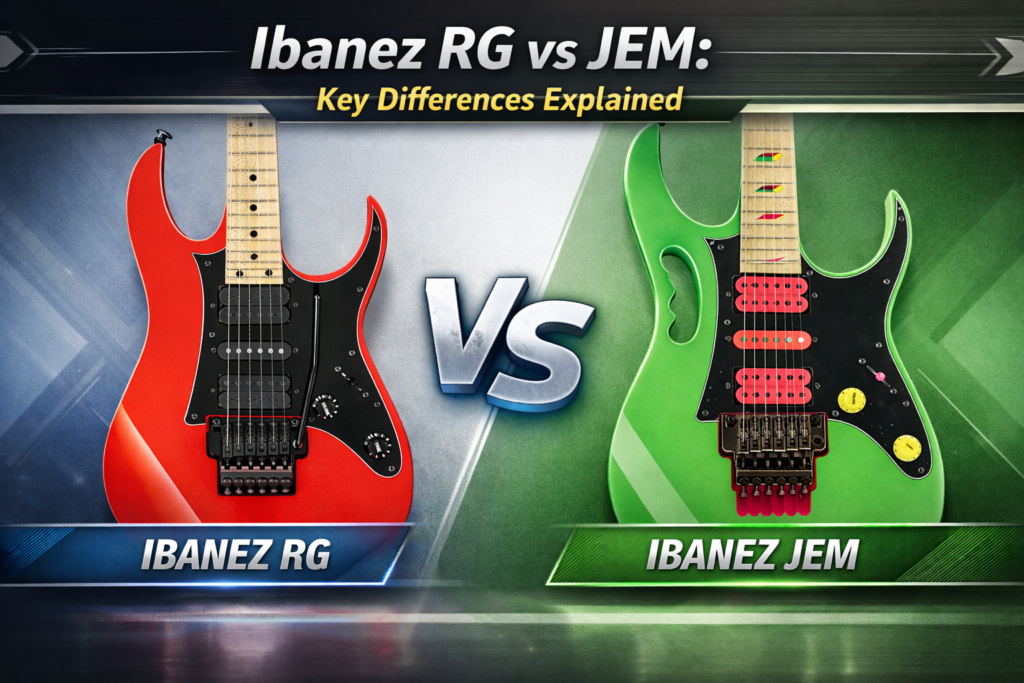
Ibanez RG vs JEM: Key Differences Explained
Ibanez RG vs JEM Quick Facts First JEM model: JEM777 (1987) First RG model: RG550…
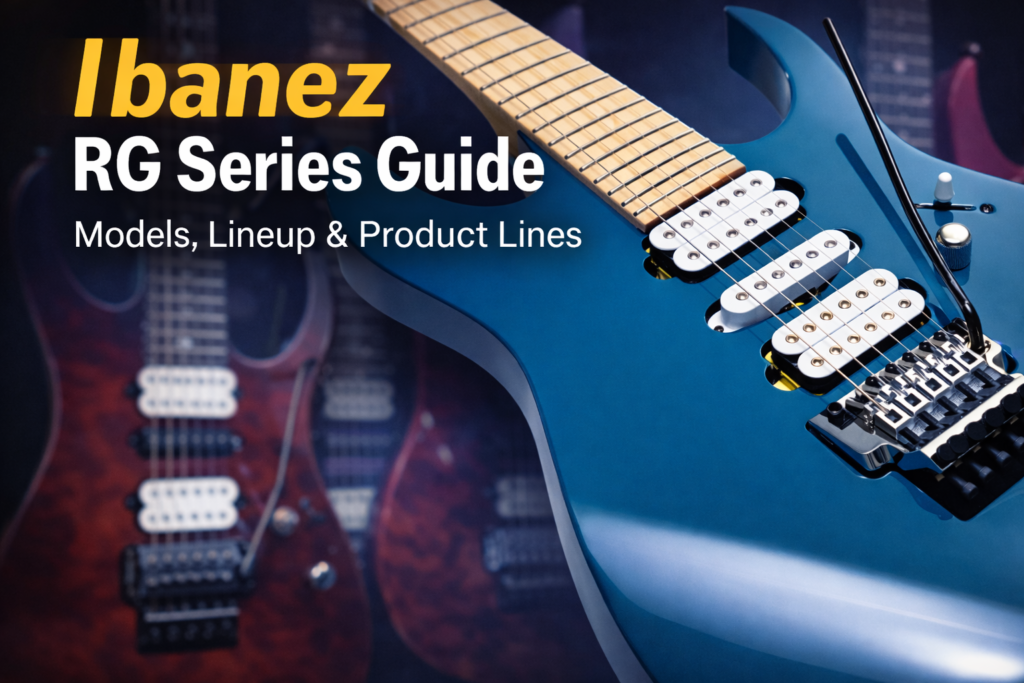
Ibanez RG Series Guide: Models, Lineup & Product Lines
Ibanez RG Models Quick Facts First RG model: RG550 (1987) Most iconic RG models: RG550,…
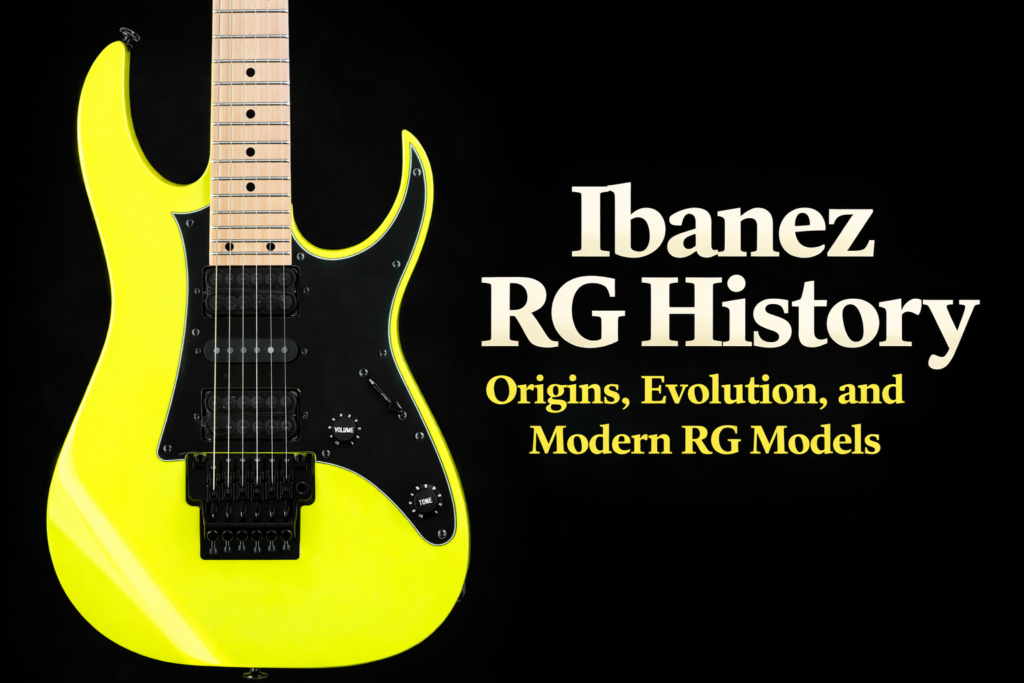
Ibanez RG History: Origins, Evolution, and Modern RG Models
The Ibanez RG series is one of the most influential modern electric guitar designs, evolving…
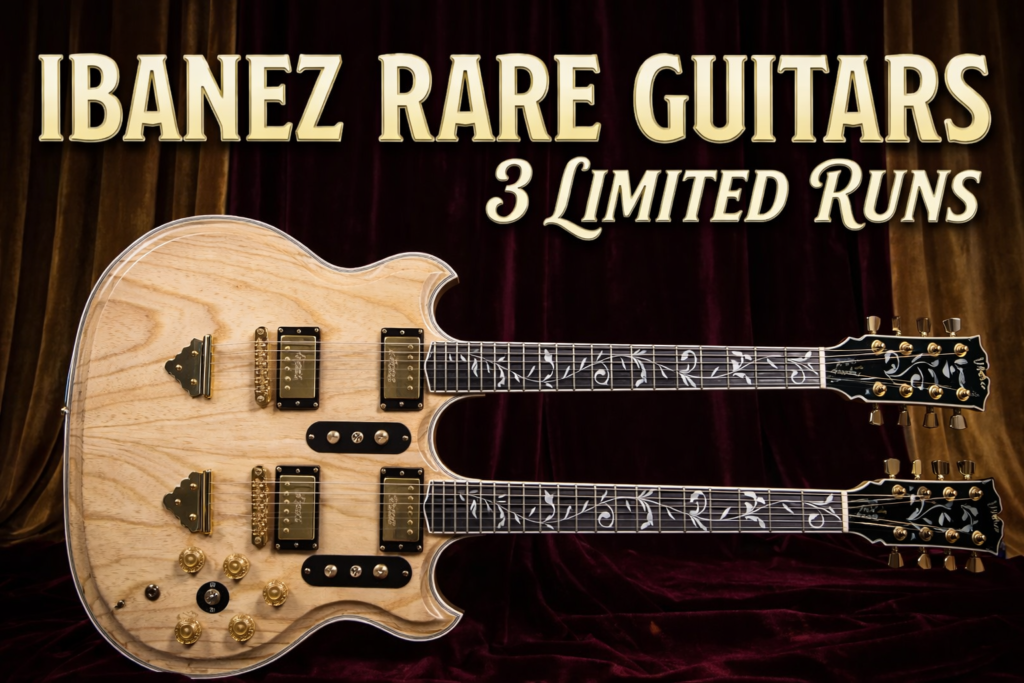
Ibanez Rare Guitars: 3 Limited Runs
Overview & Key Points Ibanez rare guitars are limited-production instruments manufactured in exceptionally small quantities,…