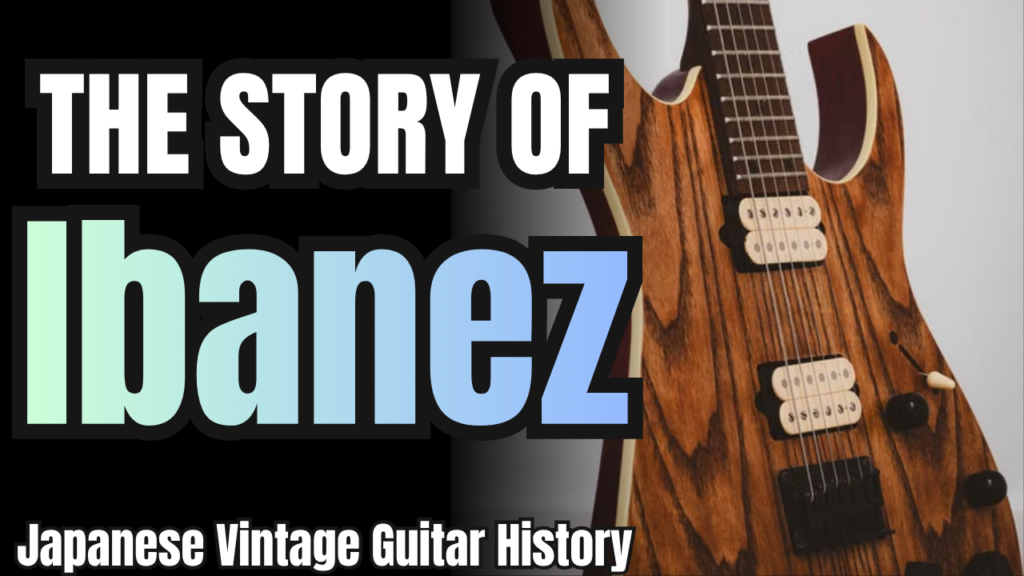
Say “shred guitar” and most players think Ibanez first. But the brand started as one department inside a Nagoya bookshop, took its name from a Spanish luthier, gave the world TAMA drums and the Tube Screamer, and has not owned a guitar factory since the late 1960s. This is the Ibanez history from 1908 to today: the copy era, the Gibson lawsuit, the JEM and RG, the 7-string revolution and the modern lineup.
Ibanez Quick Facts
- Period covered: 1908 to today
- Company: Hoshino Gakki, Nagoya, Japan
- Name origin: Spanish luthier Salvador Ibanez, whose guitars Hoshino imported from 1929
- Factories: None of its own since the late 1960s; built by Teisco, then mainly Fujigen
- Key models: Destroyer, Iceman, AR, Roadstar, JEM777, RG550, Universe 7-string, RG2228
- Key artists: Steve Vai, Joe Satriani, Paul Gilbert, Korn, George Benson, Pat Metheny
- Also from Hoshino: TAMA drums and the Tube Screamer
Prefer to watch? This article is based on my own video below.
- 1908-1950s: From a Nagoya Bookshop to Hoshino Gakki
- 1960s: Into America, and Out of Manufacturing
- 1970s: The Ibanez Copy Era and the Gibson Lawsuit
- 1973-1979: Ibanez Original Designs, From the Artist to the Iceman
- 1970s: Beyond Guitars With TAMA Drums and the Tube Screamer
- 1980s: Ibanez in the Super Strat Era
- 1986-1987: Steve Vai and the Ibanez JEM777
- 1987: The Ibanez RG550 and the RG Formula
- 1990s: RG Expansion, J.Custom and Prestige
- 1990-2007: Ibanez 7-String and 8-String Guitars
- 1990s: Talman, Basses and Jazz Guitars
- Today: The Modern Ibanez Lineup
- Ibanez History Timeline
- Final Thoughts
- FAQ
- More Ibanez guitar articles
1908-1950s: From a Nagoya Bookshop to Hoshino Gakki
The Ibanez story starts about 120 years ago. In 1908, Hoshino Shoten, a bookstore in Nagoya, opened a musical instrument department. It had begun as a bookshop, moved into sheet music, and then into instruments. The beginning of one of the biggest guitar brands on the planet was a single department in an old Japanese bookstore.
1929: Where the Ibanez Name Comes From
By 1929, demand for classical guitars was rising, and Hoshino began importing instruments from the Spanish luthier Salvador Ibanez. Hoshino later took the luthier’s name and put it on the products it sold, mainly into Japan and the wider Asian market. The same year, the instrument department was spun off as Hoshino Gakki, the company that still runs Ibanez today.
So the name Ibanez isn’t Japanese at all. It comes from a Spanish guitar maker, and I think that catches a lot of people off guard.
1935-1950s: Building, War and Recovery
In its early years Hoshino was mainly an importer and retailer, but from 1935 it began building instruments too. Exports did well and the company grew steadily until the Second World War, when its factory burned down and the business came very close to ending.
After the war Hoshino rebuilt, doubled down on exports, and had recovered by the 1950s. With electric guitars catching on overseas, it moved into electrics as well, at one point exporting Guyatone-built guitars under the Ibanez name.
1960s: Into America, and Out of Manufacturing
The 1960s brought the push into the United States. In 1965, Elger, a Pennsylvania company, became the exclusive US distributor for Ibanez. In 1972 that partnership shifted into high gear and Ibanez guitars began shipping to the States in earnest. This was Hoshino’s first serious entry into the American market.
Why Ibanez Stopped Building Its Own Guitars
At the same time, the way the guitars were made was changing. With electric guitar demand exploding, Hoshino stopped building in-house, and by the late 1960s it had closed its domestic guitar factory. Production went to contractors like Teisco and Fujigen. From that point on, Ibanez has been a company that designs and sells guitars without owning a guitar factory.
For a brand this big, that surprises people. But in Japan at the time it wasn’t unusual. Greco guitars were built by Fujigen, and Aria Pro II guitars were built by Matsumoku. Keeping the brand and the factory separate was fairly standard practice.
The advantages are clear. Splitting design and sales from manufacturing cuts inventory, rent and payroll, and lets you scale production up and down far more flexibly.
There are downsides too. Your partner’s margin is baked into the unit price, so the guitars cost more than they would otherwise. And if that partner goes under, finding a replacement who can match the same quality, price and volume is extremely difficult.
1970: Teisco Closes, Fujigen Steps In
Teisco had deep experience with electric guitars, so Ibanez leaned into electrics and kept gaining ground. Then in 1970 the Teisco factory closed, and the exact downside described above landed on Ibanez’s doorstep.
The company that caught them was Fujigen, a factory Ibanez already had close ties with. And here’s the lucky part: around 1965 Fujigen had built a large new plant in its home base of Matsumoto, so the capacity to absorb Ibanez production was already there.
Matsumoto is one of the richest guitar-building regions in Japan. Matsumoku was there, and Deviser, the maker behind Momose and Bacchus, came later. After Teisco closed, Fujigen became the core development partner for Ibanez.
1970s: The Ibanez Copy Era and the Gibson Lawsuit
Into the 1970s, Ibanez started building copies of overseas guitars. Gibson Les Paul models led the way, alongside Gretsch and Fender-style instruments, and the range was wide. The hook was price: less than half the cost of the real thing.
Japan then, and honestly Japan today, has a strong admiration for foreign brands. With Eric Clapton, Led Zeppelin and Deep Purple all over the radio, a lot of players desperately wanted a Gibson or a Fender. But those brands were priced far out of reach in Japan, and only a limited number were imported.
So it wasn’t only Ibanez. Nearly every Japanese maker built copies. Guitars that looked close without being exact reproductions, at a price people could actually pay, were simply the current of the times.
1977: Norlin Sues Hoshino and Elger
In 1977, Norlin, Gibson’s parent company, sued Elger and Hoshino Gakki over the Gibson copies. Looking back, I suspect that if these guitars had only been sold inside Japan, they would have been quietly tolerated. Once they were being exported and sold in America, it was a different matter.
Ibanez was copying the logo style and headstock shape too. Personally, I think Gibson’s own struggles in that period probably played into the decision to sue.
Ibanez had no interest in fighting, and the case was settled in 1978. Strictly speaking it was a dispute between Gibson and Ibanez and Elger, but you can see other Japanese brands pulling back from copy models around 1978 as well.
The ironic part came next. From the following year, brands like Greco and Tokai entered their golden era of meticulously accurate vintage Les Paul reproductions.
The Destroyer: Eddie Van Halen’s Ibanez
Whatever the legal outcome, the 1970s copy models were popular, and pros used them. The name that always comes up is Eddie Van Halen. He owned a 1975 Ibanez Destroyer, a copy of the Gibson Explorer, and used it on the debut record and other early Van Halen albums. He painted it white, then heavily modified it, and as the “Shark” guitar it became one of the instruments most associated with him.
Ace Frehley of KISS played an Ibanez Destroyer too. That family included the Destroyer and the Rocket Roll, models based on Gibson’s 1958 body shapes. When the lawsuit hit, they were discontinued along with the rest of the copy line.
1973-1979: Ibanez Original Designs, From the Artist to the Iceman
Was 1970s Ibanez nothing but a copy brand? Not at all. Original in-house designs started appearing around 1973, well before the lawsuit.
The Artist Series and the Birth of the AR
In 1973 Ibanez launched “The Artist Series,” developed alongside working players. It had a compact double-cutaway body with a bolt-on neck and became the template for the AR models that followed.
In 1975 came the 2405, a Les Paul-style body with a luxurious spec sheet including mother-of-pearl inlay behind the tailpiece, and the 2617, a thinner double-cutaway with a German carve-style contour.
In 1976 the Professional Series arrived: limited models that reproduced, almost exactly, instruments Ibanez had built for individual artists.
| Model | Year | What it was |
|---|---|---|
| 2405 | 1975 | Les Paul-style body, mother-of-pearl inlay behind the tailpiece |
| 2617 | 1975 | Thinner double-cutaway with German carve-style contour |
| 2681 | 1976 | Bob Weir (Grateful Dead) model, Tree of Life inlay, abalone binding |
| 2671 | 1976 | Randy Scruggs model, Tree of Life inlay, abalone binding |
| 2670 Artwood Twin | 1976 | Made-to-order doubleneck based on Rex Bogue’s guitar for John McLaughlin |
The 2681 and 2671 both used the Tree of Life inlay that still appears on high-end Ibanez models today. Combined with abalone body binding, they looked genuinely expensive.
Between the artist-spec models, the growing market for Japanese-built electrics, and Ibanez catalogs sitting in Japanese shops, the Artist Series slowly built a following at home. In 1979 it came full circle: the series went on sale in Japan as a reverse import, and the four-digit model numbers became AR. That’s how the Ibanez AR was born.
The Iceman and the Roadster
In 1975 Ibanez released the shape that became known as the Iceman. Paul Stanley of KISS became its face, and those wild looks matched the KISS stage show perfectly. The promotional value was enormous, and it turned into a flagship that pushed brand awareness way up.
In 1979 the Roadster arrived, a Stratocaster-style double-cutaway and the ancestor of the RG. The line that leads to modern Ibanez starts right here.
1970s: Beyond Guitars With TAMA Drums and the Tube Screamer
Hoshino was branching out beyond guitars in this period too, and two of those side projects became legends in their own right.
TAMA: The Drum Brand From the Same Company
TAMA, still a world-famous drum brand, also came out of Hoshino Gakki. The name comes from the wife of founder Yoshitaro Hoshino, and production started in the mid-1970s.
Unlike the guitars, the drums weren’t contracted out. They were built by Hoshino’s own subsidiary, Tama Seisakusho. That factory was set up in 1962 to build Ibanez guitars and amplifiers, but by 1966 guitar and amp production had moved to outside partners and the plant carried on making drums. That’s the operation that became TAMA.
1979: The Tube Screamer
Ibanez moved into effects pedals in the late 1970s, and one deserves its own mention: the Tube Screamer, released in 1979. Stevie Ray Vaughan made it a worldwide hit. It later became a standard boost on hard rock and metal pedalboards, and both vintage units and current production remain in demand.
Just like the guitars, it wasn’t developed in-house. It was built by a Japanese manufacturer called Maxon, which sells overdrives under its own name with identical internals.
1980s: Ibanez in the Super Strat Era
In the 1980s, hard rock and heavy metal hit their peak. American upstarts like Hamer and Charvel rose fast, and Kramer had huge momentum thanks to Eddie Van Halen. With the LA metal scene at full tilt, super strats dominated the market.
The formula was simple: build a high-output guitar, then get a superstar guitarist to carry the flag. Ibanez adapted to it.
Roadstar II, Destroyer II and the Radius
Existing models were upgraded for the era. The Roadster became the Roadstar II, with humbucker-equipped versions and models carrying an Ibanez-designed locking tremolo along the lines of the Floyd Rose. The catalogs featured Gary Moore and Steve Lukather of TOTO, and Allan Holdsworth had a Roadstar-based signature model.
The discontinued Destroyer came back as the Destroyer II, the DT series. It kept the Explorer outline, but the styling turned aggressive the way 1980s hard rock demanded, and the colors moved from traditional finishes to metallic reds and blacks. The three-pickup versions worked in practice as a Phil Collen signature model for Def Leppard, and the DT also drew attention through Dave Murray and Adrian Smith of Iron Maiden.
Personally, the Destroyer II is a guitar I’ve wanted for years. But surviving examples keep getting scarcer and prices keep climbing, so the right chance hasn’t come around yet.
In 1987, growing out of the Roadstar line, Ibanez introduced the Radius, model 540R. Its rounded, easy-to-hold body was adopted by Joe Satriani, and it lives on today in his JS signature series.
1986-1987: Steve Vai and the Ibanez JEM777
By the late 1980s Ibanez had plenty of endorsement deals. What it wanted was one figure who stood above all of it, the way Eddie Van Halen did for Kramer. The name that came up was Steve Vai.
The timing was perfect. Vai was playing a Charvel he had modified himself and was looking for something that suited him better. He had joined Frank Zappa’s touring band at twenty, replaced Yngwie Malmsteen in Alcatrazz in 1984 and released a solo record, and by the end of 1985 was in David Lee Roth’s band. He was right on the edge of becoming huge.
Built From Vai’s Own Sketches
Vai has said his requirements included 24 frets, a cutaway scooped deep enough to make the high positions playable, a bridge that could survive however hard he abused the bar, and an H-S-H pickup layout.
Several guitar companies were interested, and Vai had shared design ideas with more than one. But most of what came back was an existing instrument with modifications. Ibanez took a different approach: the development team studied his sketches and notes and built something entirely new around his ideas.
In late 1986 Ibanez sent Vai several prototypes. By his own account he went over them in detail and even took one apart to study how it was put together. After testing them thoroughly, he approved one design with only minor changes.
The 1987 Launch
The result was unveiled at NAMM with Vai himself and pulled more attention than anything the other makers brought. In 1987 it was released as the JEM777, in finishes that were pure Vai: Loch Ness Green, Desert Sun Yellow and Shocking Pink. Ibanez made 777 of them, and they were gone inside a month.
1987: The Ibanez RG550 and the RG Formula
At almost the same time, Ibanez used the JEM777 as the basis for the RG550, the first model in what would soon be known as the Ibanez RG series. It dropped the monkey grip and other JEM-specific features but kept the core concept of a genuinely powerful instrument.
With hard rock everywhere and playing styles evolving fast, players wanted guitars that could cover a wide palette of sounds, a wide pitch range and the most extreme techniques. Gibson and Fender both struggled in this period, and the Ibanez original design philosophy landed exactly in the gap.
Wizard Neck and Ibanez Locking Bridge
The specifics were 24 frets, humbucker-equipped layouts like H-S-H, a thin neck grip and a locking bridge. The Wizard neck and the locking bridge in particular are still Ibanez trademarks.
While most makers went with the Floyd Rose, Ibanez insisted on its own bridge design, with parts built by Gotoh. It delivers dynamic, smooth vibrato work and stays in tune. The neck chases the lightest possible feel while holding its rigidity, using hard timbers in a five-piece construction with a reinforced truss rod.
Ibanez didn’t go all-in on modern specs, though. Traditional series ran in parallel the whole time, covering a much wider set of needs.
What Does RG Stand For?
RG is short for Roadstar Guitar, the same Roadstar mentioned above. That one surprised me when I first learned it; I’d never thought about what the letters meant. When the RG550 first appeared it was still considered part of the Roadstar family. Over time the Roadstar name faded out and RG became the core. For the full story of the line, see my Ibanez RG history, and if you’re deciding between the two, Ibanez RG vs JEM.
1990s: RG Expansion, J.Custom and Prestige
Into the 1990s, the RG spread into an enormous range of specs and finishes. RG-based signature models arrived for Paul Gilbert of Mr. Big, Wes Borland of Limp Bizkit and John Petrucci, and the RG remains a core model today. Ibanez also built specs that mixed playfulness with practicality, including Paul Gilbert’s violin-shaped models.
1996: Japanese Manufacturing Refuses to Back Down
The 1990s were a difficult stretch for Japanese guitars. Japan was known worldwide for building high-quality instruments cheaply, but countries that could build them even more cheaply appeared, South Korea among them. With the market pushing for lower prices, Japanese brands began moving their budget lines out of Japan too.
Ibanez and Fujigen went the other way. In 1996 they launched a lineup built to show what Japanese manufacturing could do: the J.Custom and Prestige series, both still running today. Obsessively selected materials and Japanese craftsmanship applied without holding back. To me, these guitars felt like Japanese guitar building refusing to back down.
1990-2007: Ibanez 7-String and 8-String Guitars
Ibanez kept widening the range, and one direction was extended range. The seven-string was developed at Steve Vai’s own request; he was deeply involved in product development and contributed to Ibanez in many ways.
Seven-string instruments go back a long way in classical guitar and Brazilian music. But putting a modern-spec seven-string electric into general production and making it stick is the Ibanez contribution, though there are competing accounts of the origin. Normally a spec that unusual ends up as a sample, a small run or a one-off, since parts sourcing and distribution alone make a general release difficult. That it happened at all shows how much weight Vai’s request carried.
Korn, Nu Metal and the Seven-String Boom
When it launched in 1990, the seven-string didn’t sell. What changed things was the late 1990s: nu metal gave it a home, and signing Munky and Head of Korn brought the whole line back to life. They made Ibanez seven-strings famous worldwide, and the brand took such a dominant share that “seven-string” and “Ibanez” became more or less the same thought.
Ibanez answered with a new seven-string RG in 1998 and the Korn K7 in 2001. Then, drawing on custom instruments built for Fredrik Thordendal and Marten Hagstrom of Meshuggah, it released the RG2228 in 2007, the first mass-produced eight-string guitar.
1990s: Talman, Basses and Jazz Guitars
For a brand with such a strong metal identity, Ibanez also moved into retro territory with the Talman, while reissuing its own 1970s and 1980s models one after another. The Talman was aimed at the grunge and alternative crowd and got signature models from Noodles of The Offspring and Paul Gilbert.
On the bass side, the Ergodyne series arrived in 1998, followed in 1999 by the high-end BTB, with neck-through construction and other premium features. BTB stands for Boutique Bass.
Ibanez has never neglected full hollow and semi-hollow guitars either. There are George Benson and Pat Metheny models, and when players of that caliber use the instruments, that’s about as good a quality argument as you can make. That strength in jazz and fusion is, I think, one reason Ibanez keeps its following.
Today: The Modern Ibanez Lineup
The signature strategy continues. Tim Henson and Scott LePage of Polyphia have models, and on the bass side there’s Thundercat, known as a formidable session player. Putting out models with popular musicians keeps the brand in front of every age group.
If I had to name one weakness, it’s this: for a brand so good at the international market, and a Japanese one at that, there are surprisingly few Japanese signature artists. Ichika Nito and Hazuki are among the current ones.
Ibanez Grades Today
| Grade | Made in | Position |
|---|---|---|
| J.Custom | Japan | Top of the Japanese line, selected materials |
| Prestige | Japan | The standard Japanese-made pro line |
| J-Line | Japan | Standard-spec Japanese models, the most accessible way into MIJ Ibanez |
| Standard | Asia | Core mid-range models with proven Ibanez specs at an everyday price |
| Premium | Asia | Pro features at a lower cost |
| Iron Label / Axion Label | Asia | Metal-focused / modern specs |
| Axe Design Lab | Asia | Experimental, rule-breaking designs |
| Genesis Collection | Japan | Old-school specs from the ’80s catalog |
| GIO | Asia | Entry level |
Body Shapes, Basses and Acoustics
The long-running staples are the RG and the S. Until the early 2000s they were mostly bolt-on with locking bridges; now you’ll find neck-through construction and plenty of other variations. The AZ and AR carry a more traditional feel, and the RGD is built for heavier playing. On bass, the SR is the standard, the BTB looks to the next generation, and the EHB is more modern still.
Beyond that are semi-hollows, acoustic guitars and ukuleles. The acoustics and ukuleles are basically Asian-built, priced for beginners through intermediate players. There used to be Japanese-made acoustics built by Terada, but after a lineup review the range settled into its current form. Traditional models have always been there, and recent years have brought more specs aimed at solo fingerstyle playing.
Ibanez History Timeline
| Year | Milestone |
|---|---|
| 1908 | Hoshino Shoten opens an instrument department in Nagoya |
| 1929 | Salvador Ibanez imports begin; Hoshino Gakki spun off |
| 1935 | Hoshino begins building instruments |
| 1962 | Tama Seisakusho set up to build Ibanez guitars and amps |
| 1965 | Elger becomes exclusive US distributor |
| Late 1960s | Domestic guitar factory closed; production contracted to Teisco and Fujigen |
| 1970 | Teisco factory closes; Fujigen becomes core partner |
| 1973 | The Artist Series launches |
| 1975 | Iceman shape and Destroyer released |
| 1977-78 | Norlin lawsuit over Gibson copies; settled 1978 |
| 1979 | Tube Screamer, Roadster, and AR reverse import to Japan |
| 1987 | JEM777, RG550 and Radius 540R |
| 1990 | First Ibanez seven-string |
| 1996 | J.Custom and Prestige launch |
| 1998-99 | Seven-string RG, Ergodyne and BTB basses |
| 2001 | Korn K7 |
| 2007 | RG2228, the first mass-produced eight-string |
Final Thoughts
A wide price range. Plenty of models for technical playing, and plenty for everything else. Ibanez builds forward-thinking instruments that win over every kind of guitarist, and it still makes guitars in Japan today. That combination is, I think, a big part of why the brand keeps earning respect.
What stays with me most is the business behind it: a company that met global demand without owning a factory, and kept putting great instruments into the world anyway.
If you have a story of your own about an Ibanez, tell me in the comments. Additions and corrections are always welcome.
FAQ
Where does the name Ibanez come from?
From Salvador Ibanez, a Spanish luthier whose classical guitars Hoshino began importing in 1929. Hoshino later put his name on its own products.
Does Ibanez make its own guitars?
No. Hoshino Gakki closed its domestic guitar factory in the late 1960s. Since then Ibanez has designed and sold guitars built by partners, mainly Fujigen in Japan.
Why did Gibson sue Ibanez?
In 1977 Norlin, Gibson’s parent company, sued Elger and Hoshino Gakki over Ibanez copies of Gibson guitars, which also copied the logo style and headstock shape. The case was settled in 1978.
What does RG stand for?
RG stands for Roadstar Guitar. The RG550 of 1987 was originally part of the Roadstar family before the RG name took over.
Is TAMA owned by Ibanez?
Both TAMA and Ibanez belong to Hoshino Gakki. TAMA drums are built by Hoshino’s own subsidiary, which was originally set up in 1962 to build Ibanez guitars and amplifiers.
Did Ibanez make the first seven-string guitar?
No. Seven-string guitars existed in classical and Brazilian music. Ibanez was the first to put a modern seven-string electric into general production in 1990, and released the first mass-produced eight-string, the RG2228, in 2007.
More Ibanez guitar articles
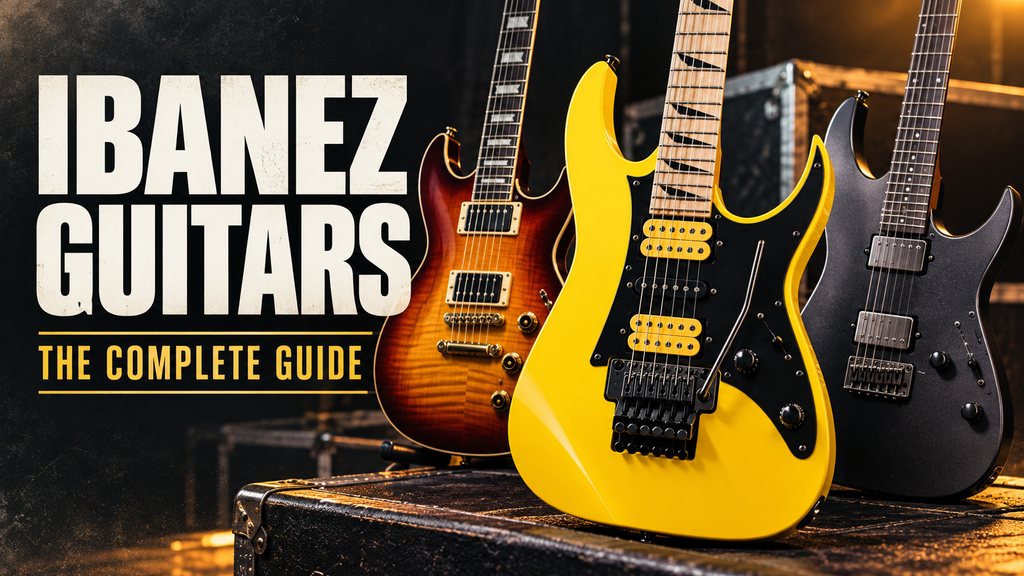
Ibanez Guitars: The Japanese Brand That Doesn’t Build Them
Ibanez guitars come from Hoshino Gakki, a Nagoya company that grew out of a bookshop’s…
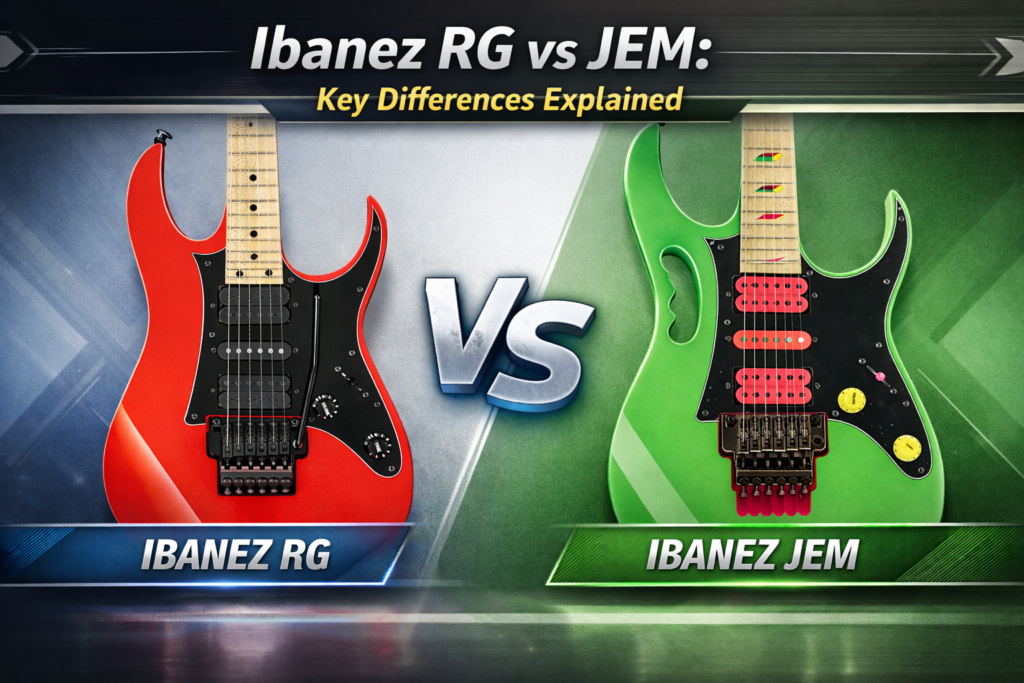
Ibanez RG vs JEM: Key Differences Explained
Ibanez RG vs JEM Quick Facts First JEM model: JEM777 (1987) First RG model: RG550…

Ibanez RG Series Guide: Models, Lineup & Product Lines
Ibanez RG Models Quick Facts First RG model: RG550 (1987) Most iconic RG models: RG550,…
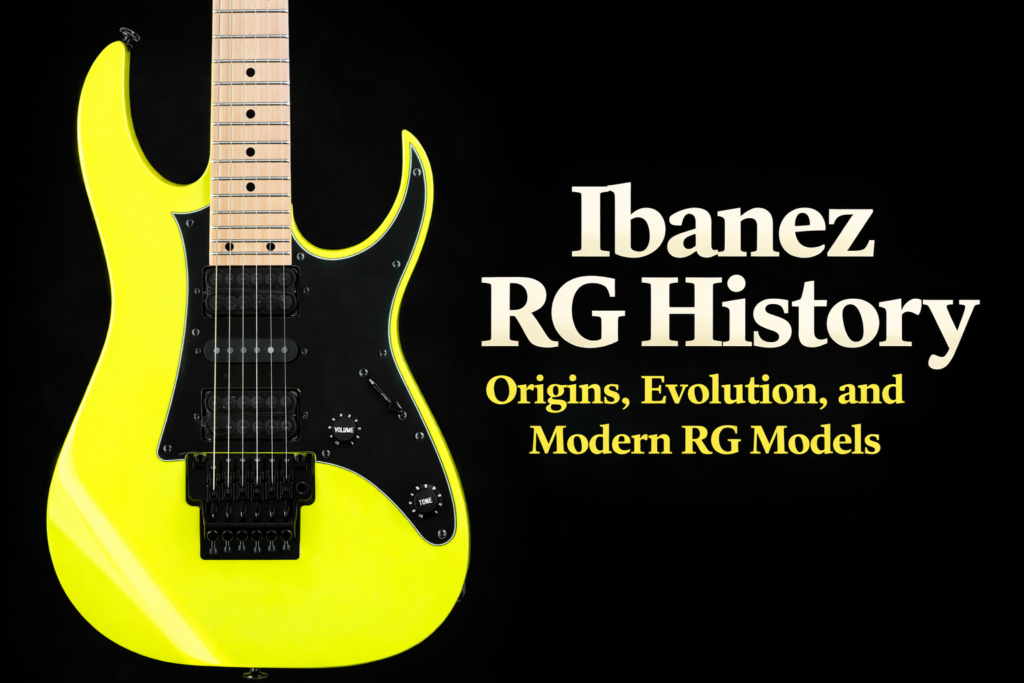
Ibanez RG History: Origins, Evolution, and Modern RG Models
The Ibanez RG series is one of the most influential modern electric guitar designs, evolving…
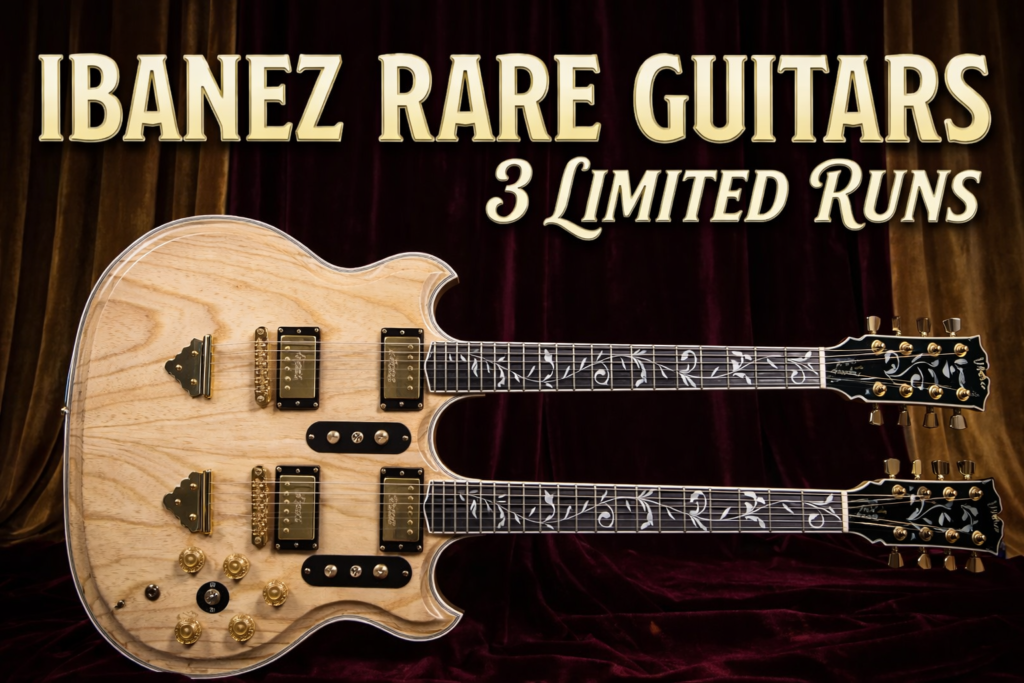
Ibanez Rare Guitars: 3 Limited Runs
Overview & Key Points Ibanez rare guitars are limited-production instruments manufactured in exceptionally small quantities,…