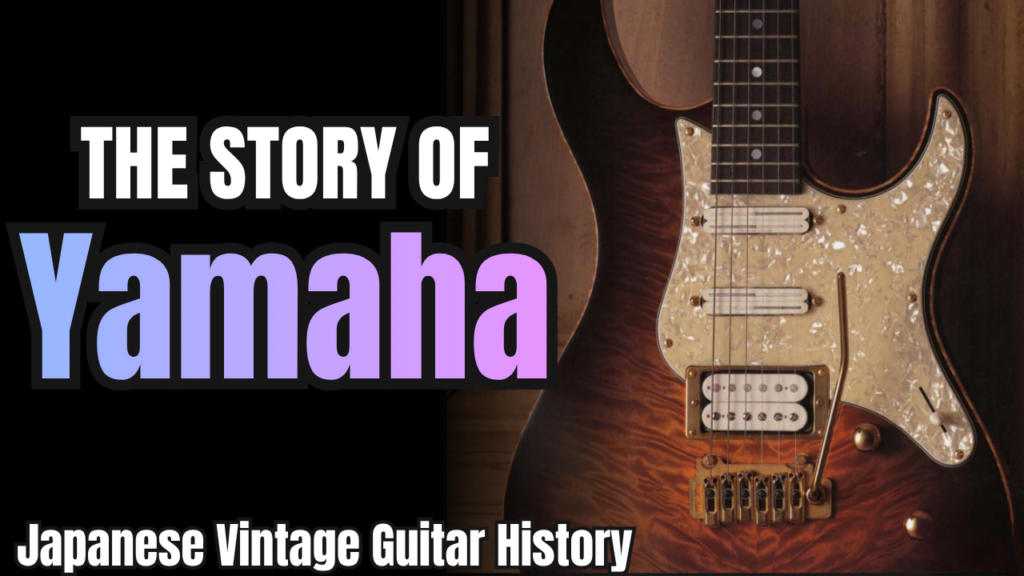
Yamaha is a name almost everyone knows, even people who have never touched a guitar. But how did the company begin, and what guitars has it built along the way? This article traces the history of Yamaha guitars from a single organ repair in 1887 to the 60th-anniversary models of 2026.
Yamaha Quick Facts
- Period covered: 1887-2026
- Origin: Hamamatsu, Japan; Nippon Gakki founded 1897
- Guitar debut: 1966: folk guitars, electric guitars and electric basses in the same year
- Key models: FG180, L Series, SG-2000, BB, Pacifica, Revstar
- Key artists: Carlos Santana, Masayoshi Takanaka, Billy Sheehan, Nathan East, Mike Stern
- Side businesses: Pianos, aircraft propellers, motorcycles (now Yamaha Motor)
Prefer to watch? This article is based on my own video below.
- 1887-1900: Yamaha Started with an Organ Repair
- 1931-1955: From Propellers to Motorcycles
- 1966: Yamaha Enters the Guitar World
- 1966-1972: The FG180 and the Birth of the Japanese Folk Guitar
- 1974-1975: The L Series and Its "Big Four"
- 1966-1974: The Beginnings of Yamaha Electric Guitars
- 1974-1978: Santana, the SG-2000 and the BB Bass
- 1980s: Yamaha in the Super Strat Era
- 1990s: The Birth of the Yamaha Pacifica
- 2000-2008: Bamboo Guitars, the Silent Guitar and A.R.E.
- Only at Yamaha: The Custom Shop and the THR Amp
- Yamaha Guitar Technology: IRA and Acoustic Design
- 2010-2026: Yamaha Guitars Today
- Final Thoughts
- FAQ
- More Yamaha guitar articles
1887-1900: Yamaha Started with an Organ Repair
The story begins in 1887. Torakusu Yamaha repaired a broken organ at an elementary school in Hamamatsu, and that same year he built an organ of his own. Ten years later, in 1897, he founded Nippon Gakki (literally “Japan Musical Instruments”). This is where today’s Yamaha began.
The company’s first logo showed a phoenix holding a tuning fork in its beak. That tuning fork lives on in the three-tuning-fork mark Yamaha uses today. In 1900, the company began building pianos. Almost no one else in Japan was making pianos at the time, and Yamaha quickly grew its share of the domestic market.
1931-1955: From Propellers to Motorcycles
Here is a surprise: Yamaha also made aircraft propellers. Crafting a precise wooden propeller turned out to be a lot like building a piano, and by 1931 the company was producing metal propellers as well. As the war went on, the propeller factory was placed under army control, and by 1939 Yamaha was producing around 60 percent of the propellers made in Japan.
After the war, its equipment was returned on the condition that the technology and facilities be used for peaceful purposes, and the company turned to motorcycles. In February 1955, Yamaha completed its first motorcycle, the YA-1. After a 10,000-kilometer endurance test around a lake, the motorcycle division became its own company that July: Yamaha Motor. The two are separate companies today, but they still share the same tuning-fork logo.
1966: Yamaha Enters the Guitar World
1966 is the year Yamaha entered the guitar world in earnest. Even before that, it had made an instrument called the Dynamic Guitar, a classical-style body strung with steel strings. What made 1966 special is that Yamaha’s folk guitars, electric guitars and electric basses all debuted in the same year.
1966-1972: The FG180 and the Birth of the Japanese Folk Guitar
In October 1966, Yamaha released the FG180 and the FG150, which Yamaha calls Japan’s first domestically made folk guitars. Here is a fun detail: the model number was the price. The FG180 sold for ¥18,000, so the name told you what it cost.
Early models are known as the Red Label and the Light Green Label, after the color of the label inside the body. Apart from the very earliest examples, the bodies were laminated wood. Even so, they were carefully built, finished in lacquer, and they sounded great.
Japan was in the middle of a folk music boom, and countless musicians picked up an FG. The FG180’s popularity has lasted for generations. In 1971, the higher-end FG1500 and FG2000 arrived, along with the 12-string FG2500. These were premium Japanese-made guitars built with the finest materials, parts and hand craftsmanship Yamaha had at the time. In 1972, the FG350E followed with a built-in pickup.
What Is a “Folk Guitar” in Japan?
Why do people in Japan say “folk guitar”? Going by the name alone, it sounds like a guitar made only for folk music. In Japan, it usually means a smaller steel-string acoustic with a deep waist, roughly the size of a Martin 00, or somewhere between a 00 and a 000.
The term took hold in the 1960s, when folk music became hugely popular in Japan. Manufacturers like Yamaha began marketing guitars by genre: classical guitars were for classical music, and steel-string acoustics were for folk. Dreadnoughts and jumbos, on the other hand, go by the same English names used overseas.
Older generations in Japan still call acoustic guitars in general “folk guitars”, which shows just how strong Yamaha’s influence was. There is no strict definition, though. Just think of it as a guitar smaller than a dreadnought, with a deeper waist.
1974-1975: The L Series and Its “Big Four”
In 1974, Yamaha introduced the L Series. The L stands for Luxury. Positioned above the FG line, these guitars were made from carefully selected materials by skilled craftsmen, starting with the handmade L-31.
In 1975, four new models appeared: the L-51, L-52, L-53 and L-54. They were very expensive for the time, and it is said Yamaha built them with little concern for profit, putting its reputation on the line. Among fans, they are known as the Big Four of the L Series, and Yamaha acoustic fans still seek them out today.
| Model | Features | Sound |
|---|---|---|
| L-51 | Asymmetrical body, designed with sound as the top priority | Balanced and delicate |
| L-52 | Jumbo body with white double pickguards | Clear, crisp chords |
| L-53 | Bold abalone headstock inlay, herringbone-style binding | Clear and focused, cuts through |
| L-54 | Detailed inlay work, original pickguard | Bright, clear and powerful |
The L Series received major redesigns in 1985 and 2004. The developer behind the 2004 redesign compared its sound to wine: it may start out modest, but the more you play it, the richer the low end becomes. The goal was a guitar you could live with for a long time.
1966-1974: The Beginnings of Yamaha Electric Guitars
In 1966, Yamaha introduced the SG-2, SG-3 and SG-7 electric guitars, along with the SB-2 bass. But these early SGs looked nothing like today’s SG. The SG-2 and SG-3 had a design that recalled the Fender Jazzmaster.
From there, the shape gradually evolved. With the SG-30 in 1973, it came close to the SG we know today. Then, in November 1974, the SG-175 arrived, with Honduras mahogany and an ebony fingerboard. Down to details like the floating pickguard, it was nearly identical to today’s SG. By combining the best of Gibson and Fender with Yamaha’s own parts, it became the first major turning point for Yamaha electrics.
1974-1978: Santana, the SG-2000 and the BB Bass
One of the players who picked up the SG-175 was Carlos Santana, who played one on his 1974 tour of Japan. Based on his feedback, Yamaha built a special guitar just for him. With a Buddha inlaid in the body, it became known as the Buddha SG.
That guitar was packed with features that would carry over to the SG-2000: a T-cross construction joining the neck and the center of the body into one piece, and a metal sustain plate beneath the bridge. In July 1976, Yamaha released the SG-2000 with these features, along with the set-neck SG-1000. The two held their place as the standard SG models for many years. For the full story of this guitar, see Yamaha SG2000: The Guitar Shaped by Santana’s Ideas.
In Japan, Masayoshi Takanaka, the fusion guitarist famous for his summery instrumentals, played an SG, and so did Bob Marley.
Yamaha created a legendary bass in this era, too. In 1977 the BB Series launched, centered on the neck-through BB1200, and its basic design has barely changed to this day. The BB1200 had only one pickup, so in 1978 Yamaha released the BB2000, keeping the neck-through construction and adding a rear pickup with bar magnets for a wider tonal range. Bassists across jazz, fusion, rock and pop played it, and Paul McCartney used a left-handed BB1200.
1980s: Yamaha in the Super Strat Era
In the 1980s, Yamaha steadily expanded its lineup around the SG and BB. In 1982 came the SG-3000 and BB3000, upgraded versions of both. In 1984, Yamaha released its first five-string bass, the BB5000.
Meanwhile, hard rock and heavy metal were taking off, and what players wanted from a guitar was changing. Yamaha answered with super-strat-style models: the SESSION512 in 1985, then the SFX-I, the RGX-1212 and the RBX-800 bass in 1986.
In the 1987 catalog, the RGX alone was split into several lines, including Rock’n Road, Standard and Maniac, alongside the SESSION II and the SFX. That shows just how wide the lineup was. Kyoji Yamamoto, guitarist of the pioneering Japanese hard rock band BOW WOW, got his own signature model in this era. Yes, in the ’80s Yamaha was making guitars with shapes this aggressive.
1990s: The Birth of the Yamaha Pacifica
In the 1990s, Yamaha’s lineup started to look more like it does today, and the best example is the Pacifica. It was the first Yamaha guitar planned and developed in the United States, born at Yamaha Guitar Development in North Hollywood, Los Angeles.
The area was home to many studio musicians, and what they wanted was a dependable studio guitar that could handle any genre. The answer was a guitar with a bolt-on neck and a single-single-humbucker pickup layout. It began as an experimental project, but Yamaha’s headquarters decided to put it into production, and the PACIFICA912 debuted in 1990.
In 1993, Yamaha began offering semi-custom Pacificas. Later came the PAC112, an entry-level model built to compete with Fender’s affordable guitars. Today, it is a go-to choice for a first electric guitar.
1995: The FG180 Reissue
In 1995, to celebrate the FG Series’ 30th anniversary, Yamaha reissued the FG180 and FG150 in limited numbers. The FG180 is said to have been limited to 500 units, and it is also said to be the first time a Japanese brand reissued one of its own acoustic guitars.
1990s Signature Models
This era also brought a string of signature models with top international players. Many are still in the current lineup, some after about 30 years, which says a lot about how well Yamaha builds its instruments.
| Year | Model | Artist | Note |
|---|---|---|---|
| 1990 | Attitude Limited | Billy Sheehan | Billy still plays an evolved version today |
| 1991 | TRB Custom | – | Yamaha's first six-string bass |
| 1994 | BB-NE | Nathan East | The first BB with an active circuit |
| 1994 | TRB-JP | John Patitucci | Six-string signature bass |
| 1997 | PAC1511MS | Mike Stern | Signature Pacifica |
2000-2008: Bamboo Guitars, the Silent Guitar and A.R.E.
Yamaha kept pushing forward in the 2000s. In November 2000, it released the FG-B1N and FGX-B1N, acoustic guitars with bamboo bodies, said to be the world’s first. Bamboo had been considered a difficult material to shape into a guitar, but with the environment in mind and bamboo’s stable supply as a resource, Yamaha took on the challenge.
In 2001, the Silent Guitar arrived. Designed to solve the problems of volume and feedback, it works for late-night practice and on stage alike. In 2008, Yamaha introduced A.R.E. (Acoustic Resonance Enhancement), a wood treatment that ages wood in a short time to bring out the sound of a well-played instrument. Unlike heat treatments such as roasting, it leaves the wood’s appearance almost unchanged.
Only at Yamaha: The Custom Shop and the THR Amp
Does Yamaha have a custom shop? It does, in Los Angeles. Yamaha Guitar Development (YGD), where the Pacifica was born, works much like Yamaha’s custom shop in the United States. Well-known YGD models include the Pacifica, which featured Michael Lee Firkins in its ads, the Weddington with Stevie Salas, and Billy Sheehan’s Attitude.
YGD is still based in California, turning feedback from working professionals into Yamaha’s production models. However, it mainly builds guitars for artists and does not take orders from the general public.
Yamaha has also built a wide range of amplifiers and compact effects ever since it started selling guitars in the ’60s. In 2011, it released the THR5 and THR10, which became a huge hit. They started with a problem Japanese guitarists knew well: in a small house or an apartment, you cannot play loud, but at low volume it is hard to get a sound you are happy with.
So Yamaha built an amp that delivers tube-like tone in a size that fits on your desk. If a big amp is your first amp and a combo is your second, the THR is the third amp you use at home. That is the idea behind it.
Yamaha Guitar Technology: IRA and Acoustic Design
One of Yamaha’s great strengths is bringing technology developed in other fields into instrument making. Two technologies stand out for its electric guitars.
The first is IRA (Initial Response Acceleration). It applies specific vibrations to a finished guitar to release stress between the wood and the finish, the neck and the fingerboard, and the body and the hardware. The result, it is said, is a brand-new guitar that sounds like it has already been played in.
The second is Acoustic Design. Yamaha scientifically analyzes the resonance of great-sounding guitars, recreates those vibrations in 3D models and runs simulations, then builds prototype after prototype, refining the specs with artist feedback. Instead of relying on feel alone, it designs the ideal resonance with data. It is a very Yamaha way of doing things.
2010-2026: Yamaha Guitars Today
2010: The SG Reborn as the SG1820
Around 2010, Yamaha electrics entered a new era. The SG was reborn as the SG1820, dropping the neck-through construction used for over 30 years in favor of a set neck. The fingerboard changed from ebony to rosewood, the top carve got deeper and the back contour was removed. It divides opinion, but the goal was a sound suited not just to sustain, but to rock.
| Model | Pickups |
|---|---|
| SG1820 | Humbuckers |
| SG1802 | P-90s |
| SG1820A | EMG |
2015: The Revstar and the Cafe Racer Idea
In 2015, Yamaha unveiled the Revstar, inspired by 1960s London cafe racers. That’s right: motorcycles. A cafe racer is a custom bike stripped of unnecessary parts for performance, and in the same way the Revstar aimed to be a simple, beautiful guitar with nothing extra.
Its design drew on input from around the world, including American artists and a British design agency. It also carries details from classic Yamaha guitars, such as the headstock of the 1966 SA15. The Revstar has won numerous awards, including the Red Dot Design Award and the iF Design Award.
2017: The BB Redesign
In 2017, the BB received a full redesign. The team’s goal was a new BB built from scratch, one Yamaha could proudly call its ideal bass. They tested it extensively with professional musicians, going through 20 to 30 prototypes. Because of how well they responded in a band setting, every model got a bolt-on neck, and the higher-end models also feature A.R.E.
2022-2026: Revstar Gen 2, New Pacificas and the 60th Anniversary
In 2022, the Revstar was fully redesigned for its second generation, gaining chambered bodies designed with Acoustic Design, new switching circuits and left-handed models. In 2024, the Pacifica Professional and Pacifica Standard Plus arrived, and for a while demand was so strong that production could not keep up.
In 2026, to mark 60 years of Yamaha guitars, Yamaha released two limited models: the RSP20B 60TH electric and the FG9 60TH acoustic. Built with carefully selected materials and parts, they are high-end guitars that blend technology and craftsmanship in true Yamaha fashion.
| Year | Milestone |
|---|---|
| 1887 | Torakusu Yamaha repairs a school organ in Hamamatsu and builds his own |
| 1897 | Nippon Gakki founded |
| 1900 | Piano production begins |
| 1955 | YA-1 motorcycle; Yamaha Motor spun off |
| 1966 | FG180/FG150, SG-2/3/7 and SB-2 debut |
| 1974-75 | L Series and the Big Four; SG-175 |
| 1976 | SG-2000 and SG-1000 |
| 1977-78 | BB1200, then BB2000 |
| 1984 | BB5000, Yamaha's first five-string bass |
| 1990 | PACIFICA912 |
| 1995 | Limited FG180/FG150 reissue |
| 2000-01 | Bamboo-body FG-B1N; Silent Guitar |
| 2008 | A.R.E. wood treatment |
| 2011 | THR5 and THR10 |
| 2015 | Revstar |
| 2017 | BB redesign |
| 2022 | Revstar second generation |
| 2024 | Pacifica Professional and Standard Plus |
| 2026 | RSP20B 60TH and FG9 60TH |
Final Thoughts
Yamaha is a name everyone knows, but behind it lies more than 130 years of history, all starting with an organ repair. Skills honed on propellers and motorcycles, folk guitars that began with the FG180, then the L Series, the SG, the BB, the Pacifica and the Revstar. In every era, Yamaha has been at the heart of Japanese guitar culture.
The next time you pick up a Yamaha guitar, think back on this history. It might look a little different to you. Yamaha’s history is huge, so this was very much the highlights. If there is a model you wanted me to cover, or a Yamaha guitar you own, let me know.
FAQ
When did Yamaha start making guitars?
Yamaha made the Dynamic Guitar before 1966, but it entered the guitar world in earnest in 1966, when its folk guitars, electric guitars and electric basses all debuted in the same year.
What was the first Yamaha folk guitar?
The FG180 and FG150, released in October 1966. Yamaha calls them Japan's first domestically made folk guitars.
Why is it called the FG180?
The model number was the price. The FG180 sold for 18,000 yen when it was released.
Are Yamaha and Yamaha Motor the same company?
No. Yamaha Motor was spun off from the musical instrument company in 1955. They are separate companies today but still share the tuning-fork logo.
Did Carlos Santana play a Yamaha?
Yes. Santana played an SG-175 on his 1974 tour of Japan, and his feedback led to the Buddha SG and the SG-2000 of 1976.
Where was the Yamaha Pacifica developed?
At Yamaha Guitar Development in North Hollywood, Los Angeles. The PACIFICA912 debuted in 1990 as the first Yamaha guitar planned and developed in the United States.
More Yamaha guitar articles
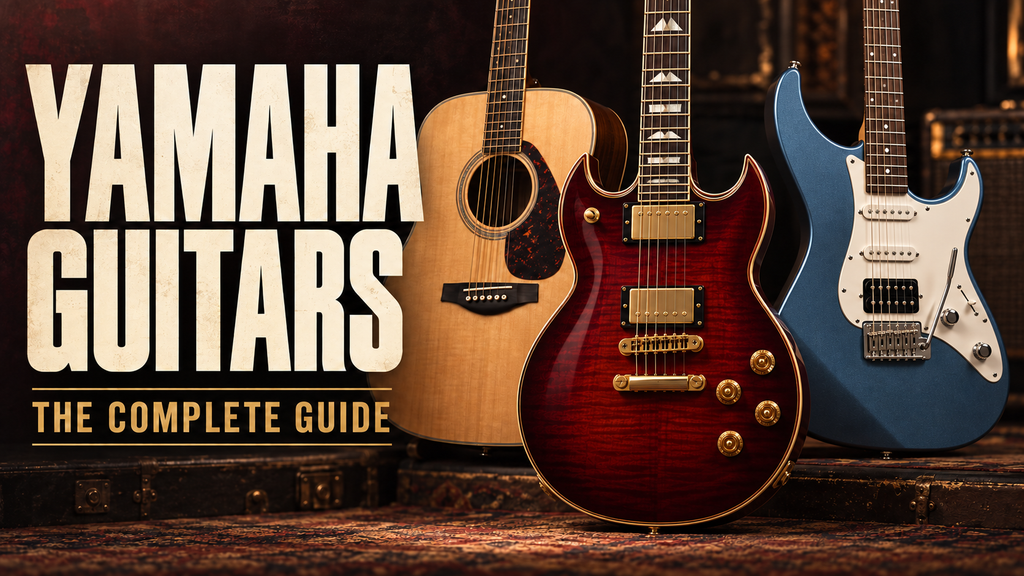
Yamaha Guitars: 60 Years from the FG180 to the Revstar
Yamaha is a Japanese instrument manufacturer (Yamaha Corporation, founded as Nippon Gakki in Hamamatsu in 1897)…
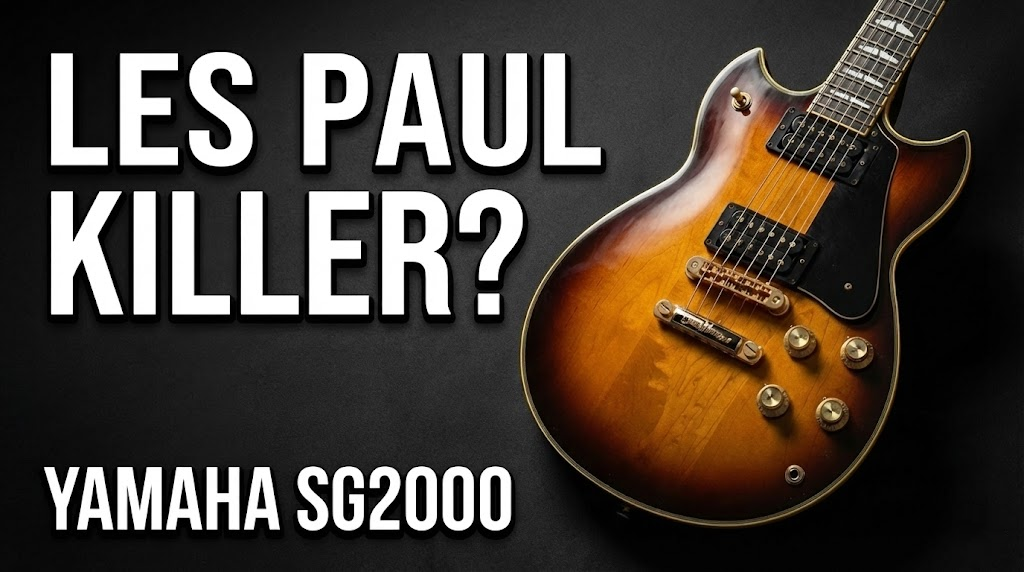
Yamaha SG2000: The Guitar Shaped by Santana’s Ideas
The Yamaha SG2000 is often seen as one of the most iconic electric guitars to…
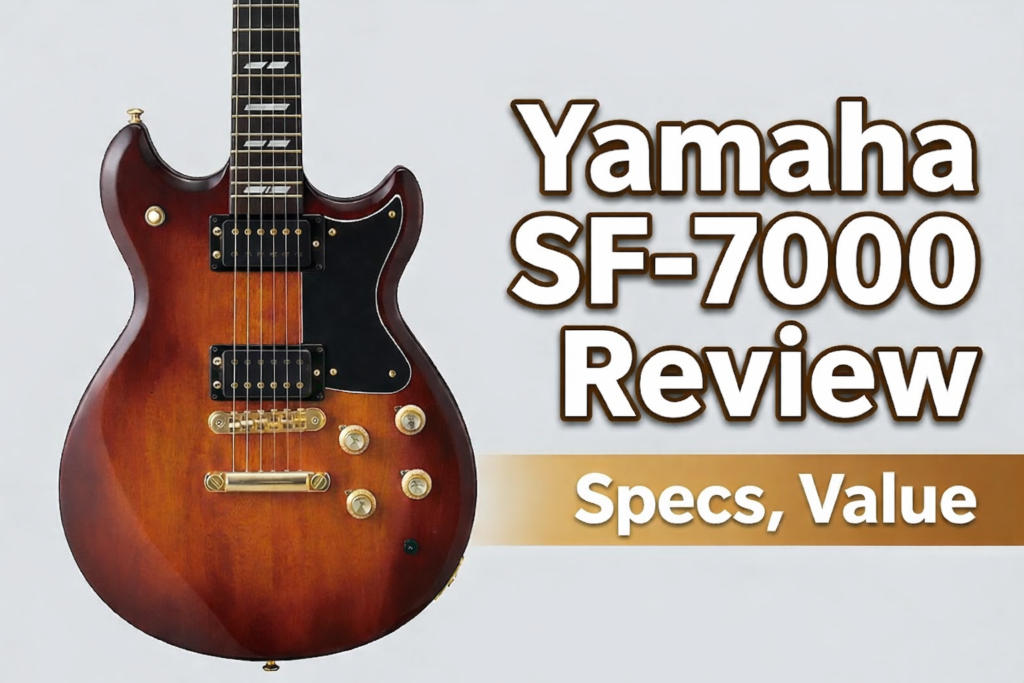
Yamaha SF-7000 Review: Specs, Value & SG Comparison
Overview & Key Points The Yamaha SF-7000 is a late 1970s to early 1980s Japanese…