The Tokai Springy Sound is the Strat-style guitar most people mean when they talk about old Tokai, but it was only the first of three lines. Alongside it came the Goldstar Sound and the Silver Star.
This guide covers all three, from 1977 to the mid-1980s, using Tokai’s own 1980, 1981 and 1984 catalogs: how to decode a model name like “ST-80GSR,” what really changed from year to year, and which one I’d look for today. For the wider brand story, see my Tokai Brand Guide.
Tokai Springy Sound, Goldstar and Silver Star Quick Facts
- Period covered: 1977 to the mid-1980s
- Three lines: Springy Sound (pre-CBS style), Goldstar Sound (its late-1983 successor), Silver Star (CBS-era 1970s style)
- Model prefixes: ST = Springy Sound, TST = Goldstar Sound, SS then TSS = Silver Star
- Model numbers: the original price in thousands of yen, so an ST-80 cost ¥80,000
- Suffixes: N = natural-finish model, a final R = rosewood fingerboard, other letters = color
- Specs change by year: DiMarzio pickups, V-shape necks and body woods depend on both grade and catalog year
- Associated players: Stevie Ray Vaughan, John Mayer; catalogs also named Joe Walsh, Mick Ronson and Nick Moroch
Key takeaways
- The number in a Tokai model name is its original price: an ST-80 cost ¥80,000.
- The same grade changed by year. A 1981 ST80 has Tokai pickups; a 1984 TST80 has DiMarzio VS-1s.
- For the most vintage-like Tokai Strat, choose by year and grade, starting at the 80 grade.
Prefer to watch? This article is based on my own video below.
- Tokai in Brief: The Road to the Tokai Springy Sound
- 1977–1983: Tokai Springy Sound, the Pre-CBS Strat
- Late 1983 Onward: Tokai Goldstar Sound and the TST Prefix
- 1978–Mid-1980s: Tokai Silver Star, the CBS-Era Strat
- How to Decode Tokai Springy Sound Model Names
- Tokai Springy Sound Myths vs. the Catalogs
- The Original Catalogs: 1980, 1981 and 1984
- Sen Ash, Linden and the Pickup Debate
- Which Tokai Springy Sound or Goldstar Should You Buy?
- Tokai Strat Players: SRV, John Mayer and More
- Final Thoughts
- FAQ
- More Tokai guitar articles
Tokai in Brief: The Road to the Tokai Springy Sound
Tokai started in 1947 as a maker of harmonicas and keyboard instruments, moved into acoustic guitars in the 1960s, and became Martin’s distributor in Japan in 1971. That connection brought technical know-how from Martin, and Tokai is also associated with Martin-related production for the Japanese market.
In 1977, Tokai began building electric guitars in earnest. Its Fender- and Gibson-style replicas captured the feel of the originals at a far lower price, and young Japanese players noticed. Tokai’s handwritten catalogs, packed with detailed specs, became part of the appeal, and they’re the backbone of this article. The full company story is in my Tokai history article.
1977–1983: Tokai Springy Sound, the Pre-CBS Strat
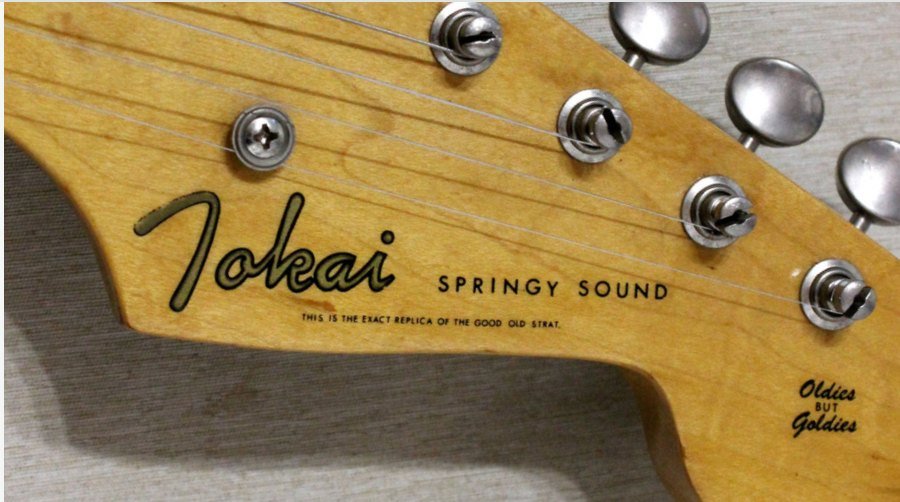
The Tokai Springy Sound was the company’s first Strat line, built to recreate the pre-CBS Stratocaster of the 1950s and early 1960s. The headstock carried a Fender-style “spaghetti” Tokai logo, the line “This is the exact replica of the good old Strat,” and an “Oldies but Goldies” script, which is a big part of why collectors chase it today.
The ST-80 and ST-100 are the best-known high-grade models, and at the very top sat the made-to-order ST-120 with a one-piece ash body, clearly aimed at the quality of a real vintage Fender. For vintage-focused players and collectors, the Tokai Springy Sound is usually the most desirable Tokai Strat line. As the catalogs below show, though, the exact specs of an “ST-80” depend on the year it was made.
Late 1983 Onward: Tokai Goldstar Sound and the TST Prefix
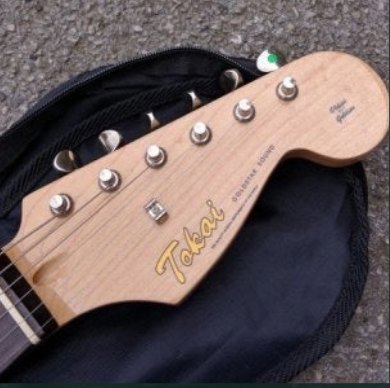
In late 1983, Tokai moved into the Goldstar Sound era. The overall direction stayed very close to the Tokai Springy Sound, but two things changed: the model prefix went from ST to TST, and the Fender-like spaghetti logo gave way to block and script logos.
The timing overlaps with the arrival of Fender Japan in 1982, so it’s possible Tokai was moving more carefully by then. Most players agree the build quality stayed high after the switch, although Springy vs. Goldstar is still debated on forums and among collectors. If anything, the 1984 catalog shows Tokai adding vintage details rather than cutting them.
TST-100ET: Tokai’s Own E.T. Tremolo
One especially interesting Goldstar model is the 1984 TST-100ET. The 1984 catalog lists it with Tokai’s “original super tremolo unit E.T.”, often called the Extra Tokai Tremolo. The heavier, solidly built metal unit is associated with strong sustain, and its two-point pivot design reduces friction compared with a traditional six-screw vintage tremolo, which helps it return to pitch.
1978–Mid-1980s: Tokai Silver Star, the CBS-Era Strat
Running alongside the Tokai Springy Sound and Goldstar lines, the Silver Star began in 1978 as Tokai’s take on the CBS-era Stratocaster. Instead of early pre-CBS features, it follows the 1970s Strat: the larger headstock, the three-bolt neck joint and the micro-tilt neck adjustment, which lets you change the neck angle without removing the neck.
Silver Star models used the SS prefix from 1978 to 1982, then TSS from 1983 to 1984, the added T lining up with the start of the Goldstar naming. From 1982 onward, all Silver Star models seem to have switched to poly finishes. Today the Silver Star is usually the most affordable way into a good vintage Tokai, although prices for some models have risen (more on John Mayer below).
How to Decode Tokai Springy Sound Model Names
This is the most useful part if you’re shopping on Reverb, eBay or a Japanese auction site. A listing name like ST-80GSR or SS-85N tells you almost everything once you know the parts. The decoder below is based on the 1980, 1981 and 1984 Tokai catalogs:
| Part | Example | What it means |
|---|---|---|
| Prefix | ST / TST / SS / TSS | Line and era: Springy Sound, Goldstar Sound, Silver Star (SS to 1982, TSS 1983–84) |
| Number | 80 | Original price in thousands of yen, which also works as the grade (¥80,000) |
| N after the number | ST85N, SS65N | A separate natural-finish model, priced ¥5,000 above the regular grade in 1981 |
| Color letters | GS, YS, OW, BB | Finish color (see the table below) |
| R at the end | GSR, OWR, BBR | Rosewood fingerboard version; no R means a one-piece maple neck |
| ET | TST-100ET | Fitted with Tokai’s E.T. tremolo unit |
So an ST-80GSR is a Tokai Springy Sound, ¥80,000 grade, in Golden Sunburst, with a rosewood fingerboard. In the 1981 catalog, the maple-neck versions were called the ST’54 Vintage models and the rosewood versions the ST’64 Oldies models, with the same grades and prices on both sides.
Tokai Color Codes Used on the Strat Lines
| Code | Color |
|---|---|
| YS | Yellow Sunburst |
| GS | Golden Sunburst |
| OW | Olympic White |
| BB | Black |
| MR | Metallic Red |
| MB | Metallic Blue |
| FO | Flamingo Orange |
| SG | Silver Gray |
| BL | Blond |
| N | Natural |
Tokai reused some codes with slightly different names from one catalog to the next. For the full list across years, the Tokai Forum keeps an excellent vintage Tokai color code thread.
TST-56 and TST-62: The Exceptions to the Number Rule
Two Goldstar models break the price-number rule. In 1984, Tokai released two Strat-style models for the American market, the AST-56 and AST-62, sold in Japan as the TST-56 and TST-62. Their numbers refer to the vintage year they copy, and in overall grade they sit roughly in the ST-60 class. Both used the revised headstock shape, so nobody would mistake them for a Fender.
- AST-56 / TST-56: 1956-style Strat with a maple fingerboard, V-shape neck and alder body.
- AST-62 / TST-62: 1962-style Strat with a rosewood fingerboard, U-shape neck and alder body.
With a Fender Stratocaster costing around ¥250,000 in Japan at the time, even an ¥80,000 Tokai was a fraction of the price. In today’s money, an ST-42 and an ST-80 work out very roughly to $265 and $500, depending on how you compare the eras.
Tokai Springy Sound Myths vs. the Catalogs
A lot of what you read about Tokai Strats online is broadly right but too simple. Here’s how the common claims hold up against the catalogs:
| Common claim | What the catalogs show |
|---|---|
| “80 grade and up means DiMarzio” | Not in 1981: ST80 and ST100 list Tokai’s ST Vintage pickups, while the SS80 and SS85N have DiMarzio Flat Strats. By 1984, the TST80 and TST100 have DiMarzio VS-1s. |
| “Only the 80 grade and up has a V neck” | True for the 1981 ST line. In 1984, the TST60 maple-neck model is already a ’54 V shape. |
| “Silver Stars are three-bolt” | Most are, but the 1984 TSS80 and rosewood TSS60 are listed with four-bolt necks. |
| “Bodies are sen or alder” | Mostly, but the 1981 ST45, SS40 and SS36 also list linden (basswood), while every 1984 TST is alder. |
| “Lower grades are just cheaper copies” | The 1984 TSTs copy Fender’s own changes by grade: 1-ply 8-screw vs. 3-ply 11-screw pickguards, slab vs. round-laminated rosewood boards. |
The practical takeaway: when you see a Tokai Strat for sale, the year matters as much as the grade number. A 1981 Tokai Springy Sound ST80 and a 1984 Goldstar TST80 share a price point but not the same pickups.
The Original Catalogs: 1980, 1981 and 1984
These four catalog pages are the primary sources behind the table above. Open each one to read my English translation of the key specs.
1980 Catalog: The Tokai Springy Sound and Silver Star Line-Up
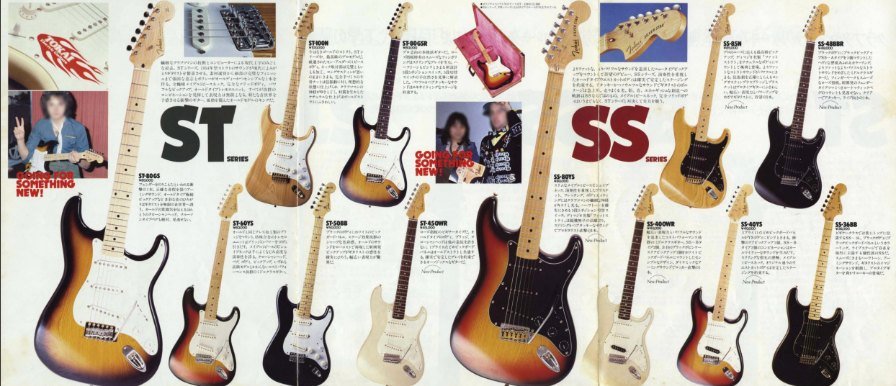
The 1980 spread shows both lines side by side: the Tokai Springy Sound ST series with the small pre-CBS headstock and the SS series with the large 1970s headstock. You can see the naming system in action on the photo labels, with models such as the ST-80GS, ST-100N and ST-80GSR, and the SS-85N and SS-80YS on the Silver Star side.
1981 Catalog: Tokai Springy Sound ST’54 Vintage, ST’64 Oldies and Silver Star
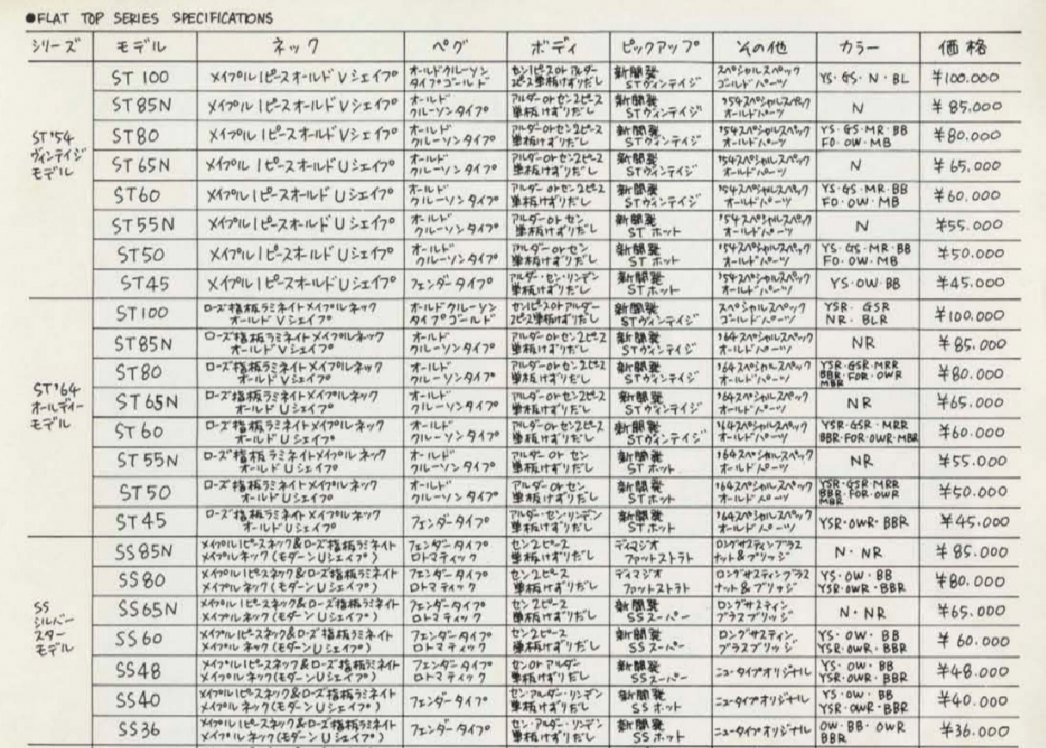
Show the English translation (1981 catalog)
| Model | Neck shape | Body | Pickups | Price |
|---|---|---|---|---|
| Tokai Springy Sound ST’54 Vintage (maple) and ST’64 Oldies (rosewood), same specs and prices | ||||
| ST100 | Old V | Sen one-piece or alder two-piece | New ST Vintage (gold parts) | ¥100,000 |
| ST85N | Old V | Alder or sen, two-piece | New ST Vintage | ¥85,000 |
| ST80 | Old V | Alder or sen, two-piece | New ST Vintage | ¥80,000 |
| ST65N | Old U | Alder or sen, two-piece | New ST Vintage | ¥65,000 |
| ST60 | Old U | Alder or sen, two-piece | New ST Vintage | ¥60,000 |
| ST55N | Old U | Alder or sen | New ST Hot | ¥55,000 |
| ST50 | Old U | Alder or sen | New ST Hot | ¥50,000 |
| ST45 | Old U | Alder, sen or linden | New ST Hot | ¥45,000 |
| SS Silver Star (maple or rosewood, modern U neck, Rotomatic-type tuners) | ||||
| SS85N | Modern U | Sen two-piece | DiMarzio Flat Strat, brass nut and bridge | ¥85,000 |
| SS80 | Modern U | Sen two-piece | DiMarzio Flat Strat, brass nut and bridge | ¥80,000 |
| SS65N | Modern U | Sen two-piece | New SS Super, brass bridge | ¥65,000 |
| SS60 | Modern U | Sen two-piece | New SS Super, brass bridge | ¥60,000 |
| SS48 | Modern U | Sen or alder | New SS Super | ¥48,000 |
| SS40 | Modern U | Sen, alder or linden | New SS Hot | ¥40,000 |
| SS36 | Modern U | Sen, alder or linden | New SS Hot | ¥36,000 |
In short: in 1981 the V-shape neck starts exactly at the 80 grade, and DiMarzio pickups appear only on the top Silver Star models.
1984 Catalog: Goldstar Sound TST Models
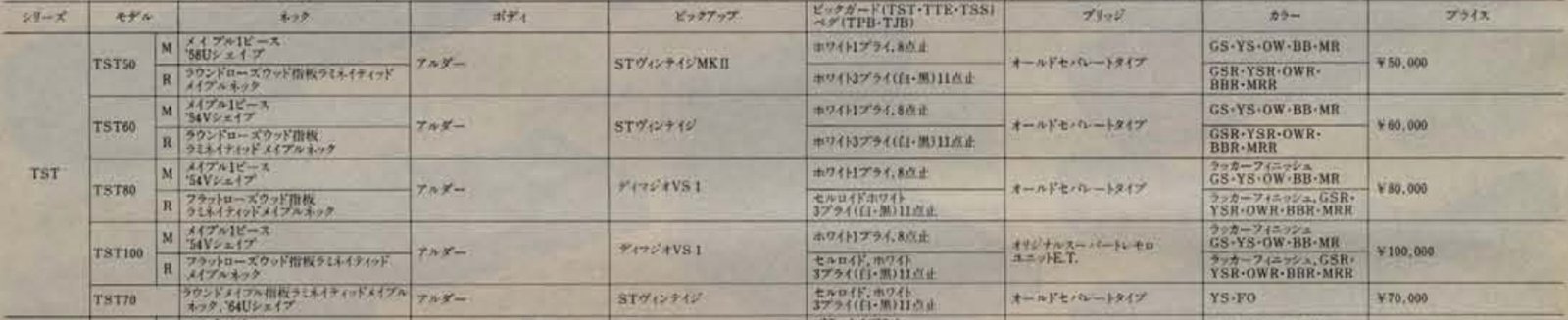
Show the English translation (1984 TST catalog)
| Model | Maple neck (M) | Rosewood version (R) | Pickups | Price |
|---|---|---|---|---|
| TST50 | One-piece maple, ’58 U shape | Round rosewood board, laminated maple neck | ST Vintage MKII | ¥50,000 |
| TST60 | One-piece maple, ’54 V shape | Round rosewood board, laminated maple neck | ST Vintage | ¥60,000 |
| TST70 | – | Laminated maple neck, ’64 U shape | ST Vintage | ¥70,000 |
| TST80 | One-piece maple, ’54 V shape | Flat (slab) rosewood board | DiMarzio VS-1, lacquer finish | ¥80,000 |
| TST100 | One-piece maple, ’54 V shape | Flat (slab) rosewood board | DiMarzio VS-1, lacquer, E.T. tremolo | ¥100,000 |
In short: every TST body is alder, DiMarzio VS-1s arrive on the TST80 and TST100, and pickguards and fingerboards follow Fender’s own 1950s and 1960s details by grade.
1984 Catalog: Silver Star TSS Models
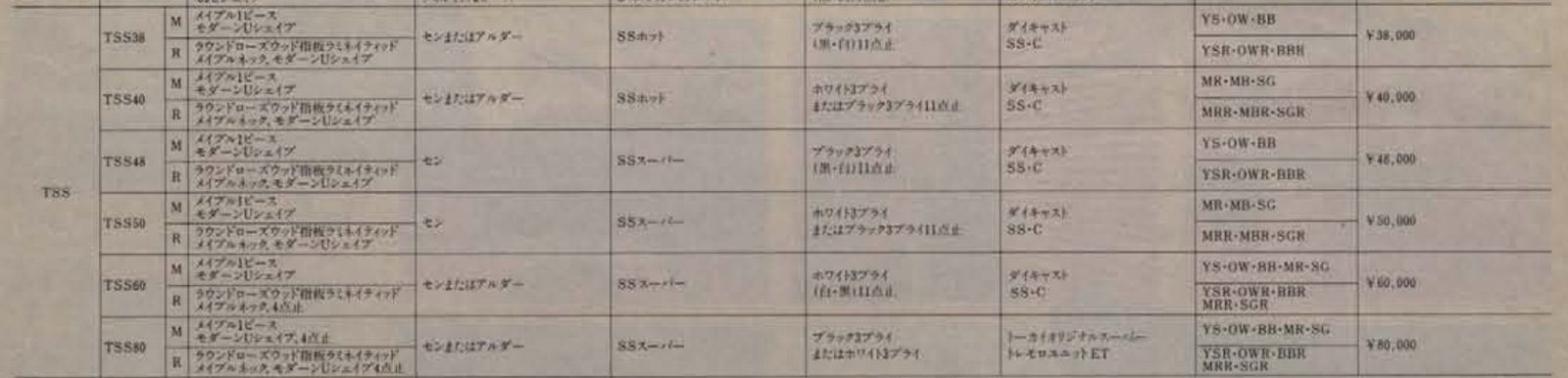
Show the English translation (1984 TSS catalog)
| Model | Body | Pickups | Bridge | Price |
|---|---|---|---|---|
| TSS38 | Sen or alder | SS Hot | Die-cast SS-C | ¥38,000 |
| TSS40 | Sen or alder | SS Hot | Die-cast SS-C | ¥40,000 |
| TSS48 | Sen | SS Super | Die-cast SS-C | ¥48,000 |
| TSS50 | Sen | SS Super | Die-cast SS-C | ¥50,000 |
| TSS60 | Sen or alder | SS Super | Die-cast SS-C (four-bolt on the rosewood version) | ¥60,000 |
| TSS80 | Sen or alder | SS Super | Tokai original E.T. tremolo, four-bolt neck | ¥80,000 |
In short: modern U-shape necks throughout, and four-bolt necks on the TSS80 and the rosewood TSS60.
Sen Ash, Linden and the Pickup Debate
Sen Ash: The Japanese Body Wood That Isn’t Ash
Sen ash (sen, or castor aralia) is an Asian tonewood widely used on Japanese guitars. It looks a lot like American ash, with a similar open grain, but it is a different species altogether. Linden, listed on a few of the cheapest 1981 models, is what American players call basswood.
Tokai Pickups vs. DiMarzio: Does It Matter?
Opinions split here. Some players feel the lower-grade Tokai pickups sound thinner; others say the real quality comes from the wood and construction and are happy with the stock pickups. If you plan to swap pickups anyway, this matters much less than the neck shape and finish, which are hard to change later.
Specs Shared Across the Range
- Five-way pickup selector: more player-friendly than a strict vintage three-way switch, since it gives you the in-between positions without modding.
- One-piece maple neck or rosewood board: most grades were offered both ways.
- Vintage-style fingerboard radius: the more curved radius of old Fenders. It feels great for chords, but bends can choke more easily than on a flatter modern board.
- Handmade details at a low price: even the cheapest catalog models list carved one- or two-piece bodies rather than plywood.
Which Tokai Springy Sound or Goldstar Should You Buy?
My pick
Choose by year and grade, not grade alone
Start at the 80 grade: the V neck and nitro finish are hard to change later. Want the spaghetti logo? Go for a Tokai Springy Sound ST-80 or higher. Want DiMarzio VS-1s, a slab rosewood board and lacquer out of the box? A 1984 Goldstar TST-80 or TST-100 is the smarter buy.
| Line | Look for | Best for |
|---|---|---|
| Tokai Springy Sound | ST-80, ST-85N, ST-100, ST-120 | Collectors who want the spaghetti logo and pre-CBS look |
| Goldstar Sound | TST-80, TST-100, TST-100ET | Players who want DiMarzios, lacquer and vintage details |
| Silver Star | SS-80, SS-85N, TSS models | Fans of the 1970s large-headstock Strat and budget buyers |
Below the 80 grade, these guitars are still very well built. A smart way to choose is to decide which parts you’re willing to replace, and buy the guitar whose fixed parts (body, neck, finish) you like. If you’re buying from a Japanese listing, my Japanese guitar condition terms glossary will help you read it.
Tokai Strat Players: SRV, John Mayer and More
Stevie Ray Vaughan always comes up, and the reason is simple: in the original photo used as the basis for the cover of Texas Flood, he is holding a Tokai Springy Sound Strat. Whether he actually used Tokai as a regular guitar is much less clear. There’s no strong evidence it was one of his long-term main guitars, and the stories about an endorsement deal are disputed.
Tokai did use him heavily in its marketing, and some people say he wasn’t happy about it. One reading is that he played a supplied guitar a few times and the image took on a life of its own. The photo is real; how much he played the guitar is still an open question.
John Mayer is the modern name. Photos of him with a black, maple-neck Silver Star spread widely online, and that exposure is often said to have pushed up prices for the model, which is commonly identified as an SS-40.
Older Tokai catalogs also featured Joe Walsh, Mick Ronson and session guitarist Nick Moroch as Tokai Strat users, and plenty of other players likely used them without ever appearing in a catalog.
Final Thoughts
Going through Tokai’s own catalogs for this article, what struck me most is how much the same model number could change in just three years, and how carefully Tokai copied Fender’s own changes, right down to slab boards and pickguard screws. That’s why the year matters as much as the grade when you shop.
If you want a Strat with real vintage character at a still reachable price, a Tokai Springy Sound or one of its siblings is one of the strongest options. If you own one, tell me your model and year in the comments. And if you have more detailed information or corrections on anything here, I’d love to hear it.
FAQ
What is the difference between Tokai Springy Sound and Goldstar Sound?
Both recreate the pre-CBS Stratocaster. Springy Sound (ST prefix) came first, from 1977, with a Fender-style spaghetti logo. Goldstar Sound (TST prefix) replaced it from late 1983 with block or script logos, keeping a very similar build.
How do I read a Tokai model name like ST-80GSR?
ST is the line (Springy Sound), 80 is the original price in thousands of yen, GS is the color (Golden Sunburst), and a final R means a rosewood fingerboard. An N after the number marks a natural-finish model.
Do Tokai Springy Sound ST-80 and ST-100 models have DiMarzio pickups?
It depends on the year. The 1981 catalog lists Tokai ST Vintage pickups on the ST80 and ST100, while the 1984 catalog lists DiMarzio VS-1 pickups on the TST80 and TST100.
What is a Tokai Silver Star?
The Silver Star, launched in 1978, is Tokai’s CBS-era Stratocaster with a large headstock and micro-tilt adjustment. It used the SS prefix until 1982 and TSS in 1983 and 1984. Most have three-bolt necks, but the 1984 TSS80 is listed with four bolts.
Did Stevie Ray Vaughan play a Tokai?
He holds a Tokai Springy Sound in the original photo used as the basis for the Texas Flood cover, but there is no strong evidence that Tokai was one of his long-term main guitars.
What is sen ash?
Sen ash is an Asian tonewood used on many Japanese guitars. It looks similar to American ash but is a different species.
More Tokai guitar articles
Japanese Les Paul Copies: Tokai vs Greco vs Burny (1978-1982)
Japanese Les Paul copies from the late 1970s are some of the most faithful Les…
Tokai Love Rock and Reborn (1978-1981): Golden-Era LS Guide
The Tokai Love Rock is Japan’s best-known Les Paul-style guitar, but it went through three…
Tokai Guitars History: From Harmonicas to the Copies That Beat the Originals
Tokai is the Japanese brand that made the phrase “better than the original” stick. It…

Tokai MAT: How Tokai Used Advanced Materials to Rethink the Guitar
The Tokai MAT is one of the most unusual guitar projects to come out of…
Tokai Talbo: The Aluminum Guitar That Failed, Came Back, and Became Tokai’s Flagship
In an era when every electric guitar was made of wood as a matter of…
Tokai Guitars: Love Rock, Springy Sound and Which One to Buy
Tokai Gakki is a Hamamatsu guitar maker that builds everything in its own factory. It…