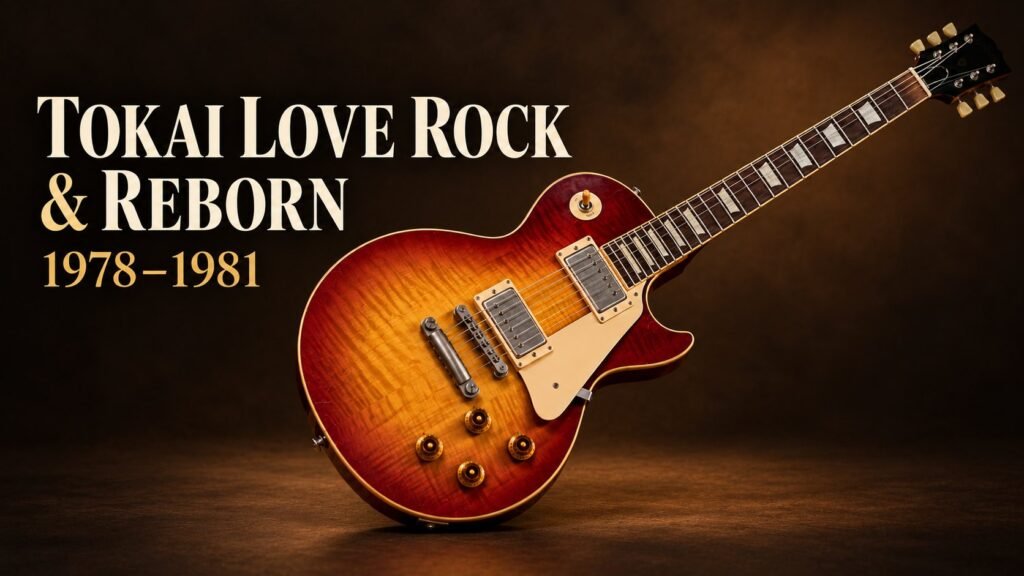
The Tokai Love Rock is Japan’s best-known Les Paul-style guitar, but it went through three names in just a few years: Les Paul Reborn, Reborn Old and Love Rock. This article covers that golden era, from the late 1970s into the early 1980s, using Tokai’s own period catalogs: what each name means, what really changed from grade to grade, and which one I’d buy. For the wider brand story, start with my Tokai Brand Guide.
Tokai Love Rock and Reborn Quick Facts
- Period covered: late 1970s to the early 1980s
- Three names: Les Paul Reborn (about 1978–1979), Reborn Old (1980), Love Rock (from 1980–81 onward)
- Target: a 1958 Gibson Les Paul, analyzed and rebuilt in detail
- Reborn grades: LS-50, LS-60, LS-80, LS-100 (plus the LC-100 Custom-style model)
- Love Rock flagships (1981): made-to-order LS150V and LS200V
- Original prices: ¥50,000 to ¥100,000 for a Reborn without case; up to ¥188,000 for an LS200V in 1981
- Associated players: Billy Gibbons, Joe Walsh
Prefer to watch? This article is based on my own video below.
- Why the Tokai Love Rock and LS Series Still Matter
- Inside the Build: Matching the Parts You Can't See
- What the Original Tokai Catalogs Show
- 1978–1979: The Les Paul Reborn Years
- 1980: Reborn Old, the Short-Lived Bridge
- Early 1980s: Tokai Love Rock Model, the Name That Stuck
- Joe Walsh and Billy Gibbons: Tokai Love Rock and Reborn Players
- Buying a Tokai Love Rock or Reborn: Which One I'd Get
- Final Thoughts
- FAQ
- More Tokai guitar articles
Why the Tokai Love Rock and LS Series Still Matter
Like Tokai’s ST series on the Stratocaster side, the LS line behind the Tokai Love Rock came from taking a vintage 1958 Les Paul apart, measuring it, and rebuilding it. Careful wood selection and precise construction got these guitars remarkably close to the character of the original.
By 1978 and 1979, the result was no longer a cheap imitation. Solid maple tops, solid mahogany backs, handmade bone nuts and clean fretwork made the best of them serious instruments, and they showed how far Japanese builders had come in less than a decade.
Inside the Build: Matching the Parts You Can’t See
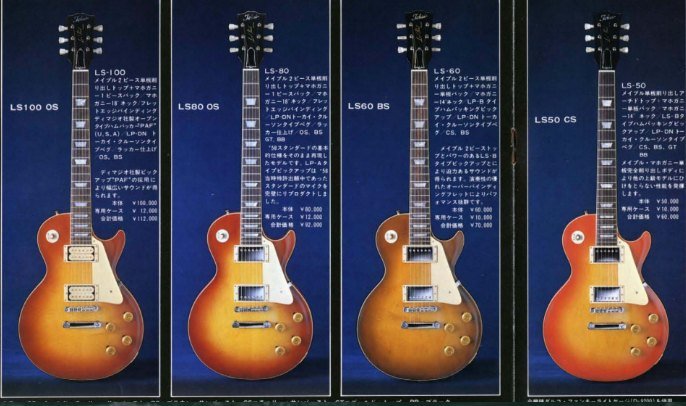
This is where the Tokai Love Rock line earned its reputation. It didn’t just copy the outline; it matched the hidden details that decide how a Les Paul feels and rings. Tokai’s own catalogs also show which grades got which details:
- Steep 18-degree headstock pitch (LS-80 and up): the catalogs list 18 degrees for the higher grades, close to the steep 1950s Gibson angle. More back-angle means more string pressure on the nut, which helps sustain. The LS-50 and LS-60 used a shallower 14 degrees.
- Long-tenon neck joint: the deep-set joint reaches well into the body, so more wood touches wood and vibration passes from neck to body more efficiently. Gibson itself had quietly moved away from this on its own production line.
- Solid mahogany back, one-piece from the LS-80 up: no weight-relief holes and no chambering, the kind that later Gibsons hid inside. That keeps the dense, focused midrange of a solid-body Les Paul.
- Real carved maple cap: a solid top rather than a thin veneer, with the right carve depth, two-piece bookmatched from the LS-60 up. It adds the bright attack that balances the mahogany.
- Handmade bone nut on every grade: the catalogs describe it as fully handmade from cow bone, which transfers string energy better than plastic.
Even the cheapest grade, the LS-50, used a carved solid maple top over a solid mahogany back. No plywood at the bottom of the range is what still sets these guitars apart.
What the Original Tokai Catalogs Show
Below are two original Tokai catalog pages, each followed by my English translation: a 1979 Reborn catalog and a Love Rock catalog dated September 1, 1981. Prices are the original Japanese retail prices in yen.
1979 Reborn Catalog: LS-50 to LS-100 and LC-100
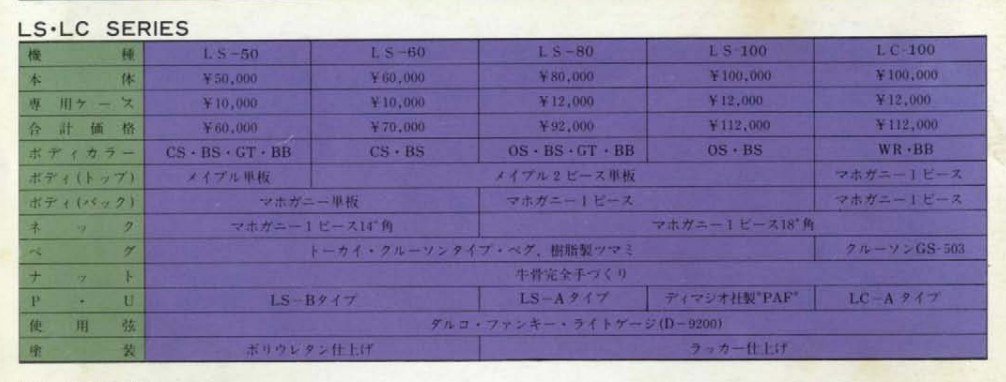
| Spec | LS-50 | LS-60 | LS-80 | LS-100 | LC-100 |
|---|---|---|---|---|---|
| Guitar | ¥50,000 | ¥60,000 | ¥80,000 | ¥100,000 | ¥100,000 |
| Case | ¥10,000 | ¥10,000 | ¥12,000 | ¥12,000 | ¥12,000 |
| Total | ¥60,000 | ¥70,000 | ¥92,000 | ¥112,000 | ¥112,000 |
| Colors | CS, BS, GT, BB | CS, BS | OS, BS, GT, BB | OS, BS | WR, BB |
| Top | Solid maple | Two-piece solid maple | One-piece mahogany | ||
| Back | Solid mahogany | One-piece mahogany | One-piece mahogany | ||
| Neck | One-piece mahogany, 14° headstock | One-piece mahogany, 18° headstock | |||
| Tuners | Tokai Kluson-type, resin buttons | Kluson GS-503 | |||
| Nut | Bone, fully handmade | ||||
| Pickups | LS-B type | LS-A type | DiMarzio “PAF” | LC-A type | |
| Strings | D’Arco Funky light gauge (D-9200) | ||||
| Finish | Polyurethane | Lacquer | |||
Look at where the line falls. Between the LS-60 and the LS-80, the price jumps by ¥22,000 including the case, and almost every important spec changes at the same point: the headstock goes from 14 to 18 degrees, the back becomes one-piece mahogany, the finish switches from polyurethane to lacquer, and the pickups move up from the LS-B to the LS-A type.
I’d also heard that Tokai decided the grade largely by how much figure was in the maple. The catalog shows that’s only part of the story: the top’s looks matter, but the LS-80 and LS-100 are also built differently from the LS-50 and LS-60.
1981 Tokai Love Rock Catalog: LS50 to the Made-to-Order LS200V
By September 1981, the Tokai Love Rock lineup had split into an LS’58 Standard line (LS50 to LS100) and an LS Vintage line above it. The same 14/18-degree divide is still there.
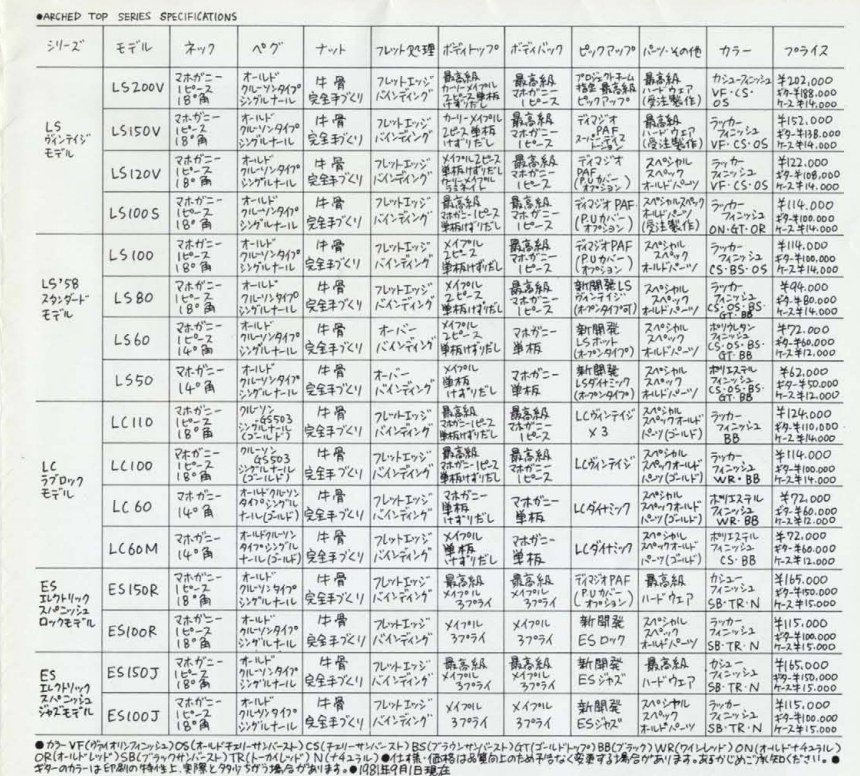
| Model | Headstock | Top | Back | Pickups | Finish | Guitar / with case |
|---|---|---|---|---|---|---|
| LS Vintage models | ||||||
| LS200V | 18° | Top-grade curly maple, two-piece, carved | Top-grade one-piece mahogany | Top-grade pickups chosen by the project team | Cashew special finish | ¥188,000 / ¥202,000 (made to order) |
| LS150V | 18° | Curly maple, two-piece, carved | Top-grade one-piece mahogany | DiMarzio Super Distortion | Lacquer | ¥138,000 / ¥152,000 (made to order) |
| LS120V | 18° | Maple, two-piece, carved | Top-grade one-piece mahogany | DiMarzio PAF | Lacquer | ¥108,000 / ¥122,000 |
| LS’58 Standard models | ||||||
| LS100 | 18° | Maple, two-piece, carved | Top-grade one-piece mahogany | DiMarzio PAF | Lacquer | ¥100,000 / ¥114,000 |
| LS80 | 18° | Maple, two-piece, carved | Top-grade one-piece mahogany | New LS Vintage | Lacquer | ¥80,000 / ¥94,000 |
| LS60 | 14° | Maple, two-piece, carved | Solid mahogany | New LS Hot | Polyurethane | ¥60,000 / ¥72,000 |
| LS50 | 14° | Solid maple, carved | Solid mahogany | New LS Dynamic | Polyester | ¥50,000 / ¥62,000 |
Two more details from the 1981 catalog: every model kept the fully handmade bone nut, and the LS80 and up had binding “nibs” at the fret ends (the frets stop at the binding, as on a vintage Gibson), while the LS50 and LS60 had frets running over the binding. The same catalog also lists Custom-style LC models and an all-mahogany LS100S. Color codes: CS = Cherry Sunburst, BS = Brown Sunburst, OS = Old Cherry Sunburst, GT = Gold Top, BB = Black, WR = Wine Red.
1978–1979: The Les Paul Reborn Years
From about 1978 (the start year given in Tokai’s Wikipedia entry) to 1979, the LS series was called the Les Paul Reborn. The reason is simple: that’s what it said on the headstock. Where a Gibson would read “Model,” the Tokai read “Reborn,” and it put “Les Paul” right there in script.
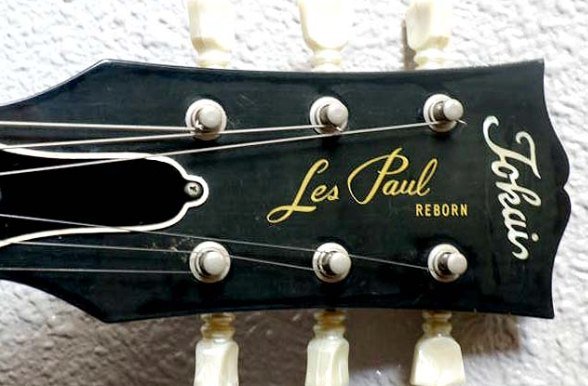
It sounds bold now. In the Japanese guitar industry of the late ’70s, though, it wasn’t unusual. As long as a maker didn’t claim the guitar was built by Gibson, putting “Les Paul” on the headstock seems to have been treated as staying just on the right side of the line. That would change during what collectors now call the lawsuit era, which I cover in my Tokai history article.
1980: Reborn Old, the Short-Lived Bridge
After the inevitable complaints from the original maker about the headstock, a version with a “Reborn Old” logo appeared for a very brief window around 1980. It sits between the Reborn and the next generation.
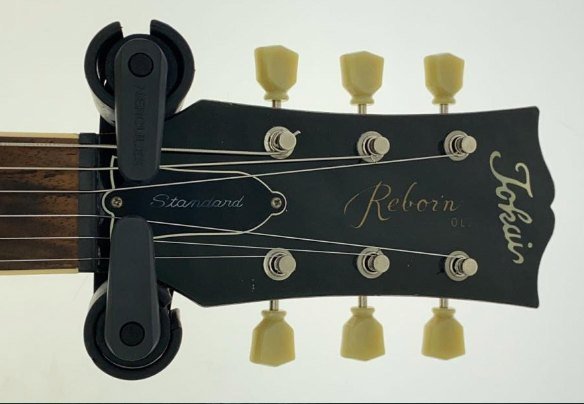
Production numbers were low, so Reborn Old guitars are rare. There’s nothing special about the materials compared with a Reborn, though. You’re paying for the short production window and the logo, not for a different build.
Early 1980s: Tokai Love Rock Model, the Name That Stuck
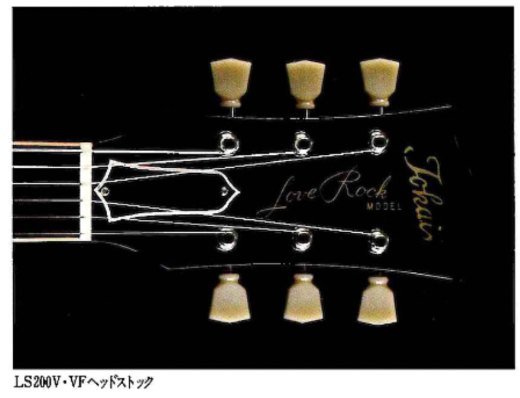
Next came the Tokai Love Rock. The headstock decal now read “Love Rock Model,” and that name still carries Tokai’s Les Paul-style guitars today. The name changed, but the build didn’t: early Love Rocks kept the Reborn DNA, with solid maple tops, lacquer on the higher grades and that long Tokai sustain.
LS150V and LS200V: Made-to-Order Flagships
At the top of the Tokai Love Rock range sat the LS150V and LS200V. The 1981 catalog marks both as made to order, with top-grade curly maple, top-grade one-piece mahogany and the best hardware Tokai had. The LS200V cost ¥188,000 before the case, nearly double an LS100. They barely reached the market, and today good examples can change hands at prices you’d normally associate with a Gibson Custom Shop Les Paul.
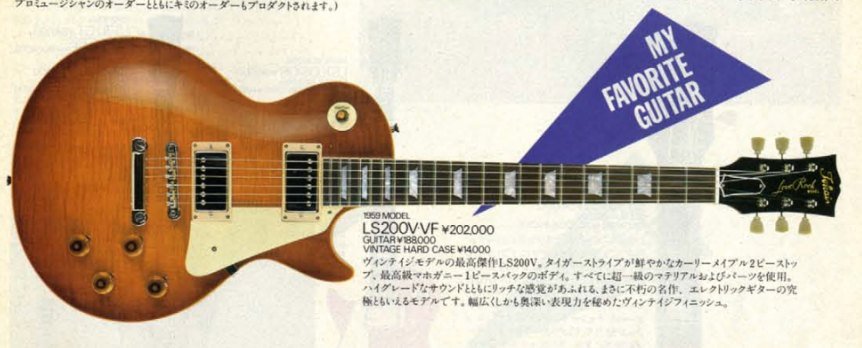
Tokai’s own catalog billed the LS200V VF as its “1959 Model”: a tiger-stripe curly maple two-piece top, a top-grade one-piece mahogany back, the best materials and parts throughout, and a vintage finish. At ¥202,000 with its vintage hard case, it was the most expensive Les Paul-style guitar in the lineup.
Joe Walsh and Billy Gibbons: Tokai Love Rock and Reborn Players
Two big names are tied to Tokai Love Rock and Reborn guitars from this era. Joe Walsh of the Eagles is said to have used a Tokai LS-100.
Billy Gibbons of ZZ Top is linked to a Tokai LS-200. As the story goes, he was afraid his own 1959 Gibson Les Paul, the famous “Pearly Gates,” would be stolen on the road, so he played the Tokai instead. That says a lot about how close these guitars got.
Buying a Tokai Love Rock or Reborn: Which One I’d Get
My pick
LS-80 or higher
If I were buying a Tokai Love Rock or Reborn, I’d go for an LS-80 or above. The main reason is the lacquer finish: on the used market, many of these have aged into a real vintage look, with checking and a mellow color that a polyurethane LS-50 or LS-60 won’t develop. The catalog backs this up from the build side too. The LS-80 is where the 18-degree headstock, the one-piece mahogany back and the lacquer all arrive together.
| Name | Years | Headstock reads | Best for |
|---|---|---|---|
| Les Paul Reborn | About 1978–1979 | “Les Paul Reborn” | Collectors who want the lawsuit-era look |
| Reborn Old | About 1980 | “Reborn Old” | Rarity hunters; same build as Reborn |
| Tokai Love Rock (early) | From 1980–81 | “Love Rock Model” | Players who want the golden-era build at a fairer price |
- Read the grade first. The LS number tells you headstock angle, back construction, finish and pickups. LS-80 and up is where the vintage-correct specs start.
- Check originality. Pickups and hardware on 40-plus-year-old guitars are often swapped. Original parts usually hold value better.
- Learn the condition terms if you buy from a Japanese listing. Words like gari and sori decide whether a guitar is a bargain or a repair job; see my Japanese guitar condition terms glossary.
Final Thoughts
From Reborn to Reborn Old to Tokai Love Rock, these guitars defined Tokai’s golden era. Going back through the original catalogs, what impresses me most is where the money went: into the headstock angle, the one-piece back and the finish, the parts nobody sees in a shop window but every player feels.
If you find a clean, original LS-80 or better from these years, you’re holding one of the moments when Japanese guitar making stopped following and started setting the standard. If you own one, tell me about it in the comments.
FAQ
What is the difference between Tokai Reborn and Tokai Love Rock?
They are the same Les Paul-style LS series under different names. Les Paul Reborn was used around 1978 to 1979, Reborn Old briefly around 1980, and Love Rock from about 1980 to 1981 onward. Early Love Rocks kept the same construction as the Reborns.
What is the difference between the Tokai LS-60 and LS-80?
According to Tokai’s catalogs, the LS-80 adds an 18-degree headstock instead of 14 degrees, a one-piece mahogany back, a lacquer finish instead of polyurethane, and better pickups. The LS-80 is where the vintage-correct specs start.
How much did a Tokai Reborn cost new?
The 1979 Tokai catalog lists the LS-50 at 50,000 yen, LS-60 at 60,000 yen, LS-80 at 80,000 yen and LS-100 at 100,000 yen, plus 10,000 to 12,000 yen for the case.
Is a Tokai Reborn Old rare?
Yes. Reborn Old was made only for a short window around 1980, so few exist. Its materials are the same as a Reborn, so the premium is for rarity rather than a different build.
Which Tokai LS models have DiMarzio pickups?
In the 1979 Reborn catalog, the LS-100 came with DiMarzio PAF pickups. In the 1981 Love Rock catalog, the LS100 and LS120V list DiMarzio PAFs and the LS150V lists a DiMarzio Super Distortion.
Which famous guitarists used Tokai Les Pauls?
Joe Walsh is said to have used a Tokai LS-100, and Billy Gibbons is linked to a Tokai LS-200, reportedly so he could leave his 1959 Gibson Les Paul at home.
More Tokai guitar articles
Japanese Les Paul Copies: Tokai vs Greco vs Burny (1978-1982)
Japanese Les Paul copies from the late 1970s are some of the most faithful Les…
Tokai Springy Sound and Goldstar: 3 Tokai Strat Lines Explained
The Tokai Springy Sound is the Strat-style guitar most people mean when they talk about…
Tokai Guitars History: From Harmonicas to the Copies That Beat the Originals
Tokai is the Japanese brand that made the phrase “better than the original” stick. It…
Tokai MAT: How Tokai Used Advanced Materials to Rethink the Guitar
The Tokai MAT is one of the most unusual guitar projects to come out of…
Tokai Talbo: The Aluminum Guitar That Failed, Came Back, and Became Tokai’s Flagship
In an era when every electric guitar was made of wood as a matter of…
Tokai Guitars: Love Rock, Springy Sound and Which One to Buy
Tokai Gakki is a Hamamatsu guitar maker that builds everything in its own factory. It…