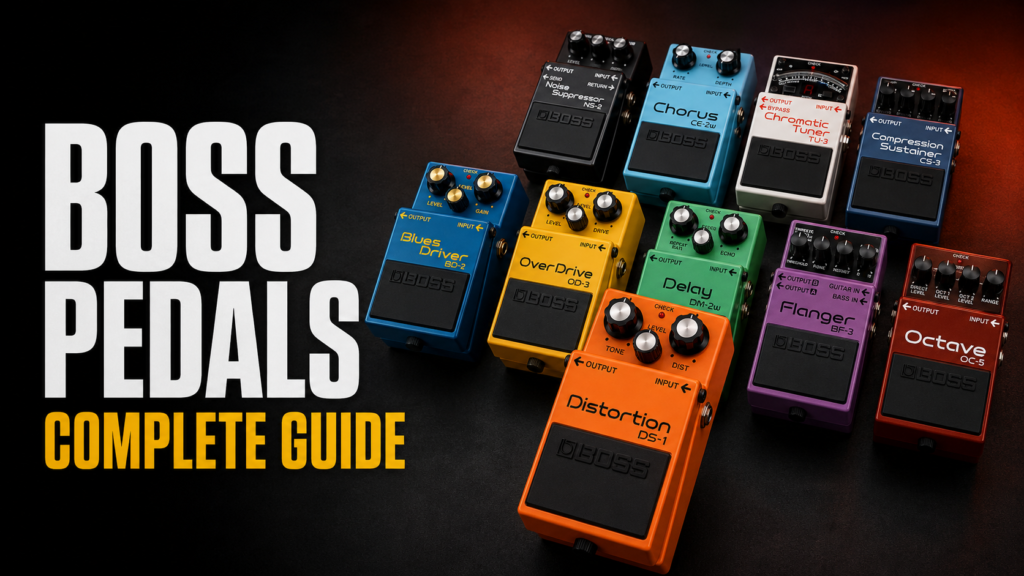
BOSS is the guitar and bass brand of Roland Corporation, a Japanese manufacturer that designs and builds its own gear rather than outsourcing a name to someone else’s factory. Founded in 1973 and shipping its first product in 1974, BOSS is best known for the compact stompbox format it invented in 1977, a chassis that has stayed essentially unchanged for nearly fifty years. If you have plugged into a rehearsal studio anywhere on earth, you have almost certainly stepped on one.
BOSS Quick Facts
- Founded: 1973, Osaka, Japan (roots in MEG Electronics; a Roland-affiliated brand)
- Parent company: Roland Corporation, a true manufacturer; BOSS formally merged into Roland in 2018
- First product: B-100 acoustic mic / preamp (1974); first pedal, CE-1 Chorus Ensemble (1976)
- Claim to fame: Invented the compact pedal format (OD-1, PH-1, SP-1, 1977) and the first compact digital delay (DD-2, 1983)
- Signature look: Die-cast enclosure, single large treadle-style footswitch that doubles as the battery door, color-coded per effect
- Best-known models: DS-1 Distortion, SD-1 Super Overdrive, BD-2 Blues Driver, MT-2 Metal Zone, HM-2 Heavy Metal, DD series delays
- Brand family: BOSS (guitar/bass), Roland (keys, drums, amps), Waza Craft (premium Japan-built pedals), Waza Amps, EURUS (guitars)
- Warranty: 5 years across the line since April 2014
History in Brief: Fifty Years in One Screen
BOSS did not start with stompboxes. The first product under the name, the 1974 B-100, was an acoustic guitar microphone and preamp sold only in the United States. The turn came in 1976 with the CE-1 Chorus Ensemble, which lifted the chorus and vibrato circuit out of the Roland JC-120 Jazz Chorus amplifier and put it on the floor. That pedal is what made the name known outside Japan.
1977 is the year that actually matters, though. The OD-1, PH-1 and SP-1 launched together in a new compact enclosure, and that enclosure is still in production today. The OD-1 is generally credited as the world’s first compact overdrive pedal. A year later the DS-1 arrived and became one of the best-selling effects pedals ever built.
| Year | Milestone |
|---|---|
| 1973 | BOSS established under Roland |
| 1976 | CE-1 Chorus Ensemble, the first BOSS effect |
| 1977 | OD-1 / PH-1 / SP-1 launch the compact series |
| 1983 | HM-2, DD-2 (first compact digital delay), TU-12 (first auto chromatic tuner) |
| 1987 | ME-5 defines the floor multi-effects format |
| 1991 / 1995 | MT-2 Metal Zone and BD-2 Blues Driver |
| 2001 | RC-20 Loop Station turns looping mainstream |
| 2014 | Waza Craft launches; warranty extended to 5 years |
| 2016 / 2024 | Katana amps launch; Gen 3 revision arrives |
| 2018 / 2021 / 2025 | Roland merger; EURUS GS-1 guitar; PX-1 Plugout FX |
Prefer the full story? I cover the whole fifty-year arc, model by model, with video, in BOSS Pedals History: 50 Years of Japan’s Most Iconic Effects.
What Makes BOSS BOSS
The Enclosure Nobody Needed to Redesign
Every compact BOSS pedal shares the same die-cast body, the same knob layout, and the same oversized footswitch. That footswitch is the clever part: it is a hinged plate that both shields the internal micro-switch from your boot and serves as the battery door. You get at a 9V battery with a thumbscrew and no tools, and the actual switching component almost never takes a direct hit.
The practical effect: learn one BOSS pedal and you can operate all of them in the dark, and a 1980 unit occupies exactly the same board space as a 2026 one.
Buffered Switching: Why BOSS Pedals Do Not Pop
BOSS uses electronic FET switching with a buffered bypass rather than mechanical true bypass. You lose the purist’s straight wire when the pedal is off, but you gain silent switching with no click through the amp, and the buffer drives long cable runs so your top end survives a 6-metre cable plus a full board. That is why eight BOSS pedals in a row still sound bright at the end of the chain, while eight true-bypass boutique pedals usually need a buffer added anyway.
Made in Japan, Then and Now: What Actually Changed
Nearly all compact pedals were built in Japan until around 1988-1990, after which volume production moved to Taiwan and later Malaysia. This matters to collectors because component choices and circuit revisions changed across that window, so two pedals with the same model number can sound measurably different depending on build year. That is the entire basis of the vintage BOSS market.
Japan-built production never fully stopped, though. The Waza Craft line reintroduced Japanese assembly with selected components in 2014, and most Waza Craft units carry a Made in Japan marking on the base plate. If Japanese build origin matters to you, check the plate before you buy rather than assuming from the series name. This is the same manufacturing story I unpack in why Japanese guitars are so good: the reputation comes from process discipline, not mystique.
The BOSS Lineup
Compact Series: The Hundred-Dollar Pedals That Built Modern Tone
This is the core of the brand. Over 130 compact models have been released since 1977, and the current catalogue still runs to several dozen covering drive, modulation, delay, reverb, EQ, utility and tuning, roughly seventeen of them gain pedals alone. What the specs mean for you:
- Buffered bypass, FET switching – silent on/off and no treble loss over long cables, at the cost of true bypass purity.
- 9V operation, PSA-100 standard – any regulated centre-negative 9V supply runs them; consumption ranges from about 12 mA on an analog DS-2 up to roughly 45 mA on a digital DS-1X, so a digital pedal will eat a battery in an evening.
- Identical footprint across the range – you can swap models without re-cutting your board’s velcro.
How to choose: if you want one drive that does most jobs, the SD-1 Super Overdrive is the safest first purchase and the cheapest way to understand the whole brand. Want amp-like touch response rather than a fixed voice? BD-2 Blues Driver. Want the sound of a thousand records from 1990 onward, aggressive and mid-scooped? DS-1. Want maximum gain with surgical EQ? MT-2 Metal Zone. Only the MT-2 genuinely requires you to learn its EQ before you can judge it, which is why it is both the most criticised and the most misunderstood pedal BOSS makes.
Waza Craft (W Series): The Japan-Built Upgrade of the Classics
Launched in 2014, Waza Craft takes existing BOSS classics and rebuilds them with revised circuits and selected components, usually in Japan. The current line runs to twelve models: SD-1W, BD-2W, DS-1W, FZ-1W, MT-2W, HM-2W, BP-1W, DM-2W, CE-2W, VB-2W, DC-2W and TU-3W.
The defining feature is the Standard / Custom mode switch. Standard reproduces the original circuit as faithfully as BOSS can manage; Custom is a new voicing developed specifically for that model, typically with more low end, more gain, or a wider frequency response. On the CE-2W you also get the original CE-1 chorus and vibrato modes, which is the closest most players will get to a real CE-1 without paying vintage money.
How to choose: buy Waza Craft when you already know you like the standard version and want more range from it, or when you specifically want a Japan-built unit. If you are still deciding whether you like the effect at all, buy the regular compact first, since it costs roughly half as much and shares the same core voice. The one exception is the DM-2W, where the genuine analog bucket-brigade delay is difficult to find anywhere else at this price.
200 Series: Studio-Grade Effects in a Pedalboard Footprint
The 200 series is BOSS’s answer to the boutique mid-tier: a slightly wider enclosure with a small display, memory slots, stereo I/O and MIDI. Current models are the OD-200 hybrid drive, DD-200 delay, MD-200 modulation, RV-200 reverb, EQ-200 graphic EQ, IR-200 amp and cab IR unit, and SY-200 synth. The RE-202 Space Echo shares the same format and recreates the Roland RE-201 tape echo.
The OD-200 is the interesting one for tone chasers: an analog first gain stage feeding digital secondary processing, which is why it responds more like a real pedal than a pure modeller across its seventeen gain types. The IR-200 quietly replaces an amp entirely for fly gigs and direct recording.
How to choose: take a 200 series pedal when you need two or three switchable sounds from one effect. If you only ever use one setting, a compact does the same job for a third of the money.
500 Series: The Deep-Editing Flagships
Where the 200 series simplifies, the DD-500, MD-500 and RV-500 go the other way: 32-bit processing, extensive parameter editing, patch memories, deep MIDI, and algorithm counts in the dozens (the MD-500 alone carries 28 modulation types including the Roland Dimension algorithm).
How to choose: these are for players building a switched rig or working in a studio, where you need recallable, precisely edited effects. If you tweak by ear with your foot and never save a preset, the 500 series is money spent on menus you will not open.
GT, GX and ME: Multi-Effects for Every Budget
BOSS has been building floor multi-effects since the ME-5 in 1987, and the modern range is layered by price. The GT-1000 and pedal-sized GT-1000CORE sit at the top with 32-bit/96kHz AIRD amp modelling, the GX line handles the mid tier, and the ME-90 keeps a knob-per-function layout for players who refuse to navigate menus.
How to choose: ME to plug in and turn knobs, GX for an all-in-one with app editing, GT-1000 for studio-grade routing. Bass versions carry a B suffix and are voiced separately, not just EQ-shifted.
RC Loop Station: The Line That Created a Genre
The RC-20 in 2001 took looping from a niche studio trick to something buskers do on street corners. The range now runs from the single-knob RC-1 up through the RC-5 and RC-10R with built-in rhythms, to the six-track RC-600 and the tabletop RC-505 MK II used by beatboxers and vocal loopers.
How to choose: RC-1 if you only want to practise over your own chord loops, RC-5 or RC-10R if you want a drum pattern to lock to, RC-600 if the loop is part of your actual performance rather than a backing track.
TU Tuners: From the TU-12 to the TU-3W
BOSS built the world’s first automatic chromatic tuner in 1983 with the TU-12, and the pedal tuners that followed are still the default on rental backlines worldwide. The TU-3 is the workhorse, the TU-3W is the Waza Craft version with a bypass buffer designed by the Waza team, and the clip-on TU-05 covers acoustic and practice use.
How to choose: put a TU-3 first in the chain if your board has no other buffer, since it doubles as one and solves treble loss for the whole rig. If you already run true bypass everywhere and want it to stay that way, the TU-3W lets you switch the buffer out.
Katana Amplifiers: BOSS DSP in a Combo
Launched in 2016 and revised to Gen 3 in 2024, Katana put BOSS’s modelling engine into conventional amp bodies at conventional prices. Gen 3 spans seven models from the Katana-50 to the Artist Head, adding a Pushed amp character, a Bloom switch for sharper attack, USB-C, Bluetooth control and onboard impulse responses for direct recording.
How to choose: the Katana-50 covers bedroom and rehearsal use, the 100 series handles band volume, and the Artist models add the better speaker that most of the tonal difference actually comes from. Power attenuation down to 0.5W means the same voicing works at apartment volume.
Brand Family: Where BOSS Sits Inside Roland
| Brand | Position |
|---|---|
| BOSS | Guitar and bass: pedals, multi-effects, loopers, tuners, Katana amps |
| Roland | Parent company: synths, V-Drums, and the JC-120 Jazz Chorus amp that started the CE-1 |
| Waza Craft | Premium sub-line: revised circuits, selected parts, generally Japan-built |
| Waza Amps | Flagship amp line, including the Waza Craft head and the licensed SDE-3000EVH |
| EURUS | BOSS’s own guitars; the Japan-made GS-1 with onboard synth arrived in 2021 |
Notable Players
| Player | BOSS connection |
|---|---|
| Kurt Cobain (Nirvana) | DS-1 and DS-2 Turbo Distortion; a large part of why the DS series defines 1990s alternative rock |
| Nicke Andersson (Entombed) | HM-2 with every knob at maximum, creating the Swedish death metal chainsaw tone |
| Andy Summers (The Police) | CE-1 chorus, the sound that made clean rhythm guitar a lead instrument |
| Joe Satriani | Long-running BOSS user across DS-1, CH-1 and DD delays |
| John Frusciante (Red Hot Chili Peppers) | DS-2 and the CE-1, both central to his recorded tones |
There is also a quieter Japanese story here. Walk into almost any rehearsal studio in Tokyo and the house amp is a Roland JC-120, which means an entire generation of Japanese players learned what “clean” sounds like through the same chorus circuit that became the CE-1. When I was living in Japan, I do not think I ever booked a studio room that did not have one waiting.
Buying a BOSS Pedal: Prices, Dating, and Where to Look
BOSS is one of the few brands where the cheap option and the collectible option carry the same model number. Approximate street and used prices as of 2026, at roughly 157 JPY to the dollar:
| Category | Typical price (JPY) | Approx. USD |
|---|---|---|
| New compact (DS-1, SD-1, BD-2) | 15,000 – 22,000 | $95 – $140 |
| Waza Craft | 25,000 – 35,000 | $160 – $220 |
| 200 series | 38,000 – 55,000 | $240 – $350 |
| 500 series | 60,000 – 78,000 | $380 – $500 |
| Used 1980s MIJ compacts (common models) | 15,000 – 40,000 | $95 – $255 |
| MIJ HM-2 (black label) | 55,000 – 130,000 | $350 – $830 |
| Silver screw OD-1 / early CE-1 | 60,000 – 160,000 | $380 – $1,020 |
Quick dating checks before you pay vintage money
- Base plate: “MADE IN JAPAN” marks pre-1990 production on compacts, and confirms Japanese assembly on Waza Craft units.
- Screw colour: the earliest units use a silver thumbscrew rather than black. This is the “silver screw” collectors pay for.
- Label style: long dash versus short dash on the model text, and black versus silver label, both narrow the production window.
- Power marking: ACA on the jack indicates an older unregulated supply design. PSA marks modern regulated power.
- Serial number: the letter prefix and digit block encode the production period; cross-check it against the visual cues above rather than trusting it alone.
Where to buy. For new gear, Sweetwater and the usual retailers. For used and vintage, Reverb and eBay have the deepest Western supply, but Japanese domestic stock is where the clean 1980s units still surface: Ishibashi Music and Kurosawa both ship internationally, and proxy services can reach Yahoo! Auctions Japan and Digimart listings that never appear on Western sites. Expect to pay for shipping and import duty, and expect the condition descriptions to be more conservative than what you are used to.
Final Thoughts
Some players avoid BOSS precisely because everyone has one, which gets the situation backwards. Because almost every guitarist has heard these circuits, the catalogue works as a shared reference point: when someone says a distortion is too fizzy or an overdrive feels amp-like, the baseline in their head is probably a BOSS pedal.
What keeps the brand interesting after fifty years is that it never picked a lane. The same company built the first compact overdrive, the first compact digital delay, the first automatic chromatic tuner, a licensed Fender modelling line, a guitar with a synth inside, and now a digital platform that reloads its own back catalogue. Most manufacturers get one of those moments.
If you are starting a board, start here: a used SD-1 costs less than a decent cable and will still work in twenty years. If you are chasing something specific, the vintage Japanese units are worth the hunt.
Reference website: https://www.boss.info/
Frequently Asked Questions
Are BOSS pedals still made in Japan?
Some are. Nearly all compact pedals were Japan-built until around 1988 to 1990, after which volume production moved to Taiwan and later Malaysia. Waza Craft models reintroduced Japanese assembly from 2014 and most carry a Made in Japan marking on the base plate, so check the plate rather than assuming from the series name.
What is the difference between a BOSS compact pedal and a Waza Craft version?
Waza Craft models use revised circuits and selected components, and add a Standard / Custom mode switch. Standard reproduces the original voice, while Custom is a new voicing with more gain, low end or frequency range. They usually cost roughly double the standard compact, so buy the regular version first unless you already know you want more range from that effect.
Which BOSS pedal should a beginner buy first?
The SD-1 Super Overdrive is the safest starting point: it works as a main drive or as a boost, it is inexpensive new or used, and it teaches you how the whole brand behaves. If you want touch-sensitive amp-like response instead, choose the BD-2 Blues Driver. For classic 1990s rock distortion, the DS-1.
Do BOSS pedals have true bypass?
No. BOSS uses FET switching with a buffered bypass. You give up true bypass purity, but you get silent switching and a buffer that preserves high frequencies over long cable runs, which is often a net gain on a large board or a big stage.
What power supply do BOSS pedals need?
Modern BOSS pedals use the PSA-100 standard: regulated 9V DC, centre negative. Consumption runs from about 12 mA on an analog DS-2 to around 45 mA on a digital DS-1X. Some vintage pedals were designed for the discontinued unregulated ACA-100 supply, so check Roland’s official guidance before running an older unit from a modern power brick.
How can I tell how old a BOSS pedal is?
Check four things: a MADE IN JAPAN marking on the base plate, a silver rather than black thumbscrew on the earliest units, the label style (long dash versus short dash, black versus silver label), and whether the power jack is marked ACA or PSA. Use the serial number to confirm, not as the sole source.
More BOSS Articles
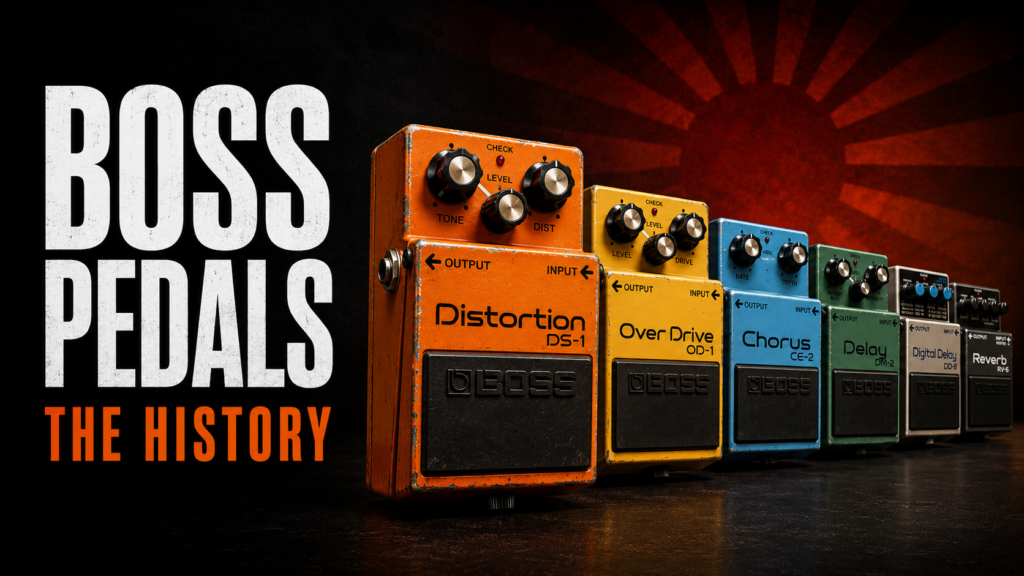
BOSS History: 50 Years of Japan’s Most Iconic Effects
Small, colorful, and built to last: BOSS pedals are everywhere. Even if you have never…