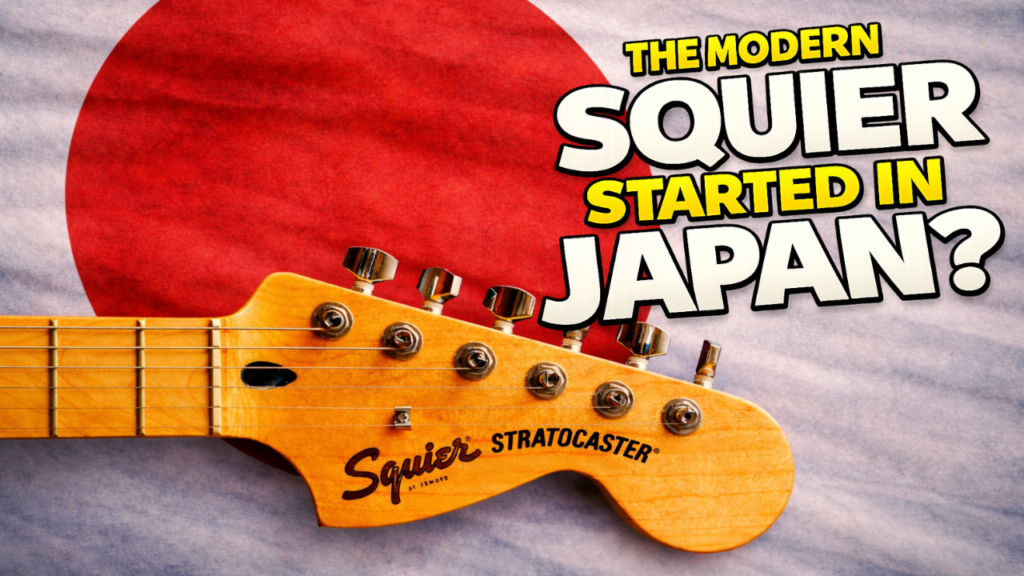
Most players know Squier as Fender’s affordable brand, but the modern Squier guitar story did not start in California. It started in Japan in 1982, at the Fujigen factory, alongside the launch of Fender Japan. Those early Japan-made Squiers were so close to the American originals that they confused buyers at the time, and today they are among the most respected guitars Fender has ever put its name on.
Squier Quick Facts
- Original company: V.C. Squier Company, a violin and string maker in Battle Creek, Michigan (founded 1890)
- Bought by Fender: early 1965, months before CBS took over Fender
- Modern guitar brand launched: 1982, together with Fender Japan
- First factory: Fujigen, Nagano, the same plant building Fender Japan instruments
- Key Japan-made lines: JV Series, SQ Series, Contemporary Series, Katana, SST, Vista Series
- Notable players: George Harrison (JV Stratocaster), Yngwie Malmsteen (Alcatrazz, 1984)
- Today: Fender’s global entry-level brand, built mainly in China, Indonesia and Vietnam
Prefer to watch? This article is based on my own video below.
- Squier Did Not Start as a Guitar Brand
- The CBS Era and Why Fender Lost Ground
- How Japanese Copies Changed the Market
- Fender Japan, 1982: Rebuilding Fender in Japan
- Why Fender Revived the Squier Name
- The JV Series: The First Japan-Made Squier Guitars
- The SQ Series and the 1970s Look
- Famous Players Who Used Early Squiers
- Beyond Reissues: The Contemporary Series and the Katana
- Production Moves Offshore: Korea, China and Indonesia
- The Vista Series: Squier Goes Back to Japan
- Squier in the 1990s and 2000s: The Brand We Know Today
- Squier History Timeline
- Final Thoughts
- FAQ
Squier Did Not Start as a Guitar Brand
The Squier name goes back to the late 1800s, long before Leo Fender built his first electric guitar. It began with Jerome Bonaparte Squier, a violin maker who came to the United States from Europe and set up shop building and repairing instruments.
From Violins to Hand-Wound Strings
His son, Victor Carroll Squier, grew the business in Battle Creek, Michigan, and started making hand-wound strings. That turned out to be the decision that mattered. Squier strings built a serious reputation for quality and consistency, and by the early 20th century strings, not violins, were the core of the business.
Fender Buys V.C. Squier in 1965
By the 1950s, Squier was supplying strings to Leo Fender. The relationship deepened through the early 1960s, and in early 1965 Fender bought the V.C. Squier Company outright, turning it into its in-house string operation. The Battle Creek plant kept running until 1981, and by the mid-1970s the Squier name had quietly disappeared from string packaging as Fender marketed everything under its own logo.
A note on the date: you will see 1961 quoted in some places, but period sources and Fender’s own history place the purchase in early 1965, shortly before CBS acquired Fender later that same year. V.C. Squier had already been an official Fender supplier since 1963, which is probably where the earlier dates come from.
The CBS Era and Why Fender Lost Ground
Almost immediately after the Squier purchase, Fender itself was sold. In 1965 the company went to CBS, the media corporation, and the CBS era is the one that still carries a bad reputation among players. Production scaled up, quality control slipped, and the guitars coming out of Fullerton stopped feeling like the instruments people had fallen in love with in the 1950s and early 1960s.
How Japanese Copies Changed the Market
While Fender was struggling, something else was happening on the other side of the Pacific. Japanese makers such as Tokai and Greco were building copies of the classic Fender and Gibson designs, and they were doing it well. These guitars were far cheaper than the American originals, and in a lot of cases the craftsmanship was simply better than what CBS-era Fender was shipping. If you want the detail on how far those makers took it, my write-ups on the Greco Super Real Series and on Tokai guitars cover the peak of that era.
By the end of the 1970s these instruments were eating directly into Fender’s market share. Fender needed an answer, and the answer came from Japan itself.
Fender Japan, 1982: Rebuilding Fender in Japan
In 1982, Fender teamed up with Japanese partners and launched Fender Japan. Production went mainly to Fujigen, one of the most respected guitar factories in the country and the plant already responsible for a huge share of Japan’s export instruments.
The concept behind the project is what makes it interesting. It was not about chasing the newest, flashiest models. It was about recreating vintage instruments as accurately as anyone had ever attempted.
243 Stratocasters and the Original Blueprints
To pull that off, the team got their hands on 243 old Stratocasters and went through them in detail with the engineers of the day. With Fender’s cooperation, they dug the original blueprints out of a huge pile of archive material, then checked those drawings against the guitars they had taken apart.
The result was roughly 100 nailed-down spec points on the Stratocaster and about 70 on the Telecaster. Here is one example of how deep they went. The pickguard on an early Strat looks like a single solid white sheet. It was actually two thin layers of plastic. That is the level of detail they were catching.
| Research item | Detail |
|---|---|
| Reference instruments | 243 vintage Stratocasters sourced and disassembled |
| Documents | Original Fender blueprints recovered from archive material |
| Stratocaster spec points | Approximately 100 confirmed |
| Telecaster spec points | Approximately 70 confirmed |
| Example finding | The early single-ply white pickguard was actually two thin plastic layers |
Why Fender Revived the Squier Name
Right around the time Fender Japan was getting started, Fender ran into a second problem. Distributors around the world were asking for a cheaper Fender-style guitar, something that could go head to head with the Japanese imports flooding their markets.
So Fender decided to roll out a lower-priced line, also built in Japan. Instead of inventing a brand-new name, the company went digging through the trademarks it already owned. That is where Squier came back into the picture. The name of an old string company was brought back to life, and in 1982 the modern Squier guitar brand was officially born.
The JV Series: The First Japan-Made Squier Guitars
Those first Squiers were built in the exact same Fujigen factory making the Fender Japan instruments. Collectors call them the JV Series today. JV stands for Japanese Vintage, and those letters appear on the serial numbers of both Fender Japan and Squier models from the period.
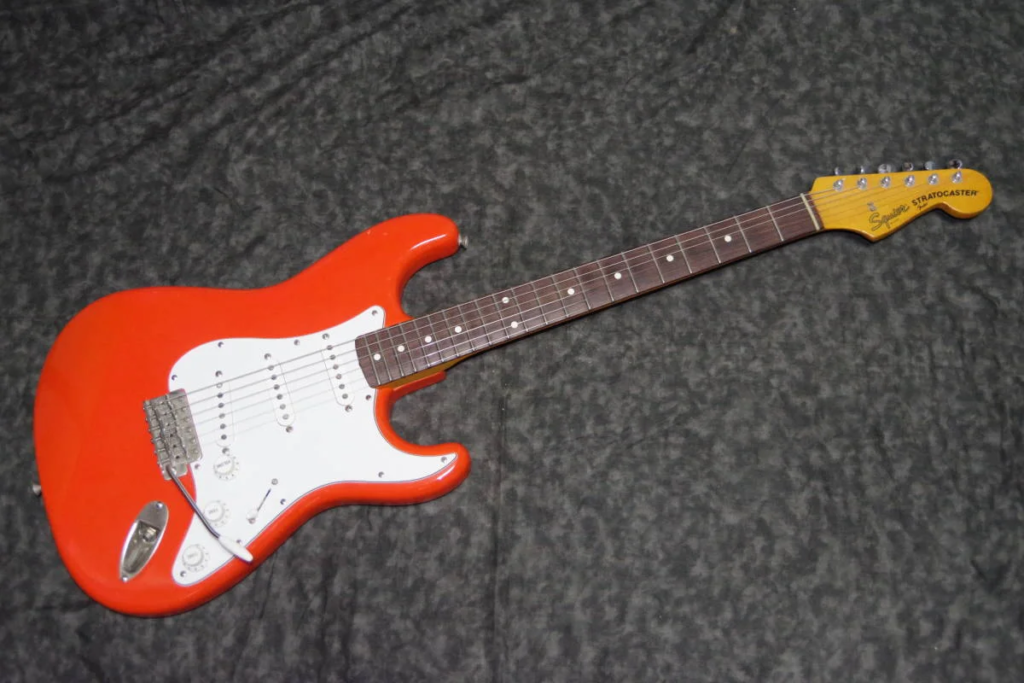
Just like the Fender-branded models, they were faithful recreations of 1950s and 1960s Fender guitars, using the same quality wood and the same vintage-focused thinking. The differences came down mostly to hardware such as tuners, and to finish details, at least going by what people who have had both apart say.
Either way, the build quality jumped out at you immediately. A lot of players felt these Japanese Squiers were every bit as good as the Fender USA guitars of the same years, and sometimes better. I have had viewers comment on my older videos saying they own one and cannot say enough good things about it. It still amazes me that they have held up this well.
Big Fender Logo, Tiny Squier Decal
Some of the earliest JV serial guitars carried a large Fender logo right on the headstock, with only a small Squier decal up near the tip. The guitars were good enough that this caused real confusion in export markets, where buyers could easily mistake them for American-made Fenders.
Fender changed the export decals pretty quickly. The Squier logo got bigger and more obvious, with “by Fender” added underneath to tie it clearly to the parent brand.
Export Squiers vs Domestic Fenders
Here is another detail worth knowing if you are shopping. These early Squiers were aimed mostly at the export market, while the Fender-logo versions built on the same line were intended mainly for buyers inside Japan. That is why JV Squiers turn up so often in the UK and Europe, and why Fender-branded JV models are more common in the Japanese used market.
The SQ Series and the 1970s Look
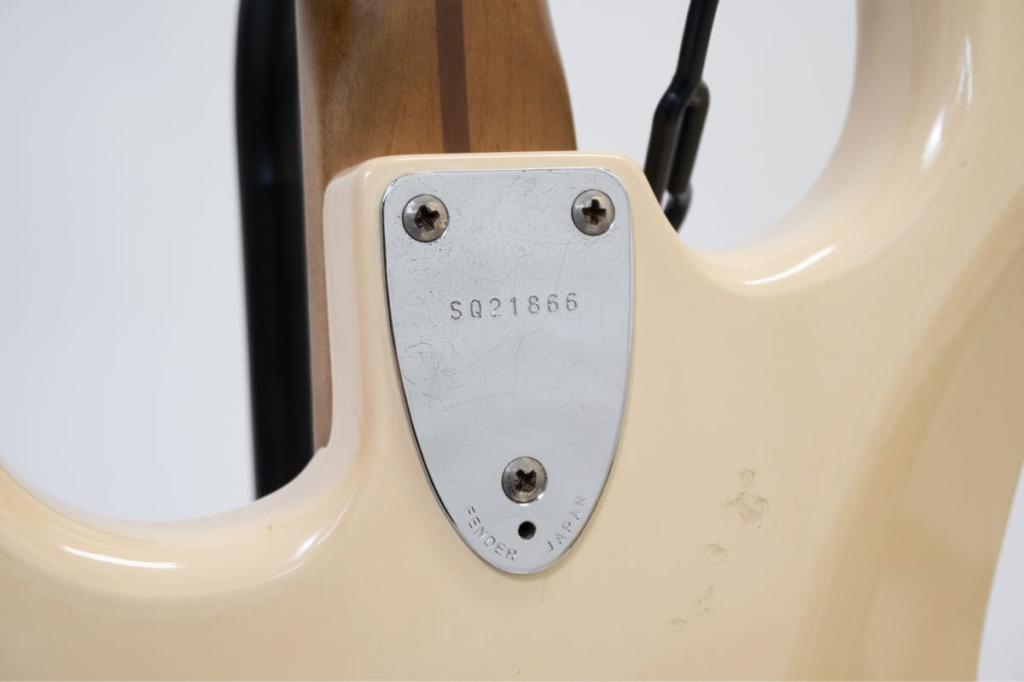
As production moved into its next phase, a new line appeared, the one collectors now call the SQ Series. These leaned into the 1970s Fender look, with a large headstock and a three-bolt neck plate instead of the four-bolt vintage spec of the JV models.
| Series | Period | Styling reference | Identifying features |
|---|---|---|---|
| JV Series | 1982 to 1984 | 1950s and 1960s Fender | JV serial prefix, small headstock, four-bolt neck, early examples with large Fender logo |
| SQ Series | 1983 to 1984 | 1970s Fender | SQ serial prefix, large headstock, three-bolt neck plate |
| Contemporary Series | from 1983 | 1980s superstrat | Bright colors, humbucker options, UpperRox and BottomRox locking hardware |
| Vista Series | 1996 to 1998 | Original offset designs | Super-Sonic, Venus, Venus 12, Jagmaster, Musicmaster Bass, made in Japan |
Famous Players Who Used Early Squiers
These early 1980s Strats made it onto some pretty big stages, which says a lot about how good they were.
George Harrison played an export-spec tobacco sunburst JV serial Stratocaster, one he had bought for his son Dhani, at the Prince’s Trust Rock Gala at Wembley Arena on June 5th, 1987.
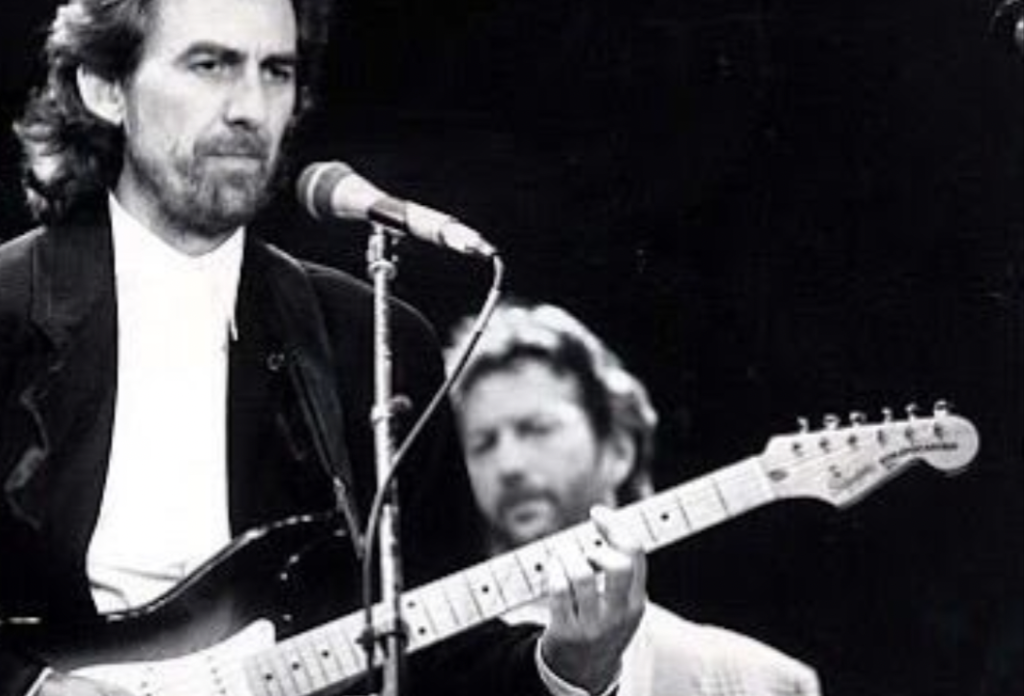
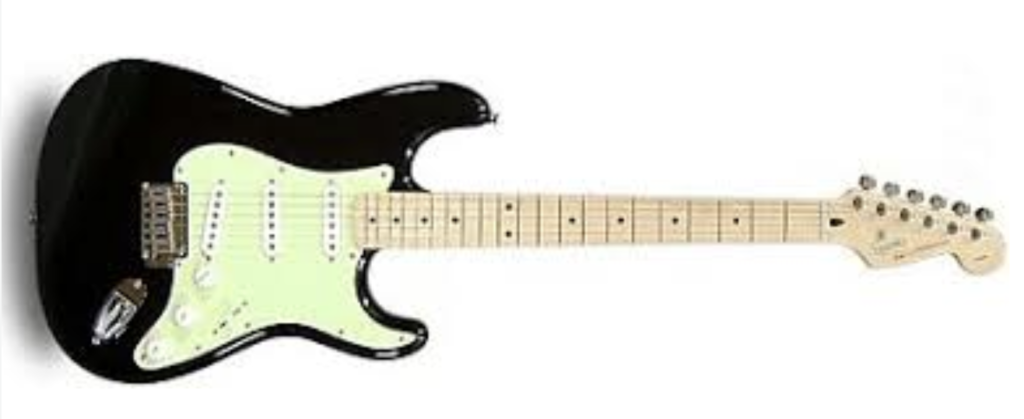
The European Fender Artist Relations manager was so pleased about it that he later gave Harrison a guitar of his own, customized to Harrison’s taste with the vintage tremolo swapped for a two-point unit and a mint green pickguard. Its serial starts with an L, so it is probably a 1991 model.
The other name is Yngwie Malmsteen, who played “Evil Eye” on a Squier at Alcatrazz’s 1984 Tokyo show. That particular guitar did not survive the tour. It was absolutely destroyed on stage later on.
Beyond Reissues: The Contemporary Series and the Katana
After the vintage reissues established the brand, Squier started taking a swing at original models too.
Squier Contemporary Series and the UpperRox System
One example from the 1983 catalog is the Squier Contemporary Series, and it was clearly built for the heavy metal era. Flashy colors, and on some models dual humbuckers.
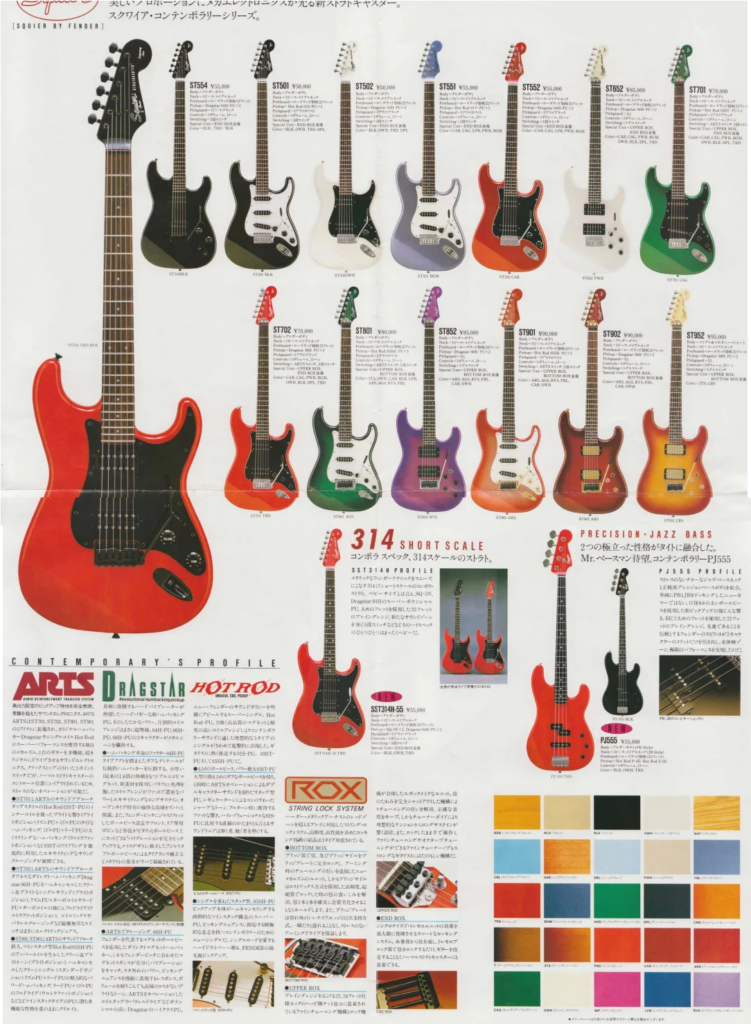
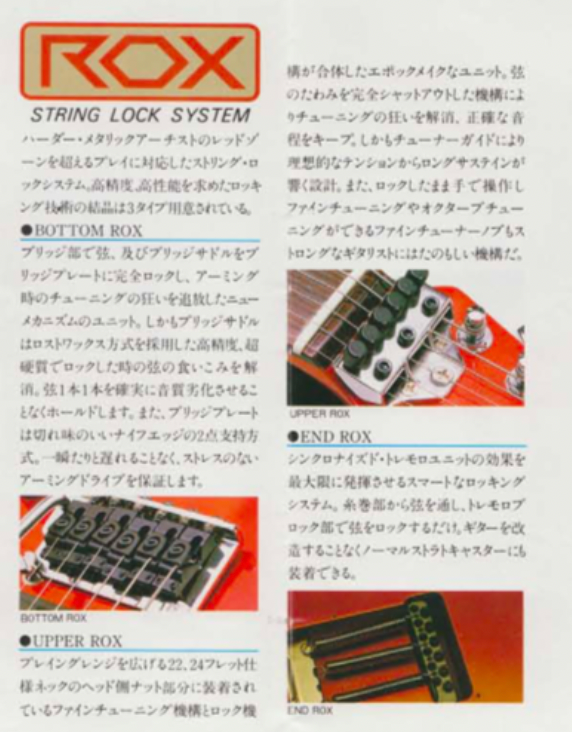
Some guitars from this period came with a locking system called UpperRox. It worked differently from a Floyd Rose. Instead of replacing the nut with a dedicated locking nut, the locking mechanism sat above a regular nut. They paired it with a special bridge called BottomRox, which at first glance looked like a normal synchronized tremolo, but like a Floyd Rose let you lock the strings in place with a hex wrench.
The Squier Katana
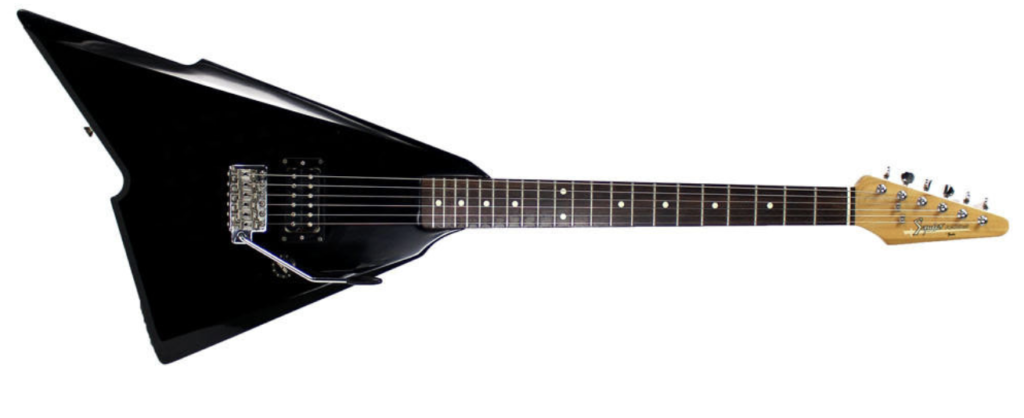
Another experimental model from this era is the Squier Katana. It arrived right in the thick of the 1980s guitar boom with a sharp, angular body that looked nothing like a traditional Fender. It was released under both the Fender and Squier names, but it was made and sold far more widely as a Squier. The run was short, but it is one of those models that has held onto a loyal following ever since.
Production Moves Offshore: Korea, China and Indonesia
As the 1980s rolled on, building guitars in Japan got more expensive. If Fender wanted to compete in the growing entry-level market, Squiers had to get cheaper, so production gradually shifted, first to Korea, then to places like China and Indonesia.
Through all of this, Fender’s lineup got a lot clearer. Fender stayed the main brand, and Squier grew into Fender’s global entry-level line. Japanese production did not stop entirely, though. Vintage-style Squier models such as the SST series, around since the 1980s, were still being made in Japan into the 1990s.
The Vista Series: Squier Goes Back to Japan
In the late 1990s a small batch of Japanese-made Squiers came out as the Vista Series, and this is where things got genuinely strange in the best way.
Squier Super-Sonic
The one that really turned heads was the Super-Sonic. The body looks like a Jazzmaster flipped upside down, and the headstock is reversed too. The idea supposedly came from watching the left-handed Jimi Hendrix play a right-handed guitar. It had a basswood body, two humbuckers, and both knobs were volume controls, no tone control at all. Oddly, that setup let it stay bright and cutting even with humbuckers.
It was only made for a year or two and it did not really sell, so it disappeared from stores fast. Of course, the second it was gone people started wanting it back. It is a collector’s item now, and you will only see one pop up on the used market a few times a year.
Squier Venus, Jagmaster and Musicmaster Bass
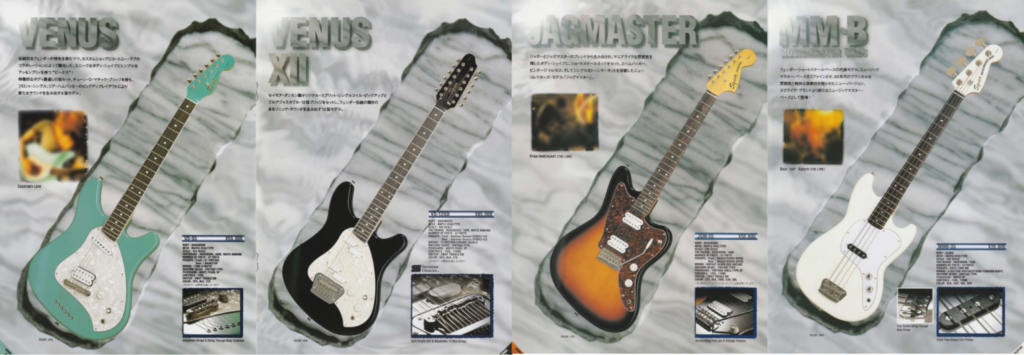
The Vista Series also included the Venus, a collaboration with Courtney Love. It has a retro, almost bizarre body shape and a Tune-o-matic style bridge that is very un-Fender, so it is packed with character. There was a 12-string version too, the Venus 12. Rounding out the line were the Jagmaster and the Musicmaster Bass. All of them were quirky and a little out there, and all of them are sought-after collector’s pieces today.
Squier in the 1990s and 2000s: The Brand We Know Today
From the 1990s into the early 2000s, Squier settled into the role most players recognize. The Bullet, Affinity and Standard series became massively popular entry-level guitars all over the world, and by the early 2000s Squier had grown into one of the best-selling guitar brands on the planet by sheer volume.
Squier History Timeline
| Year | Event | Why it matters |
|---|---|---|
| Late 1800s | Jerome Bonaparte Squier builds violins in the United States | The origin of the Squier name, with no connection to guitars |
| 1890 | Victor Squier establishes the business in Battle Creek, Michigan | Hand-wound strings become the company’s main product |
| 1950s | Squier supplies strings to Leo Fender | First direct link between the two companies |
| 1965 | Fender acquires the V.C. Squier Company | Squier becomes Fender’s in-house string operation |
| 1965 | Fender is sold to CBS | Start of the era associated with declining quality control |
| Late 1970s | Tokai, Greco and others take market share | High-quality Japanese copies undercut Fender worldwide |
| 1982 | Fender Japan established, production at Fujigen | Vintage reissues built from original blueprints and 243 reference Strats |
| 1982 | The Squier guitar brand is launched | An existing Fender trademark revived for a lower-priced Japan-made line |
| 1982 to 1984 | JV Series | The most collectible Squiers, often compared favorably to Fender USA |
| 1983 | Contemporary Series and the Katana appear | Squier’s push into original 1980s metal-oriented designs |
| Late 1980s onward | Production moves to Korea, then China and Indonesia | Rising Japanese costs push Squier toward the entry-level market |
| 1996 to 1998 | Vista Series built in Japan | Super-Sonic, Venus, Jagmaster and Musicmaster Bass, now collector pieces |
| 1990s to 2000s | Bullet, Affinity and Standard series | Squier becomes one of the best-selling guitar brands in the world |
Final Thoughts
What gets me about this story is how little of it matches the reputation. Squier is the brand people apologize for owning, and yet the first guitars to wear the modern logo came out of a project where engineers took apart 243 Stratocasters and chased down a hundred separate spec points, right down to how many layers of plastic were in a pickguard. That is not budget thinking. That is obsession.
Those old Japanese-made Strats are getting harder to find, and they are only getting more valuable. If you have one, or there is a model you have had your eye on, drop it in the comments. If I got something wrong or left something out, let me know down there too. I will keep making videos and articles about Japanese-made guitars.
FAQ
Was Squier originally a guitar brand?
No. Squier began in the United States in the late 1800s as a violin and string making business, founded by Jerome Bonaparte Squier and built up by his son Victor in Battle Creek, Michigan. It only became a guitar brand in 1982.
When did Fender buy the V.C. Squier Company?
Fender bought the V.C. Squier Company in early 1965, a few months before CBS acquired Fender itself later that year. Squier had already been an official Fender string supplier since 1963, which is why some sources quote earlier dates such as 1961.
What is the Squier JV Series?
JV stands for Japanese Vintage. It refers to the earliest modern Squier guitars, built at the Fujigen factory in Japan from 1982, with serial numbers beginning with the letters JV. They were close recreations of 1950s and 1960s Fender designs and are the most collectible Squiers today.
What is the difference between the JV and SQ series?
JV models follow 1950s and 1960s Fender specs, with a small headstock and a four-bolt neck joint. SQ models lean into the 1970s Fender look, with a large headstock and a three-bolt neck plate. Both were made in Japan in the early 1980s.
Why do some early Squiers have a large Fender logo on the headstock?
The earliest JV serial Squiers carried a large Fender logo with only a small Squier decal near the tip. Because the guitars were so good, export buyers were mistaking them for American-made Fenders, so Fender enlarged the Squier logo and added the words by Fender underneath.
Are Japanese Squiers better than Fender USA guitars?
Many players who have owned both feel the early Japan-made Squiers match or beat Fender USA instruments from the same years, especially compared with late CBS-era production. Build consistency, fretwork and wood selection at Fujigen were unusually high for the price.
What was the Squier Vista Series?
The Vista Series was a small run of Japanese-made Squiers from the late 1990s, including the Super-Sonic, the Courtney Love designed Venus and Venus 12, the Jagmaster and the Musicmaster Bass. They sold poorly at the time and are sought-after collector pieces now.
Where are Squier guitars made today?
Squier is Fender’s global entry-level brand and current production is based mainly in China and Indonesia, with earlier offshore production in Korea. Japanese Squier production ended for most lines by the 1990s.