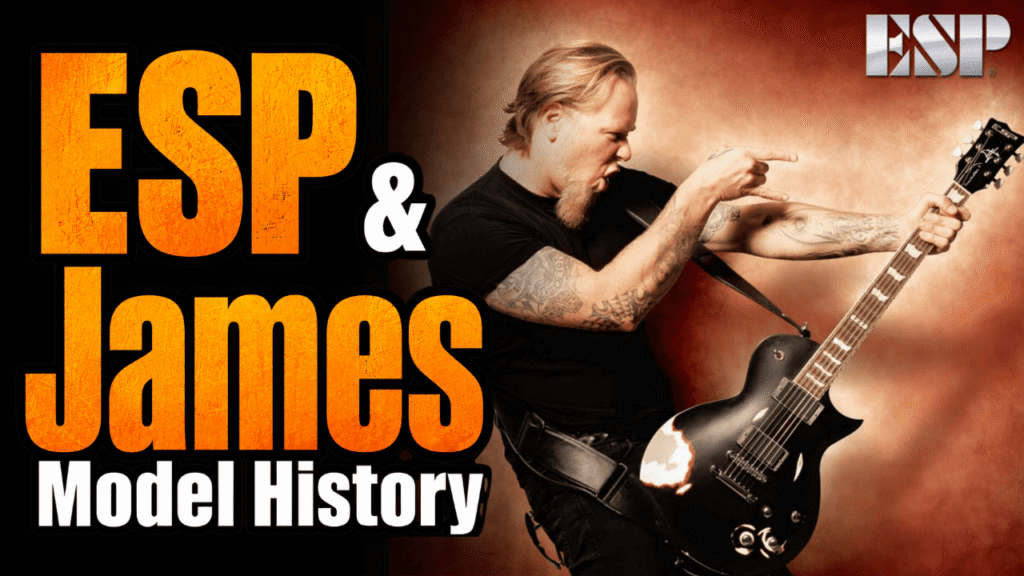
James Hetfield’s ESP guitars are among the most iconic instruments in heavy metal. His partnership with the Japanese brand ESP began at the 1987 NAMM show and has shaped Metallica’s rhythm tone ever since — spanning everything from the legendary “EET FUK” Explorer to today’s Snakebyte and Vulture signature models.
James Hetfield ESP Quick Facts
- First ESP guitar: “EET FUK” MX-220 (1987)
- How it started: A handshake with ESP CEO Matt Masciandaro at the 1987 NAMM show
- Signature models: JH-1/JH-2/JH-3, Truckster, Iron Cross, Snakebyte, Vulture
- Pickups: EMG 81/60 — now his own EMG “JH Het Set” (since 2013)
- Trademarks: Explorer & V body shapes, active EMGs, custom graphics and nicknames
Prefer to watch? This article is based on my own video below.
- Where It All Began: James Hetfield's First ESP
- The MX-220 Series: The Early Workhorses
- The MX-250 Series: James Hetfield's Most-Used Model
- The Double-Necks
- Side Note: The ESP EXP
- The Era of Signature Limiteds: JH-1, JH-2, JH-3
- The Raw St. Anger Era: Seven-Strings and a Baritone
- Rat Rods and Tattoos: Truckster and Kustom Kulture
- Back to the Roots: Iron Cross
- The Current Flagships: Snakebyte and Vulture
- Conclusion: A Relationship Built on a Handshake
- FAQ
James Hetfield’s ESP guitars are among the most iconic instruments in heavy metal. His partnership with the Japanese brand ESP began at the 1987 NAMM show and has shaped Metallica’s rhythm tone ever since — spanning everything from the legendary “EET FUK” Explorer to today’s Snakebyte and Vulture signature models.
James Hetfield ESP Quick Facts
- First ESP guitar: “EET FUK” MX-220 (1987)
- How it started: A handshake with ESP CEO Matt Masciandaro at the 1987 NAMM show
- Signature models: JH-1/JH-2/JH-3, Truckster, Iron Cross, Snakebyte, Vulture
- Pickups: EMG 81/60 — now his own EMG “JH Het Set” (since 2013)
- Trademarks: Explorer & V body shapes, active EMGs, custom graphics and nicknames
Where It All Began: James Hetfield’s First ESP
The story starts in 1987. James, along with drummer Lars Ulrich, was walking the floor at the NAMM show in Los Angeles. That’s where he first ran across ESP and what they had to offer, and where he first met their CEO, Matt Masciandaro.
The two had never met before, but as they started talking, James just felt comfortable. He told Matt he was after an Explorer-type shape — one that fit his body — but made from a heavier, denser, darker wood, with a bigger headstock in the same color as the guitar. He’d always liked the Gibson shape, but its neck felt a bit too big in the back and the radius too round. He wanted something flatter and faster. He even asked for the headstock to be oversized, so it would look like a hockey stick. That request, and ESP simply saying yes, was the beginning of the whole relationship. Matt’s answer was immediate: “Absolutely, we can do that.”
What sealed it for James was that ESP was a small, renegade company — and that he was talking to the boss himself, someone genuinely willing to work up exactly what he wanted. It was something he simply couldn’t have gotten from anyone else at that time. And that one guitar became the start of a relationship that has lasted his entire career.
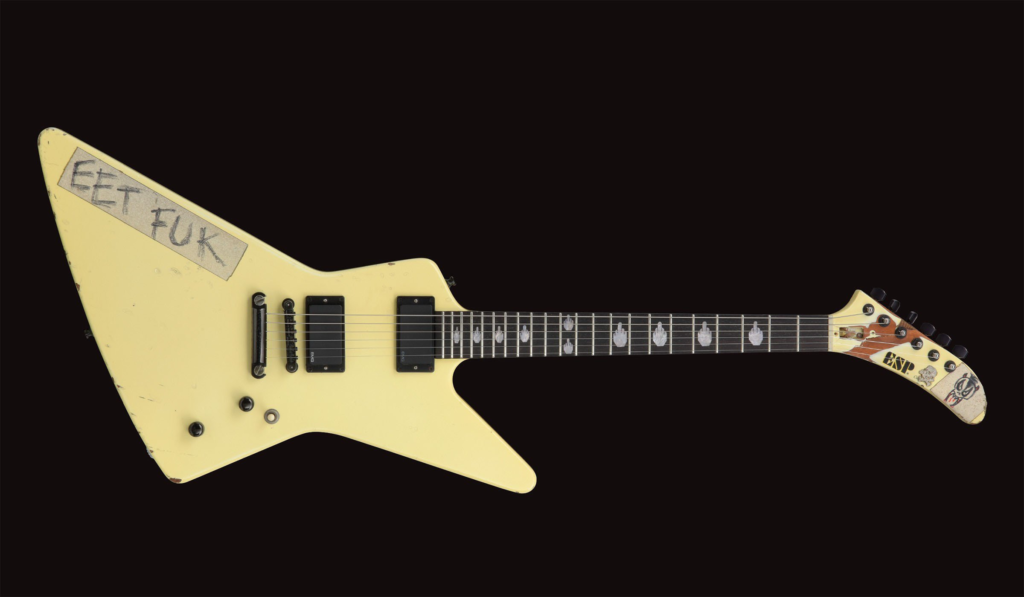
In less than six months, James had his first ESP, delivered from the custom shop in Japan alongside its backup. This is the guitar that would become legendary — a white, Explorer-shaped MX-220 that fans know by a rather unprintable nickname: EET FUK.
The First Inlaid Neck
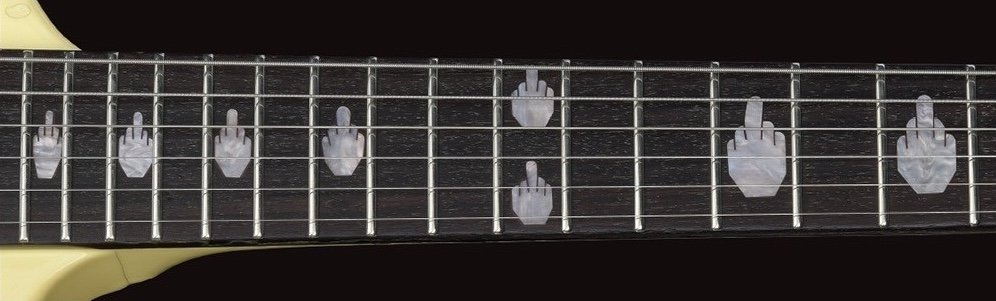
EET FUK was also the first inlaid neck James ever had — ESP’s take on a middle finger, and to him it was perfect. The fingers were made a little fat so they’d stand out on the neck. To James, that willingness to do exactly what he asked was proof they cared about the artist. And whenever he asked for something on the inlays, the answer was always yes.
EET FUK Specs
A mahogany body, set neck, and a dark rosewood fretboard with those “middle finger” inlays, 22 extra-jumbo frets, and a 24.75-inch scale. It carries an ABR-1 Tune-o-Matic bridge with a stop bar, Gotoh tuners, and a set of EMG 81/60 active pickups. The headstock is that big, swooping “banana” shape. The controls are simple — two volumes and a toggle switch, and no tone knob. James wanted the toggle placed where he could flip from clean to dirty in a hurry. As he likes to put it, there are just too many knobs in the music industry anyway. For him, it’s two volumes and a toggle. Simple.
The Stickers and Their Stories
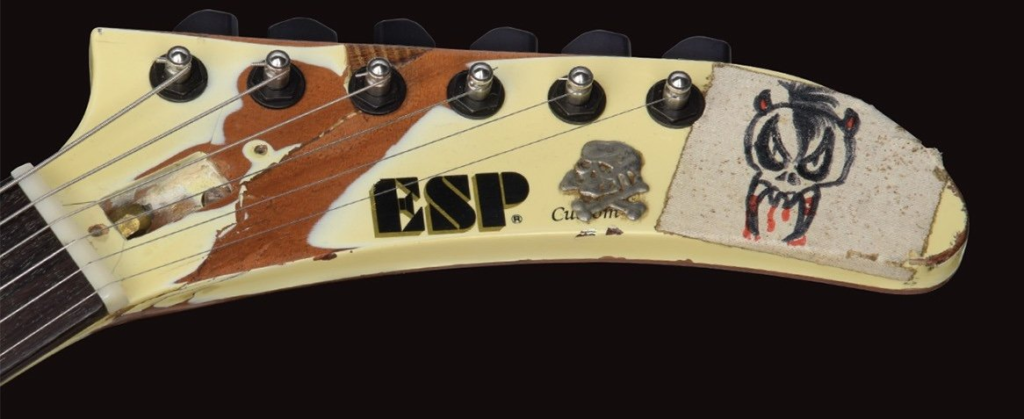
The stickers on the body each have a story. For the headstock, James wanted it looking more like a hockey stick, and the “Scary Guy” gaffer tape wrapped around it was his attempt at that. Then there’s the writing that gives the guitar its nickname — just one of those deliberately meaningless Metallica phrases, scrawled onto a strip of tape. Over the years, a couple of other stickers came and went, including one carrying a bit of backstage slang from the English guys in the crew — including Shaky, the pyro tech who would one day accidentally light James on fire. There’s also a death’s head sticker he found at an Army surplus store somewhere. Maybe a little Lemmy influence there, he says.
Damage, Repair, and Retirement
The headstock has been broken off, most likely during the Damaged Justice Tour — James broke it on Lars’s cymbals, probably during “For Whom the Bell Tolls.” It was later re-veneered. In 1989, the guitar was used for the majority of the “Binge & Purge” concert in Seattle.
EET FUK was retired around the end of the Wherever We May Roam Tour. But in 2008, it was one of the old friends that came out of storage for the Death Magnetic album, when Rick Rubin encouraged the band to look back into their early roots. It was repaired by Gary Brawer, and James wrote “Suicide & Redemption” on it in the studio. He loves that one of the early guitars he started with is one he’s still going for. He even compares it to Brian May and the “Old Lady” — the guitar Brian built with his dad from a fireplace mantel. People have tried to copy it forever, but there’s only one real one. James feels good keeping certain guitars safe at home, and this is exactly that kind of guitar. It’s not going out on the road again. As he sees it, it has paid its dues, earned its stripes, got its scars, and more than earned its respect.
The MX-220 Series: The Early Workhorses
So Fucking What
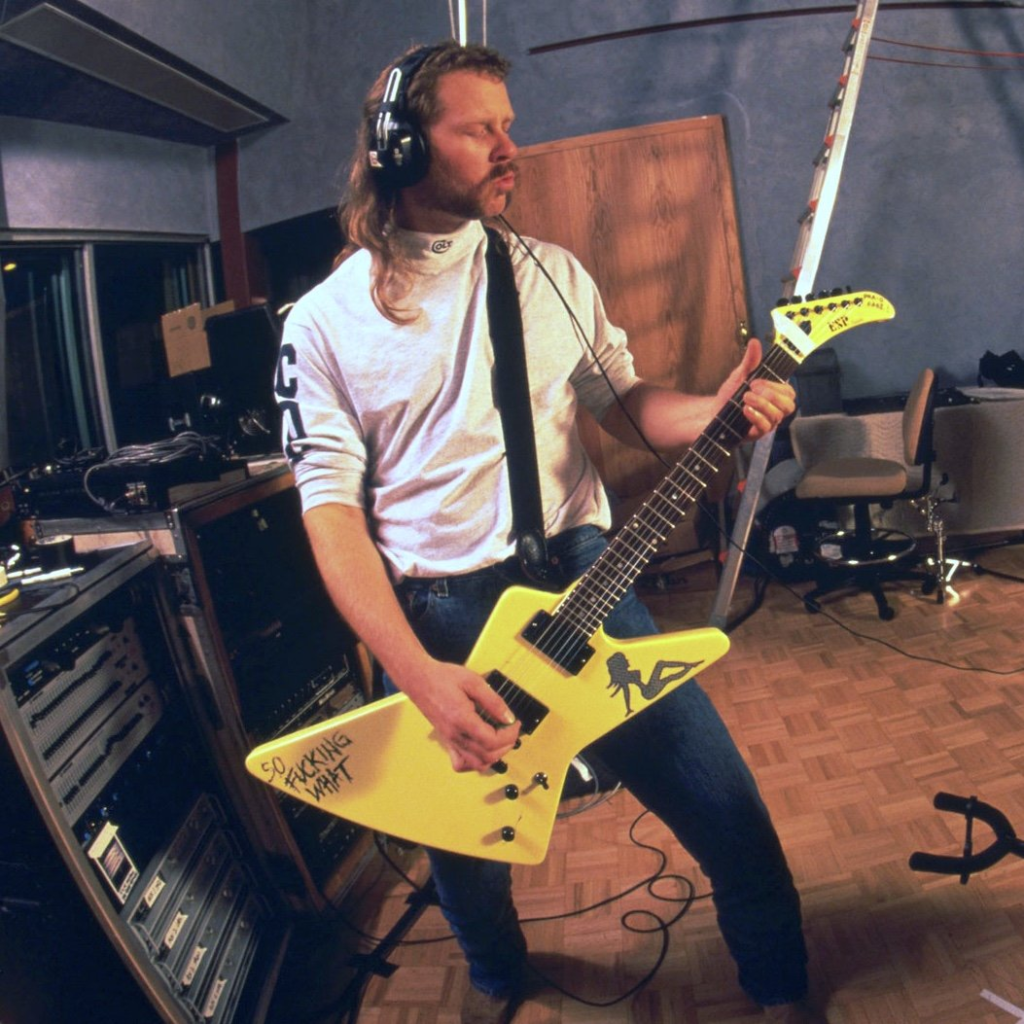
The backup mentioned earlier is a twin-like second MX-220, born alongside his first. Its name is a cheeky nod to one of his earlier guitars, the 1984 Gibson Explorer he called “So What.” This “So What” tribute was more than just a backup during the …And Justice for All era — it was later used in the studio to record a lot of the Black Album and Load. In fact, the solo on “Nothing Else Matters” was recorded with this very guitar.
Fuk Em Up
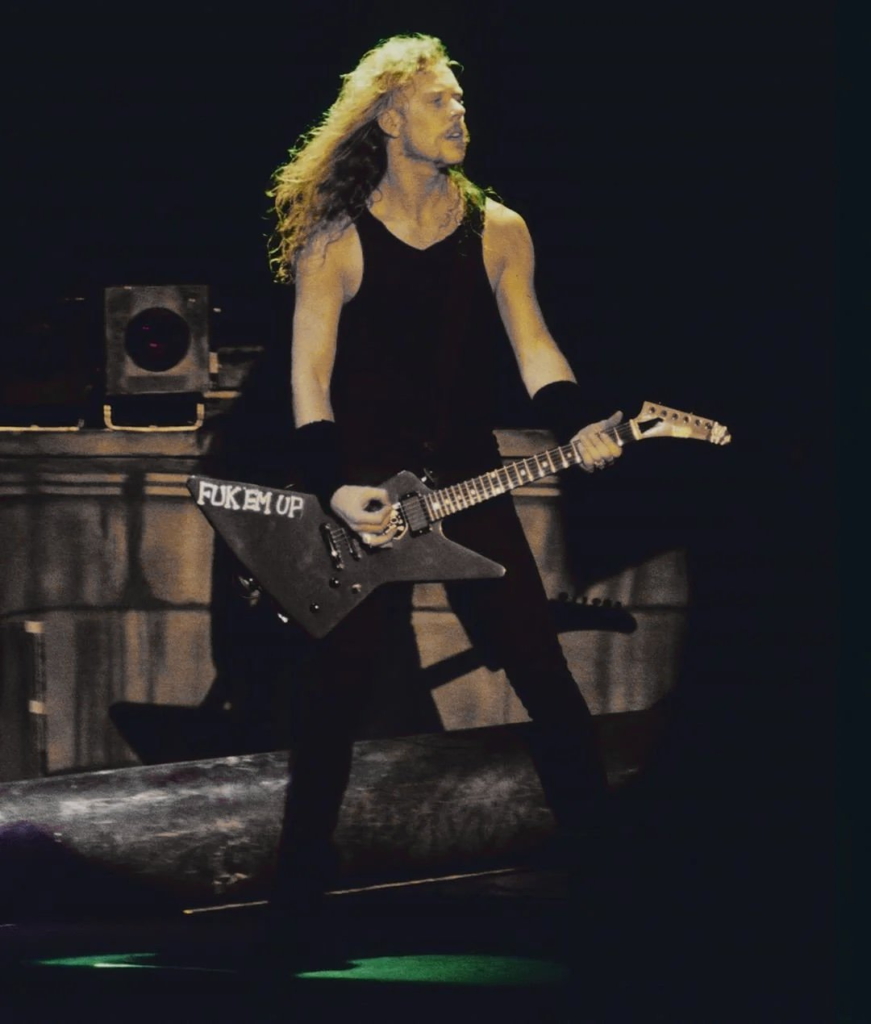
The third MX-220 showed up on the 1988 Damaged Justice Tour — a black one whose nickname, once again, isn’t exactly family-friendly. It was basically the same as the first two, but a “dark” version — finished in black with grey metallic sparkle and black hardware. Along with the usual writing, it also wore an LA Raiders sticker.
What Does MX-220 Mean?
Here’s where the name MX-220 comes from. It’s said to stand for “M” for Metallica, “X” for eXplorer, “220” for the price in yen, and “II” for two pickups. The old Explorer body was eventually retired in 2000 due to the Gibson lawsuit, and ESP moved to a new shape, the “EX” series. Today, the MX-220 is considered the rarest of the ESP Explorers.
The MX-250 Series: James Hetfield’s Most-Used Model
Arriving as the successor to the MX-220, the MX-250 was a refined evolution — sharper body edges, a shortened headstock, and no more “dip” in the outline of the earlier banana-style head. The mahogany body was about 39mm thick, and the fretboard switched to ebony for an improved feel. This model had a remarkably long life, produced from 1991 to 2000, and then continued as a Japan-only custom order — under the name “MX-2” — all the way to 2021. That’s around 30 years.
Snake
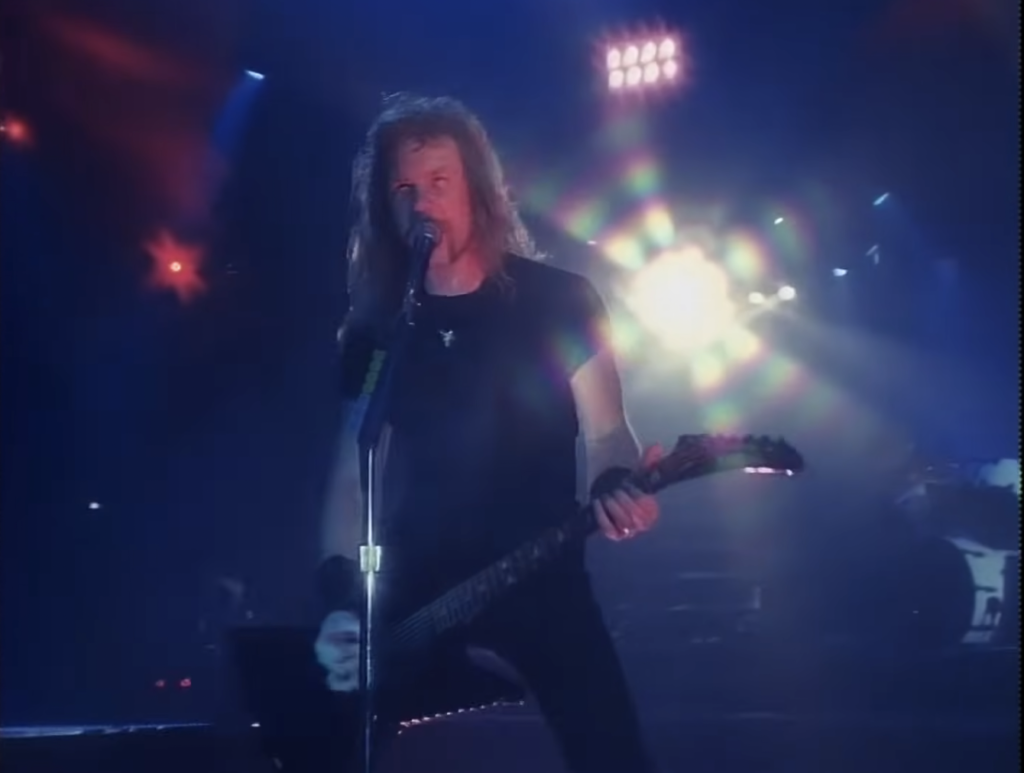
First up is “Snake,” which James started using in 1991 while working on the Black Album. It has a gloss black body, with a “snake” inlay on the fretboard to match the album cover. That design comes from the Gadsden flag of the American Revolution, and the words on that flag — “Don’t Tread on Me” — became the title of one of the songs on the album. An MX-250 with this “snake” inlay was only made in very small numbers by custom order — as few as three or four, some say — making it extremely rare. At the 1992 “Binge & Purge” concert in San Diego, you can see James playing this guitar on “Sad But True.”
Of Wolf & Man
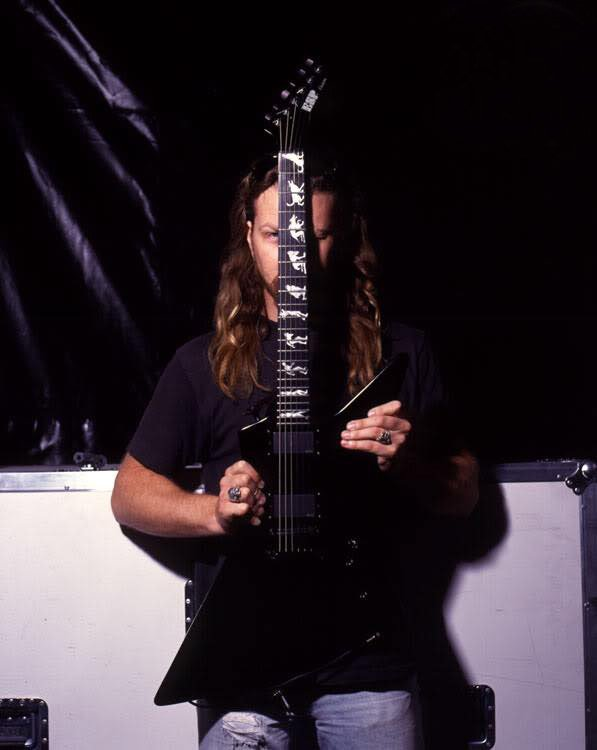
Of all the MX-250s, the one James loved the most, and used the most extensively throughout his career, is “Man to Wolf.” This “Of Wolf & Man” inlay model was custom-ordered from ESP’s shop in Japan, and only about ten were ever made. Only around five have been tracked down, one of which is James’s own. His guitar was displayed for a time at the ESP Museum in Shibuya, Tokyo, but from 2019 he began using it live again.
Elk Skull
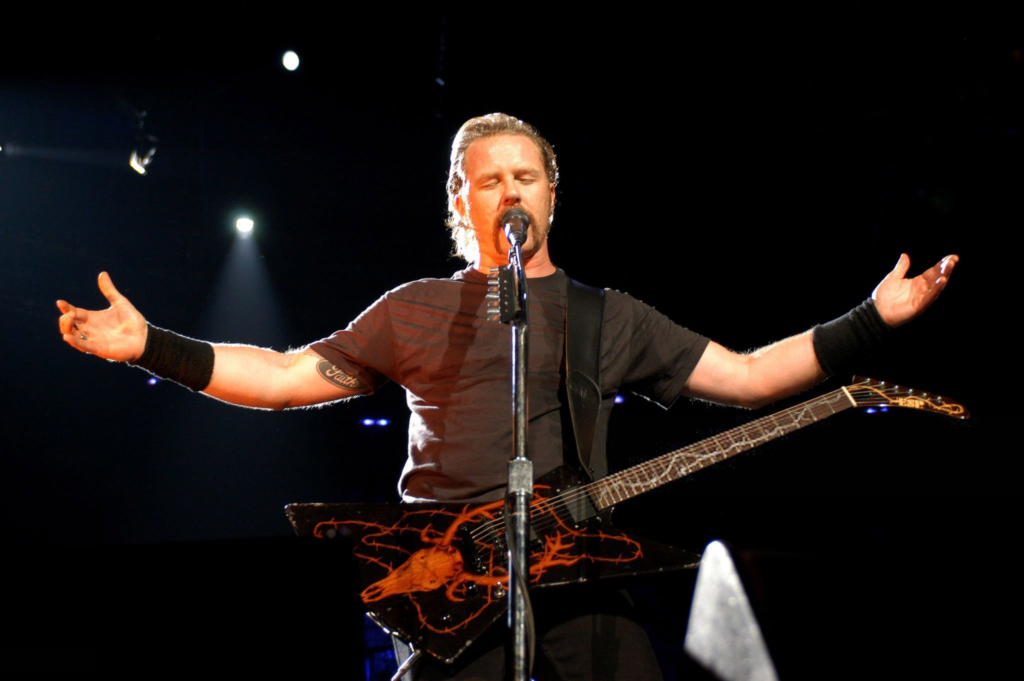
In 1996, around the release of Load, came “Elk Skull.” On the body is an elk skull surrounded by barbed wire — a famous example of the pyrography technique, burning the design into the surface with a heated metal point. The barbed wire extends onto the fretboard as a silver inlay. It was used live during the Load and Reload era.
Black Diamond Plate Deer Skull
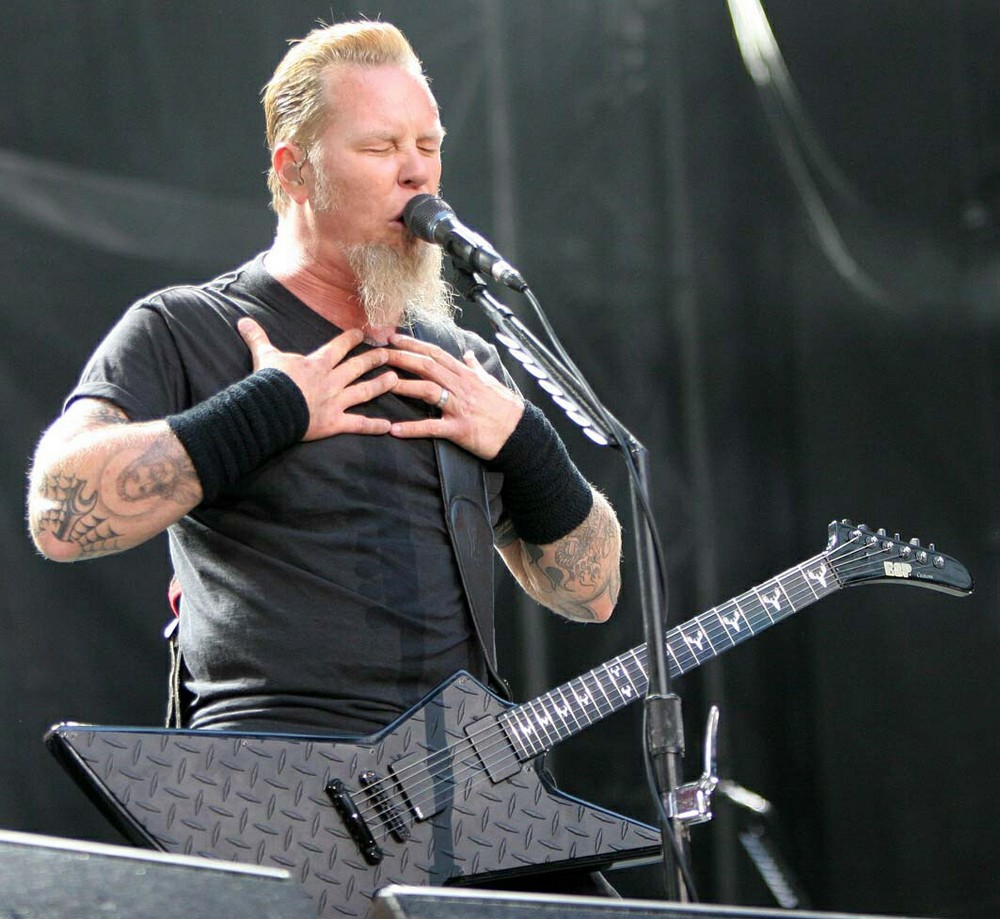
Also from 1996 is a custom MX-250 called “Black Diamond Plate Deer Skull” — a mahogany body with a black diamond plate on top, and a deer skull inlay on the ebony fretboard.
Silver Diamond Plate
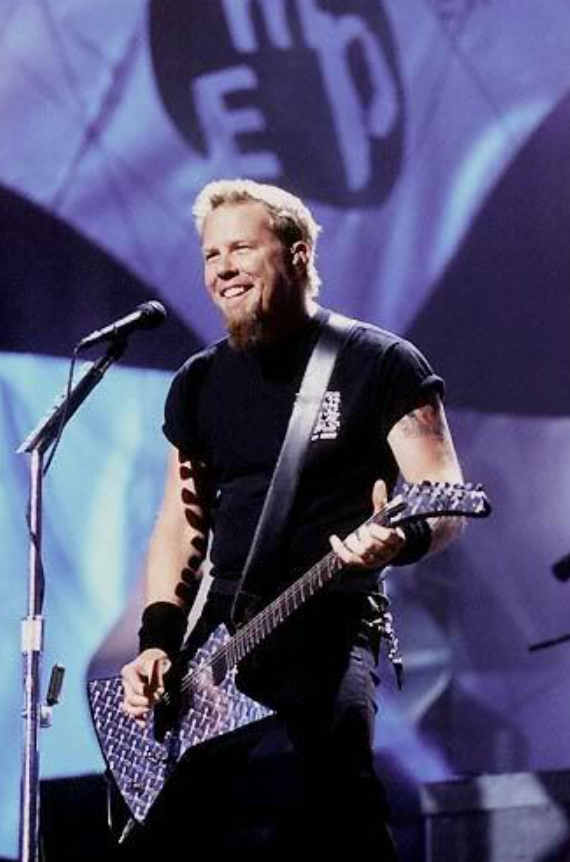
In 2000 came “Silver Diamond Plate” — black with a silver diamond plate, “diamond” inlays, and an “M” ninja star on the first fret. James owns two of these.
Papa Het Tattoo
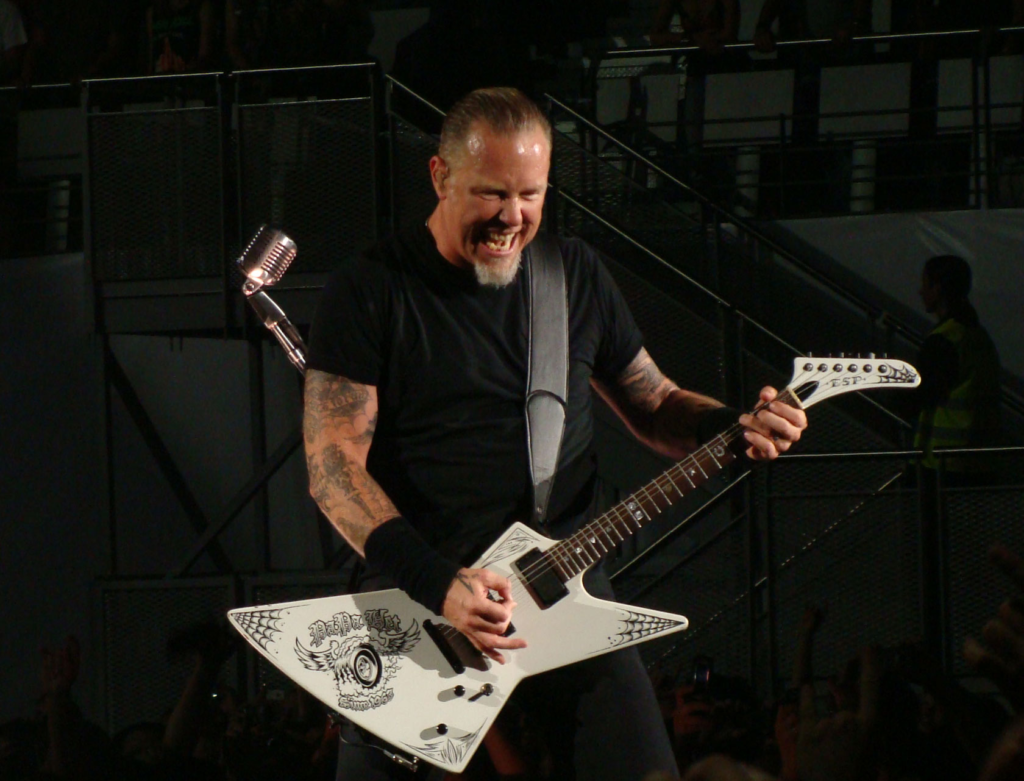
And in 2003, a real oddity: “Papa Het Tattoo.” James gave one of his favorite Explorers to freelance artist Dirty Donny, and this was the result. It features a burning tire with wings and the words “since 1963,” a reference to James’s birth year. The fretboard carries “lucky charms” inlays.
The Double-Necks
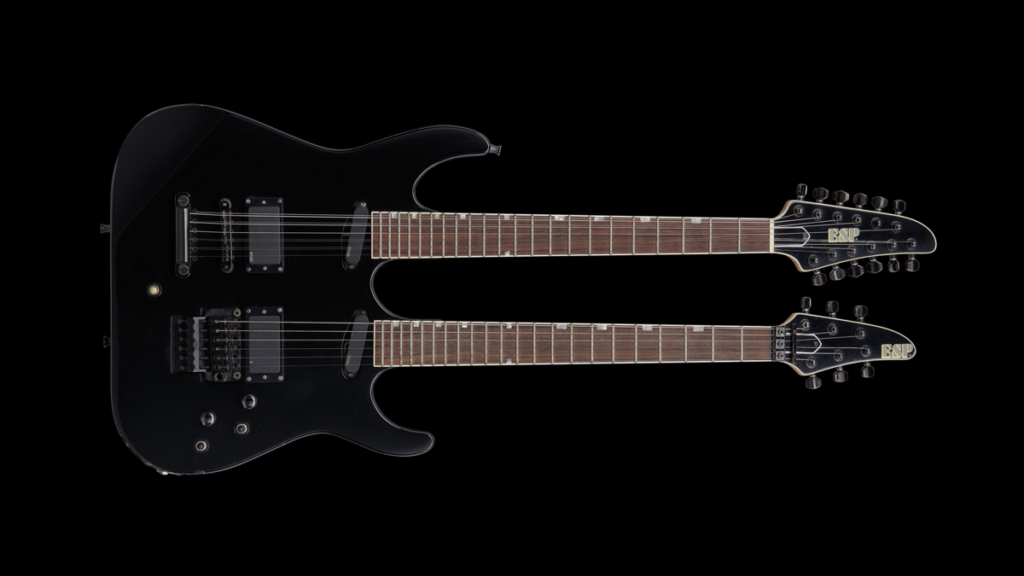
MX-250 Double-Neck
James’s collection also includes a double-neck, with two necks in one body. Used in the early ’90s mainly to play “Fade to Black” live, this MX-250 double-neck has a 12-string on top and a 6-string on the bottom. You can spot it at European shows in 1993 and at the 1994 Woodstock festival.
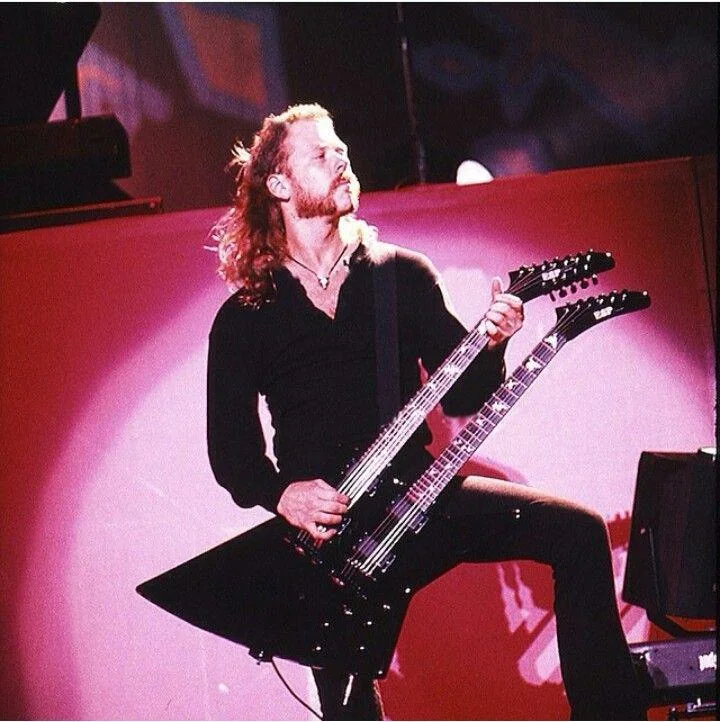
ESP Horizon “Fire Accident”
And you can’t forget the ESP Horizon double-neck, known as “Fire Accident.” This is the guitar James was holding during the infamous pyro accident at the Montreal show on August 8th, 1992. A single guitar carries one of the most unforgettable moments in the band’s history.
Side Note: The ESP EXP
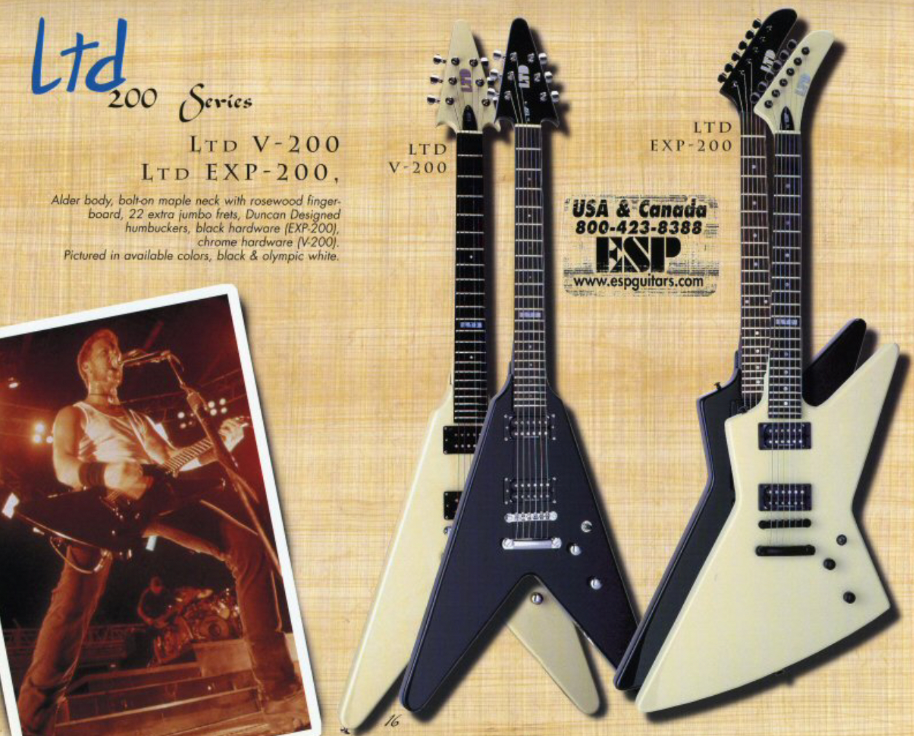
ESP also made a mass-market version of this Explorer shape, called the EXP, produced from the early ’90s until around 2000. Unlike James’s set-neck customs, it used a bolt-on maple neck, and a more affordable version was even sold under ESP’s budget LTD brand.
The Era of Signature Limiteds: JH-1, JH-2, JH-3
In 1996, James started using two ESP-made Flying Vs. Built by Matt Masciandaro, one had green flames and the other red, and otherwise they were identical — mahogany body, maple neck, rosewood fretboard, EMG 81/60, and Sperzel locking tuners.
JH-1
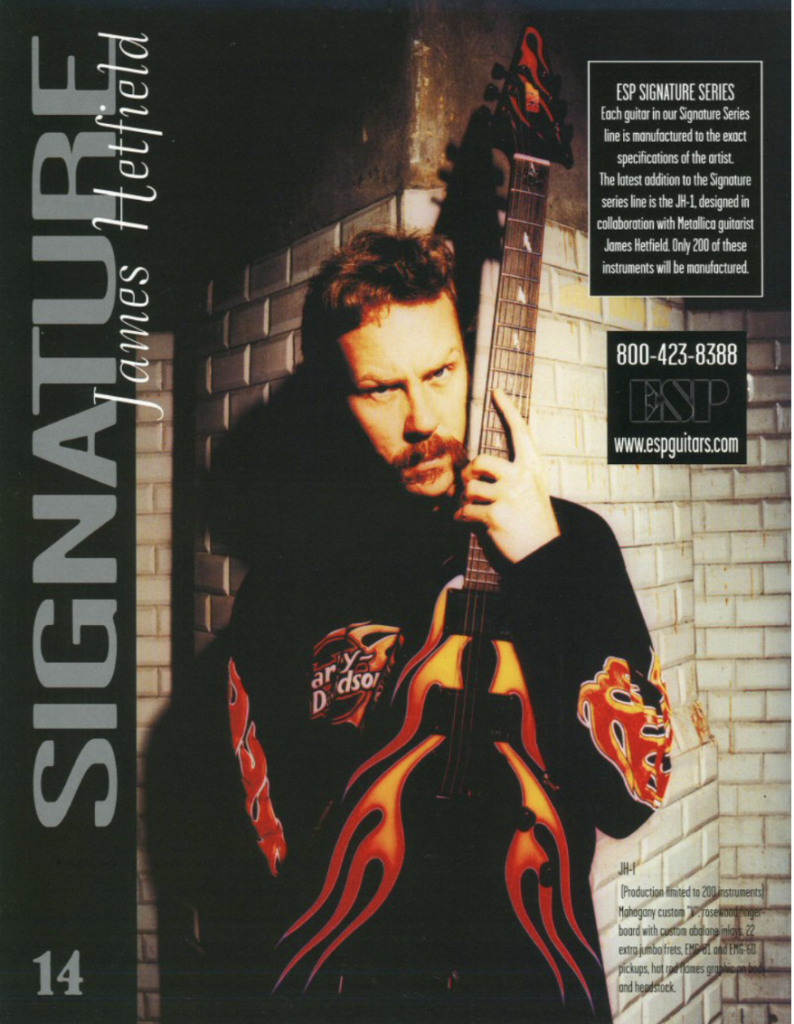
In 1997 came the production model, the “JH-1,” a Flying V signature made in a limited run of 200. It had an alder body, a maple neck, a rosewood fretboard with “ARROW” inlays and an “M” ninja star on the first fret, all in black with red hot rod flames. Each one came with a Certificate of Authenticity dated April 30, 1997, signed by James Hetfield.
JH-2
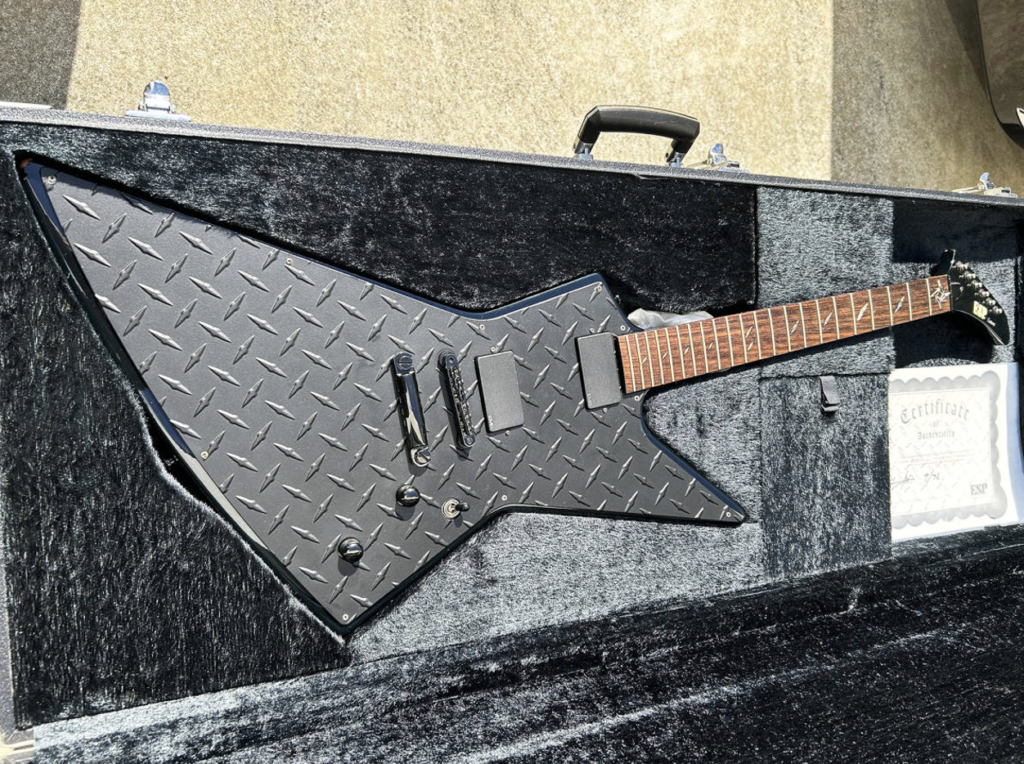
Next, in 1998, came his second signature, the “JH-2” — also a limited run of 200. It’s known for appearing in the “I Disappear” music video. It shares the EXP shape, finished in black with a metallic diamond plate and a rosewood fretboard with “diamond” inlays and a ninja star. James owns two, the only difference being the first-fret inlay.
JH-3
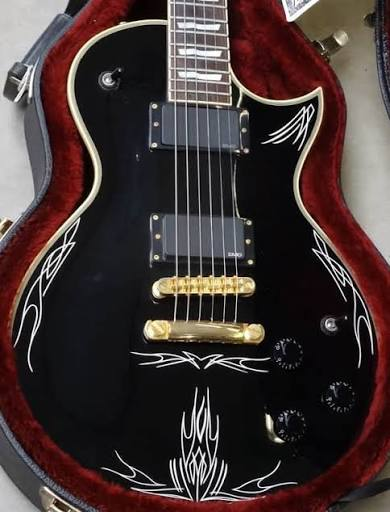
Then in 1999, his third signature, the “JH-3” — a limited run of 100. It has the same shape as the ESP Eclipse, an alder body, gold hardware, and custom tribal artwork designed by James himself. Here’s a fun detail: it has two pickup switches, but only the bottom one actually works — the top one is purely for looks. It was used during the Reload promotion.
The Raw St. Anger Era: Seven-Strings and a Baritone
The 2003 St. Anger era brought some very different guitars.
LTD MF-207
First, the “LTD MF-207,” a seven-string used in the “Some Kind of Monster” music video.
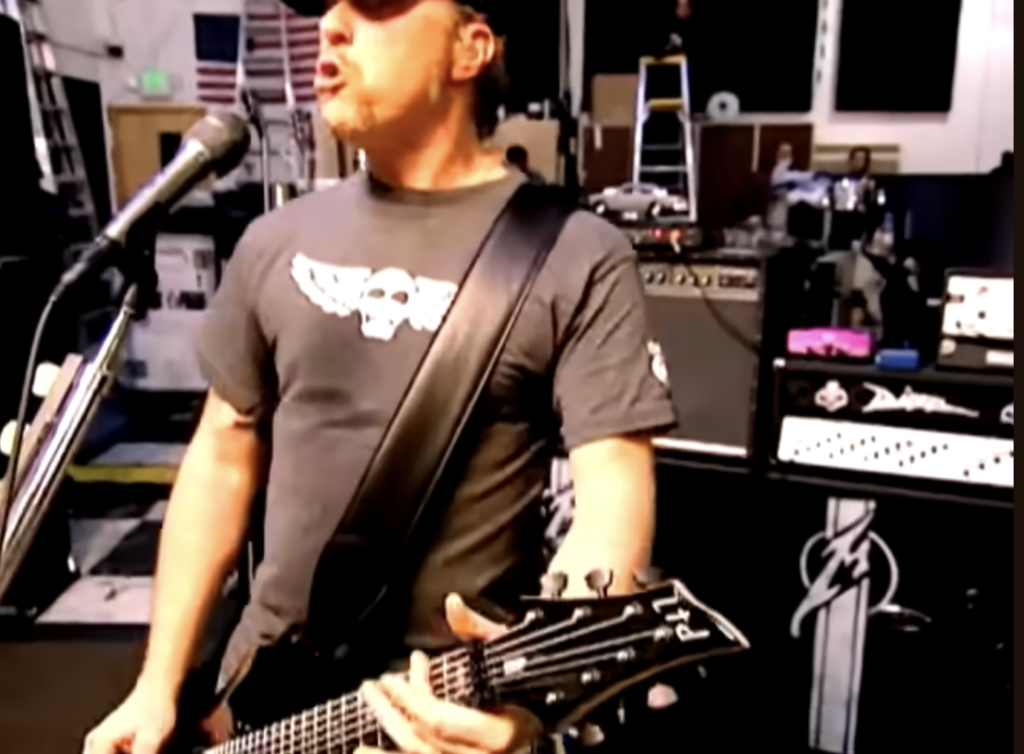
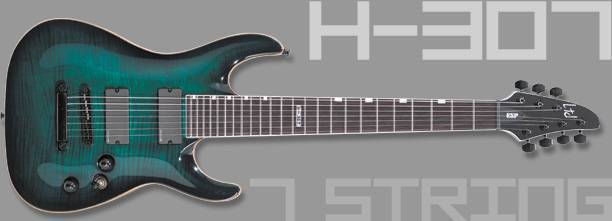
LTD H-307
Also a seven-string, the “LTD H-307” was the one actually used to record “Some Kind of Monster,” tuned to CCGCFAD for that track. It’s a beautiful model with a see-thru black cherry figured maple top.
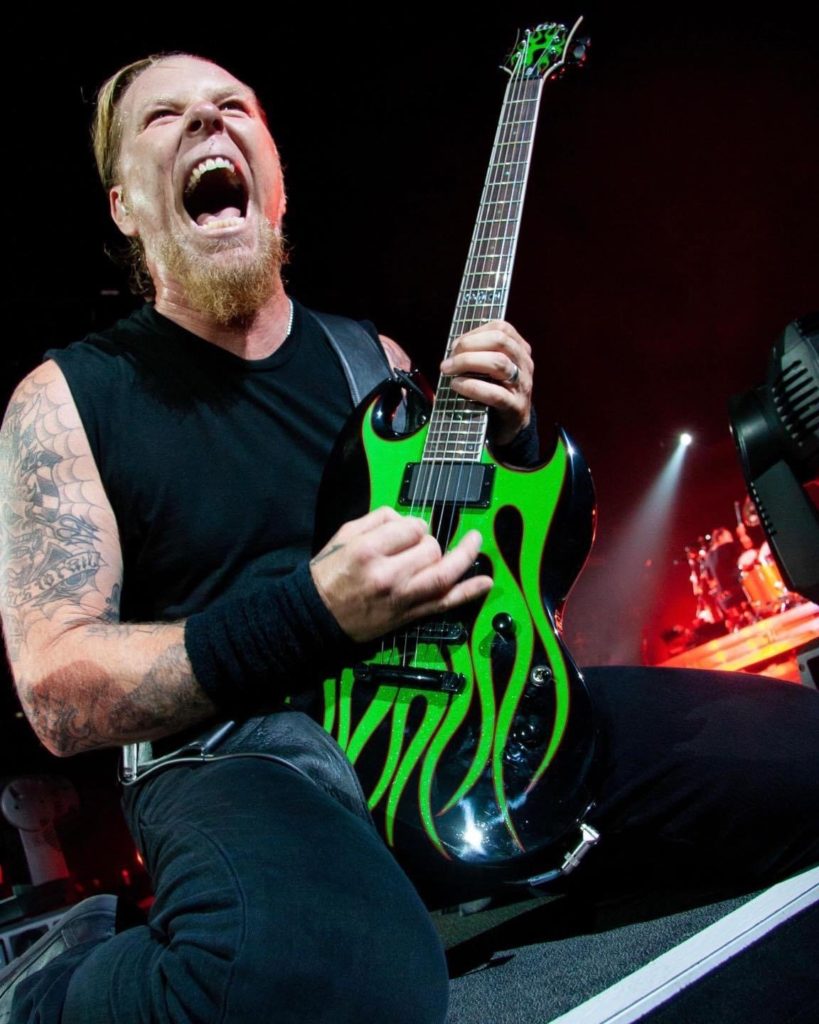
LTD Viper “The Grynch”
And then the “LTD Viper ‘The Grynch,'” a baritone made in a limited run of 260, used live for drop-tuned songs like “Frantic” and “Invisible Kid.” It has a black body with green metallic hot rod flames — a design inspired by James’s car, a 1952 Oldsmobile nicknamed “Grinch.”
Rat Rods and Tattoos: Truckster and Kustom Kulture
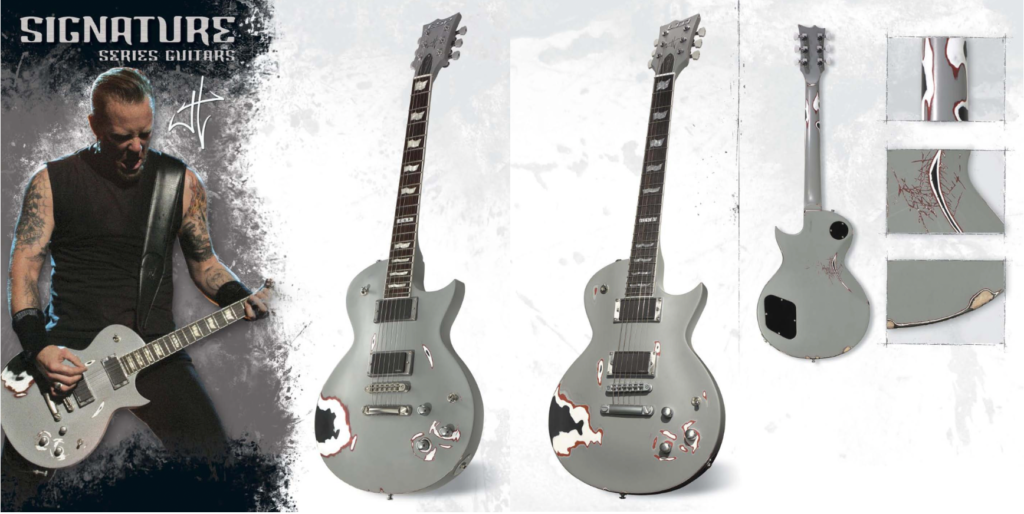
Truckster
The “Truckster,” released in 2004, is a signature model based on the ESP Eclipse. Its standout feature is the finish — matte black or silver, with artificial wear, a road-worn look inspired by rat rod culture. Think of old cars that people restore, where the last thing they can afford is the paint, so the worn, layered finish carries a history all its own. That’s exactly the idea James was going for. The Truckster was also the first model to carry ESP’s custom EMG set — the “JH-B” and “JH-N,” better known as the “JH Het Set” — developed in 2013 based on James’s own feedback. These pickups capture the sound he’d long been chasing: the heft of an EMG, but with dynamics and clarity. Today they’re standard on many of his current signatures — the very heart of that massive rhythm tone.
Kustom Kulture Eclipse
From around 2004 to 2006, he also occasionally used the “Kustom Kulture Eclipse,” a custom-built ESP Eclipse with custom paintwork by tattoo artist Dennis McPhail across the headstock, front, and back of the body.
Back to the Roots: Iron Cross
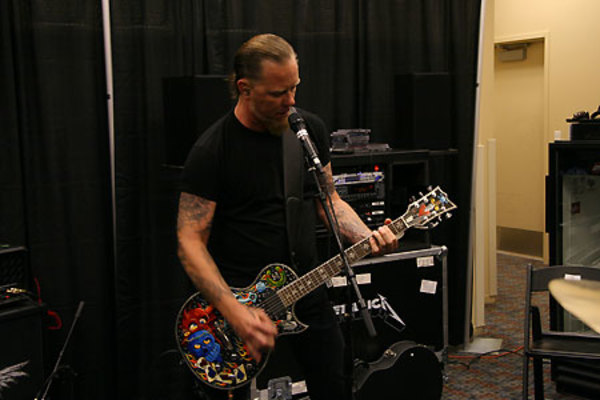
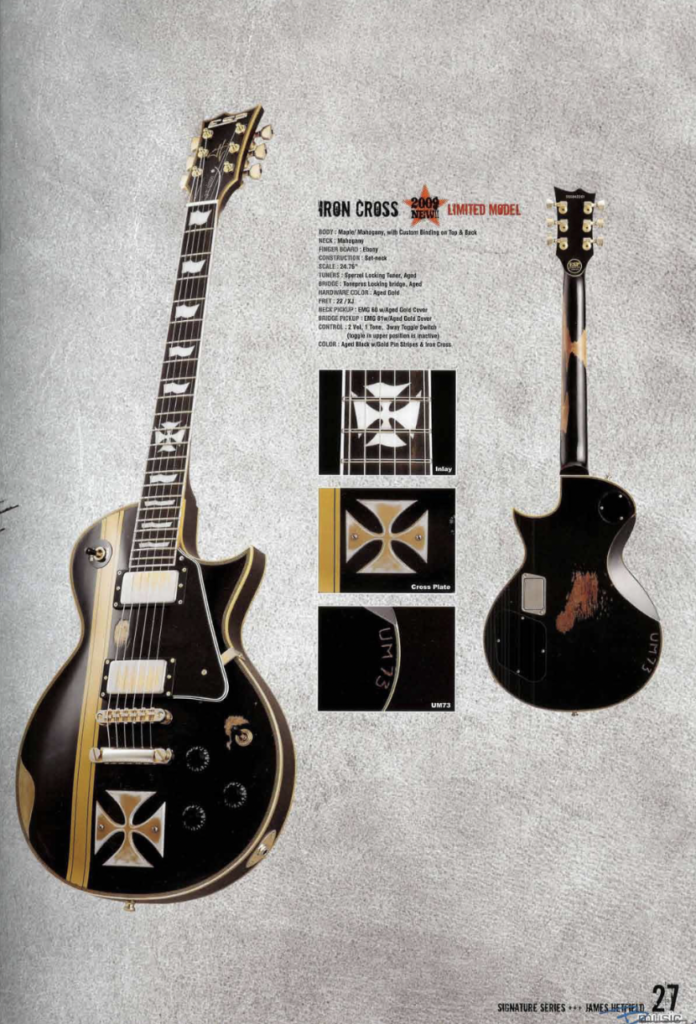
The “Iron Cross” is a signature model heavily inspired by the 1973 Gibson Les Paul Custom that James used extensively during the St. Anger era. The custom shop version was made in 2009, a limited run of 100 — an Eclipse-style body with a maple top, an ebony fretboard with “flag” inlays and an iron cross inlay at the 12th fret. Every scar and bit of wear from the original ’73 Les Paul was faithfully recreated. The more accessible LTD version has been available since 2014.
The Current Flagships: Snakebyte and Vulture
Snakebyte
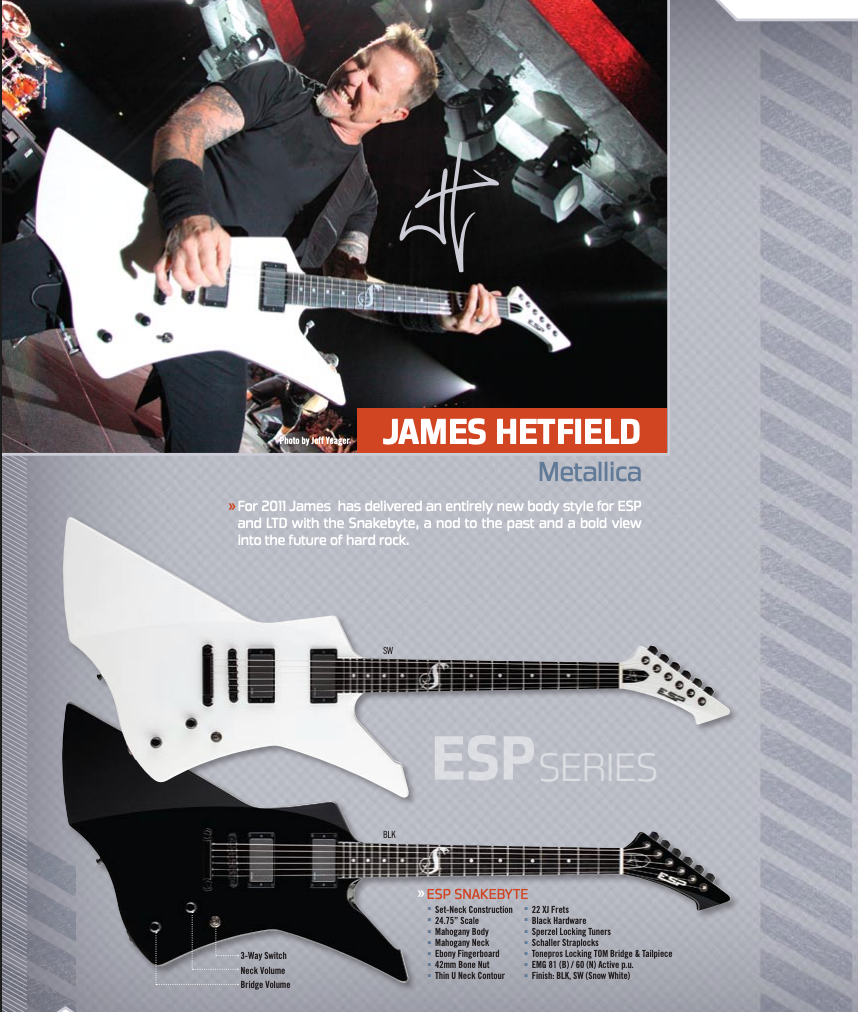
Officially released in 2011, the “Snakebyte” is a signature James designed himself — sketched out by hand and then worked up in Photoshop. He wanted a shape that was different enough to still feel good and balanced on his body, but look more interesting than a traditional Explorer. It’s also noticeably thinner and lighter, and it’s a guitar he clearly loves. It’s a modernized Explorer shape with a mahogany set neck and ebony fretboard, originally EMG 81/60 and, from 2013, the EMG JH Het Set. Finishes range from Black Satin and Snow White to the Kuiu camo added in 2022.
ESP vs. ESP LTD: Which Snakebyte Should You Buy?
If you’re thinking about buying one of James’s current signatures, it’s worth knowing the difference between the “ESP” version and the “ESP LTD” version. The higher-end “ESP” version is handmade at the custom shop in Japan. The “LTD” version is line-produced in Korea and more affordable. The LTD versions drop things like the Schaller straplocks and use different-grade tuners and bridges — but both carry James’s sound and feel.
Snakebyte Baritone
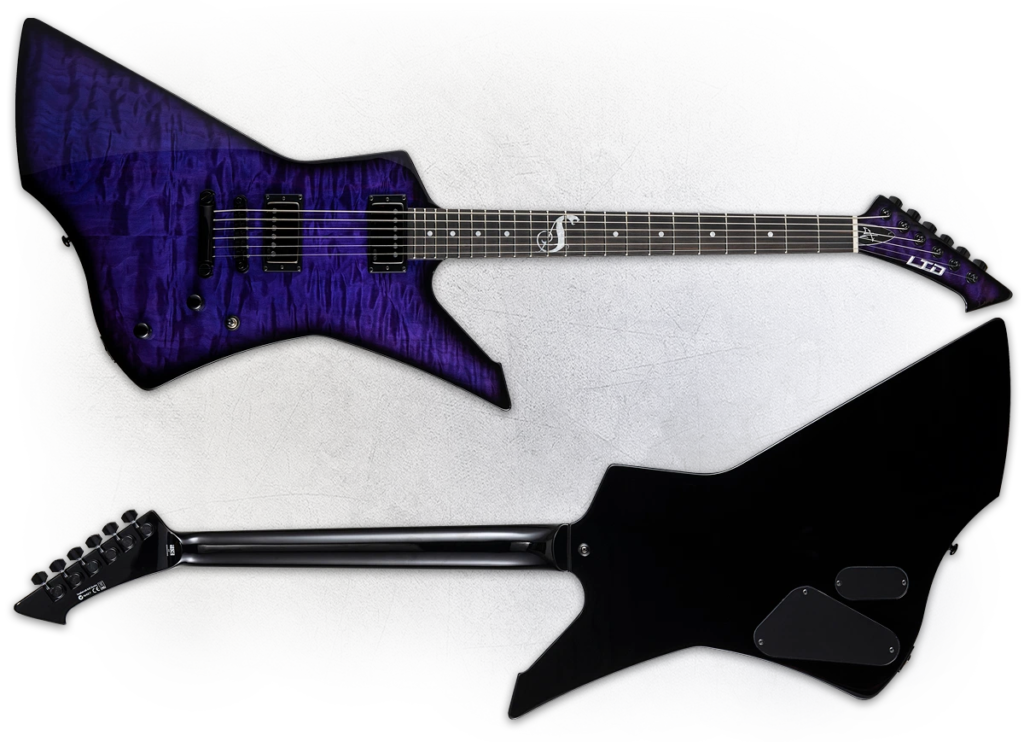
The Snakebyte also comes in a baritone version for lower tunings. James owns two custom baritones — one in gray military-style camo, the other in purple sunburst — used for down-tuned songs, most notably “Sad But True.” In 2018 came the “Snakebyte SE Baritone.” With a see-thru purple sunburst over a quilted maple top and a 27-inch baritone scale, it ships tuned B–E–A–D–F#–B from the factory.
Vulture
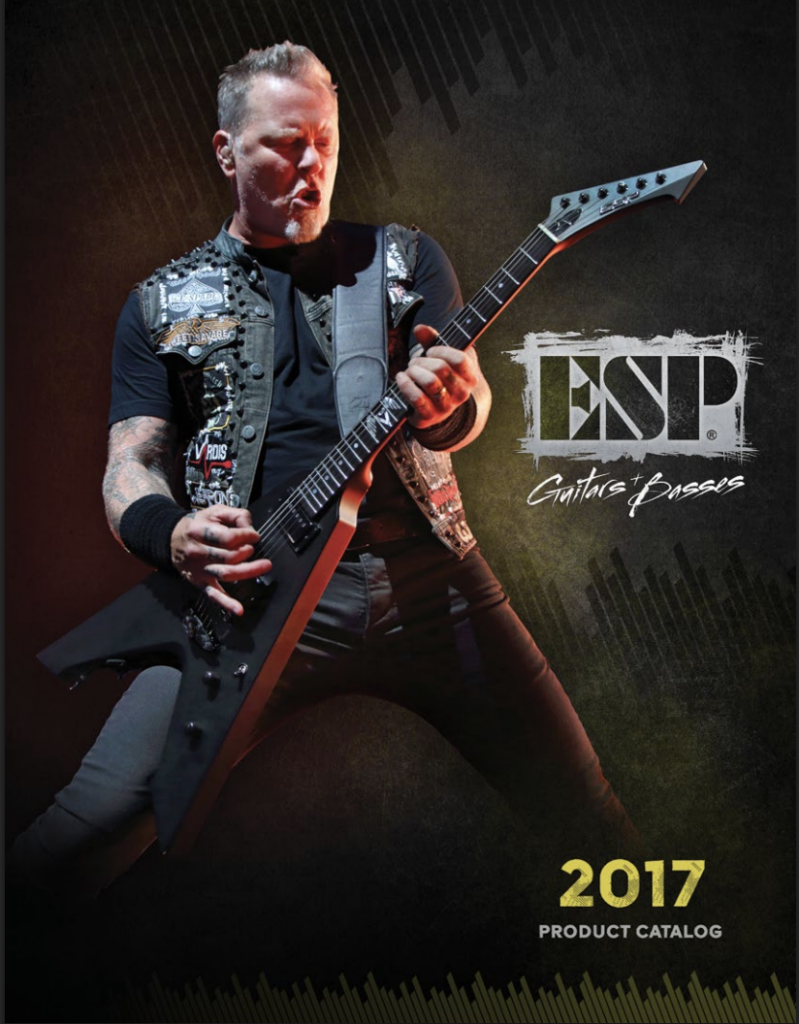
The newest V-shaped signature, unveiled in 2016, is the “Vulture.” Once again a joint effort between ESP and James, it takes cues from the vintage Flying V but with a shape that’s modern and sinister while staying understated. The headstock is Snakebyte-style, with a mahogany body, ebony fretboard, and the EMG JH Het Set. In 2022, a signed black ESP Vulture was auctioned for the MusiCares charity, and together with related items brought in $32,000. And since 2023, James has been using a Vulture finished with the artwork from the album 72 Seasons — as of 2026, it seems he still brings it out on tour.
Conclusion: A Relationship Built on a Handshake
It all started with a single meeting at the 1987 NAMM show. For James, it was never about the paperwork — he doesn’t even remember if he ever signed a contract with ESP. In his own words: “At the end of the day, is your heart there? Is the love there? Is the handshake there? There’s no exclusive with them. I play them because I like ’em.”
From that very first guitar to the Vulture, every one of James Hetfield’s ESP guitars carries a piece of Metallica’s history — and a piece of the man himself.
FAQ
When did James Hetfield start playing ESP guitars?
James Hetfield began his relationship with ESP in 1987, after meeting ESP CEO Matt Masciandaro at the NAMM show in Los Angeles. His first ESP was a custom white MX-220 Explorer nicknamed ‘EET FUK,’ which became his main guitar during Metallica’s …And Justice for All era.
What is James Hetfield’s EET FUK guitar?
EET FUK is James Hetfield’s first ESP guitar — a white, Explorer-shaped MX-220 built in 1987. It has a mahogany body, EMG 81/60 active pickups, and a rosewood fretboard with custom ‘middle finger’ inlays. Its nickname comes from a deliberately nonsensical phrase written on the body.
What pickups does James Hetfield use?
For most of his career, James Hetfield used EMG 81/60 active pickups. Since 2013 he has used his own signature EMG ‘JH Het Set’ (the JH-B and JH-N), which first appeared on the ESP Truckster and is now standard across his current signature models.
What ESP signature models does James Hetfield have?
James Hetfield’s ESP signature models include the early JH-1, JH-2, and JH-3, the Truckster and Iron Cross (both based on the ESP Eclipse), and his current flagships — the Snakebyte, an Explorer-style design, and the Vulture, a V-shaped design.
What’s the difference between an ESP and an ESP LTD Snakebyte?
The ESP version is handmade at ESP’s custom shop in Japan and is higher-end, while the ESP LTD version is line-produced in Korea and more affordable. The LTD models use different-grade hardware — for example, no Schaller straplocks — but both deliver James Hetfield’s core sound and feel.
What is the ESP James Hetfield Vulture?
The Vulture is James Hetfield’s V-shaped signature model, unveiled in 2016. It takes cues from the vintage Flying V with a modern, understated shape, and features a mahogany body, ebony fretboard, and EMG ‘JH Het Set’ pickups. Since 2023 he has used a version finished with artwork from Metallica’s album 72 Seasons.