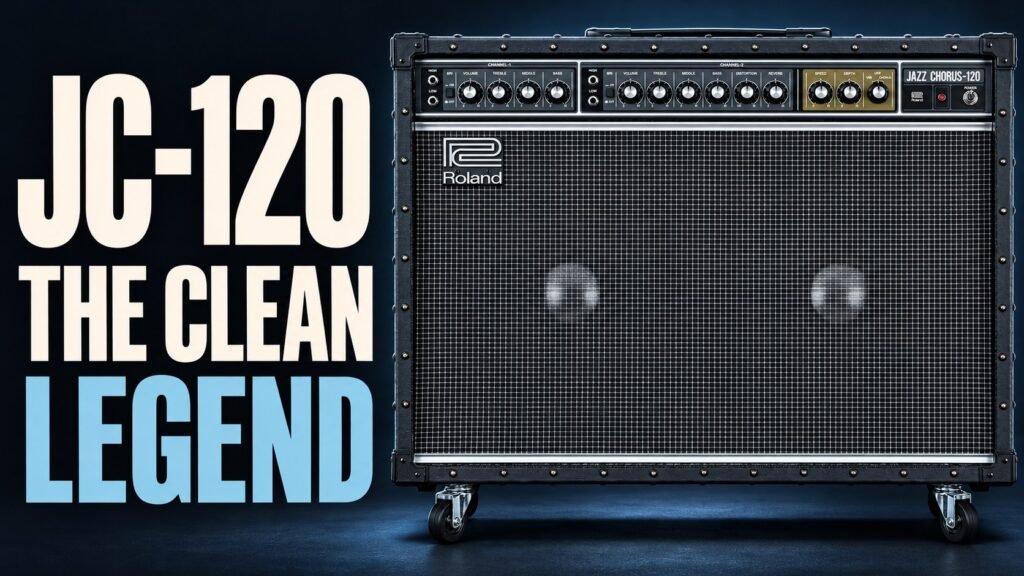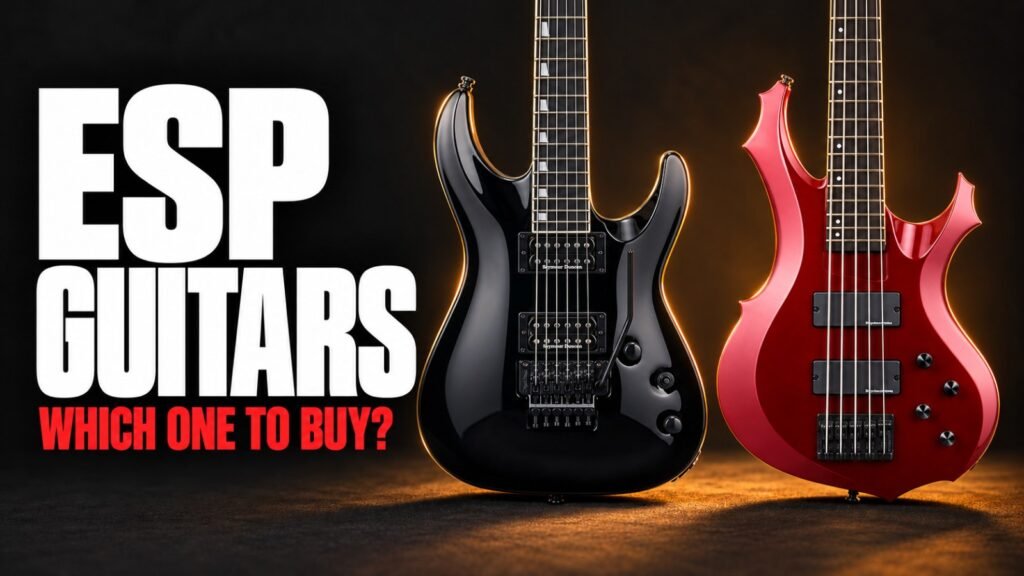
ESP is a Japanese guitar maker founded in Tokyo in 1975. It began as a repair and custom shop, grew into Japan’s first full order-made guitar program, and is now best known worldwide for metal instruments played by Metallica, George Lynch and Children of Bodom. It also runs a family of sub-brands, from the Japan-made E-II to the globally affordable LTD.
This page is the hub: what ESP actually makes, how the brand tiers relate, who plays them, and which ones are built in Japan.
ESP Guitars Quick Facts
- Founded: February 1975, Jingumae, Tokyo
- First house brand: Navigator (1976), discontinued July 31, 2025
- Claim to fame: Japan’s first full custom-order system (1979)
- Signature shapes: HORIZON, FOREST, Random Star, SNAPPER, THROBBER, M-II
- Breakthrough artists: George Lynch, Bruce Kulick, Kirk Hammett, James Hetfield
- Brand family: ESP, E-II, Edwards, GrassRoots, LTD (Navigator ended 2025)
- Made in Japan: ESP and E-II; Edwards, LTD and GrassRoots are built in Asian factories
ESP History in Brief
ESP opened in February 1975 in Jingumae, Tokyo, as an “Electric Sound Center” handling sales, repairs and custom work. It launched Navigator as its first house brand in 1976, then in 1979 introduced what is generally described as Japan’s first full custom-order system.
Expansion through the 1980s was fast: ESP USA in 1981, factories and craft houses across Japan, a guitar-building school in 1983, and a New York store in 1986. That New York shop, plus a walk-in custom order from George Lynch in Tokyo the same year, is what put ESP in front of American players.
Prefer the full story, including the George Lynch walk-in and the Metallica years? I cover it properly, with video, in my ESP history article on the founding years, 1975 to 1989.
What Makes ESP
Order-Made Since 1979: ESP Builds What You Describe
ESP’s defining trait is not a body shape. It is that the company was built around order-made work from very early on, and that shows up everywhere in the catalog.
Because specs came from individual players rather than a product committee, ESP models often carry one unusual decision: a control layout stripped down to a single volume knob, a bridge choice that goes against the era’s default, a scale length picked for one band’s tuning. Those quirks survived into production, which is why the lineup feels less standardized than other brands.
The Neck Obsession: Carbon Rods Where You Cannot Replace the Neck
Many ESP models use neck-through construction, which gives long sustain and unobstructed upper-fret access. It has one serious weakness: if the neck goes bad, there is no bolt to undo. The neck is the guitar.
Wood moves with humidity, temperature and decades of string tension. On a bolt-on that is an annoyance you eventually fix with a replacement neck. On a neck-through it can end the instrument. ESP’s answer is support carbon rods inside the neck to increase rigidity and resist that movement. It photographs badly and sells nothing on a shop wall, but it is why a non-replaceable neck is a reasonable thing to own.
I read this as the repair-shop origin showing through. ESP spent its first years fixing other people’s guitars, so it knew precisely how they fail.
No House Style: From Bolt-On Traditionals to Carved Sculptures
ESP’s range runs wider than almost any comparable brand, and the extremes are genuinely extreme.
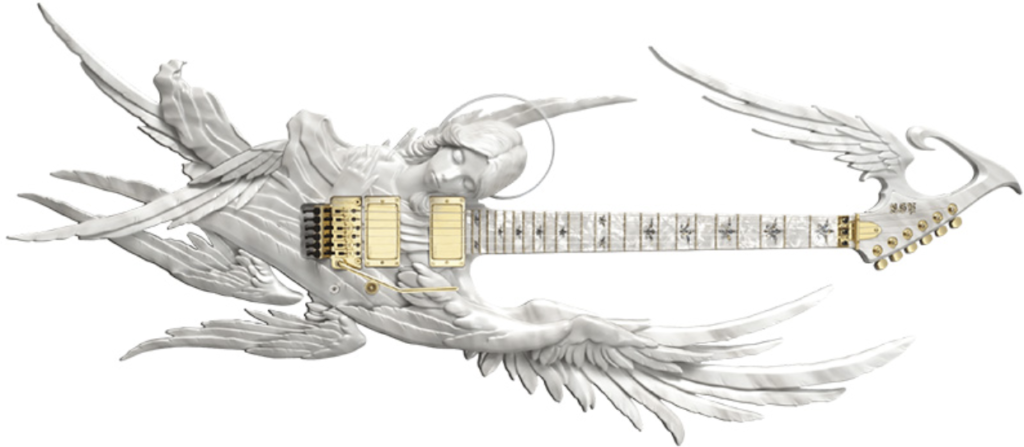
The Angel Guitar family built for Toshihiko Takamizawa of THE ALFEE uses carved three-dimensional bodies and unusual materials. A flat body with artwork on it is a finishing job; a body carved into wings changes mass distribution, strap balance and where your forearm sits, and all of that has to stay playable for a two-hour show.
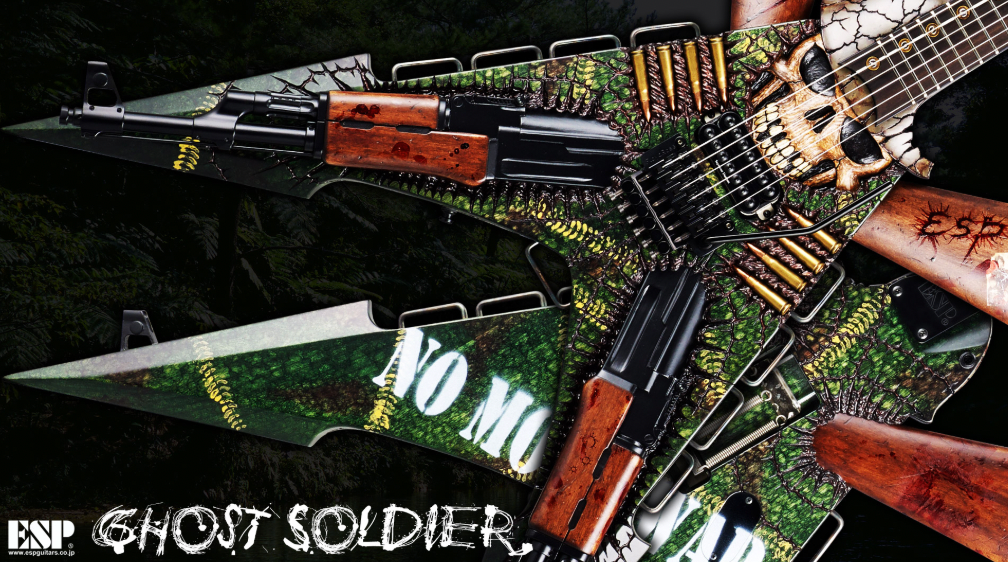
ESP also builds exhibition instruments for events like the NAMM Show, and collaboration models most international readers have never heard of: a Godzilla guitar, Monster Hunter models, and a Hatsune Miku guitar. Treat these as proof of capability rather than novelty. A licensed character guitar has to satisfy a rights holder and remain a working instrument at the same time.
The ESP Lineup: Original Models
HORIZON: The Neck-Thru Flagship That Defines ESP
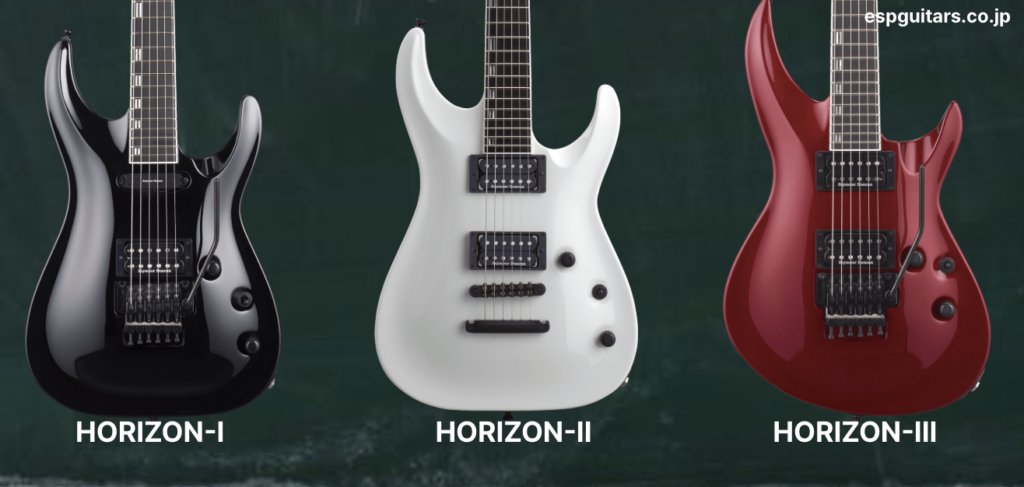
ESP positions the HORIZON as its symbolic flagship, the company’s history condensed into one shape. If you only ever look at one ESP, look at this, and our ESP Horizon guide traces it from the first 1984 model to today.
| Model | Build | Bridge | Pick it if you want |
|---|---|---|---|
| HORIZON-I | Neck-through, alder wings | Floyd Rose | The classic ESP lead platform with a trem |
| HORIZON-II NT | Neck-through, mahogany | Tune-O-Matic style | Warmth and sustain without a Floyd |
| HORIZON-III | HORIZON-I spec, asymmetric body | Floyd Rose | The same guitar in a more striking shape |
FOREST, ANTELOPE & FRX: The Spiked Shape That Started as a Bass
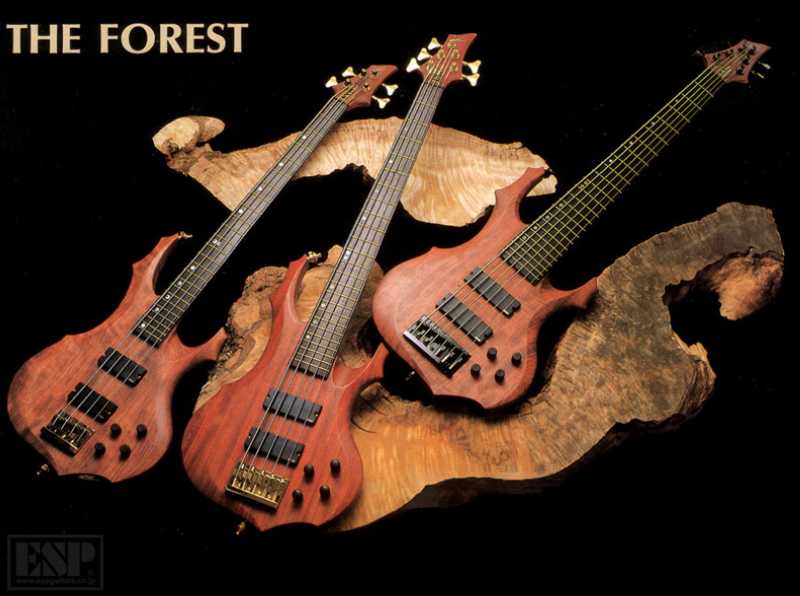
The FOREST is one of ESP’s most recognizable original shapes, with a strikingly spiked multi-horn body. Here is the detail most people do not know: it debuted as a bass. The response was strong enough that ESP developed a guitar version afterwards.
The ANTELOPE and FRX are related designs that rework the same idea with different body treatments. Tom Araya of Slayer plays an FRX bass, which brings the shape back to where it started.
SNAPPER & THROBBER: ESP for Players Who Don’t Play Metal
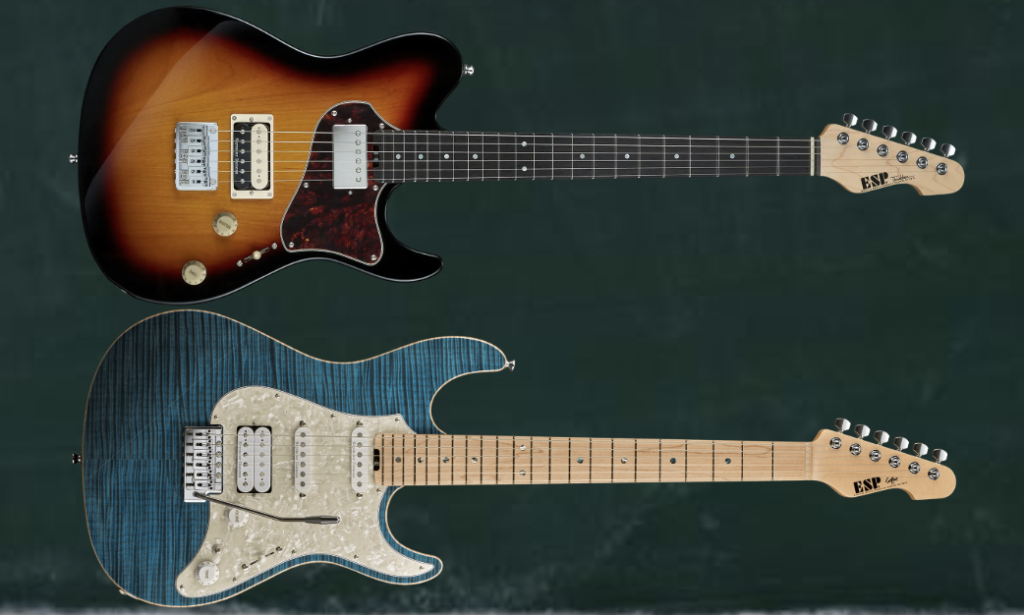
These two are the answer to “I like Japanese build quality but I do not play metal.”
The SNAPPER has Stratocaster-like character and the THROBBER has Telecaster-like character. Both are bolt-on, which means the neck is serviceable and replaceable, and both sit in genre-flexible territory rather than chasing the metal market. They have become an important part of the modern lineup and are consistently the ESP models I recommend to players who assumed the brand was not for them.
The ESP Brand Family: Which Tier Is Which
This is the most common source of confusion, so here is the short version. Our ESP vs LTD guide explains every tier, with the same guitar compared at three price levels.
| Brand | Made in | Position |
|---|---|---|
| ESP | Japan (Tokyo) | The flagship, handmade; order-made work available in Japan |
| E-II | Japan | Successor to the ESP Standard Series; pro-level MIJ at a lower price |
| Edwards | Asia (sold mainly in Japan) | Mid-price ESP and Navigator styling; rarely exported |
| GrassRoots | Overseas | Entry level |
| LTD | Asia (Korea, Indonesia, China and others) | The global affordable line, on sale since 1996 |
| Navigator | Japan | Vintage-style line; regular production ended July 31, 2025 |
Notable ESP Players
| Artist | Band | Notable ESP models |
|---|---|---|
| George Lynch | Dokken | Kamikaze, Skull & Snakes |
| Bruce Kulick | KISS | M-1 (Flip-Flop Blue) |
| Ron Wood | The Rolling Stones | Ron Wood custom model |
| Kirk Hammett | Metallica | KH-2 (Mirage / M-II based) |
| James Hetfield | Metallica | Truckster, Iron Cross, Snakebyte |
| Jeff Hanneman | Slayer | LTD JH-600 |
| Tom Araya | Slayer | Tom Araya FRX (bass) |
| Alexi Laiho | Children of Bodom | ARROW HEAD, SCYTHE, SAWTOOTH, HEXED, RIPPED |
| Gus G | Firewind / Ozzy Osbourne | Gus G signature models |
| Kai Hansen | Gamma Ray / Helloween | ESP Custom Shop SV |
| Kiko Loureiro | Angra / Megadeth | Signature model (2005) |
| Akira Takasaki | LOUDNESS | Random Star |
| Toshihiko Takamizawa | THE ALFEE | Angel Guitar, Archangel |
Alexi Laiho: One Shape, Five Names
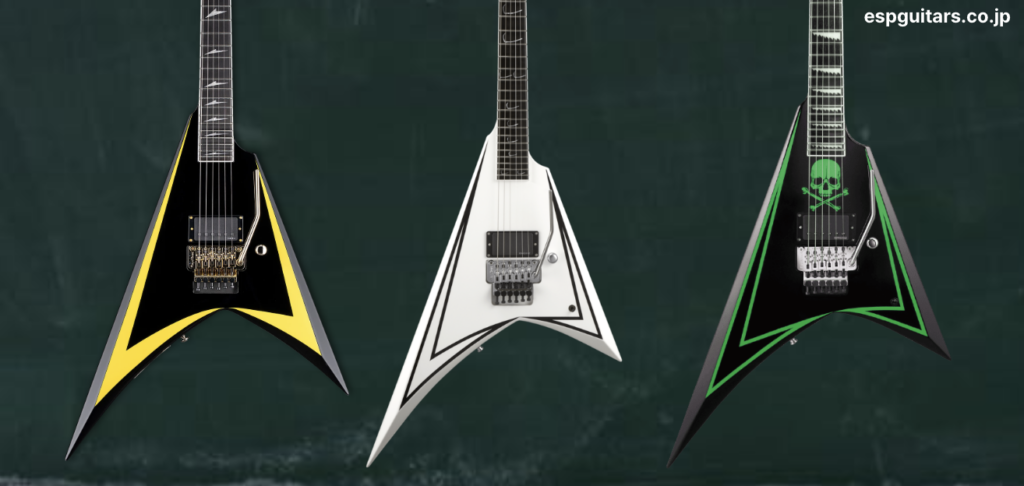
The Alexi Laiho line looks like five models, but it is one platform: an offset V body, neck-through, one pickup and one volume knob. The ARROW HEAD, SCYTHE and SAWTOOTH are choices of look, not of instrument.
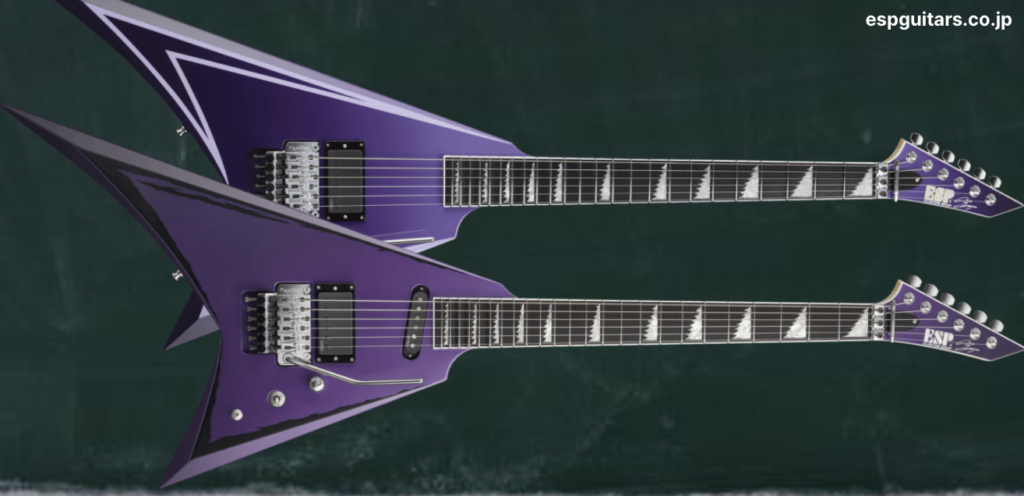
The exception is the RIPPED, his last design and the first Alexi model with a neck pickup. ESP has kept the line going since his death in 2020, including a made-to-order ARROW HEAD “Legacy” from January 2025. The full story is in our guide to Alexi Laiho’s ESP guitars.
Akira Takasaki: The Random Star That Made ESP Japanese Metal
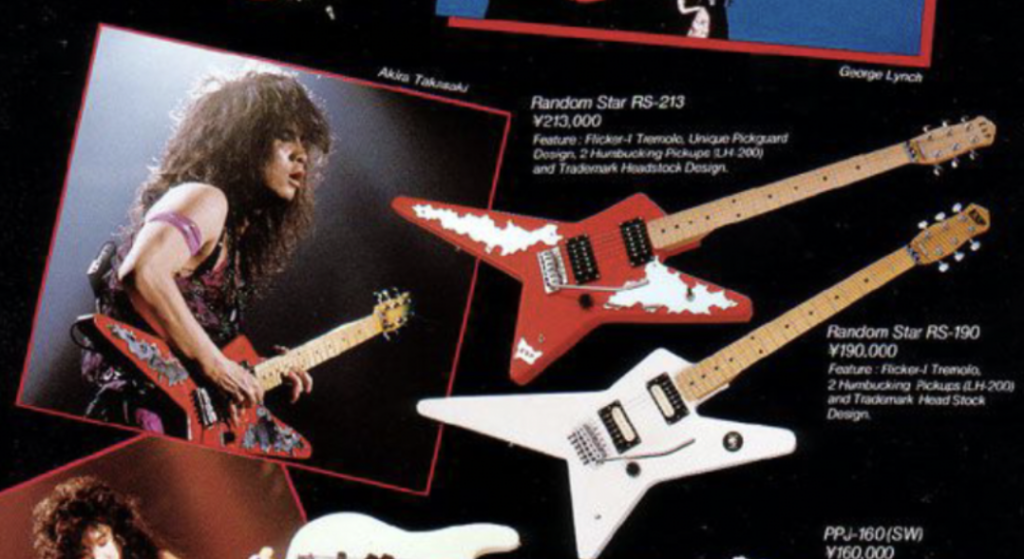
Akira Takasaki plays in LOUDNESS, the first Japanese metal band to break internationally. His instrument is based on the Random Star, a shape that dates back to the Navigator era, and the combination of a red body with mirror-finish material is one of the images that fused ESP and heavy metal in the Japanese public imagination.
Metallica’s James Hetfield has the deepest ESP catalog of anyone on this list. I have covered every model in my complete guide to James Hetfield’s ESP guitars.
Buying an ESP: What to Know First
Most people arriving here are trying to work out which tier to buy, so let me be direct about it.
| You want… | Look at | Why |
|---|---|---|
| Japanese build without flagship money | E-II | Made in Japan, the successor to the ESP Standard Series; the tier most international buyers should start with |
| An ESP signature shape at the lowest price | LTD | How most people get their first Alexi or KH model |
| Vintage-style Fender or Gibson designs | Used Navigator | Regular production ended in July 2025 |
| To shop the Japanese domestic market | Edwards | Priced below ESP and rarely exported officially |
Two practical warnings. First, older instruments may be labelled ESP Standard Series rather than E-II, since E-II replaced it; they are not different quality tiers, just different eras of the same idea. Second, if you are buying from a Japanese listing, the condition vocabulary is its own skill. Terms like gari, sori and nari carry specific meanings that decide whether a guitar is a bargain or a repair bill, and I break them down in my glossary of Japanese guitar condition terms.
If you are travelling and want to handle these in person, ESP has its own shops in Tokyo and the used market is extraordinary. See my guide to the major guitar shop chains in Japan.
Final Thoughts
ESP is introduced as a metal brand almost everywhere, and the reputation is earned. But the metal association is a result, not a strategy.
What ESP actually built, starting from a repair bench in 1975 and an order-made programme in 1979, was the capacity to construct whatever a specific person described. Metal players happened to be the ones asking for the most unusual things in the 1980s, so that is who showed up, and the image stuck.
Look past it and you find bolt-on traditionals, carved sculptures, a Rolling Stone’s custom and a Godzilla guitar, all from the same company. That range, not any single body shape, is what ESP is.
That is why I think ESP is best understood not as a metal brand, but as a workshop that turns a player’s ideas into a real guitar.
FAQ
When was ESP founded?
ESP was founded in February 1975 in Jingumae, Tokyo, as a shop offering guitar sales, repairs and custom work. It launched its first original brand, Navigator, in 1976 and began Japan’s first full custom-order system in 1979.
What is the difference between ESP, E-II, Edwards, GrassRoots and LTD?
ESP is the Japan-made flagship line. E-II is the Japan-made factory line that succeeded the ESP Standard Series, at a more realistic price. Edwards is a mid-price brand made in Asia and sold mainly in Japan that shares some ESP-family parts and specs. GrassRoots is the entry-level brand, and LTD, on sale since 1996, is the affordable global line built mostly in Korea, Indonesia and China.
Which ESP guitars are made in Japan?
ESP and E-II are the Japan-made lines, and Navigator was as well before production ended. Edwards is Japan-focused and shares family specs on some models. LTD and GrassRoots are built overseas, mainly in Korea, Indonesia and China.
Is ESP only a metal guitar brand?
No. ESP is strongly associated with metal thanks to Metallica, George Lynch and Children of Bodom, but it also builds traditional bolt-on models like the SNAPPER and THROBBER, vintage-style instruments, art-piece customs such as the Angel Guitar for THE ALFEE, and models for artists like Ron Wood of The Rolling Stones.
What is the ESP HORIZON?
The HORIZON is ESP’s symbolic flagship shape. The HORIZON-I uses neck-through construction, alder wings and a Floyd Rose; the HORIZON-II NT uses mahogany wings and a Tune-o-matic-style bridge for a warmer voice; and the HORIZON-III adds an asymmetric body. Support carbon rods reinforce the non-replaceable neck-through neck.
What happened to the Navigator brand?
Navigator, ESP’s premium vintage-style brand dating back to 1976, ended production of all regular models on July 31, 2025. Some signature models were announced to continue for the time being, but Navigator is now essentially a used-market brand.
More ESP guitar articles
Alexi Laiho ESP Guitars: Arrow Head, Sawtooth, Scythe and the Final Ripped and Hexed
Alexi Laiho’s ESP guitars are some of the most recognizable V-shapes in metal: an offset…
ESP Horizon: The Remarkable History of ESP’s Flagship Guitar (1984-Today)
The ESP Horizon is the guitar ESP itself calls its symbolic flagship: a model that…
ESP vs LTD: The Essential Guide to E-II, Edwards, GrassRoots and Navigator
ESP vs LTD is the first question most people ask when they start shopping for…
Kirk Hammett ESP Guitars: From Zorlac and the KH-2 to the Mummy and Ouija
Kirk Hammett ESP guitars are some of the most iconic instruments in his huge collection….
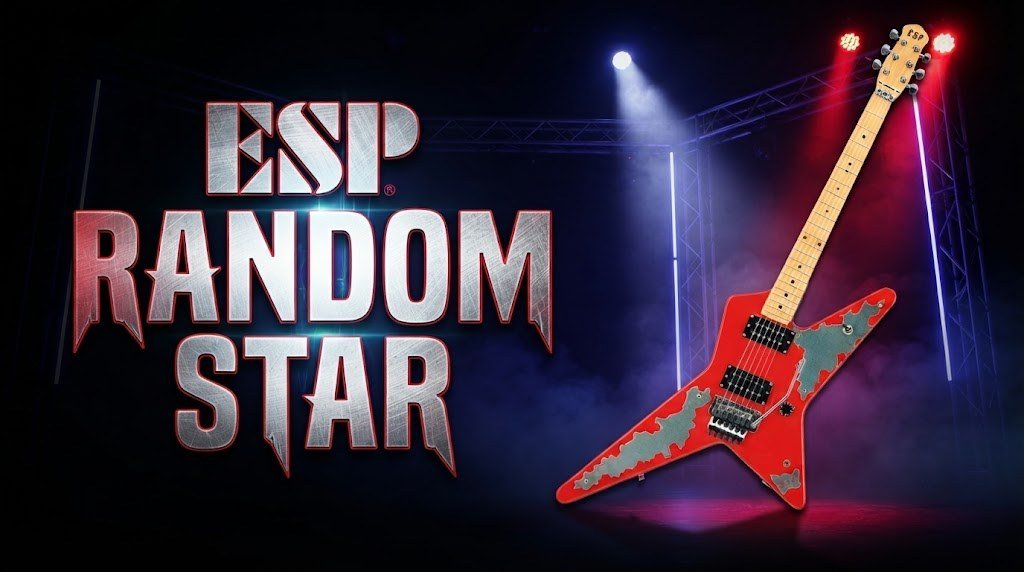
ESP Random Star: How Japan’s Iconic Star Guitar Really Began (1981-Today)
The ESP Random Star is one of ESP’s defining guitars of the 1980s, and most…
ESP History: The Founding Years, 1975 to 1989
ESP is known worldwide as a metal brand, but the company started in 1975 as…