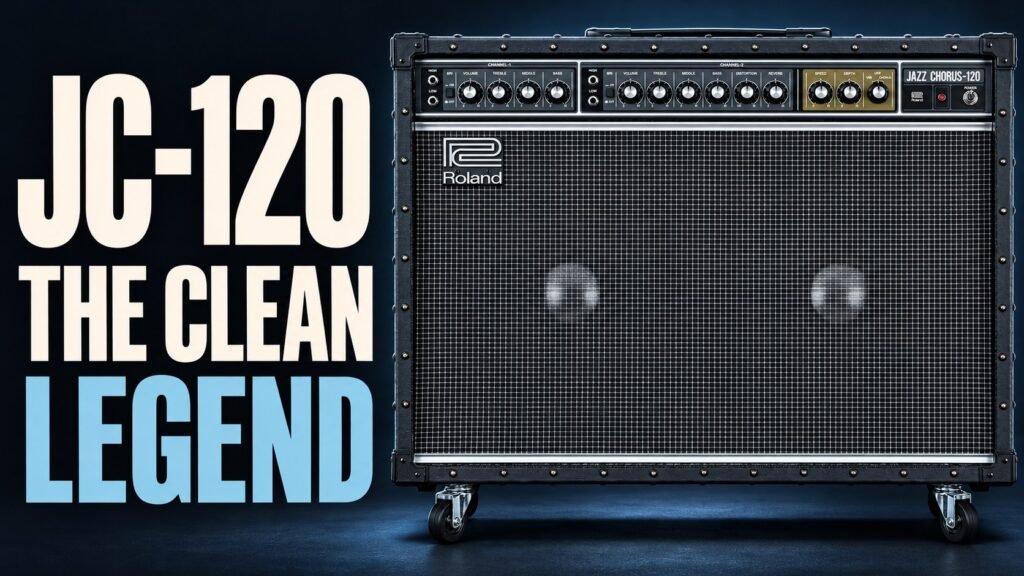
When people think of Japanese guitar amps, many immediately think of the Roland JC-120 Jazz Chorus. It became a solid-state classic known for its clean sound and reliable performance, and Roland says it has never left the lineup since 1975. But the Jazz Chorus did not appear in a vacuum: it was Roland’s answer to a real problem that Japanese tube amps were facing in the 1970s. This is the story of how it took over, what makes it different, and which Jazz Chorus to choose today.
Roland JC-120 Quick Facts
- Released: 1975
- Power: 120 watts stereo, two 12-inch “silver cone” speakers
- Signature: JC Clean tone and the Dimensional Space Chorus
- Channels: Normal and Effect, each with three-band EQ and bright switch
- Effects: Vibrato, distortion, spring reverb and chorus
- Status: In continuous production for over five decades
Prefer to watch? This article is based on my own short below.
Before the Jazz Chorus: Japan’s Tube Amp Problem
In the early 1970s, Japan’s guitar boom was still active, yet domestic amps were starting to face a serious problem with distortion. High-gain models such as the Marshall 1959 were entering the country, and players wanted the thick drive those amps delivered.
Japanese tube amps could not match that sound. They lacked strong distortion, and they did not clean up well when the gain was lowered. They often fell into a weak middle ground, and lost ground to imported models.
Roland’s Answer: The JC-120
Roland responded with the Jazz Chorus. According to Roland, the JC-120 was designed from the start to be the best clean amp ever made, aiming for a totally different sound from the warm distortion of tube amps. It stayed clean under almost any setting, and its light weight and easy maintenance solved many of the issues found in tube amps.
Roland also admits that at first, the pure JC Clean sound felt foreign to some players used to tube saturation. Over time, though, its transparency became highly sought after by musicians and producers.
Why It Sounds So Clean
The secret is in the layout. The JC-120 uses two separate power amps, each driving its own speaker. Roland describes the result as punchy, full and clear, with plenty of headroom, and that uncolored sound is exactly why it works so well as a platform for pedals.
The First Chorus Effect
Chorus is everywhere today, but it was a Roland innovation that debuted with the JC-120 in 1975. The Dimensional Space Chorus uses the two-speaker design: one speaker plays the dry signal, the other plays the same signal with pitch modulation, and the two mix in the air to create a wide, moving stereo sound.
A year later, in 1976, the effect moved into a pedal with the BOSS CE-1 Chorus Ensemble, the first BOSS effect. That story is covered in my BOSS pedals history.
The JC-120 in Detail

| Feature | Details |
|---|---|
| Output | 120 watts stereo |
| Speakers | Two 12-inch “silver cone” speakers |
| Channels | Normal and Effect, each with three-band EQ and bright on/off |
| Effects | Chorus/vibrato, distortion and spring reverb |
| Effects loop | Stereo, with series or parallel operation |
| Outputs | Mono or stereo line out |
| Footswitch | Turns chorus/vibrato, reverb and distortion on and off |
| Build | Heavy-duty cabinet with casters, edge protectors and corner brackets |
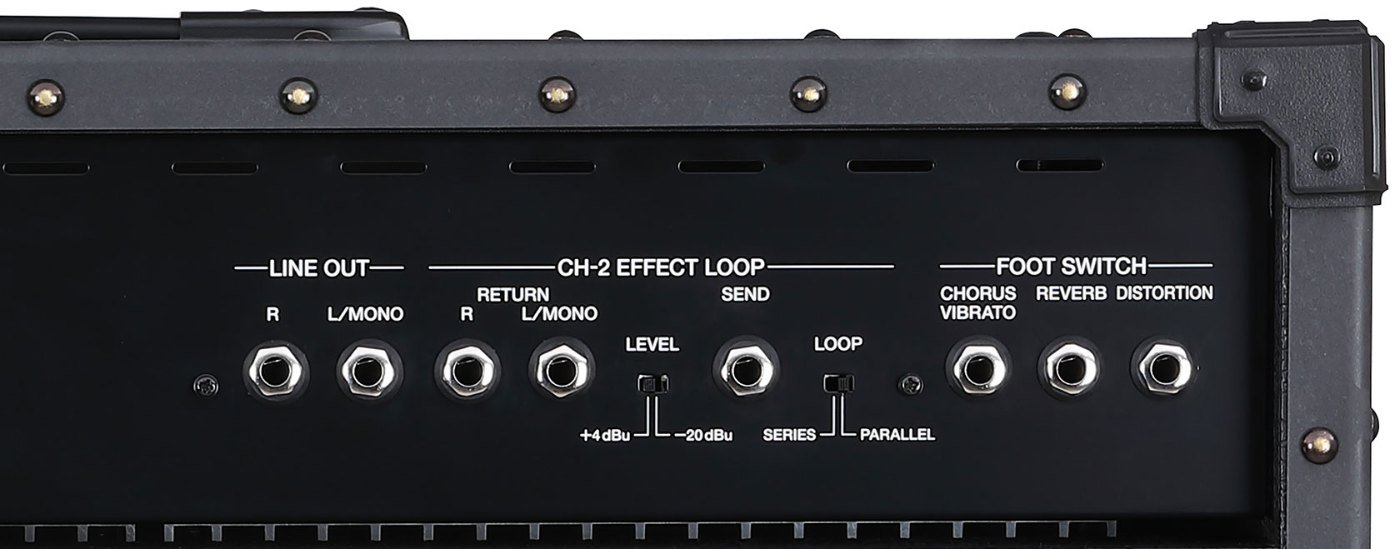
Roland also describes it as a great match for multi-effects, amp modelers and guitar synths, since the clean tone lets you hear exactly what your devices are doing.
After the Jazz Chorus: Clean From Japan, Gain From Pedals
The JC-120 also fit well with the growing trend of creating distortion with pedals. From that point on, imported tube amps were chosen for gain, while the Jazz Chorus became the standard for clean tones.
Who Played It
Roland’s own Jazz Chorus history page highlights players and producers such as Jeff “Skunk” Baxter, Andy Summers of The Police, Adrian Belew, Billy Duffy of The Cult and Johnny Marr, along with producers Steve Levine and Gil Norton.
The Jazz Chorus Family
The JC-120 was never alone. Roland has released many Jazz Chorus models over the years, from the JC-60 that launched alongside it to today’s compact home amps.
| Year | Model | Details |
|---|---|---|
| 1975 | JC-120 | The flagship: 120 watts stereo, two 12-inch speakers |
| 1975 | JC-60 | 60 watts, one 12-inch speaker |
| 1976 | JC-160 | 120 watts, four 10-inch speakers |
| 1976 | JC-80 | 60 watts, one 15-inch speaker |
| 1978 | JC-200 / JC-200S | Stack-style, 200 watts, the largest output in JC history |
| 1978 | JC-50 | 50 watts, one 12-inch speaker |
| 1984 | JC-120H | 120-watt head with variable high-treble control |
| 1984 | JC-77 | 80 watts, two 10-inch speakers |
| 1986 | JC-55 | 50 watts, two 8-inch speakers |
| 1992 | JC-20 | 20 watts, two 5-inch speakers |
| 1996 | JC-85 | 80 watts, two 10-inch speakers |
| 1997 | JC-90 | JC-85 upgrade with two 10-inch Eminence speakers |
| 2015 | JC-40 | 40 watts, two 10-inch speakers; first JC with a stereo input |
| 2016 | JC-22 | 30 watts, two 6.5-inch speakers; a compact home amp |
Source: Roland’s Jazz Chorus history page.
There was also a limited 50th Anniversary Edition of the JC-120, with only 350 units made, each with a natural cherry wood veneer and a hand-engraved serial number.
Which Jazz Chorus Should You Buy?
| You want… | JC-120The classic | JC-40Gig-ready | JC-22Home amp |
|---|---|---|---|
| PowerOutput | 120W | 40W | 30W |
| SpeakersSize | 2 x 12” | 2 x 10” | 2 x 6.5” |
| Best forUse | Stages and studios | Small gigs, stereo pedalboards | Home playing and recording |
| Stereo inputFor modelers | — | Yes | Yes |
JC-120: The Real Thing
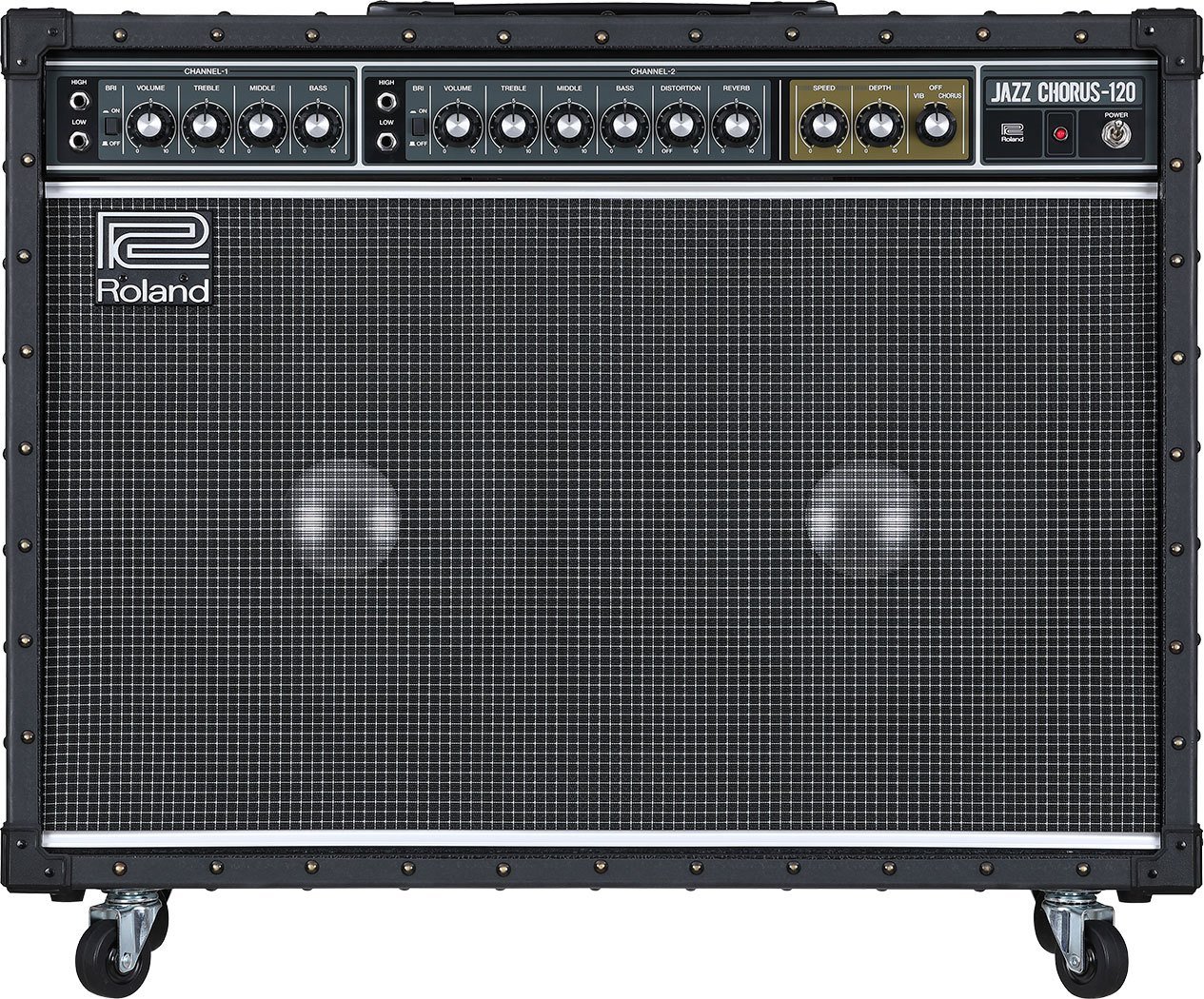
If you want the sound on the records and you have the space, it has to be the JC-120. It is big and heavy, but nothing else gives you the full two-12-inch stereo chorus.
JC-40: The Gig-Ready Jazz Chorus
The JC-40 gives you the genuine JC voice in a small combo, and it was the first Jazz Chorus with a stereo input, which makes it a strong choice for stereo pedalboards, modelers and multi-effects.
JC-22: Jazz Chorus at Home
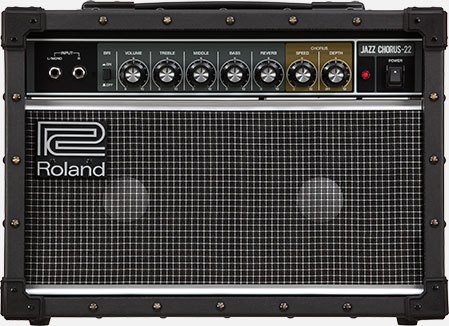
The JC-22 brings the essential features of the JC-40 into an even smaller amp for home playing and recording, with reverb, the Dimensional Space Chorus and a stereo input on the front panel.
The Japanese Tube Amps That Came Before
Today, the old Japanese tube amps that lost out to imports are quietly returning as vintage favorites. Here are a few worth knowing.
Teisco Checkmate
From Teisco, you get the Checkmate line, known for its clear, glassy cleans. In the US, Checkmate amps were sold under the Teisco Del Rey name, and for a time these amps even found real momentum on the vintage market.


Fender Japan FAT Series
Fender Japan introduced the FAT series, voiced with the classic USA-made Twin Reverb sound in mind. As the catalog shows, FAT stands for “Fender All Tube.” Elk is also said to have built many of the Fender Japan amplifiers from the 1980s onward.

Roland Bolt Series
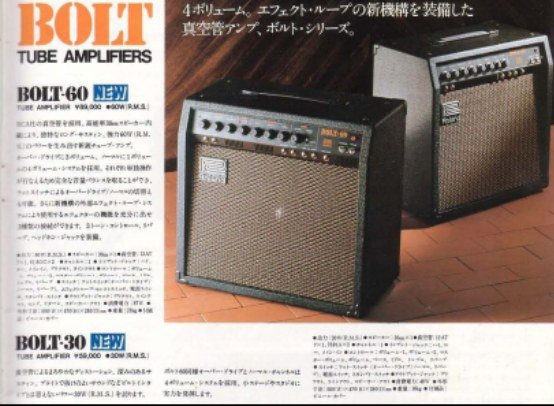
Here is the twist: even after the Jazz Chorus, Roland went back to tubes. The Bolt series was listed in Roland’s catalog as tube amplifiers, featuring four volume controls and an effects loop. The Bolt-60 was a 60-watt model at ¥89,000 and the Bolt-30 a 30-watt model at ¥59,000. The Bolt series is often described as a hybrid design that combined solid-state circuitry with tubes.
Other Names to Know
Guyatone, a true staple of the 1960s and 1970s, released the original 2000 series, Twin Reverb-style Reverb series amps and even a few Marshall-inspired models. Ace Tone had the Mighty 5 series, and its founder, Ikutaro Kakehashi, went on to found Roland in 1972. Elk’s Viking series is one of the most recognized Japanese tube classics. There is also the Royal Super Bunny from the 1970s, and Shin-Ei, better known for its fuzz pedals, once made tube amps too.
Final Thoughts
The Jazz Chorus earned its place by solving real problems: Japanese tube amps could not deliver the drive players wanted, and the JC-120 answered with something completely different. Fifty years later, it is still in production, and the JC Clean sound is still the benchmark Roland built it to be.
Frequently Asked Questions
When was the Roland JC-120 released?
In 1975. Roland says it has stayed in continuous production for more than five decades.
Is the Roland JC-120 a tube amp?
No. It is a solid-state amp with two separate power amps, each driving its own 12-inch speaker.
Did the JC-120 invent the chorus effect?
According to Roland, the chorus effect debuted with the JC-120 in 1975 as the Dimensional Space Chorus. The BOSS CE-1 pedal brought it to pedal form in 1976.
What is the difference between the JC-120, JC-40 and JC-22?
The JC-120 is the 120-watt flagship with two 12-inch speakers. The JC-40 is a 40-watt combo with two 10-inch speakers and a stereo input. The JC-22 is a 30-watt home amp with two 6.5-inch speakers.
Is Ace Tone related to Roland?
Ace Tone’s founder, Ikutaro Kakehashi, went on to found Roland in 1972.