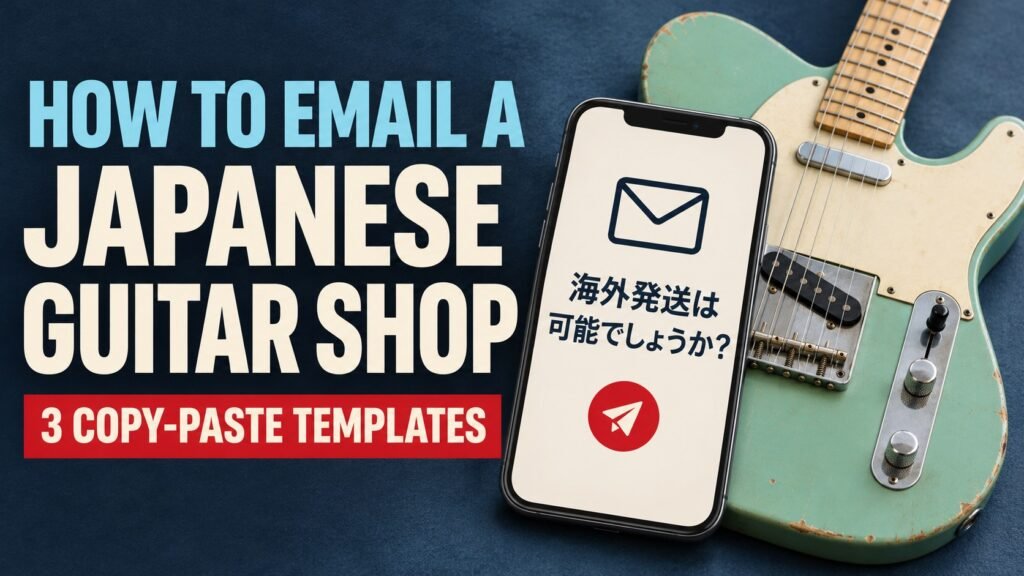
Many Japanese guitar shops don’t list international shipping, but a short, polite email in Japanese often gets you an answer. This guide gives you copy-and-paste templates for the three questions overseas buyers ask most: shipping abroad, condition and extra photos, and original parts. For the bigger picture, start with How to Buy a Guitar from Japan.
Emailing a Japanese Guitar Shop: Quick Facts
- Best language: Simple, polite Japanese
- Key rule: Use keigo (polite form), even in a short email
- Length: Short: one item, a few clear questions
- Most common questions: International shipping, condition and photos, modifications
- Always include: The item name and the link to its page
Why Polite Japanese Matters: Keigo

Japanese has a polite register called keigo. In business it is the default, and shop staff expect it from customers too. Polite sentences end in forms like desu, masu and deshou ka. Casual Japanese, called tameguchi (or tamego), is what you use with close friends.
My Take
Even simple Japanese gets more replies than English alone, and polite, short emails work best. The one thing I want readers to know: use keigo, even if your email is only a few lines. Casual Japanese can look like spam, and you may never get a reply.
If you use a translation tool, check that the result is in the polite form. A quick test: most sentences should end in です (desu), ます (masu) or でしょうか (deshou ka).
The Structure of a Polite Inquiry
The five parts of a polite inquiry
Chart: MIJ Guitar Guide.
Template 1: Asking About International Shipping
Replace カナダ (Canada) with your country, for example アメリカ (USA), イギリス (UK) or オーストラリア (Australia). Many shops still say no to overseas shipping. If that happens, other routes are covered in the buying guide.
Template 2: Asking About Condition and Extra Photos
Terms like sori (neck bow) and gari (scratchy pots) come up in replies. They are explained in Japanese Guitar Terms Every Buyer Should Know.
Template 3: Asking About Modifications and Original Parts
Originality matters for value, especially on vintage models. The original grade of the guitar is often in its model number, as explained in Japanese Guitar Model Numbers.
Useful Polite Phrases
| Japanese | Romaji | Meaning |
|---|---|---|
| はじめまして | Hajimemashite | Nice to meet you (first contact) |
| 〇〇と申します | ___ to moushimasu | My name is ___ (polite) |
| 〇〇でしょうか | ___ deshou ka | Is it ___? (polite question) |
| いただけますと幸いです | Itadakemasu to saiwai desu | I would be grateful if you could… |
| 恐れ入りますが | Osoreirimasu ga | I am sorry to trouble you, but… |
| よろしくお願いいたします | Yoroshiku onegai itashimasu | Thank you in advance (closing) |
Final Thoughts
You don’t need perfect Japanese. Keep it short, keep it polite, and name the exact item. If a shop can’t ship abroad, thank them and move on to another route.
And if writing in Japanese feels like too much, it’s fine to send your email in English. You may get fewer replies, but I’ve heard that more Japanese shops now have English-speaking staff or handle English inquiries, so it’s worth a try.
Frequently Asked Questions
Should I email a Japanese guitar shop in English or Japanese?
Simple, polite Japanese usually gets more replies. English is fine if you are stuck: replies may be fewer, but more Japanese shops now have staff who handle English. Keep the email short and include the item name and link.
What is keigo?
Keigo is the polite register of Japanese used in business. Sentences end in forms like desu, masu or deshou ka. Use it even in a short email.
Can I use a translation tool?
Yes, but check that the result is in the polite form. Casual Japanese can look like spam and may not get a reply.
How do I ask a Japanese shop if they ship overseas?
Ask whether the item can be shipped to your country and request the shipping cost and payment methods. Template 1 in this article can be copied as is.
What should I do if the shop doesn’t ship abroad?
Thank them and try another route, such as Reverb or eBay sellers based in Japan or a proxy service.