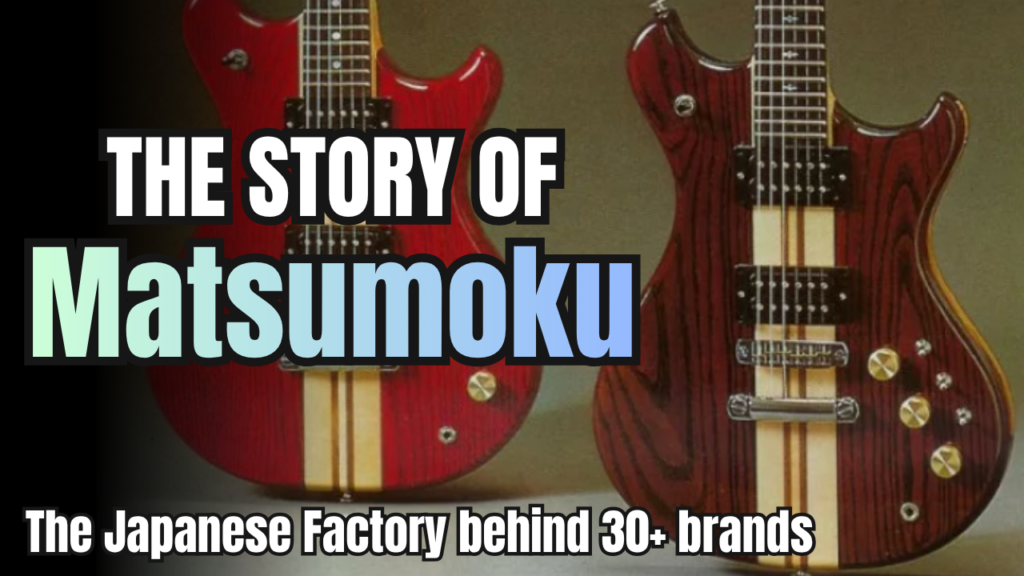
Matsumoku is the most important Japanese guitar factory that almost nobody outside Japan can name. Between 1963 and 1987 this Matsumoto workshop built guitars for Epiphone, Aria Pro II, Greco, Westone, Fernandes and dozens of other badges, then vanished. This article follows the full story, from a furniture shop founded in 1951 to the day the company dissolved in February 1987.
Matsumoku Quick Facts
- Period covered: 1951 to 1987 (guitar production 1963 to 1987)
- Founded: 1951 as Matsumoto Mokko Co., Ltd. in Nagisa, Matsumoto City, Nagano
- Renamed: Matsumoku Industrial Co., Ltd. in 1971
- Original business: Furniture and sewing machine cabinets for Singer
- Key brands built: Epiphone (Japan era), Aria / Aria Pro II, Greco, Westone, Azusa, Fernandes, Vantage, Washburn, Skylark and many OEM badges
- Landmark model: Aria Pro II PE-1500 (1977), designed by Nobuaki Hayashi
- Closed: February 1987, with roughly 1 billion yen in debt
- Today: The factory site in Matsumoto is Tobu Park, marked by a guitar-shaped stone monument
Prefer to watch? This article is based on my own video below.
- 1951: Matsumoto, the Wood Town That Made Matsumoku Possible
- 1960: Singer, Sewing Machines, and a 40,000 Square Meter Factory
- 1963: How a Drink at a Club Turned Matsumoku into a Guitar Factory
- 1964 to 1965: Arai and Company, the Aria Brand, and the First Electric Boom
- 1966: The Electric Guitar Backlash and the Semi-Hollow That Saved the Factory
- 1970: Epiphone Moves to Matsumoto
- 1971: The Name Change and the Tipping Point
- The 1970s: Matsumoku in the Golden Age of Copy Models
- 1977: The Aria Pro II PE-1500
- 1978 to 1979: A Strong Yen, a Recession, and Buddhist Altars
- 1980 to 1983: Westone Goes Global
- 1983 to 1986: The Beginning of the End
- February 1987: The Closure
- Matsumoku Timeline at a Glance
- Final Thoughts
- Matsumoku FAQ
1951: Matsumoto, the Wood Town That Made Matsumoku Possible
The story starts in Matsumoto City, Nagano Prefecture. Nagano is a mountain province with a long forestry tradition, and the area around Matsumoto had been a woodworking town for generations. Furniture, joinery, wooden household goods: workshops large and small clustered there, and the skills were already in the local labor pool.
One of those companies was Shinyu Mokko, a furniture and instrument maker that also produced goods for the Allied occupation forces. Its paint shop manager, Mr. Tsukada, left the company after taking responsibility for a fire. In 1951 he set up his own workshop in the Nagisa district of Matsumoto.
That workshop was Matsumoto Mokko Co., Ltd. This is where Matsumoku begins.
One name is worth remembering from the very start: Norikatsu Harayama, who joined at the age of 21 as a furniture craftsman. He would later become the pioneer of guitar building inside the company.
1960: Singer, Sewing Machines, and a 40,000 Square Meter Factory
Matsumoto Mokko gradually picked up contract work from the American sewing machine giant Singer: machine tables and cabinets. In that era a sewing machine was a piece of furniture, so for a woodworking shop this was large, stable, repeat business.
In 1960 the company became a wholly owned subsidiary of a Singer-affiliated joint venture, and with encouragement from Matsumoto City it built and moved into an enormous new plant on the edge of town. That is the 40,000 square meter site the factory is known for.
At this point Matsumoku had no interest in guitars whatsoever. It was a sewing machine company’s factory, built for sewing machines. Nothing more.
In 1963 a young art school graduate named Nobuaki Hayashi joined the firm. His first assignment was designing sewing machine cabinets. Fourteen years later he would draw one of the most important guitars in Japanese history, but that comes later.
1963: How a Drink at a Club Turned Matsumoku into a Guitar Factory
The way Matsumoku met the guitar business is almost absurdly accidental.
Matsumoto was also home to Fuji Gen Gakki, later known as FujiGen, which had started building electric guitars around 1962. A FujiGen sales rep happened to meet Matsumoto Mokko’s managing director, Mr. Tsukada, at a drinking club, and made a small request: could Matsumoku dry timber for them?
That was the entire first job. Just dry the wood. But when Tsukada brought the request back, the company president asked him a bigger question on the spot: could we machine the guitars too?
The answer was yes.
The timing was close to perfect. Singer cabinet production was drifting toward cheaper labor markets and Matsumoku needed a new pillar. And the plant already had industrial timber kilns and around 400 woodworking machines. Everything a guitar body and neck line needs was already sitting on the floor.
So a drying contract turned into full body and neck production. FujiGen’s OEM orders climbed from 500 units to 1,000, then 2,000, very quickly.
Eventually FujiGen asked Matsumoku not to take more than 3,000 units. The reason was obvious. Matsumoku was staffed by people from major corporations and had real capital behind it. Left unchecked, it would start dealing directly with clients and overtake them.
That is exactly what happened.
1964 to 1965: Arai and Company, the Aria Brand, and the First Electric Boom
In 1964 Matsumoku had the meeting that defined the rest of its life. Through an introduction from a Nagoya instrument wholesaler, Shiro Arai of Arai and Company visited the Matsumoto plant. Exports under the Aria name, then spelled Arai, started from there.
Arai understood the overseas music and instrument market better than almost anyone in Japan, and he was later called the man who sold Japanese guitars to the world. The partnership between his company and Matsumoku lasted more than twenty years.
By 1965 Japan was in the middle of its first electric guitar boom. The Ventures, and teenagers with solidbody electrics. Anything you built, you sold. Matsumoku production was running flat out.
1966: The Electric Guitar Backlash and the Semi-Hollow That Saved the Factory
Then, in November 1966, a national youth affairs council pushed an “expel the electric guitar” campaign and the whole country decided the electric guitar was a symbol of delinquency. The boom ended like a cliff edge.
Solidbody sales collapsed and some Japanese guitar makers went bankrupt outright. Matsumoku was hurt, but not fatally, and the reason was a decision Shiro Arai had made shortly before: he had brought semi-acoustic guitar production to Matsumoto.
The Beatles were the reference point of the moment, and what they played was hollowbody. Arai read the shift from solid to semi-hollow early, or got very lucky. Either way, semi-acoustics under the Arai Diamond badge (the Aria trademark was owned by Kawai at the time, which forced the name change) sold well, and Matsumoku rode out the storm.
The Group Sounds boom arrived in 1967 and pushed demand even further toward semi-hollows. From 1968, folk guitar production and export ramped up in earnest.
Solid, then semi-hollow, then flat-top acoustic. Every time the market turned, Matsumoku changed what it built and survived. That range was as much a part of its strength as its machinery.
1970: Epiphone Moves to Matsumoto
1970 brought the biggest turning point yet. Arai and Company acquired the Japanese distribution agency for Gibson, informally known as Nippon Gibson.
The first consequence was immediate. As an official Gibson agent, Arai could no longer sell Gibson copies under its own brands, so Gibson-style copy production at Matsumoku was stopped on the spot.
The second consequence was much larger. Manufacturing of Gibson’s Epiphone brand was handed to Matsumoku.
That needs some context. Epiphone reads today as Gibson’s entry-level brand, but it began as a prestigious New York maker and was once Gibson’s direct rival. Gibson bought it in 1957, after which Epiphones were built alongside Gibsons in the same Kalamazoo plant. The Casino and Texan the Beatles used are products of that period.
By the late 1960s, with copy models flooding the world market, Gibson could not compete on price while building Epiphones in Kalamazoo. So it ended American Epiphone production.
The factory that caught it was Matsumoku.
Casino, Sheraton, Riviera, Wilshire. Almost every model in a 1970s Epiphone catalog left Matsumoto. The story of the Japanese Epiphone starts here.
That same year, guitars accounted for 46 percent of Matsumoku’s revenue. A sewing machine company was turning into a guitar company.
1971: The Name Change and the Tipping Point
In 1971 Matsumoto Mokko Co., Ltd. became Matsumoku Industrial Co., Ltd. In the same year sewing machine cabinet output fell and guitars rose to 52 percent of sales.
The balance had finally flipped, and it kept going.
| Year | Guitars as share of Matsumoku sales |
|---|---|
| 1970 | 46% |
| 1971 | 52% |
| 1972 | 70% |
| 1974 | 74% |
| 1976 | 88% |
| 1979 | over 90% |
The sewing machine company was now, completely, a guitar factory.
The 1970s: Matsumoku in the Golden Age of Copy Models
The 1970s were Japan’s rock golden age. Foreign artists toured constantly, and on those stages were Gibsons and Fenders. Young players wanted exactly that, and the desire produced an unprecedented copy model boom.
Through this decade Matsumoku was carrying two huge accounts at the same time.
Greco for Kanda Shokai
From around 1970 Matsumoku took contract work on Greco Les Paul copies, the EG series. A set neck with a carved arched top was labor-intensive by the standards of the day, and there is testimony that FujiGen simply did not have the capacity, so Matsumoku absorbed the overflow.
In the second half of the 1970s Matsumoku also built Greco’s Fender-style copies. Some bolt-on models carry a MATSUMOKU stamp on the neck joint plate, and that stamp is one of the best known identification clues collectors use today. If you want the wider picture of that brand, see our Greco guitars overview.
Aria Pro II for Arai and Company
In 1975 Arai and Company launched Aria Pro II as a new brand focused on electric guitars. Manufacturing was, of course, Matsumoku.
Matsumoku plus Arai with Aria Pro II, against FujiGen plus Kanda Shokai with Greco. Those two pairings drove the Japanese guitar industry through the 1970s.
Around the same time Matsumoku started growing house brands of its own. The name was Westone, initially a folk guitar line sold domestically through Kanda Shokai, alongside another in-house acoustic brand called Azusa.
| Brand | Client / owner | Rough period at Matsumoku |
|---|---|---|
| Aria / Arai Diamond | Arai and Company | 1964 to 1980s |
| Epiphone (Japan era) | Gibson, via Arai | 1970 to early 1980s |
| Greco | Kanda Shokai | circa 1970 to late 1970s |
| Aria Pro II | Arai and Company | 1975 to 1987 |
| Westone / Azusa | Matsumoku in-house | mid 1970s to 1987 |
| Fernandes | Fernandes | December 1983 to 1987 |
1977: The Aria Pro II PE-1500
And then 1977, the single biggest moment in Matsumoku’s history.
Nobuaki Hayashi, who had joined as a sewing machine cabinet designer, developed a guitar with one goal only: an original design that could compete anywhere in the world.
That guitar was the Aria Pro II PE-1500.
Break the design down and you can see what he was doing:
- Single cutaway, 22 frets
- A neck joint that fuses set-neck and bolt-on thinking
- No neck heel, attacking the upper fret access problem that both Gibson and Fender designs share, at a structural level
- Carving on both the top and the back of the body, a classical, violin-influenced shape
In other words the PE-1500 was not built to resemble a Les Paul or a Stratocaster. It was designed as an answer to the weaknesses of both.
List price was 135,000 yen, or 150,000 yen with a hard case, at a time when copy models sold for around 50,000 yen. That was extraordinary pricing for the period.
And people involved at the time say it was still cheap. Double-sided carving, a complex joint, dedicated metal hardware: the real production cost was higher than the price implied. It was, in part, a strategic price set to establish the brand.
The PE-1500 was well received and the series expanded into the PE-1000, PE-800 and PE-600 with adjusted specs. In Japan, top players including Kazumi Watanabe and Masaki Matsubara endorsed it and recognition rose quickly.
As far as the record goes, the first guitarist handed a PE-1500 was Kyoji Yamamoto of BOW WOW.
And here is the irony. In the same year as its greatest success, the designer left. Hayashi resigned from Matsumoku in 1977, caught between the conflict of endlessly building copy models and the desire to compete with original work. He went independent and founded his own brand, Atlansia.
That is one of the real branch points in Japanese guitar history.
1978 to 1979: A Strong Yen, a Recession, and Buddhist Altars
The wind changed almost immediately after the peak.
In 1978 the yen strengthened to around 175 to the dollar. Matsumoku’s revenue was heavily export-weighted, so a rising yen cut straight into margins.
In 1979 a recession piled on and guitar sales dropped sharply. By then Matsumoku depended on guitars for more than 90 percent of revenue. The flexibility that had let it pivot from sewing machines to guitars had turned into single-product risk.
To cover the shortfall, Matsumoku moved into a new woodworking product: butsudan, Japanese Buddhist household altars.
On paper it made sense. Decades of woodworking and lacquer finishing skill transfer directly. In practice the decision became a serious wound.
On the guitar side, though, this period produced a wave of original models. Between 1979 and 1981 the RS, TS, CS, NK and ST series appeared. The TS in particular was a big hit thanks to an accessible price and excellent playability, and the CS-350 sold enormously as a low-cost original model.
1980 to 1983: Westone Goes Global
In the early 1980s Tokai lit the fuse on a second copy model war, and Matsumoku with Aria Pro II swung back toward copies for a while. The DiMarzio Powered series, loaded with DiMarzio pickups, was a hit.
At the same time, though, Matsumoku was executing a long-term change of direction: getting out of pure OEM.
The vehicle was its own brand, Westone. In 1981 Westone was formally shown to overseas buyers in a hotel room at the Frankfurt Musikmesse, and European expansion started from there.
By 1982 the distributor network had grown to eleven countries. In 1983 the company took its own standalone booth at Frankfurt. Westone reached number one market share in the UK at one point, and to this day it is far better known outside Japan than inside it.
The design process was unusual too. Market reports from overseas buyers plus trends observed firsthand at NAMM and Frankfurt were brought home and turned into in-house designs. Plenty of wild, radical body shapes came out of it. Internally they were called “WAY OUT DESIGN GUITAR”.
In December 1983 Matsumoku also took on production for Fernandes. That decision, however, was one of the triggers that strained the relationship with Arai and Company.
There is one more story from this period. In the early 1980s Kanda Shokai approached Matsumoku about building Fender Japan. Matsumoku could not accept it because of its relationships with Arai and Gibson. Fender Japan production went to FujiGen instead.
If Matsumoku had said yes, the history of the Japanese guitar would look completely different.
1983 to 1986: The Beginning of the End
The gears started slipping.
First, the altar business. The butsudan production started in the late 1970s failed and produced roughly 200 million yen in losses.
In 1984, to rebuild, the company sold 7,260 square meters of factory land to Matsumoto City for about 437 million yen. The board was trimmed to five directors and 50 staff were cut through early retirement.
From October 1985 Matsumoku began a serious overhaul, installing the latest equipment including electrostatic paint systems, and recorded output of more than 32,000 units a year.
1986 brought further capital investment: automatic sanders, automatic fingerboard sanders, six NC routers. Up to that point this is a genuine, determined fightback.
Then the yen went to the 170 per dollar range in 1986.
Europe held up, but North American exports fell. Aria Pro II, Westone and Fernandes together came to 7,500 units a year, and the export to domestic ratio was adjusted to 50:50, but the currency effect was overwhelming and export division earnings fell to 50 percent of the previous year.
For a company where the United States and Canada already accounted for over 60 percent of exports, that was fatal. In July 1986 Matsumoku went into the red.
Management ran out of road. Because the situation had been announced more than a year in advance, staff had already been leaving and the plant could no longer run at full production.
February 1987: The Closure
In February 1987, carrying roughly 1 billion yen in debt and needing to fund severance for its workers, Matsumoku Industrial dissolved, on the condition that Matsumoto City purchase the factory land.
Thirty-six years from founding. Twenty-four years from the first guitar.
Today the site of the factory is Tobu Park, an ordinary public park where local people walk their dogs. And where the factory entrance once stood, there is a single guitar-shaped stone monument, standing quietly.
Matsumoku Timeline at a Glance
| Year | Milestone |
|---|---|
| 1951 | Matsumoto Mokko founded in the Nagisa district of Matsumoto City |
| 1960 | Becomes a Singer-affiliated subsidiary; new 40,000 sq m plant built |
| 1963 | Timber drying job from FujiGen turns into full guitar production |
| 1964 | Shiro Arai visits; Aria / Arai exports begin |
| 1966 | Electric guitar backlash; semi-acoustics keep the factory alive |
| 1970 | Arai gains the Gibson agency; Epiphone production moves to Matsumoku |
| 1971 | Renamed Matsumoku Industrial; guitars pass 50% of sales |
| 1975 | Aria Pro II launched, built at Matsumoku |
| 1977 | PE-1500 released; designer Nobuaki Hayashi leaves the company |
| 1978 to 1979 | Strong yen and recession; Buddhist altar business begins |
| 1981 | Westone shown to overseas buyers at Frankfurt |
| 1983 | Standalone Frankfurt booth; Fernandes production begins in December |
| 1984 | Factory land sold to Matsumoto City; staff reduced |
| 1986 | Yen hits the 170 range; company goes into the red in July |
| Feb 1987 | Matsumoku Industrial dissolved |
Final Thoughts
What gets me about Matsumoku is how ordinary the beginning was. A furniture man opens a shop after a fire. A sewing machine contract lands. A sales rep asks a favor over drinks. None of it was a plan to become one of the most important guitar factories in the world, and yet that is what happened, because the machinery, the timber kilns and the craftsmen were already in the room when the opportunity walked in.
The other thing that stays with me is the shape of the ending. Matsumoku did not fail because it built bad guitars. The 1985 and 1986 equipment investments show a company that was still trying to build better ones. It failed because it had bet almost everything on exports at exactly the moment the yen turned, and because a reasonable-sounding diversification into altars went wrong. Good work and good outcomes are not the same thing.
If you own a 1970s or early 1980s Epiphone, Aria Pro II, Greco or Westone, there is a decent chance the wood in your hands passed through that Matsumoto plant. The name is not on the headstock, and the company has been gone since 1987, but the instruments are still working. That stone guitar in Tobu Park is a nice gesture. The better monument is the ones people are still playing.
Matsumoku FAQ
What was Matsumoku?
Matsumoku was a woodworking company in Matsumoto City, Nagano, Japan. Founded in 1951 as Matsumoto Mokko and renamed Matsumoku Industrial in 1971, it started with furniture and Singer sewing machine cabinets, began building guitars in 1963, and became one of the largest guitar factories in Japan before dissolving in February 1987.
Which brands did Matsumoku build guitars for?
Matsumoku built Aria and Aria Pro II for Arai and Company, Japanese-era Epiphone for Gibson, Greco for Kanda Shokai, Fernandes from December 1983, and its own brands Westone and Azusa, along with many other export badges.
Were 1970s Epiphone guitars made by Matsumoku?
Yes. Gibson ended American Epiphone production in the late 1960s because it could not compete on price, and from 1970 the brand was built in Japan at Matsumoku. Models such as the Casino, Sheraton, Riviera and Wilshire in 1970s Epiphone catalogs came from the Matsumoto plant.
How can I tell if my guitar was made at Matsumoku?
There is no single rule, but one well known clue is the neck joint plate on some bolt-on Greco models from the late 1970s, which carries a MATSUMOKU stamp. Otherwise identification usually depends on the brand, the model and the production period rather than a factory mark.
What is the Aria Pro II PE-1500?
The PE-1500 is a 1977 original design by Nobuaki Hayashi, built at Matsumoku. It has a single cutaway, 22 frets, a neck joint combining set-neck and bolt-on ideas, no neck heel for better upper fret access, and carving on both the top and back of the body. It listed at 135,000 yen when copy models sold for around 50,000 yen.
Why did Matsumoku close?
A failed Buddhist altar business begun in the late 1970s cost roughly 200 million yen, and the strong yen of the mid 1980s hit a company that depended on exports, with over 60 percent going to the United States and Canada. Matsumoku went into the red in July 1986 and dissolved in February 1987 with about 1 billion yen in debt.
Is the Matsumoku factory still there?
No. The site in Matsumoto City is now a public park called Tobu Park. A guitar-shaped stone monument stands where the factory entrance used to be.