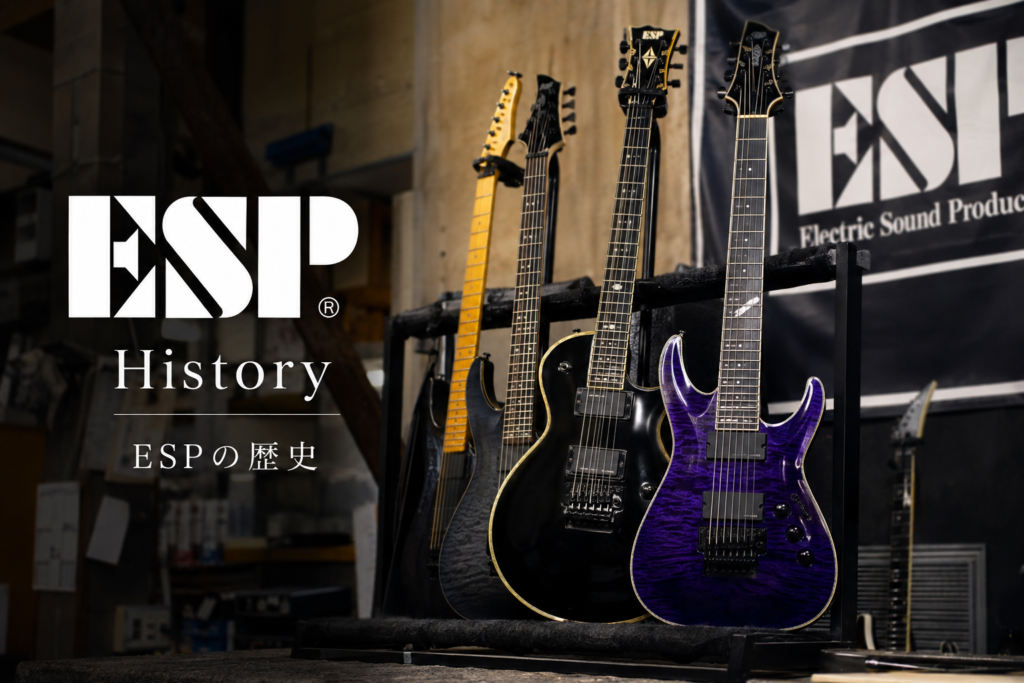
ESP is known worldwide as a metal brand, but the company started in 1975 as a small Tokyo shop that sold, repaired and customized other people’s guitars. This article covers ESP’s founding era only: 1975 to 1989. That fifteen-year stretch is when the company was actually built, from a storefront in Jingumae to a store in New York and the first Metallica guitars.
What ESP became after 1989, including the LTD launch, the E-II line and the modern signature roster, is a different story with a different shape. I touch on it briefly at the end and cover it properly elsewhere.
ESP Founding Era Quick Facts
- Period covered: 1975 to 1989, ESP’s founding era
- Founded: February 1975, Jingumae, Tokyo, as an “Electric Sound Center” for sales, repairs and custom work
- First house brand: Navigator (1976), with ESPARTO, LESPA, TELESPO and ESPIONAGE Bass models
- Landmark: Japan’s first full custom-order system, launched 1979
- Overseas expansion: ESP USA in 1981; New York store in 1986
- Breakthrough artists of the era: Ron Wood, Bruce Kulick, George Lynch, Kirk Hammett, James Hetfield
- US acquisition: Schecter Guitar Research, 1987 (operated separately from ESP)
Prefer to watch? This article is based on my own video below.
- 1975: Electric Sound Center, Where ESP Began
- 1976: Navigator, ESP's First Original Brand
- 1979: Japan's First Full Custom-Order System
- 1978 to 1987: Ten Years of Explosive Growth
- 1986: The New York Store, ESP's American Gateway
- 1986: George Lynch and the Kamikaze, the Walk-In That Changed ESP
- 1987: When ESP Bought Schecter
- 1988: Metallica, and Where the Founding Era Ends
- What Happened After 1989 (In Brief)
- Final Thoughts
- FAQ
- More ESP guitar articles
1975: Electric Sound Center, Where ESP Began
ESP was founded in February 1975 in Jingumae, Tokyo. At that point it was not a guitar manufacturer at all. It was an “Electric Sound Center”, a shop that handled sales, repairs and custom work, staffed by people who already had hands-on experience building and fixing instruments.
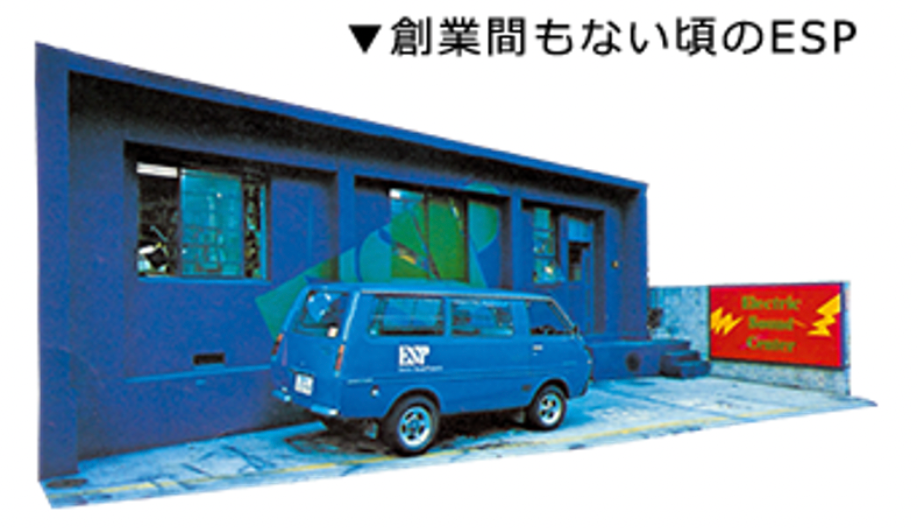
That starting point matters more than it might sound. A repair shop does not get to choose its problems. Whatever walks through the door, you deal with it: a neck that will not stay straight, a bridge that was routed in the wrong place, a player who wants something the factory never offered. ESP spent its first years solving other people’s guitar problems before it ever tried to sell its own design.
Almost everything ESP became later grows out of that. The custom-order system, the willingness to build absurd one-off shapes, the obsession with neck stability: all of it reads like a repair shop’s worldview scaled up into a manufacturer.
1976: Navigator, ESP’s First Original Brand
Just one year after opening, in 1976, ESP launched its first house brand: Navigator. The early Navigator guitars were copy-style models based on Fender and Gibson designs, which was completely normal in Japan at the time. What was not normal was the naming.
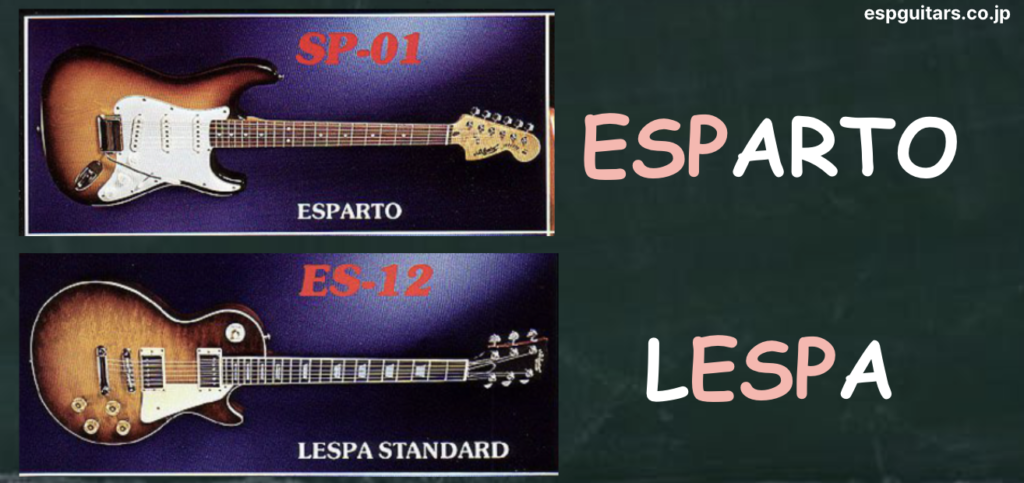
The Strat-style models were called ESPARTO. The Les Paul-style models were called LESPA. Telecaster-style guitars became the TELESPO, and Fender-style basses became the ESPIONAGE Bass. Every single one works the letters E, S and P into the model name. It is a small detail, but it tells you the company already thought of itself as a brand rather than a copy factory.
And ESP did not stay in copy territory for long. Original shapes and non-standard specifications crept in year after year, and that steady drift away from copies is where ESP’s real identity started forming.
1979: Japan’s First Full Custom-Order System
In 1979 ESP did two things that changed the company permanently. First, it began selling bodies and necks as separate parts. Second, it launched what is generally described as Japan’s first full custom-order system.
Plenty of makers took special orders. A full order-made program is a different thing: a customer specifies body wood, neck profile, scale length, pickup layout, hardware and finish, and the company builds that exact instrument. In 1979 Japan, offering that as a standard service rather than a favour for pros was genuinely new.
This is the single most important fact in ESP’s history. Everything that follows in this article, including the guitar that made ESP famous in America, happens because ESP had already built the machinery to say yes to strange requests.
1978 to 1987: Ten Years of Explosive Growth
What surprises me most when I go through ESP’s early records is the sheer pace. Factories, schools, retail stores and acquisitions all stack up inside a single decade.
| Year | Event | Why it mattered |
|---|---|---|
| 1975 | ESP founded in Jingumae, Tokyo | Sales, repair and custom shop staffed by experienced builders. |
| 1976 | Navigator brand launched | ESPARTO, LESPA, TELESPO and ESPIONAGE Bass models. |
| 1978 | Head office in Kanda Nishikicho; ESP Technical House opens | A permanent Tokyo base for the company. |
| 1979 | Parts sales and full custom-order system begin | Considered Japan’s first full order-made guitar program. |
| 1981 | ESP USA established; Tokyo factory opened | First overseas presence and in-house production capacity. |
| 1982 | Nagoya factory; ESP Craft House opens in Shibuya | Custom work gets a dedicated home in central Tokyo. |
| 1983 | Guitar-building school opens; acquires Japan’s Seymour Duncan distributor | ESP starts training its own future builders. |
| 1984 | Musician training school opens | Education becomes a second business pillar. |
| 1985 | Acquires Kiso Suzuki Violin; Nagoya factory relocates to Kiso | Brings established woodworking expertise in-house. |
| 1986 | Sado Island factory in Niigata; Sendai and New York stores open | The New York store became ESP’s gateway to overseas artists. |
| 1987 | Acquires Schecter Guitar Research | USA Schecter and Schecter Japan operate separately from ESP. |
By the mid-1980s ESP is also said to have supplied bodies and necks to Kramer, which was one of the biggest names in American hard rock guitars at the time. Long before most players outside Japan knew the ESP logo, ESP parts were already circulating in the US market.
1986: The New York Store, ESP’s American Gateway
Of everything on that timeline, the 1986 New York store did the most for ESP’s international profile. It was not simply a shop that sold Japanese guitars in Manhattan. It was a shop where you could order one.
From roughly 1984 to 1985, ESP had already begun working with New York session players and local musicians. Session players are a useful audience for a custom builder, because they need specific tools for specific jobs and they talk to each other. Word moved quickly.
Ron Wood: Proof ESP Was Never Only a Metal Brand
One of ESP’s early high-profile custom clients was Ron Wood of The Rolling Stones, who worked with ESP to develop a custom guitar that later became his signature model.
I think this fact deserves more attention than it usually gets. The standard version of ESP history jumps straight from Japan to thrash metal, but a Rolling Stone was in the customer list early on. ESP’s reputation was built on custom capability first, and the metal association came later.
Bruce Kulick and the ESP M-1
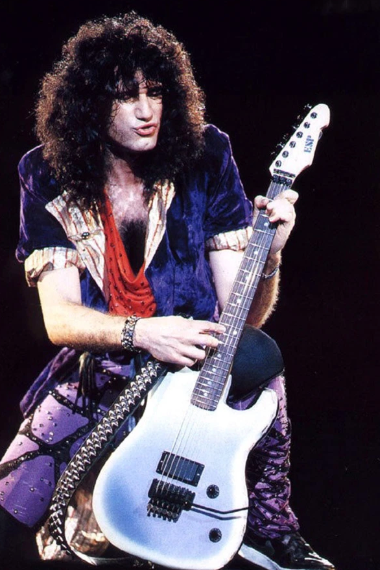
Bruce Kulick of KISS was another early champion. He played a Flip-Flop Blue ESP M-1 heavily on the Asylum tour, and that exposure did a lot to make the M-1 shape recognizable to American audiences.
1986: George Lynch and the Kamikaze, the Walk-In That Changed ESP
If one story explains ESP, it is this one.
George Lynch of Dokken had been playing Charvel and Kramer guitars. In 1986, while on tour in Tokyo, he walked into an ESP store to buy a replacement neck. That was the entire purpose of the visit. While he was there, he found out that ESP could also build complete custom guitars.
So he sat down with ESP’s luthiers and ordered what became the first famous Kamikaze.
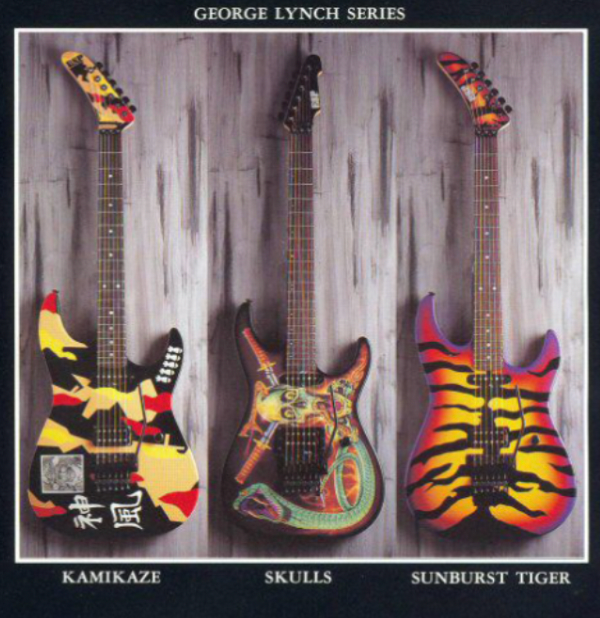
The Kamikaze was shaped entirely around his preferences: a maple body, a wider neck feel, and a deliberately minimal control layout with a single volume knob using a push/pull function to switch pickups. Nothing there is exotic on its own. The point is that every choice came from the player, not from a catalog.
What happened next is the part American players remember. Lynch’s ESP guitars with tiger-stripe graphics and skull-and-snake artwork were loud, aggressive and impossible to miss on stage. They were not subtle, and that was exactly why they worked in the 1980s.
Walking into a Tokyo guitar shop and leaving with a custom build is still very much how things work in Japan today, which is something I get asked about constantly. If you are planning a trip, my guide to the major guitar shop chains in Japan covers where to start.
1987: When ESP Bought Schecter
In 1987 ESP acquired Schecter Guitar Research in the United States. This one confuses people regularly, so it is worth stating plainly: Schecter has been operated separately from ESP’s own guitar brand. USA Schecter and Schecter Japan function as their own entities, and a Schecter is not a rebadged ESP.
Taken together with the guitar-building school, the musician academy, the Seymour Duncan distribution business and the Kiso Suzuki Violin acquisition, a pattern emerges. By the late 1980s ESP was not really a guitar brand. It was a music-industry group that happened to make excellent guitars.
1988: Metallica, and Where the Founding Era Ends
The last chapter of ESP’s founding era belongs to Metallica, and specifically to Kirk Hammett and James Hetfield.
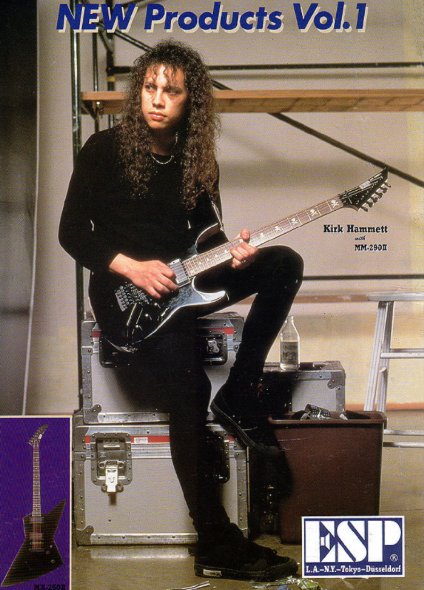
Kirk Hammett began using ESP seriously in the late 1980s. ESP’s own company history points to the circa-1988 prototype of what became the KH-2 as the pivotal instrument. It was based on the Mirage and M-II platform, with skull-and-crossbones inlays, EMG pickups and a Floyd Rose tremolo.
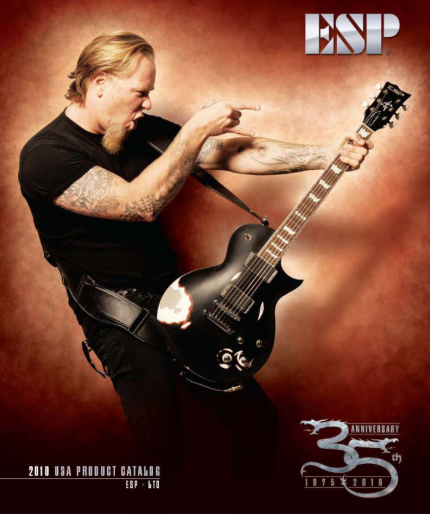
James Hetfield took a different route in this period. He became known for ESP custom models built around the Explorer shape, and Explorer-style ESP guitars close to his personal specs were chased hard by fans for years. His officially available signature models came later, well outside this article’s window, with the Truckster, Iron Cross and Snakebyte being the easiest to pin down. I have covered every one of them in my complete guide to James Hetfield’s ESP guitars.
This is the natural end point for the founding story. By 1989, ESP had a custom-order program, its own factories, two schools, a New York store, an American subsidiary brand and guitars in the hands of the biggest metal band on earth. The company it would become already existed in outline.
What Happened After 1989 (In Brief)
Everything from here is outside the scope of this article, but it is worth sketching so the timeline does not just stop.
The 1990s turned ESP into a default choice for metal guitarists worldwide, from Slayer to Children of Bodom. LTD launched in the mid-1990s as an affordable global brand built largely in Korea, Indonesia and China. E-II later succeeded the ESP Standard Series as the Japan-made factory line. Navigator, the brand that started it all in 1976, ended production of all regular models on July 31, 2025.
The modern lineup, the brand hierarchy and the full signature roster are all covered in my ESP Guitars overview.
Final Thoughts
ESP began in 1975 as a small shop in Tokyo. Within roughly fifteen years it had a custom-order program, multiple factories, two schools, a store in New York and an American brand on its books. That speed still impresses me every time I go back through the dates.
The metal image is strong, and it is deserved. But I do not think it is the whole story, and the founding era is where you can see that most clearly. Before the thrash guitars, ESP was a company that fixed instruments and then learned to build whatever a player asked for. Ron Wood was a customer before Metallica was.
George Lynch walked in for a replacement neck and walked out having designed a guitar. That is ESP’s first fifteen years in one sentence.
If you own an ESP-family instrument from this era, or if there is a model you have always wanted, let me know in the comments. And if you spot anything here that needs correcting, please tell me. I would rather fix it.
FAQ
When was ESP founded?
ESP was founded in February 1975 in Jingumae, Tokyo. It began as an ‘Electric Sound Center’, a shop offering guitar sales, repairs and custom work, staffed by people with instrument-building and repair experience.
What was ESP’s first original brand?
Navigator, launched in 1976. Early Navigator models were Fender and Gibson style copies with names that worked ESP into them: the ESPARTO Strat-type, the LESPA Les Paul-type, the TELESPO Telecaster-type and the ESPIONAGE Bass.
When did ESP start its custom-order system?
In 1979. That year ESP began selling bodies and necks as separate parts and launched what is generally described as Japan’s first full custom-order system, allowing players to specify woods, neck profiles, pickups and hardware.
How did George Lynch start using ESP?
In 1986, while on tour in Tokyo, George Lynch visited an ESP store to buy a replacement neck. He learned there that ESP could build full custom guitars, sat down with ESP’s luthiers and ordered what became the first famous Kamikaze, featuring a maple body, a wider neck and a single volume control with a push/pull pickup switch.
When did Metallica start using ESP?
Kirk Hammett began using ESP seriously in the late 1980s, and ESP points to the circa-1988 prototype of the KH-2 as the pivotal model. James Hetfield became known for Explorer-style ESP customs in the same period, with the Truckster, Iron Cross and Snakebyte arriving later as official signature models.
Does ESP own Schecter?
ESP acquired Schecter Guitar Research in 1987, but Schecter has been operated separately from ESP’s own guitar brand. USA Schecter and Schecter Japan function as separate entities, so a Schecter is not a rebadged ESP.
What happened to ESP after the 1980s?
The 1990s onward expanded ESP well beyond its founding era. LTD launched in the mid-1990s as an affordable global brand made largely in Korea, Indonesia and China, E-II later succeeded the ESP Standard Series as the Japan-made factory line, and the signature roster grew to include Alexi Laiho, Jeff Hanneman, Gus G and many others. Navigator ended production of all regular models on July 31, 2025.
More ESP guitar articles
ESP Guitars Explained: Models, Brand Tiers and Which One to Buy
ESP is a Japanese guitar maker founded in Tokyo in 1975. It began as a…
James Hetfield’s ESP Guitars: The Complete Guide to Every Model
James Hetfield’s ESP guitars are among the most iconic instruments in heavy metal. His partnership…
LOUDNESS 45th Anniversary Models Announced by ESP for 2026
LOUDNESS 45th Anniversary Limited Models by ESP ESP has announced official limited models to commemorate…
G-STREAM-Miku -SNOW MIKU Edition-
GrassRoots has added the G-STREAM-Miku -SNOW MIKU Edition- to its lineup, a signature model developed…
Mick Thomson MT-1 Released by ESP and LTD
ESP / LTD MT-1 Announced ESP Guitars has introduced the new MT-1, the latest signature…