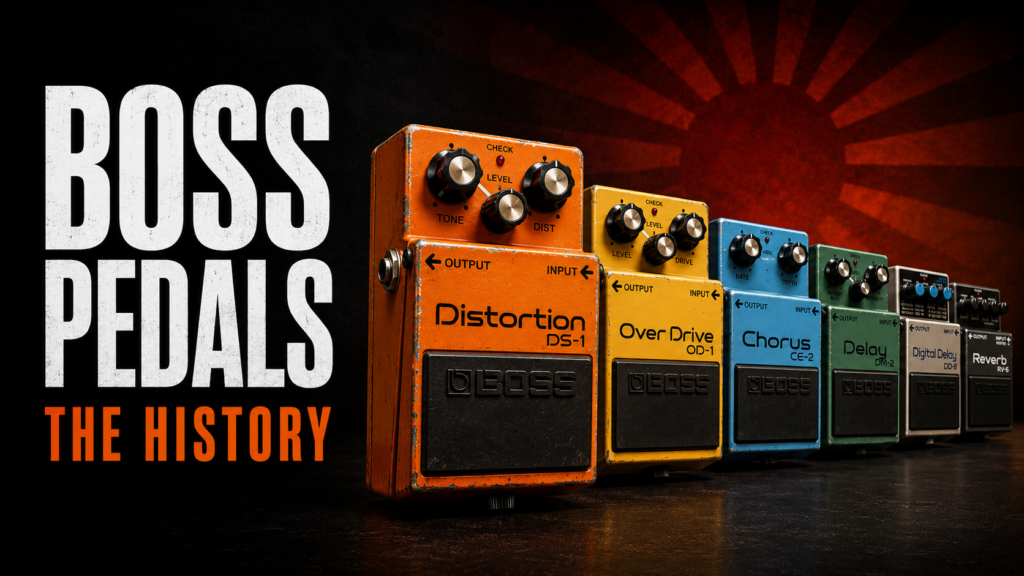
Small, colorful, and built to last: BOSS pedals are everywhere. Even if you have never owned one, you already know the shape, the single footswitch, and the candy-colored enclosure. This article traces the full BOSS story from its 1973 origins in Osaka through the CE-1, OD-1 and DS-1, the digital era, Waza Craft, and the company’s most recent releases, and explains why the brand has stayed at the center of the pedal world for more than fifty years.
BOSS Quick Facts
- Founded: 1973, as a Roland-affiliated brand rooted in MEG Electronics, Osaka, Japan
- First product: B-100 acoustic guitar microphone / preamp (1974, US market only)
- First effect pedal: CE-1 Chorus Ensemble (1976), derived from the Roland JC-120 amp
- Compact series debut: OD-1 Overdrive, PH-1 Phaser, SP-1 Spectrum (1977)
- Best known models: DS-1 Distortion, SD-1 Super Overdrive, MT-2 Metal Zone, BD-2 Blues Driver, DD series delays
- Production: Made in Japan through the late 1980s; later production moved offshore, with Waza Craft and select models still Japan-assembled
- Warranty: Extended from 1 year to 5 years across the line in April 2014
- Corporate: BOSS merged into Roland in 2018 and now operates as Roland’s guitar and bass brand
Prefer to watch? This article is based on my own video below.
- 1973 to 1976: From MEG Electronics to the CE-1 Chorus Ensemble
- 1977 to 1978: The Compact Pedal Is Born
- 1981: The SD-1 Super Overdrive and the Tube Screamer Question
- 1983 to 1987: Heavy Tones, Digital Delay, and the First Chromatic Tuner
- Late 1980s: The Rise of Floor-Based Multi-Effects
- 1991 to 1996: Metal Zone, Blues Driver, and the GT-5
- 2000s to 2014: Amp Modeling, Waza Craft, and the X Series
- 2016 to 2025: Katana, the Roland Merger, EURUS, and the PX-1
- BOSS Timeline: Key Milestones at a Glance
- What Actually Defines BOSS
- Final Thoughts
- Frequently Asked Questions
1973 to 1976: From MEG Electronics to the CE-1 Chorus Ensemble
BOSS was established in 1973 as a brand under Roland, the Japanese company already known for building equipment aimed at guitar and bass players. The story does not really start there, though. It traces back to MEG Electronics in Osaka, and by 1974 products were being released under the BOSS name.
The very first model was the B-100, and it was not a stompbox at all. It was an acoustic guitar microphone and preamp, sold only in the United States. So BOSS did not begin with guitar effects in quite the way most players assume today.
That changed in 1976, when BOSS released the CE-1 Chorus Ensemble. It was based on the chorus and vibrato circuit from the Roland JC-120 amplifier, better known as the Jazz Chorus. The JC-120 had already become a studio and stage standard around the world: a solid-state amp rather than a tube design, prized for a clean, sharp voice, and set apart by its built-in chorus and vibrato. The CE-1 put those sounds in a box you could place in front of any amp.
That move mattered. The CE-1 was an immediate success, and it is really the point where the BOSS name started earning global recognition.
1977 to 1978: The Compact Pedal Is Born
In 1977 things moved quickly. BOSS released three key models at once: the OD-1 Overdrive, the PH-1 Phaser, and the SP-1 Spectrum. More importantly, these pedals introduced the compact enclosure that would become the brand’s signature. Almost fifty years later you can still identify a BOSS pedal instantly, from across a stage, purely by its silhouette.
Most of these early models were manufactured in Japan until the late 1980s. Over that period internal components and specifications changed more than once, which means the sound can vary noticeably depending on when a given unit was built. That is exactly why early versions are so highly valued today, both for their tone and as collectible objects. Collectors usually call these the “silver screw” models, after the screw used on the back plate.
Among them the OD-1 stands out. It is widely considered the world’s first compact overdrive pedal, which makes it a genuine turning point in pedal history. Even now it is used both for shaping core tone and as a clean boost in front of an already-driven amp.
Then in 1978 came the DS-1 Distortion, and this is where things really take off. It became one of the most iconic and best-selling pedals in the company’s history, used by countless artists across an incredible range of music. Around the same time BOSS kept expanding the lineup, moving into analog delay with models like the DM-1 and delivering the warm repeats players still chase today.
1981: The SD-1 Super Overdrive and the Tube Screamer Question
In 1981 BOSS introduced the SD-1 Super Overdrive, essentially an evolution of the OD-1. It added a tone control while keeping the core character intact, and it remains one of the most widely used drive pedals ever made.
From this point BOSS was not only releasing new products. The company started refining what it already had: improving designs, adjusting details, and building a reputation for consistency and reliability that most competitors could not match.
This is also the era where the inevitable comparison starts, BOSS overdrive against the Ibanez Tube Screamer. Both work extremely well, whether as a main source of drive or as a boost. It is not really about one being better than the other. In the end it comes down to your sound, your gear, and the music you play. You can choose between them depending on the situation, and honestly you cannot go wrong with either.
1983 to 1987: Heavy Tones, Digital Delay, and the First Chromatic Tuner
As BOSS kept releasing new products, its compact and easy-to-use pedals spread to players all over the world. By the 1980s music itself was changing. Hard rock and metal demanded more aggressive tones and more complex effects, and BOSS answered with models like the HM-2 Heavy Metal.
You probably associate the HM-2 with the chainsaw tone later adopted by Swedish death metal bands. In reality it is far more versatile than its reputation suggests and works across a wide range of styles once you stop treating the knobs as decorations.
At the same time BOSS was pushing into something new: digital technology. The DD-2 Digital Delay was a big deal when it arrived. Digital delays were usually large rack-mounted units, and BOSS brought that technology into a compact pedal. That changed everything. Suddenly digital delay was easy to carry, easy to integrate, and actually usable in a real setup.
In 1983 BOSS also introduced something different in kind: the TU-12, the world’s first automatic chromatic tuner. It made tuning dramatically easier by letting players check pitch visually in real time, and it set the template for every tuner that followed.
Building an ecosystem around the pedal
Around the same time BOSS started building an ecosystem: accessories designed specifically for their own pedals. Carrying cases like the BCB-6 became popular and could even accommodate a TU-12. The company also developed switching systems such as the SCC-700 Sound Control Center, which was ahead of its time and can fairly be seen as one of the early foundations of modern switching systems. For a lot of players, seeing a setup like that was the moment the dream started: building a full pedalboard of your own.
Late 1980s: The Rise of Floor-Based Multi-Effects
By the late 1980s digital technology had advanced far enough to make multi-effects units practical. At first these were rack systems developed by Roland, but BOSS focused on something more usable for working players: floor-based units designed for performance. The ME-5 combined multiple effects into a single device that was both portable and cost-effective.
There were real differences between analog and digital sound at the time, and some analog tones were still difficult to recreate convincingly. But convenience won. Having everything in one unit made these enormously popular, and for the first time players could store and recall presets instantly.
1991 to 1996: Metal Zone, Blues Driver, and the GT-5
The 1990s brought another major hit: the MT-2 Metal Zone. High gain, a powerful EQ section, and a sound that defined an era. Love it or not, it is one of the most recognizable pedals BOSS ever made and still sells in volume.
Not long after came the BD-2 Blues Driver, designed to respond more like a tube amp. It became a favorite almost immediately. Despite the name it is not limited to blues at all; its touch sensitivity and versatility make it work across a lot of different styles.
In the mid-1990s BOSS pushed further with the GT-5, and this is where the modern multi-effects unit starts to look familiar. The GT-5 packed in a wide range of effects, presets, an expression pedal, and amp modeling. For the first time players could simulate different amplifiers inside a single floor unit. It also aimed to bridge the gap: digital convenience with a more analog-like feel.
2000s to 2014: Amp Modeling, Waza Craft, and the X Series
Through the 2000s BOSS kept evolving, refining what worked and introducing new ideas. As amp modeling took off the company entered that space too, but with a difference. Instead of “inspired by” designs, BOSS released officially licensed Fender models. Most other brands simply would not have been able to release products using the Fender name, and that licensing set BOSS apart.
In 2013 BOSS released the TE-2 Tera Echo, the 100th model in the compact pedal series. Then in 2014 came the Waza Craft line. Waza Craft was about craftsmanship: deeper refinement, redesigned circuits, and carefully selected components. Many Waza Craft models also include a mode switch that opens up more distinctive variations, or tones inspired by classic legendary pedals. It was not just about updating existing designs; it was about rethinking them.
Around the same time the X series appeared with a different approach, using digital processing to expand classic effects into something new. Not better or worse, just different, and that is really the point. Each line has its own strengths, and it comes down to the sound you are looking for.
2016 to 2025: Katana, the Roland Merger, EURUS, and the PX-1
In 2016 BOSS launched the Katana amplifier series: versatile, accessible, and covering everything from vintage cleans to modern high gain. It shipped in multiple formats, from full-size combos to compact and headphone-friendly versions, and quickly became one of the best-selling modeling amp lines on the market.
In 2017 BOSS marked 40 years of compact pedals by reissuing a limited set of the original three models. Collaborations also started appearing around this time, including work with JHS Pedals: one example combines the Angry Charlie with the Blues Driver in a single unit, two sounds in one enclosure.
Then in 2018 something structurally important happened. BOSS and Roland officially merged, with BOSS positioned as the group’s brand focused specifically on guitar and bass. Partly because of that, the lineup has kept expanding: vintage-style recreations such as Tone Bender-inspired fuzz and Space Echo units, modern gear like the 200 series, guitar synthesizers, and collaborations with brands including EVH.
And then something genuinely unexpected. In 2021 BOSS released its own guitar, the EURUS GS-1. A Japan-made instrument with built-in synth sounds, it lets players switch seamlessly between synthesizer voices and traditional guitar tones.
In 2023 BOSS marked its fiftieth anniversary with limited-edition models and special finishes. More recently the company introduced the PX-1 Plugout FX, a new approach that recreates classic BOSS pedals using modern digital technology while focusing on individual effects rather than a multi-effects patch. Models based on the OD-1, DS-1, CE-2, and DD-2 are all part of the set. Even now, BOSS continues to grow.
BOSS Timeline: Key Milestones at a Glance
| Year | Milestone | Why it mattered |
|---|---|---|
| 1973 | BOSS established under Roland | Origins trace back to MEG Electronics in Osaka |
| 1974 | B-100 acoustic mic / preamp | First BOSS product, US market only, not a stompbox |
| 1976 | CE-1 Chorus Ensemble | JC-120 chorus in pedal form; first global hit |
| 1977 | OD-1, PH-1, SP-1 | Launch of the compact series and its iconic enclosure |
| 1978 | DS-1 Distortion | Became one of the best-selling pedals of all time |
| 1981 | SD-1 Super Overdrive | OD-1 evolution with added tone control |
| 1983 | HM-2, DD-2, TU-12 | Heavier gain, first compact digital delay, first auto chromatic tuner |
| 1987 | ME-5 multi-effects | Established the floor-based multi-effects format |
| 1991 | MT-2 Metal Zone | Defined a high-gain generation |
| 1995 | BD-2 Blues Driver | Amp-like response, far more versatile than the name suggests |
| 1996 | GT-5 | Amp modeling arrives in a floor multi-effects unit |
| 2013 | TE-2 Tera Echo | 100th model in the compact pedal series |
| 2014 | Waza Craft line, 5-year warranty | Premium redesigns; warranty extended across the whole range in April |
| 2016 | Katana amplifiers | Accessible modeling amps across multiple formats |
| 2018 | BOSS and Roland merge | BOSS becomes the group’s guitar and bass brand |
| 2021 | EURUS GS-1 | BOSS builds its own Japan-made guitar with onboard synth |
| 2023 | 50th anniversary | Limited editions and special finishes |
| 2025 | PX-1 Plugout FX | Classic BOSS circuits recreated digitally in one compact enclosure |
What Actually Defines BOSS
1. The sheer variety
Even just within drive pedals, BOSS currently offers around seventeen different models. Because of that you can almost always find the sound you are looking for somewhere in the catalog. If you are chasing boutique-level refinement they might feel a bit limited, but if you want to explore new sounds without spending too much, BOSS is a great place to start.
2. The balance between analog and digital
Classic analog circuits are still alive in the lineup while newer models keep exploring digital possibilities. Very few brands manage to push both forward at the same time, and fewer still do it for fifty years without abandoning one side.
3. The design
Almost every compact pedal shares the same structure: a solid enclosure, a footswitch that doubles as the battery compartment, and a quiet, reliable switching system. Once you learn one, you can use them all. That footswitch design is genuinely clever, protecting the internal switch while serving as the battery cover. It is the kind of quiet engineering decision that explains why Japanese-built gear earned the reputation it has, something I have written about in more detail in why Japanese guitars are so good.
4. Power supply details worth knowing
BOSS pedals are designed for PSA-100 adapters, and that is for a reason. Power consumption varies a lot depending on the model. An analog pedal like the DS-2 draws around 12 mA, while a digital pedal like the DS-1X can pull close to 45 mA. On batteries alone the DS-1X might only last a few hours. With an adapter you get stable power and you do not have to think about it.
| Adapter type | Used by | Notes |
|---|---|---|
| PSA-100 | All current BOSS compact pedals | Regulated 9V DC, center negative; the standard for modern boards |
| ACA-100 | Many vintage BOSS pedals | Unregulated supply; no longer manufactured, so check Roland’s guidance before substituting a modern adapter |
With vintage units things can get tricky. Some older pedals require ACA-100 adapters and may not behave correctly without them, and those are not made anymore. Roland does publish guidance on how to use modern adapters instead, so if you own one, or you are thinking about buying one, it is worth reading before you plug anything in.
5. The five-year warranty
From April 2014 the warranty period was extended from one year to five years across all models, which is impressive for gear in this price range. These pedals get stepped on constantly, hauled to gigs, and pushed hard. If they were not durable, frequent repairs would be unavoidable and that would hurt BOSS as a business. Offering that warranty anyway says a lot about how confident the company is in its own build quality.
6. Availability anywhere in the world
You can find BOSS pedals almost anywhere on the planet, and many models have been in continuous production for decades. If something breaks, replacing it is easy. For touring musicians that kind of reliability matters more than any spec sheet.
Final Thoughts
Some players avoid BOSS precisely because it is so common. In a way, that is exactly the point. It is a sound almost every guitarist has experienced, whether they realize it or not, which makes the BOSS catalog something close to a reference point for the whole pedal world. When someone describes a distortion as “too fizzy” or an overdrive as “amp-like,” there is a decent chance the mental baseline they are comparing against is a BOSS pedal.
What keeps impressing me is that the company never picked a lane and stayed in it. The same brand that built the first compact overdrive in 1977 also built the first compact digital delay, the first automatic chromatic tuner, a licensed Fender modeling line, a guitar with a synth inside, and now a digital platform that reloads its own classics. Most companies get one of those moments. BOSS has had a dozen.
So if there is a model that interests you, it is worth trying for yourself rather than reading another opinion about it. There are far more products and artists connected to BOSS than I could cover here, so if you have a favorite, or a guitarist whose BOSS setup you think deserves attention, I would like to hear about it.
Frequently Asked Questions
When was BOSS founded, and is it the same company as Roland?
BOSS was established in 1973 as a brand under Roland, with roots going back to MEG Electronics in Osaka. The first products carrying the BOSS name appeared in 1974. In 2018 BOSS and Roland officially merged, and BOSS now operates as the group’s brand dedicated to guitar and bass.
What was the first BOSS pedal?
The first product released under the BOSS name was the B-100, an acoustic guitar microphone and preamp sold only in the United States in 1974. The first true effect pedal was the CE-1 Chorus Ensemble in 1976, based on the chorus and vibrato circuit of the Roland JC-120 amplifier.
Are old Japan-made BOSS pedals worth more?
Often yes. Most early compact models were made in Japan until the late 1980s, and components and specifications changed over that period, so the sound can vary depending on build date. Collectors particularly seek the so-called silver screw models, and the OD-1 in particular, widely considered the world’s first compact overdrive pedal.
BOSS overdrive or a Tube Screamer, which should I buy?
Neither is objectively better. Both work well as a main drive or as a boost, and the right choice depends on your guitar, your amp, and the music you play. Many players own both and switch depending on the situation, so you cannot really go wrong with either.
What power supply do BOSS pedals need?
Current BOSS compact pedals are designed for the PSA-100 adapter. Consumption varies by model: an analog pedal like the DS-2 draws around 12 mA, while a digital model like the DS-1X can draw close to 45 mA. Some vintage pedals were designed for the unregulated ACA-100 adapter, which is no longer made, so check Roland’s official guidance before using a modern supply with an older unit.
What is the difference between Waza Craft and the X series?
Waza Craft, launched in 2014, is about craftsmanship: redesigned circuits, carefully selected components, and usually a mode switch offering more distinctive variations or tones inspired by classic pedals. The X series takes the opposite route, using digital processing to expand classic effects into new territory. Neither is better; they simply target different sounds.
How long is the BOSS warranty?
From April 2014 the warranty period was extended from one year to five years across all models. That is unusually long for stompboxes, and it reflects how much abuse these pedals are expected to survive on stage.