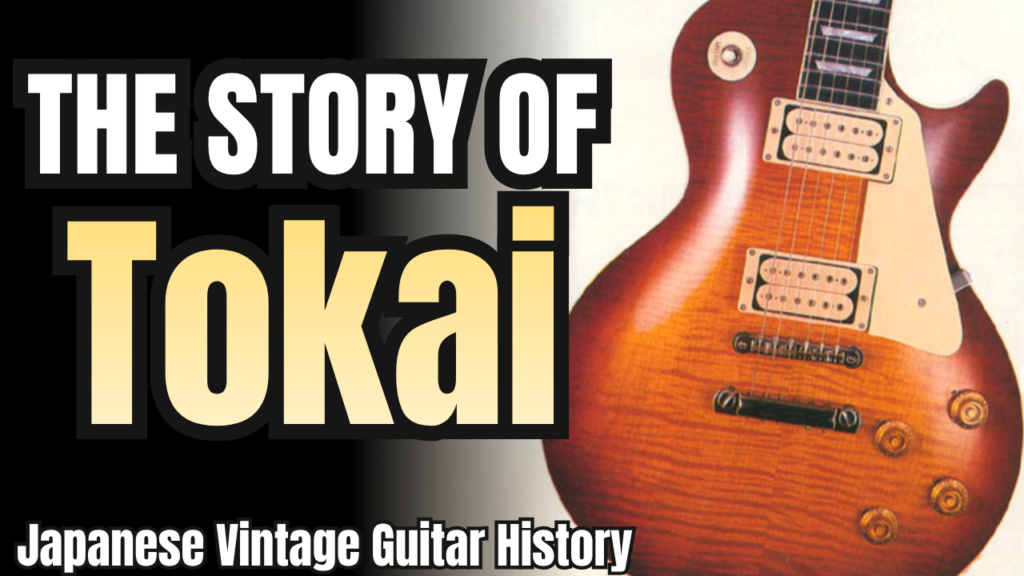
Tokai is the Japanese brand that made the phrase “better than the original” stick. It started out in 1947 building harmonicas and pianos, turned into the maker of the most accurate Stratocaster and Les Paul copies of the Lawsuit Era, walked away from the deal that became Fender Japan, gambled on aluminum and carbon fiber bodies, and got sued by Gibson in 2004 rather than in the 1980s. This article traces the full Tokai history from 1947 to today, model by model and year by year.
Tokai Quick Facts
- Founded: 1947, as the Tokai Gakki Research Institute
- Home base: Hamamatsu, Shizuoka Prefecture, Japan
- First products: Harmonicas and pianos, then the Pianica melodica in 1961
- Guitar milestones: Classical guitars 1965, Hummingbird electrics 1968, Cat’s Eyes acoustics 1975, Springy Sound 1977, LS series 1978, Talbo 1983
- Signature models: Springy Sound / Goldstar Sound (Strat type), Love Rock LS (Les Paul type), Breezy Sound (Tele type), Cat’s Eyes (acoustic), Talbo (aluminum)
- Notable players: Stevie Ray Vaughan, Billy Gibbons, Joe Walsh, John Mayer, HISASHI (GLAY), Susumu Hirasawa
- Legal history: Fender pressure in the early 1980s, Gibson trademark suit in 2004 (won by default)
Prefer to watch? This article is based on my own video below.
- 1947: A Harmonica Workshop in Hamamatsu
- 1965 to 1972: Classical Guitars, Hummingbird and Gaban
- 1972: The Martin Partnership That Changed Everything
- 1975: Cat's Eyes, the "Japan Martin"
- 1977: Springy Sound and the Birth of the Tokai Legend
- 1978: The LS Series and the "Les Paul Reborn"
- 1979: Breezy Sound Telecasters and the Overlooked Basses
- 1982: Fender Japan and the Deal Tokai Walked Away From
- 1983 to 1985: Aluminum, Carbon Fiber and Bankruptcy
- 1990s: The Talbo Revival and "Crafted in Japan"
- 2004: SEB Construction and the Gibson Lawsuit
- Tokai Timeline at a Glance
- Final Thoughts
- Tokai Guitars FAQ
- More Tokai guitar articles
1947: A Harmonica Workshop in Hamamatsu
In 1947 the Tokai Gakki Research Institute was founded in Hamamatsu, Shizuoka Prefecture, set up to research and develop pianos and harmonicas. It later became Tokai Gakki Co., Ltd. Getting a manufacturing business off the ground just two years after the end of the war is remarkable in itself, and it says a lot about Hamamatsu, the city that also gave us Yamaha, Kawai and Roland.
In 1961 Tokai successfully developed the Pianica and put it into production. The Pianica is a keyboard harmonica: you blow into a hose and a note only sounds when you press a key. From around 1967 Tokai also supplied it as an OEM product under the Yamaha brand, and in Japan it spread as a standard classroom instrument. It hit a very specific need, a keyboard instrument cheap enough and portable enough that every schoolchild could own one.
Having gone to kindergarten and elementary school in Japan, this one is deeply nostalgic for me. I had a Pianica, and we used it in every music class. In North America and Europe you probably know this kind of instrument as a melodica, and in fact I have come across accounts that Tokai started developing it after being inspired by the Melodica that Germany’s Hohner had made earlier.
1965 to 1972: Classical Guitars, Hummingbird and Gaban
Tokai kept building and developing instruments on its own, and in 1965 it began producing and selling classical guitars. Instead of the English “Tokai” logo you would see today, these were marked with the kanji for Tokai: very understated, very classical looking instruments. They are old and production numbers were probably low, because you almost never see them on the used market anymore.
1968: Hummingbird electrics
In 1968 Tokai launched electric guitars under the Hummingbird brand, and the look is striking: a body shape like a Mosrite sharpened to a point. Japan was in the middle of an electric guitar boom and the Ventures, who played Mosrites, were enormous there. My guess is that the design was tailored directly to that market.
Some Hummingbird electrics apparently had a built-in fuzz, with control over both its volume and how hard the effect hit. It ran on a single AA battery instead of a 9V, and there was a dedicated route carved into the body for it. That must have been a pain to build.
1970: Hummingbird acoustics and the folk boom
In 1970 Tokai began producing acoustic guitars, again under the Hummingbird name. Riding the folk song movement that had been building in Japan since the late 1960s, the lineup centered on dreadnought and folk guitar copies plus an original size that sat somewhere between a triple-O and a dreadnought.
I have heard before that Brian May owned one of these Hummingbird acoustics and used it on a recording. The story goes that he found it at a music shop while touring Japan and liked it enough to buy it. I still have not found anything to confirm it, so if you know more, I would love to hear it.
In the early 1970s Tokai also rolled out guitars under the Gaban brand, said to be early-days Les Paul and SG copies.
1972: The Martin Partnership That Changed Everything
In 1972 Tokai signed a sole distributor agreement in Japan with C.F. Martin & Co. The following year, 1973, imports began along with a technical partnership. The deal lined up neatly with what both sides wanted.
Martin’s goal was to fight back against the low-price market. The backdrop was the flood of Japanese copy models: in the 1970s Japanese guitars had become serious rivals to American makers thanks to high quality and a favorable exchange rate. While plenty of American brands were simply getting hammered by copies, Martin took a different tack and brought Tokai in as its official Japanese distributor to out-maneuver the competition. Through this partnership Martin rolled out the more affordable Sigma brand. Production moved overseas in the 1980s, but up to that point most Sigmas were built by Tokai.
Tokai, for its part, wanted to formally learn Martin’s construction and traditional know-how, things like bracing patterns, in order to raise the quality of its own acoustics. Tokai staff traveled to Martin’s factory in the United States for training and came back with serious skills. That transfer of American technique is the hinge point of the whole Tokai story, and everything that made the company famous in the following decade grows out of it.
1975: Cat’s Eyes, the “Japan Martin”
In 1975 Tokai launched one of its all-time greats, the Cat’s Eyes acoustic series. Built with the benefit of Martin’s technical guidance, these guitars were nicknamed “Japan Martins” and they carried Japanese acoustic players right through the folk guitar boom.
Martin was far too expensive for most Japanese buyers back then, so a domestic guitar that could go toe to toe with the real thing was a huge hit. The careful build, the value, and that powerful, rich tone are still praised today. The lineup ran the full range from beginner models to high-end top-tier instruments. After a production hiatus in the mid 1980s the line came back in 1991, moved to Chinese production from 2007, and it is still alive today.
1977: Springy Sound and the Birth of the Tokai Legend
After Cat’s Eyes, in 1977, Tokai got seriously into electric guitar production and its reputation started to climb. That is when the ST series was born, known today as Springy Sound, an essential name in the history of Japanese vintage guitars. To take on rivals like Greco, who dominated the copy model market at the time, Tokai dove in armed with the genuine American technique and quality it had inherited from Martin.
Tokai had already figured out the value in recreating popular models as vintage reissues, and it planned a line of Stratocaster replicas based on genuine vintage specs. The first ones out of the gate recreated the pre-CBS Strats of the 1950s and early 1960s. Tokai engineers got their hands on real vintage Strats, took them apart, measured the dimensions, photographed everything, and reassembled them using parts they had made themselves.
| Model | Body / neck | Notes |
|---|---|---|
| ST120 | One-piece ash body, figured maple neck | Made to order, top of the line, aimed at vintage Fender quality |
| ST100 | Nitro-finished sen ash or alder | DiMarzio VS-1 pickups, expensive at the time |
| ST80 | Nitro-finished sen ash or alder | High-end build for the era |
| ST50 / ST60 | Standard grades | Entry into the Springy Sound line |
Because they were built this well, they are still popular with vintage enthusiasts here in 2026. They were often described as “quality that beat the original” at a price you could actually reach. These days, clean examples can climb past the price of a current Fender.
1978: Silverstar Sound, the CBS-era alternative
Alongside Springy Sound, from 1978 Tokai also built Silverstar Sound, a replica of the CBS-era Fender Stratocaster. This one went in a different direction, following the 1970s CBS style: large headstock, three-bolt neck and micro tilt.
The players: Stevie Ray Vaughan and John Mayer
Part of why these guitars come up so often is the famous names attached to them. On the cover of Stevie Ray Vaughan‘s debut album Texas Flood, you can spot him holding a Tokai Springy Sound Strat. Whether he actually favored it is up for debate: some say a guitar was provided for promotional purposes and he only used it briefly, while others point to photos of him using one on stage.
John Mayer was photographed holding a Silverstar Sound SS-40. That photo went up on Facebook and spread far and wide, and it is said to have driven up prices on that model for a while.
1978: The LS Series and the “Les Paul Reborn”
The year after Springy Sound came another gem: the LS series, Tokai’s Les Paul copy. Like the ST series, this line came from thoroughly analyzing and reconstructing a vintage 1958 Les Paul. With high-quality wood selection and precise construction it came remarkably close to the character of the original.
Here is the part that still surprises people: even the cheapest LS50 has a carved solid maple top over a solid mahogany back. The lineup broke down into four grades, LS100, LS80, LS60 and LS50, but in terms of wood they are built the same way. Back then Tokai reportedly decided the grade based on how much figuring was in the maple. Grade 80 and up got a nitro finish, and the 100 got DiMarzio pickups.
| Grade | Construction | What separated it |
|---|---|---|
| LS200 / LS150 | Carved solid maple top, solid mahogany back | Fully made to order, hand-selected premium woods, rarely seen on the market |
| LS100 | Carved solid maple top, solid mahogany back | Best figuring, nitro finish, DiMarzio pickups |
| LS80 | Carved solid maple top, solid mahogany back | Nitro finish, strong figuring |
| LS60 / LS50 | Carved solid maple top, solid mahogany back | Same woods, plainer maple figuring, polyester finish |
How far the accuracy actually went
It is worth slowing down on this, because it is where Tokai earned its reputation. The headstock was pitched at the correct 17 to 18 degree angle with the open book shape Gibson used. The neck joint used a long tenon, the deep-set style Gibson had quietly moved away from on its own production line. The mahogany back was solid and one piece, with none of the weight relief holes or chambering that later Gibsons hid inside. The top was a real carved maple cap, not a thin veneer, and the carve had the right depth to it.
In other words, Tokai was not just copying the look. It was matching the things you cannot see, the details that actually decide how a Les Paul feels and rings.
Reborn, Reborn Old, Love Rock: reading the headstock
From late 1977 to 1979 the LS series was called the “Les Paul REBORN.” The reason is simple: that is what it says on the headstock. Where a Gibson would read “Model,” the Tokai read “Reborn,” and it said “Les Paul” right there above it.
This would later become part of what people call the Lawsuit Era. At the time, as long as Tokai was not actually claiming these guitars were made by Gibson, putting “Les Paul” on the headstock seems to have been treated as just barely staying on the right side of the line. It sounds crazy now, but in the Japanese guitar industry of the late 1970s this was not unusual.
After the inevitable complaints from the original maker, a version with the “Reborn Old” logo appeared for a very brief window in 1980. Production numbers were low so it is rare in that sense, but there is nothing especially different about the materials. What came next was the Love Rock model, with a headstock decal reading “LoveRock Model,” and that name carries through to Tokai’s Les Paul copies to this day.
| Period | Headstock logo | Notes |
|---|---|---|
| Late 1977 to 1979 | “Les Paul Reborn” | The most openly Gibson-referencing era, most collectable today |
| 1980 (brief) | “Reborn Old” | Short transitional run, low production, same materials |
| 1980 onward | “LoveRock Model” | Tokai’s own name, still used today |
At the top of the Love Rock range Tokai added the LS200 and LS150, fully made-to-order flagship grades loaded with carefully selected woods. These barely ever hit the market, the prices got seriously rich, and today they trade for as much as a Gibson Custom Shop guitar.
A couple of artists worth pointing out from this era: Joe Walsh used a Tokai LS100, and Billy Gibbons used a Tokai LS-200, apparently because he was afraid his own 1959 Gibson Les Paul would get stolen, so he played the Tokai instead.
1979: Breezy Sound Telecasters and the Overlooked Basses
It was not only Stratocasters and Les Pauls. Around 1979 Tokai went after the Telecaster with the Breezy Sound series. Like Springy Sound, a lot of players still rate the Breezy Sound as one of the most accurate non-Fender Telecaster copies ever built.
The basses get overlooked far too often, which is a shame, because they are excellent. The Precision Bass copy was the Hard Puncher, first sold as the Pulser Bass. The Jazz Bass copy was the Jazz Sound. Both are Lawsuit Era Fender copies in the truest sense, right down to the headstock shape and a logo styled to echo Fender’s own. Ash bodies, tight maple necks, clean fretwork: the same Tokai standard, just on four strings, and plenty of bass players will tell you they go toe to toe with the Fenders they were copying for a fraction of the money.
| Tokai series | Based on | From |
|---|---|---|
| Springy Sound (ST) | Pre-CBS Fender Stratocaster | 1977 |
| Silverstar Sound (SS) | CBS-era Stratocaster | 1978 |
| LS / Les Paul Reborn / Love Rock | 1958-59 Gibson Les Paul | 1978 |
| Breezy Sound (TE) | Fender Telecaster | approx. 1979 |
| Hard Puncher (ex-Pulser Bass) | Fender Precision Bass | late 1970s |
| Jazz Sound | Fender Jazz Bass | late 1970s |
| Goldstar Sound | Stratocaster, redesigned headstock and logo | 1983 onward |
Through this era of faithful vintage builds, later called its golden age, Tokai grew into the third largest instrument maker in Japan.
1982: Fender Japan and the Deal Tokai Walked Away From
Then in 1982, something happened: the founding of Fender Japan. Fender teamed up with Japan’s Kanda Shokai and FujiGen to manufacture and sell officially licensed products for the Japanese market. Because of that, other makers pulled back on producing Fender copies or gave them minor redesigns.
Tokai changed the design of its Fender-style copies from 1983 on, shifting to names like Goldstar Sound and specifically redesigning the headstock and logo into something original. The earliest Tokais wore a flowing spaghetti-style script close enough to Fender’s that Fender leaned on them, so Tokai switched to block and script logos of its own. It is fair to say Tokai was moving more carefully by then.
The Fender Japan that almost was
Here is the part most people do not know: Tokai was tangled up in the founding of Fender Japan itself. Back in 1980 Tokai was manufacturing Fender-branded acoustic guitars for CBS Fender, and according to Tokai the two companies had a great relationship right through the end of 1981.
Then things shifted. CBS wanted to take the Fender-type guitars Tokai was building, roll them out under a new “Fender Japan” brand, and keep distribution under Fender’s own control. Tokai had the skill to build them, but it wanted to expand the Tokai brand outside Japan, not to disappear into someone else’s logo. That mismatch broke the negotiations down.
The relationship deteriorated from there. Fender warned Tokai’s UK dealers of legal action, and it reached the point where British customs seized Tokai guitars. Having hit a dead end with Tokai, Fender took the Fender Japan idea to FujiGen and Kanda Shokai, and that is how the Fender Japan history we all know came to be. We could very easily have ended up with a Tokai-built Fender Japan instead.
1983 to 1985: Aluminum, Carbon Fiber and Bankruptcy
Rather than staying boxed in by faithful copies, Tokai set out to develop something genuinely new. In 1983 it succeeded in developing and selling the Talbo, the world’s first electric guitar with a metal body and an original shape entirely its own.
Meanwhile, in 1985, Tokai effectively went bankrupt. Guitar sales were slumping, and the piano manufacturing business it had kept pushing on was dragged down by weak domestic demand and a strong yen. Cheap Korean pianos were entering the market too, so competition was heating up.
Also in 1985, Tokai developed the MAT, an electric guitar with a carbon fiber and fiberglass body and neck. Short for “Most Advanced Technology,” the MAT leaned on carbon fiber’s strength and its resistance to temperature changes, with an ebony fretboard.
I got to try one once. The sound was sharp above all else, but it also felt like it would not get buried in a band mix. Sustain ran long and it was not bad with distortion either. There is none of the piece-to-piece variation you get with wood, and far less worry about the neck warping. It had a lot going for it, but it launched at the final stage of the company’s financial crisis and ended up a disappointment. Along with the Talbo it was a proud attempt at pushing cutting-edge materials, but sales did not take off, production costs were high, and it was eventually discontinued.
1990s: The Talbo Revival and “Crafted in Japan”
Here is the twist: the Talbo got a re-evaluation once the 1990s rolled around, because Japanese musicians adopted it as a personal trademark. HISASHI of GLAY and Susumu Hirasawa are the two names that matter here. That brought the Talbo back in 1996, and today it is one of Tokai’s staple models.
On top of that, from 1995 Tokai supplied Fender Japan, whose production had by then moved to Dyna Gakki, with parts it had woodworked and finished. These are the “Crafted in Japan” stamped Fender Japans: parts made by Tokai and Terada, assembled at Dyna Gakki. So the Tokai that had once walked away from the negotiating table ended up indirectly involved again a good ten years later.
2004: SEB Construction and the Gibson Lawsuit
In 2004 Tokai developed SEB construction, short for “Sound Effect Body,” its own patented body design. The idea came from piano building and exploits the relationship between grain direction and how fast vibration travels through wood. Vibration moves faster along the grain, so by shaping the wood sandwiched between the body’s top and back so that its grain runs perpendicular to the face of the body, Tokai sped up vibration transfer inside the body and dramatically improved attack. As a side effect the tone gets clearer and sustain improves too.
It flatly rejects the whole “solid one-piece wood is king” mindset, and you can really feel Tokai’s aggressive streak in the design.
Gibson v. Tokai
Also in 2004, Tokai was suddenly sued by Gibson. At the time Tokai was trying to bring the Love Rock back to the American market. In 2001, to avoid exactly this kind of trouble, it had already changed the body and headstock shapes, and it exhibited at NAMM from 2002 through 2004. Despite all that, Gibson sued for trademark infringement, and it did so in the 2000s rather than back in the 1980s when the copies were far more blatant.
It seems to have caught Tokai off guard. Then-president Shohei Adachi left a comment saying he was surprised by Gibson’s move. Because Tokai did not put up an adequate defense in court, Gibson won by default: the ruling went their way simply because Tokai never properly fought it. Tokai later tried to reopen the case, but in 2007 that request was rejected too.
The lawsuit did not end Tokai or the Love Rock itself, but Tokai effectively pulled the Love Rock out of the U.S. market. When it returned to North America in 2007, it focused on original designs instead.
Tokai Timeline at a Glance
| Year | Milestone |
|---|---|
| 1947 | Tokai Gakki Research Institute founded in Hamamatsu |
| 1961 | Pianica developed and put into production |
| 1965 | Classical guitar production begins |
| 1967 | Pianica supplied as OEM under the Yamaha brand |
| 1968 | Hummingbird electric guitars launched |
| 1970 | Hummingbird acoustic guitars launched |
| 1972-73 | Martin distribution deal and technical partnership; Sigma production |
| 1975 | Cat’s Eyes acoustics launched, the “Japan Martin” |
| 1977 | ST series / Springy Sound; “Les Paul Reborn” logo begins |
| 1978 | LS series Les Paul copies; Silverstar Sound |
| 1979 | Breezy Sound Telecaster copies |
| 1980 | Brief “Reborn Old” logo, then Love Rock |
| 1982 | Fender Japan founded after Tokai negotiations collapse |
| 1983 | Talbo released; Fender-style models renamed Goldstar Sound |
| 1985 | MAT released; Tokai effectively goes bankrupt |
| 1995 | Tokai supplies parts for “Crafted in Japan” Fender Japan |
| 1996 | Talbo revived on the back of HISASHI and Susumu Hirasawa |
| 2004 | SEB construction patented; Gibson files trademark suit |
| 2007 | Reopening request rejected; Tokai returns to North America with original designs |
Final Thoughts
Today’s Tokai does not have quite the momentum it had in the 1970s and 1980s, but the quality is seriously high. Considering that spec research has come a long way since then, there is plenty that current Tokai actually does better than the guitars everyone romanticizes. Led by the Talbo, they build classic models, Les Pauls, Strats and Teles, with Tokai’s own touches added. Every now and then a shop order Tokai comes out with specs that hit vintage enthusiasts right where it counts, and in recent years there have even been limited runs of Les Pauls wearing the “Reborn Old” logo.
What I keep coming back to is that Tokai carries two opposite instincts at once. On one side, vintage copies so carefully researched that they outdid the originals in some respects. On the other, a challenger’s streak that produced aluminum bodies, carbon fiber necks and a body construction borrowed from piano design, all of it commercially risky and some of it commercially disastrous. Most companies pick one of those personalities. Tokai never did, and that willingness to keep pulling in new ideas is exactly what makes the brand worth paying attention to. Definitely give them a look, and if you have a Tokai or another Japanese-made guitar, I would love to hear about it.
Reference website: https://tokaigakki.com/
Tokai Guitars FAQ
When was Tokai founded and what did it make first?
Tokai was founded in 1947 in Hamamatsu, Shizuoka Prefecture, as the Tokai Gakki Research Institute, set up to research and develop pianos and harmonicas. It did not begin building guitars until 1965, and its first big commercial success was the Pianica keyboard harmonica in 1961.
Why are Tokai guitars called better than the originals?
Tokai took vintage Fenders and Gibsons apart, measured them, photographed them and rebuilt them with its own parts, matching details you cannot see: the 17 to 18 degree headstock pitch, the long tenon neck joint, a solid one-piece mahogany back with no chambering, and a real carved maple cap. During the same period the American originals had moved away from several of those specs.
What is the difference between Les Paul Reborn, Reborn Old and Love Rock?
They are the same LS series line under three headstock logos. Late 1977 to 1979 guitars read “Les Paul Reborn,” a brief 1980 run read “Reborn Old,” and from 1980 onward the decal read “LoveRock Model,” which Tokai still uses today. The materials did not change meaningfully between the Reborn and Reborn Old versions.
Did Tokai almost become Fender Japan?
Yes. Tokai built Fender-branded acoustics for CBS Fender around 1980, and CBS wanted to roll Tokai’s Fender-type guitars into a new Fender Japan brand under Fender’s own distribution. Tokai wanted to grow the Tokai name overseas instead, so negotiations collapsed and Fender took the idea to FujiGen and Kanda Shokai in 1982.
Why did Gibson sue Tokai in 2004 and not in the 1980s?
Tokai was trying to bring the Love Rock back to the American market, having already changed the body and headstock shapes in 2001 and exhibited at NAMM from 2002 to 2004. Gibson filed for trademark infringement anyway, which reportedly caught Tokai off guard. Tokai did not mount an adequate defense, so Gibson won by default, and a 2007 request to reopen the case was rejected.
Which famous guitarists have used Tokai guitars?
Stevie Ray Vaughan is pictured with a Tokai Springy Sound Strat on the cover of Texas Flood, Billy Gibbons played a Tokai LS-200 rather than risk his 1959 Gibson Les Paul, Joe Walsh used an LS100, and John Mayer was photographed with a Silverstar Sound SS-40. In Japan, HISASHI of GLAY and Susumu Hirasawa made the Talbo their trademark.
Are Tokai guitars still made in Japan today?
Tokai still builds Japanese-made guitars, alongside more affordable overseas-produced lines. The Cat’s Eyes acoustic series moved to Chinese production from 2007, while the Japanese-built Love Rock, Strat-type and Tele-type models and the Talbo remain the core of the domestic lineup.
More Tokai guitar articles
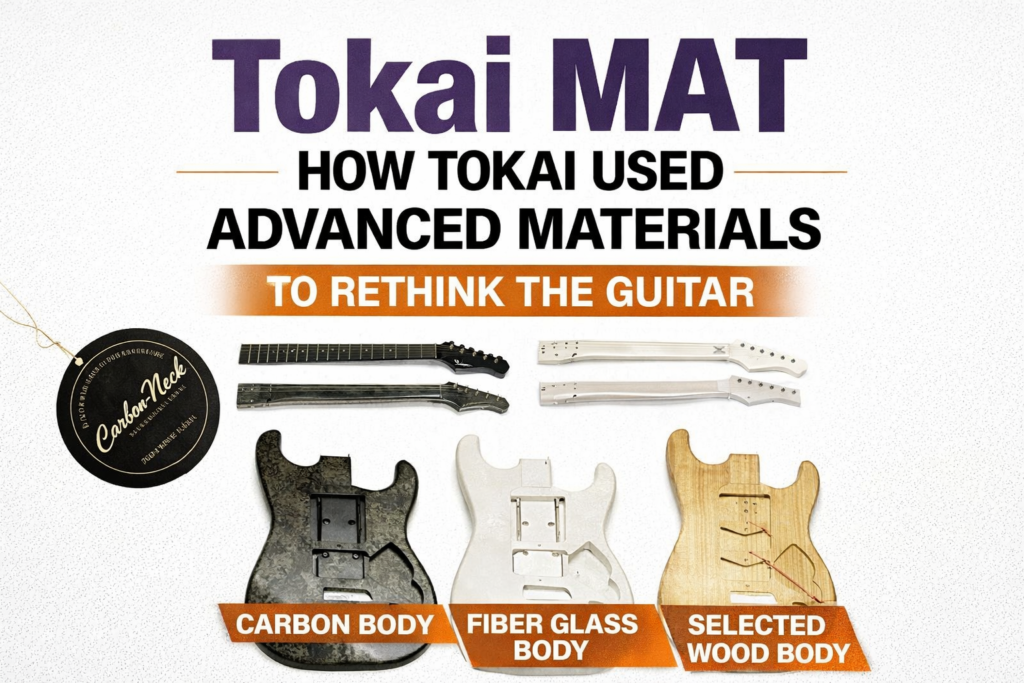
Tokai MAT: How Tokai Used Advanced Materials to Rethink the Guitar
The Tokai MAT is one of the most unusual guitar projects to come out of…
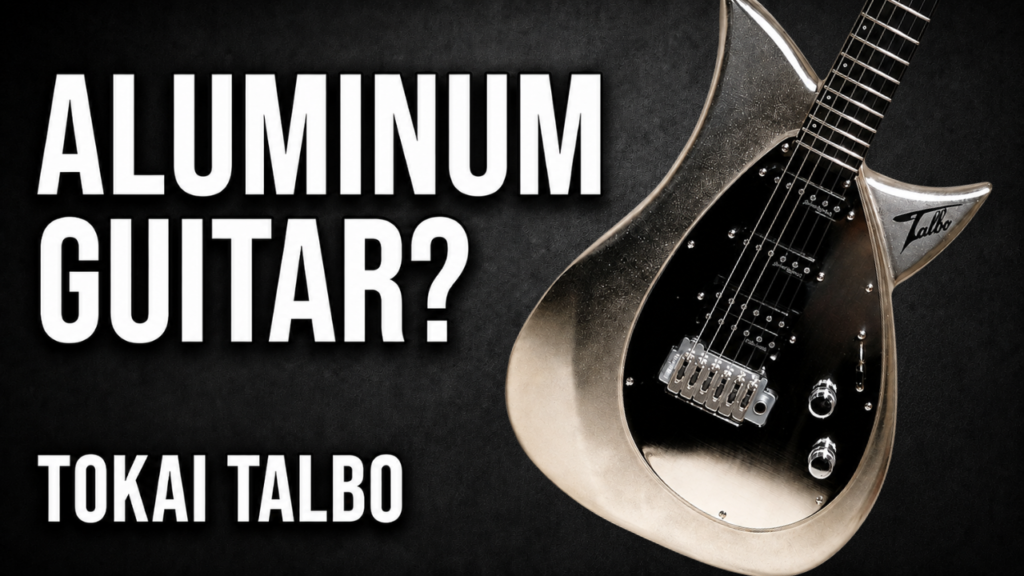
Tokai Talbo: The Aluminum Guitar That Failed, Came Back, and Became Tokai’s Flagship
In an era when every electric guitar was made of wood as a matter of…
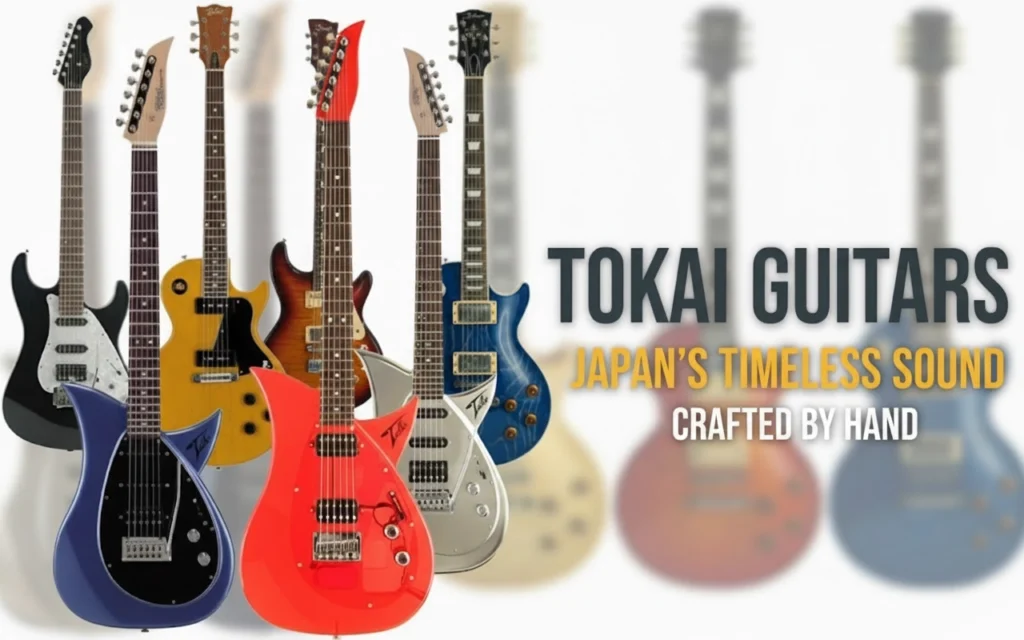
Tokai Guitars — The Art of Japanese Timeless Sound and Craftsmanship
Tokai Gakki Manufacturing Co., Ltd. (東海楽器製造株式会社) is a Hamamatsu-based manufacturer in the truest sense: a…